






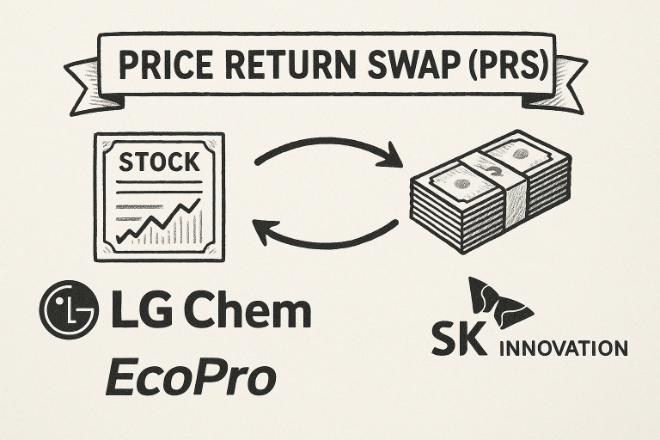
According to industry sources on the 9th, LG Chem is reviewing the conclusion of a PRS agreement with domestic securities firms, based on a portion of its stake in LG Energy Solution (LG Ensol). The financing amount is expected to exceed 2 trillion won, representing 2-3% of its 81.8% stake in LG Ensol.
EcoPro is reportedly pursuing a PRS agreement to raise 700 billion won in funds using EcoPro BM shares.
SK Innovation plans to secure 1.6 trillion won through PRS as part of its 5 trillion won capital expansion plan announced on July 30. Previously, its subsidiary SK On also signed a PRS agreement worth 1.5 trillion won last year.
Lotte Chemical also signed PRS agreements twice, in November last year and March this year. It first raised 660 billion won with a 40% stake in its US subsidiary LCLA, and then additionally raised 650 billion won by leveraging a 25% stake in its Indonesian subsidiary LCI.
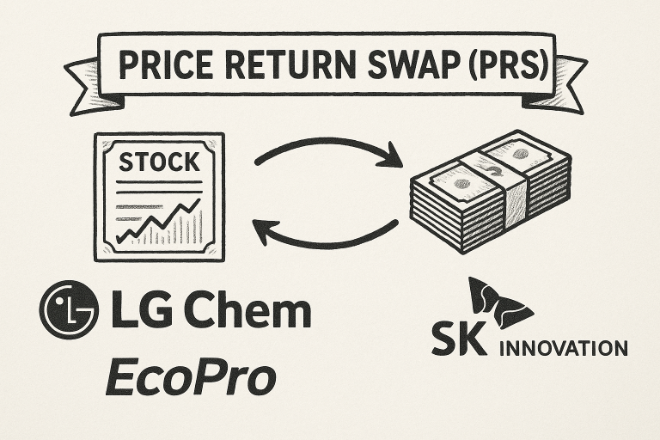
PRS is a derivative contract that settles stock price fluctuations over a certain period, structured such that companies raise funds from financial institutions by using their owned shares as collateral.
From a corporate perspective, it is advantageous to utilize PRS when there is confidence in stock price appreciation. If the stock price rises above the initial reference price, the financial institution pays the profit to the company. If the stock price falls, the company must pay the difference to the financial institution. Financial institutions, without fear of principal loss, earn fees that are generally higher than interest rates. Companies take on the risk of additional costs or stock price declines, making it difficult to proceed without a strong conviction that the stock has "hit rock bottom."
Petrochemical Restructuring Underway… Will S-OIL’s ‘Time Bomb’ Go Off?SK Safeguards Battery Business with Cash Cow Enmove, While LG Sells Non-Core Growth BusinessesWhy Bill Gates Met SK Bioscience and LG Chem but Not Vaccine Specialist GC PharmaLG Chem’s Shin Hak-cheol Issues KRW 1.4T in Exchangeable Bonds Alongside Push to Sell Non-Core Assets
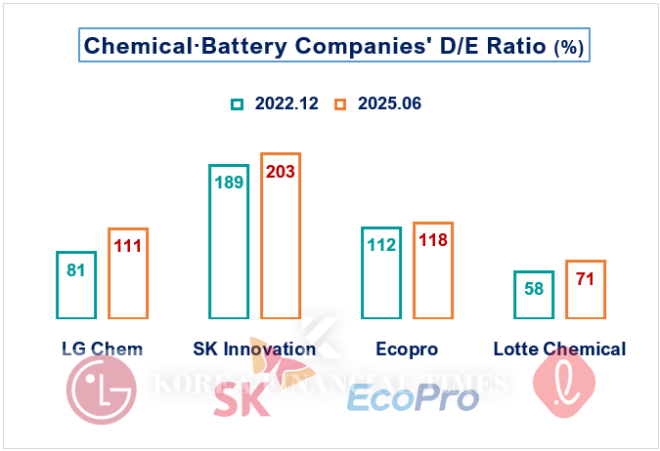
LG Chem, EcoPro, and SK Innovation are petrochemical and battery companies whose financial stability is being shaken by rising debt-to-equity ratios due to deteriorating industry conditions. Amid pressure from credit rating downgrades, it is not easy for them to access the corporate bond market, a traditional fundraising method.
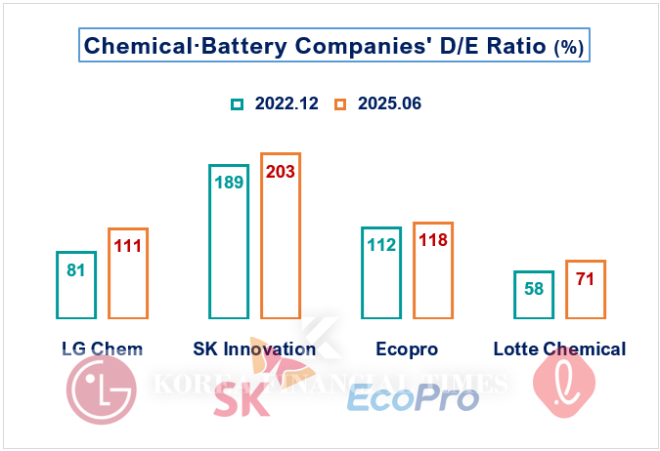
LG Chem is experiencing increasing financial burdens due to the petrochemical downturn. Its profit generation capacity has sharply declined, yet large-scale investments are underway in battery cathode materials and eco-friendly materials for business transformation. Its debt-to-equity ratio has risen from 81.4% at the end of 2022 to 110.7% at the end of the second quarter of 2025.
It is reported that after Lotte Chemical experienced an Event of Default (EOD) in November last year, financial institutions have been demanding higher interest rates than before.
However, some accounting firms and credit rating corporates have recently pointed out that PRS, in substance, is strongly akin to "loans collateralized by shares" and should be accounted for as debt.
Gwak Horyung (horr@fntimes.com)











![서초구 '아크로리버파크' 34평, 10억 오른 74억원에 거래 [일일 신고가]](https://cfnimage.commutil.kr/phpwas/restmb_setimgmake.php?pp=006&w=69&h=45&m=5&simg=20260624115142011110dd55077bc212411124362.jpg&nmt=18)

![동대문구 '전농우성' 32평, 3.9억 떨어진 6.1억원에 거래 [일일 하락가]](https://cfnimage.commutil.kr/phpwas/restmb_setimgmake.php?pp=006&w=69&h=45&m=5&simg=20260727083903035290b372994c951245313551.jpg&nmt=18)


![[그래픽 뉴스] ‘순대’가 경제용어라고? 순(純)대외자산, 한국의 진짜 해외자산은 얼마일까?](https://cfnimage.commutil.kr/phpwas/restmb_setimgmake.php?pp=006&w=298&h=298&m=1&simg=202609021356075202de68fcbb3512411124362_0.jpg&nmt=18)
![[그래픽 뉴스] ISA 대개편! 나에게 유리한 계좌는?](https://cfnimage.commutil.kr/phpwas/restmb_setimgmake.php?pp=006&w=298&h=298&m=1&simg=202608041713155615de68fcbb3512411124362_0.jpg&nmt=18)
![[그래픽 뉴스] 미국 증시 새로운 키워드 'MANGOS'](https://cfnimage.commutil.kr/phpwas/restmb_setimgmake.php?pp=006&w=298&h=298&m=1&simg=202607291740382069de68fcbb3512411124362_0.jpg&nmt=18)

![[그래픽 뉴스] 은퇴후 30년 부모님 세대의 생존전략](https://cfnimage.commutil.kr/phpwas/restmb_setimgmake.php?pp=006&w=298&h=298&m=1&simg=202606301704439153de68fcbb3512411124362_0.jpg&nmt=18)
![[신간]은퇴연옥…김경록의 은퇴 후 삶의 나침반](https://cfnimage.commutil.kr/phpwas/restmb_setimgmake.php?pp=006&w=81&h=123&m=5&simg=20260414140833047280f8caa4a5ce12411124362.jpg&nmt=18)
![[신간] 물처럼 흐르고 원칙으로 서다…김용환의 통찰을 담다](https://cfnimage.commutil.kr/phpwas/restmb_setimgmake.php?pp=006&w=81&h=123&m=5&simg=20260409114249027860f8caa4a5ce12411124362.jpg&nmt=18)
![[안현정 서평] 플랫폼의 영지에서 ‘미학적 주권’을 선포하라...'K가 죽어야 K가 산다' 장준환 著](https://cfnimage.commutil.kr/phpwas/restmb_setimgmake.php?pp=006&w=81&h=123&m=5&simg=20260527121426063220c1c16452b012411124362.jpg&nmt=18)
![[서평] 추세 매매의 대가들...추세추종 투자전략의 대가 14인 인터뷰](https://cfnimage.commutil.kr/phpwas/restmb_setimgmake.php?pp=006&w=81&h=123&m=5&simg=2023102410444004986c1c16452b0175114235199.jpg&nmt=18)


![[머니무브 2026] “지금 사도 될까?” 답이 안 보인다면…하반기 투자, 4명의 전문가에게 물어보세요](https://cfnimage.commutil.kr/phpwas/restmb_setimgmake.php?pp=006&w=89&h=45&m=1&simg=202609151044050355302a735e27af12411124362.jpg&nmt=18)
![[AD] ‘PBV 라인업 확장’ 기아, 9월 독일서 ‘PV7’ 첫 공개](https://cfnimage.commutil.kr/phpwas/restmb_setimgmake.php?pp=006&w=89&h=45&m=1&simg=2026083111010602815074925877361231180222.jpg&nmt=18)
![[AD] 제네시스, 럭셔리 경험 더한 ‘2027 GV70’‧‘GV70 그래파이트’ 출시](https://cfnimage.commutil.kr/phpwas/restmb_setimgmake.php?pp=006&w=89&h=45&m=1&simg=20260702143546085600749258773622211122717.jpg&nmt=18)
![[AD] 개소세 혜택 종료…현대차, ‘썸머 페스타’로 고객 부담 완화](https://cfnimage.commutil.kr/phpwas/restmb_setimgmake.php?pp=006&w=89&h=45&m=1&simg=20260702142355004830749258773622211122717.jpg&nmt=18)
![[AD] 기아 ‘디 올 뉴 셀토스’, 인도 타임스 드라이브 어워즈서 ‘올해의 SUV’ 선정](https://cfnimage.commutil.kr/phpwas/restmb_setimgmake.php?pp=006&w=89&h=45&m=1&simg=202605071156400590007492587736124111243152.jpg&nmt=18)