





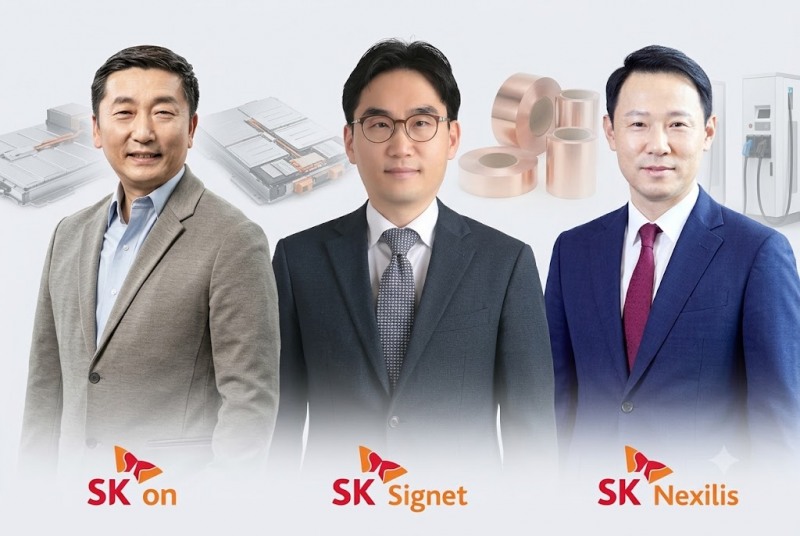
From left: Lee Yong-wook, CEO of SK On; Cho Hyung-ki, CEO of SK Signet; and Kim Jong-woo, CEO of SK Nexilis. / Created using generative AI, based on photos provided by the respective companies.
이미지 확대보기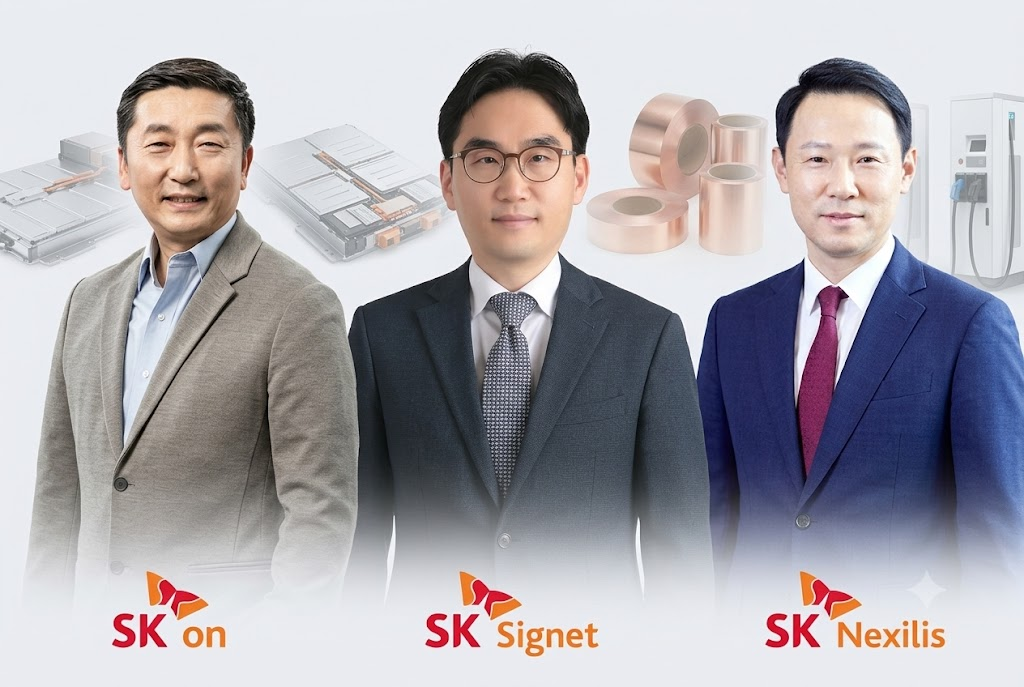
But when the EV chasm — a temporary slowdown in demand — hit starting in 2023, these once-promising ventures turned into liabilities. As earnings deteriorated and the financial burden on parent companies grew, the three became prime targets in the group's rebalancing efforts.
While SK Group's EV affiliates have kept afloat through intra-group mergers and capital support from parent firms, they are now seeking breakthroughs as the chasm eases and new business lines emerge. SK On and SK Nexilis are accelerating expansion into energy storage systems (ESS), while SK Signet is pushing into overseas markets, including North America.
SK On, Nexilis, Signet: A Chasm That Weighed Down Parent Companies Too
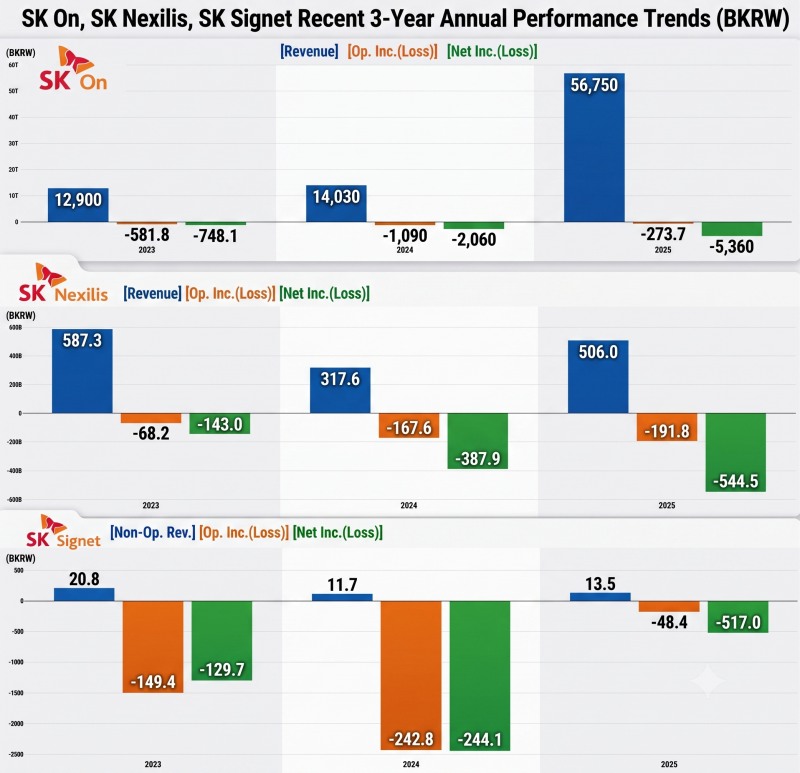
SK On, which handles SK Group's battery business, was spun off from SK Innovation, the group's energy-focused intermediate holding company, in 2021. The move was meant to strengthen SK's global competitiveness in EV batteries as the EV era arrived.However, SK On entered the market later than rivals LG Energy Solution and Samsung SDI, falling behind in securing global customers, and has yet to post a single annual profit since its founding. Its cumulative losses through last year reached roughly KRW 4 trillion.
SK On's struggles have weighed on parent company SK Innovation as well. The battery/materials division that houses SK On posted operating losses of KRW 1.4095 trillion in 2024 and KRW 1.1065 trillion in 2025 — two consecutive years of losses exceeding KRW 1 trillion.
SK Innovation's energy/chemicals division had offset the battery/materials losses by generating operating profits of roughly KRW 1.5 trillion to KRW 2 trillion annually through 2024. But in 2025, that division's operating profit fell to KRW 836.6 billion amid a downturn in the refining business. As a result, SK Innovation posted its first-ever annual operating loss, at KRW 269.9 billion.
In the first quarter of this year, the energy/chemicals division posted over KRW 2 trillion in operating profit thanks to rising international oil prices, while the battery/materials division recorded an operating loss of KRW 421.7 billion.
SK Nexilis, which handles copper foil, is also considered a major risk to its parent's profitability. SK Nexilis was acquired by chemical materials holding company SKC in 2020 for roughly KRW 1.247 trillion to enter the copper foil business — a key material for EV batteries.
Copper foil serves as the battery's negative electrode current collector, either collecting electrons generated by electrochemical reactions or supplying electrons needed for those reactions. Once used mainly in IT device batteries, it has since become a core material in EV batteries.
SK Nexilis turned solid profits through 2022. But as the chasm took hold in 2023, it posted its first-ever operating loss of roughly KRW 68.2 billion. Losses widened further to KRW 167.6 billion in 2024 and KRW 191.8 billion in 2025. Last year, SK Nexilis accounted for 62.9% of SKC's total operating loss.
Like SK Nexilis, SK Signet — another EV-era acquisition by the SK Group — has also failed to escape losses since the chasm began. SK Group's holding company SK Inc. acquired EV charger maker Signet EV for roughly KRW 300 billion in 2021.
SK Signet posted an operating profit of KRW 3 billion on a consolidated basis in 2022, its first full year under SK Group, but swung to an operating loss of KRW 149.4 billion in 2023. Losses widened to KRW 242.7 billion in 2024, before narrowing to KRW 48.4 billion in 2025 thanks to quality improvements and operational efficiency measures.
Reconstructed using generative AI, based on the original content researched and produced by the reporter.
이미지 확대보기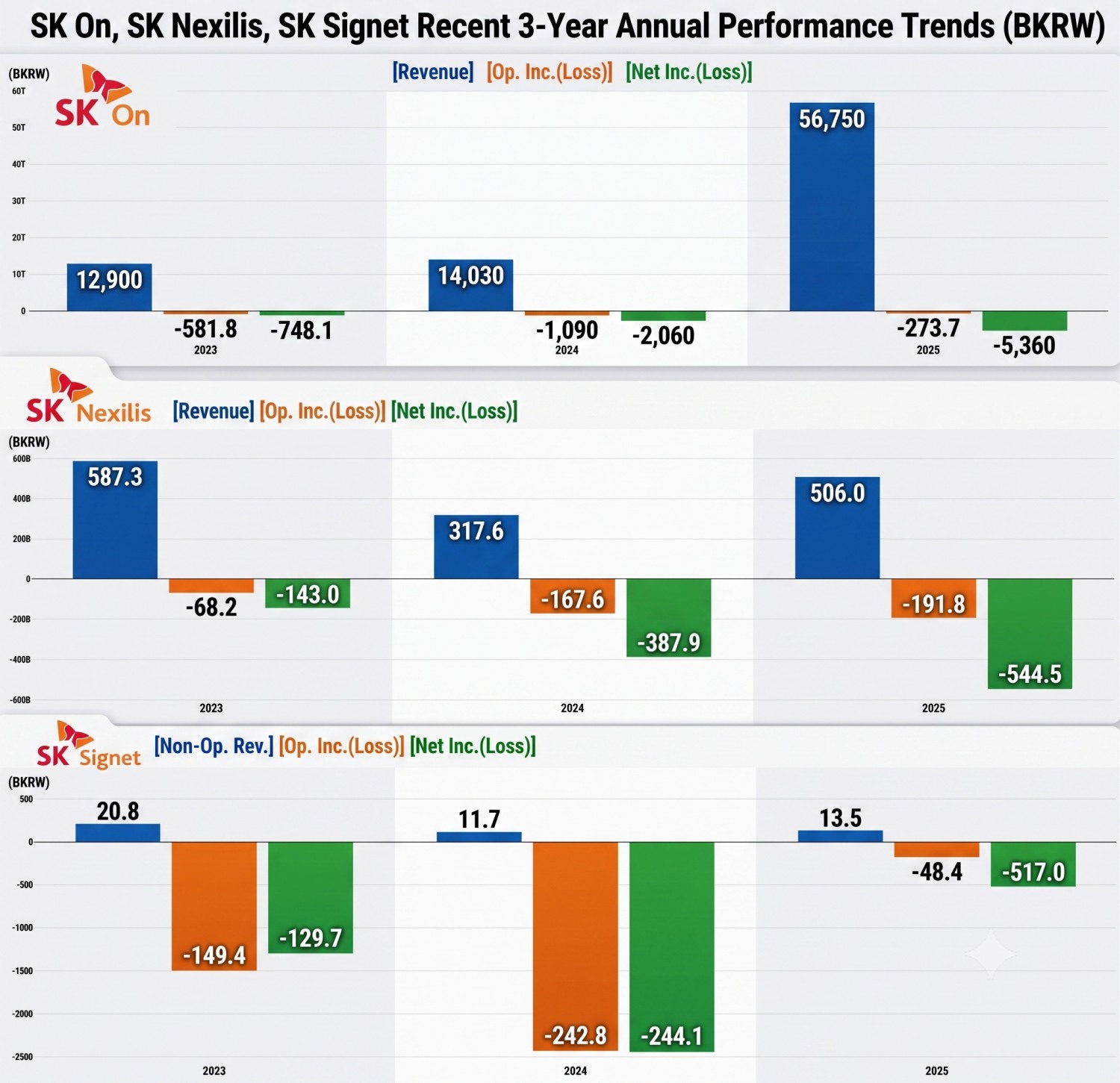
Spring for EVs Is Coming — Parent Companies Push for Normalization
As the SK Group affiliates set up to prepare for the EV era turned into millstones amid the chasm, concerns grew both within and outside the group. Amid SK Group's liquidity crunch and rebalancing drive, the three were repeatedly cited as top candidates for divestiture.But the parent companies of SK On, SK Nexilis, and SK Signet chose normalization over disposal — a decision focused on restructuring their businesses to strengthen their market position once the chasm subsides. The parents combined capital support with mergers involving profitable affiliates to drive normalization, while pushing into new businesses such as ESS to bolster sustainability.
For SK On, whose top priority is strengthening its financial footing, the company merged with several profitable SK Innovation affiliates — since client companies weigh financial soundness heavily when awarding contracts, and the mergers also aimed to boost business synergy and efficiency across affiliates.
Starting with SK Trading International (SKTI) in November 2024, followed by SK Enterm in February 2025 and SK Enmove in November 2025, SK On absorbed several of SK Innovation's profitable affiliates spanning petroleum, trading, and lubricants — all businesses that had posted consistent operating profits within SK Innovation.
At the same time, SK On has reduced its reliance on EV batteries by accelerating its ESS business. Late last year, it reorganized to create an "ESS Operations Office" and an "ESS Sales Office," completing an all-in-one business structure spanning ESS R&D, production, and sales.
SK On is also focusing on expanding ESS production capacity. This year, it converted BlueOval SK — its joint venture with Ford in the U.S. — to sole operation and switched part of its production lines to ESS. It also swapped equity stakes with Chinese battery maker EVE Energy to take sole control of its Yancheng, China plant, which SK On plans to convert to ESS production as well.
Choi Dae-jin, head of SK On's ESS Business Office, said, "The U.S. is a key market where demand for renewable energy expansion and grid stabilization is growing simultaneously." He added that the company would continue to broaden its customer touchpoints, actively promote its differentiated product competitiveness and fire-safety technology, and further strengthen its position in the North American ESS market.
SK Nexilis's parent, SKC, has instead sought normalization through a private equity partnership rather than an IPO. Last year, it pursued an investment deal worth roughly KRW 300 billion with IMM Investment, under which it would sell part of its shares to boost value, then buy back the stake roughly five years later. However, the two sides' agreement remains stalled at the memorandum-of-understanding stage.
More recently, SKC has been pursuing normalization of SK Nexilis independently. In addition to its existing battery copper foil business, the company is expanding into copper foil for ESS applications. It also plans to expand into copper foil for next-generation batteries, including solid-state batteries, positioning itself as a materials company spanning future industries such as robotics and air mobility.
SK Signet, once rumored as a possible divestiture target, is seeking a breakthrough in overseas markets with financial support from parent company SK Inc.
In June, SK Inc.'s board approved a KRW 70 billion capital injection into SK Signet through a rights offering. The company had previously provided KRW 115 billion through a rights offering in March last year, bringing its total capital support since the acquisition to roughly KRW 300 billion.
With this support, SK Signet has been expanding its overseas presence, including boosting production capacity in North America. The company established a local production facility in Plano, Texas in 2023, where it manufactures 100kW and 350kW ultra-fast chargers.
In May, SK Signet signed a strategic partnership with U.S. EV charging infrastructure operator synergEV to expand its ultra-fast charging business in North America. The two companies plan to collaborate across multiple areas — starting with an EV charging hub pilot project in the U.S., and extending to charger supply, operational support, and software integration — while also exploring potential expansion into Mexico and Latin America.
Seo Young-hoon, SK Signet's Chief Operating Officer and CEO of its Americas subsidiary, said the partnership was significant for expanding SK Signet's ultra-fast charging infrastructure business in North America while laying the groundwork for entry into Latin America. He added that the company would continue strengthening its competitiveness in the global charging infrastructure market, building on its ultra-fast charging technology and operational experience.
Kim JaeHun (rlqm93@fntimes.com)











![[그래픽 뉴스] ‘순대’가 경제용어라고? 순(純)대외자산, 한국의 진짜 해외자산은 얼마일까?](https://cfnimage.commutil.kr/phpwas/restmb_setimgmake.php?pp=006&w=298&h=298&m=1&simg=202609021356075202de68fcbb3512411124362_0.jpg&nmt=18)
![[그래픽 뉴스] ISA 대개편! 나에게 유리한 계좌는?](https://cfnimage.commutil.kr/phpwas/restmb_setimgmake.php?pp=006&w=298&h=298&m=1&simg=202608041713155615de68fcbb3512411124362_0.jpg&nmt=18)
![[그래픽 뉴스] 미국 증시 새로운 키워드 'MANGOS'](https://cfnimage.commutil.kr/phpwas/restmb_setimgmake.php?pp=006&w=298&h=298&m=1&simg=202607291740382069de68fcbb3512411124362_0.jpg&nmt=18)

![[그래픽 뉴스] 은퇴후 30년 부모님 세대의 생존전략](https://cfnimage.commutil.kr/phpwas/restmb_setimgmake.php?pp=006&w=298&h=298&m=1&simg=202606301704439153de68fcbb3512411124362_0.jpg&nmt=18)
![[신간] 장애가 가르쳐준 삶의 의미...목진석 9단 아버지 목이균씨의 자서전](https://cfnimage.commutil.kr/phpwas/restmb_setimgmake.php?pp=006&w=81&h=123&m=5&simg=20261023093852062530f8caa4a5ce12411124362.jpg&nmt=18)
![[신간]은퇴연옥…김경록의 은퇴 후 삶의 나침반](https://cfnimage.commutil.kr/phpwas/restmb_setimgmake.php?pp=006&w=81&h=123&m=5&simg=20260414140833047280f8caa4a5ce12411124362.jpg&nmt=18)
![[안현정 서평] 플랫폼의 영지에서 ‘미학적 주권’을 선포하라...'K가 죽어야 K가 산다' 장준환 著](https://cfnimage.commutil.kr/phpwas/restmb_setimgmake.php?pp=006&w=81&h=123&m=5&simg=20260527121426063220c1c16452b012411124362.jpg&nmt=18)
![[서평] 추세 매매의 대가들...추세추종 투자전략의 대가 14인 인터뷰](https://cfnimage.commutil.kr/phpwas/restmb_setimgmake.php?pp=006&w=81&h=123&m=5&simg=2023102410444004986c1c16452b0175114235199.jpg&nmt=18)


![[머니무브 2026] “지금 사도 될까?” 답이 안 보인다면…하반기 투자, 4명의 전문가에게 물어보세요](https://cfnimage.commutil.kr/phpwas/restmb_setimgmake.php?pp=006&w=89&h=45&m=1&simg=202609151044050355302a735e27af12411124362.jpg&nmt=18)
![[AD] ‘PBV 라인업 확장’ 기아, 9월 독일서 ‘PV7’ 첫 공개](https://cfnimage.commutil.kr/phpwas/restmb_setimgmake.php?pp=006&w=89&h=45&m=1&simg=2026083111010602815074925877361231180222.jpg&nmt=18)
![[AD] 제네시스, 럭셔리 경험 더한 ‘2027 GV70’‧‘GV70 그래파이트’ 출시](https://cfnimage.commutil.kr/phpwas/restmb_setimgmake.php?pp=006&w=89&h=45&m=1&simg=20260702143546085600749258773622211122717.jpg&nmt=18)