






According to industry sources on the 31st, Hanwha Group will carry out a reshuffle of key executives and some subsidiary CEOs effective August 1. At the center of the reshuffle are personnel changes involving the three sons of the group. Chairman Kim Seung-youn's eldest son, Vice Chairman Kim Dong-kwan, was promoted to senior vice chairman; second son Kim Dong-won, president of Hanwha Life, was promoted to vice chairman; and third son Kim Dong-seon, vice chairman of Hanwha Vision, was promoted to president.
Hanwha Group explained the background of President Kim's promotion, saying he had delivered results in cutting-edge industries, including expanding the distribution, leisure and food and beverage businesses and entering the semiconductor equipment market. Having been promoted in step with the launch of the new holding company, President Kim will now take full charge of independent management spanning both tech and life businesses.
Hanwha Group plans to use this reshuffle to strengthen competitiveness across its business areas and accelerate efforts to secure future growth engines. President Kim, for his part, has been put to the test, tasked with simultaneously creating synergy across businesses and improving profitability under the new holding company structure.
Tech Needs 'Investment,' Life Business Needs 'Profitability'
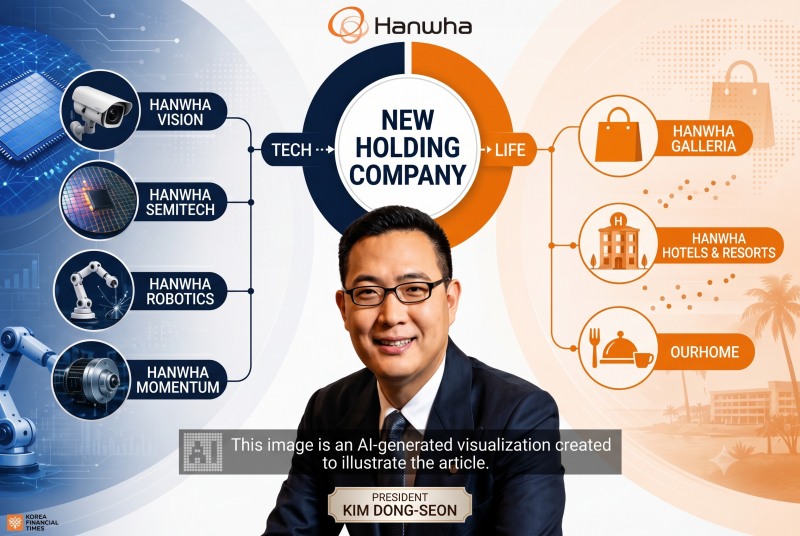
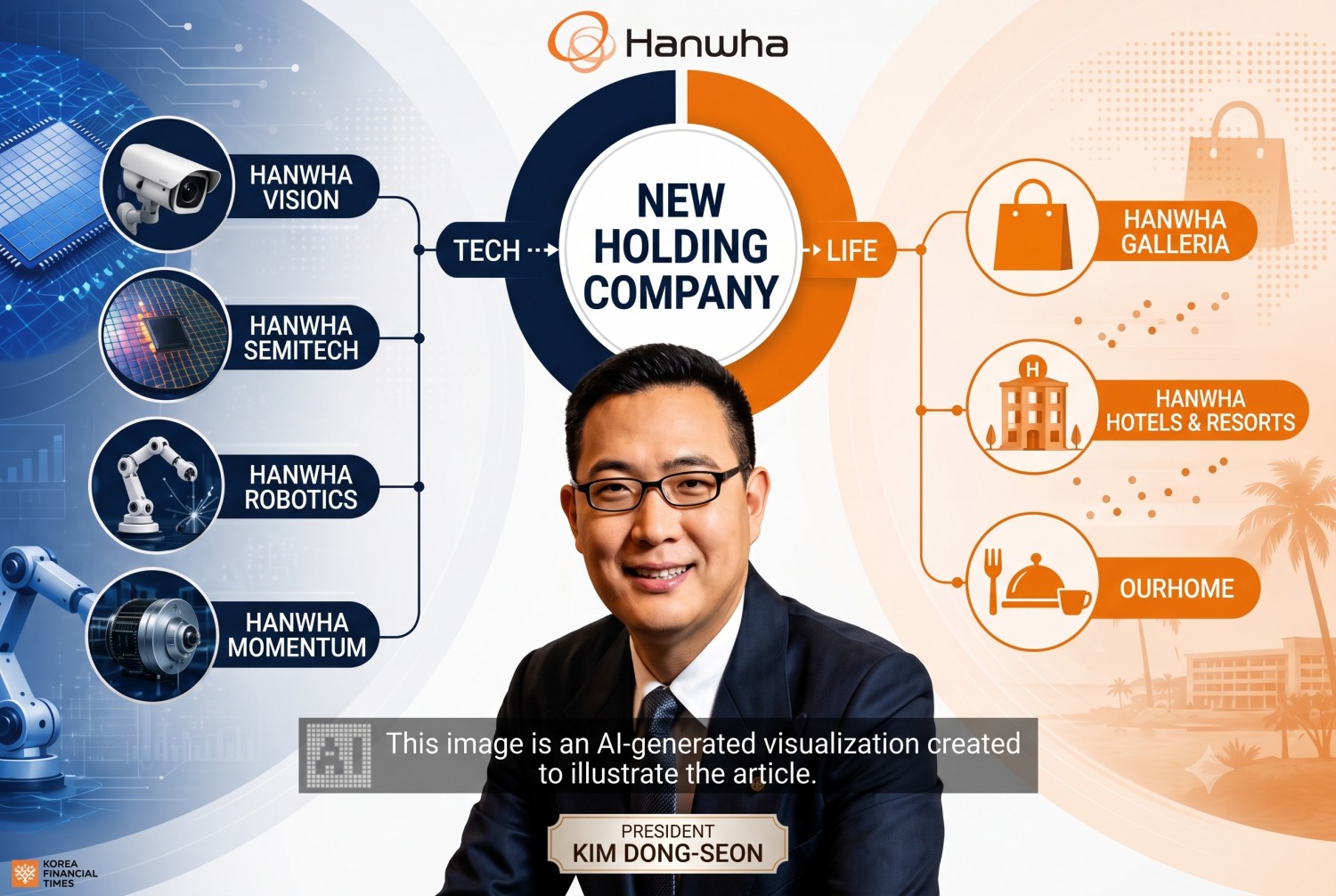
The new holding company that President Kim will lead will bring together tech businesses — Hanwha Vision, Hanwha SemiTech, Hanwha Robotics and Hanwha Momentum — alongside life businesses including Hanwha Galleria, Hanwha Hotels & Resorts and Ourhome. As businesses with different growth models and investment structures are being placed under a single holding company, attention is focused on the future direction of management.The tech business is a future growth engine that requires continuous investment. While Hanwha Vision generates stable earnings based on its security business, Hanwha SemiTech, Hanwha Robotics and Hanwha Momentum — which handle semiconductor equipment — remain at a growth stage requiring ongoing R&D and capital expenditure. Analysts note that while their growth potential is high, it will take time before they can serve as stable cash generators in the short term.
Indeed, the group has laid out a large-scale investment plan. Hanwha has set a goal of investing a combined KRW 4.7 trillion through the new holding company by 2030 — KRW 2.1 trillion in capital expenditure, KRW 2 trillion in R&D and KRW 600 billion in mergers and acquisitions — while targeting 30% average annual revenue growth. The core strategy is to build a "physical AI" value chain by linking Hanwha Vision's AI video analytics technology with Hanwha Robotics, Hanwha Momentum and Hanwha SemiTech.
However, growth businesses come with investment burdens. Korea Ratings said in a report earlier this year that substantial future investment is expected to be concentrated in businesses with high growth potential, such as Hanwha SemiTech, Hanwha Robotics and Ourhome. Kim Sang-soo, a researcher at Korea Ratings, said that while Hanwha Aerospace and Hanwha Ocean continue to benefit from favorable external conditions, businesses being spun off with high growth potential — such as Hanwha SemiTech, Hanwha Robotics and Ourhome — are expected to require considerable investment going forward, adding that the firm plans to further review the financial capacity to handle such large-scale investment as well as the investment performance of each business.
Hanwha Eyes Jeju as Strategic Hub for Space, Defense, and TourismNew '3% Rule' on Duplicate Listings Puts HD Hyundai Robotics, LS Essex in the CrosshairsHD Hyundai vs. Hanwha Ocean: The Battle for Thailand's Frigate ContractLIG D&A, Hanwha Systems Enter Full-Scale Rivalry as Defense AI Battle Reaches the BoardroomHanwha Solutions Trims Rights Offering Size, Shares Rebound — But KRW 600 Billion Shortfall Remains
Meanwhile, unlike the tech business, the life business faces profitability improvement as a more pressing task than large-scale R&D. In particular, generating synergy from the Ourhome acquisition and improving the performance of affiliates such as Hanwha Galleria and Hanwha Hotels & Resorts are crucial to building a stable cash-generating base and securing the new holding company's financial stability.
In short, the success of the new holding company hinges on maintaining investment in the tech business while raising profitability in the life business to secure stable cash flow. Managing expanded investment alongside the resulting financial burden will be the first test President Kim faces.
From Life to Tech — The Weight Behind the 'Hanwha Vision President' Title
One notable aspect of President Kim's promotion is which affiliate he was promoted within. He has served as head of future vision strategy across multiple affiliates, including Hanwha Galleria, Hanwha Hotels & Resorts and Hanwha Vision. In particular, as new businesses were driven mainly in the distribution and life sectors — Hanwha Galleria and Hanwha Hotels & Resorts — he had come to be seen as the figure representing those businesses.However, ahead of the launch of the new holding company, President Kim stepped down from his future vision strategy roles at all affiliates except Hanwha Vision, and was then promoted to president of Hanwha Vision in this reshuffle. The fact that Hanwha Vision was the one affiliate he retained as his official post among several suggests that the center of gravity under his leadership may shift toward the tech business going forward.
Hanwha Vision is seen as the linchpin connecting the tech affiliates within the new holding company, given its stable security business and its AI video analytics technology. The group's blueprint to build a "physical AI" value chain by applying Hanwha Vision's technology to Hanwha Robotics, Hanwha Momentum and Hanwha SemiTech lends further weight to this interpretation.
Notably, following the July 30 reshuffle in which Kim Ki-chul, CEO of Hanwha Vision, was named to concurrently serve as CEO of Hanwha SemiTech, expectations have grown that decision-making speed as well as technological cooperation and business linkages between Hanwha Vision and SemiTech will be further strengthened.
That said, no joint R&D or concrete business integration plans between the affiliates have been disclosed so far. President Kim now faces the task of maintaining Hanwha Vision's existing profitability while translating investment in semiconductor equipment, robotics and automation into tangible results. He must prove his leadership by securing competitiveness in the tech business.
An industry source said that while President Kim has so far led acquisitions and business restructuring, he has now entered a stage where he must prove those results, adding that how quickly he can grow the tech business centered on Hanwha Vision and raise the new holding company's corporate value will be the core challenge of the Kim Dong-seon era.
Park seulgi (seulgi@fntimes.com)










![‘삼전닉스ʼ에 가린 반도체주…주성엔지니어링 ‘질주ʼ·리노공업 ‘주춤ʼ [정답은 TSR]](https://cfnimage.commutil.kr/phpwas/restmb_setimgmake.php?pp=006&w=69&h=45&m=5&simg=20260918223152079000dd55077bc212411124362.jpg&nmt=18)

![스틱벤처스 정보라, 네오사피엔스 IPO 잰걸음 ‘딥테크 투자 강화ʼ [VC 2026 하반기 프리뷰 (7)]](https://cfnimage.commutil.kr/phpwas/restmb_setimgmake.php?pp=006&w=69&h=45&m=5&simg=20260918221427079140dd55077bc212411124362.jpg&nmt=18)


![[그래픽 뉴스] ‘순대’가 경제용어라고? 순(純)대외자산, 한국의 진짜 해외자산은 얼마일까?](https://cfnimage.commutil.kr/phpwas/restmb_setimgmake.php?pp=006&w=298&h=298&m=1&simg=202609021356075202de68fcbb3512411124362_0.jpg&nmt=18)
![[그래픽 뉴스] ISA 대개편! 나에게 유리한 계좌는?](https://cfnimage.commutil.kr/phpwas/restmb_setimgmake.php?pp=006&w=298&h=298&m=1&simg=202608041713155615de68fcbb3512411124362_0.jpg&nmt=18)
![[그래픽 뉴스] 미국 증시 새로운 키워드 'MANGOS'](https://cfnimage.commutil.kr/phpwas/restmb_setimgmake.php?pp=006&w=298&h=298&m=1&simg=202607291740382069de68fcbb3512411124362_0.jpg&nmt=18)

![[그래픽 뉴스] 은퇴후 30년 부모님 세대의 생존전략](https://cfnimage.commutil.kr/phpwas/restmb_setimgmake.php?pp=006&w=298&h=298&m=1&simg=202606301704439153de68fcbb3512411124362_0.jpg&nmt=18)
![[신간]은퇴연옥…김경록의 은퇴 후 삶의 나침반](https://cfnimage.commutil.kr/phpwas/restmb_setimgmake.php?pp=006&w=81&h=123&m=5&simg=20260414140833047280f8caa4a5ce12411124362.jpg&nmt=18)
![[신간] 물처럼 흐르고 원칙으로 서다…김용환의 통찰을 담다](https://cfnimage.commutil.kr/phpwas/restmb_setimgmake.php?pp=006&w=81&h=123&m=5&simg=20260409114249027860f8caa4a5ce12411124362.jpg&nmt=18)
![[안현정 서평] 플랫폼의 영지에서 ‘미학적 주권’을 선포하라...'K가 죽어야 K가 산다' 장준환 著](https://cfnimage.commutil.kr/phpwas/restmb_setimgmake.php?pp=006&w=81&h=123&m=5&simg=20260527121426063220c1c16452b012411124362.jpg&nmt=18)
![[서평] 추세 매매의 대가들...추세추종 투자전략의 대가 14인 인터뷰](https://cfnimage.commutil.kr/phpwas/restmb_setimgmake.php?pp=006&w=81&h=123&m=5&simg=2023102410444004986c1c16452b0175114235199.jpg&nmt=18)


![[머니무브 2026] “지금 사도 될까?” 답이 안 보인다면…하반기 투자, 4명의 전문가에게 물어보세요](https://cfnimage.commutil.kr/phpwas/restmb_setimgmake.php?pp=006&w=89&h=45&m=1&simg=202609151044050355302a735e27af12411124362.jpg&nmt=18)
![[AD] ‘PBV 라인업 확장’ 기아, 9월 독일서 ‘PV7’ 첫 공개](https://cfnimage.commutil.kr/phpwas/restmb_setimgmake.php?pp=006&w=89&h=45&m=1&simg=2026083111010602815074925877361231180222.jpg&nmt=18)
![[AD] 제네시스, 럭셔리 경험 더한 ‘2027 GV70’‧‘GV70 그래파이트’ 출시](https://cfnimage.commutil.kr/phpwas/restmb_setimgmake.php?pp=006&w=89&h=45&m=1&simg=20260702143546085600749258773622211122717.jpg&nmt=18)
![[AD] 개소세 혜택 종료…현대차, ‘썸머 페스타’로 고객 부담 완화](https://cfnimage.commutil.kr/phpwas/restmb_setimgmake.php?pp=006&w=89&h=45&m=1&simg=20260702142355004830749258773622211122717.jpg&nmt=18)
![[AD] 기아 ‘디 올 뉴 셀토스’, 인도 타임스 드라이브 어워즈서 ‘올해의 SUV’ 선정](https://cfnimage.commutil.kr/phpwas/restmb_setimgmake.php?pp=006&w=89&h=45&m=1&simg=202605071156400590007492587736124111243152.jpg&nmt=18)