






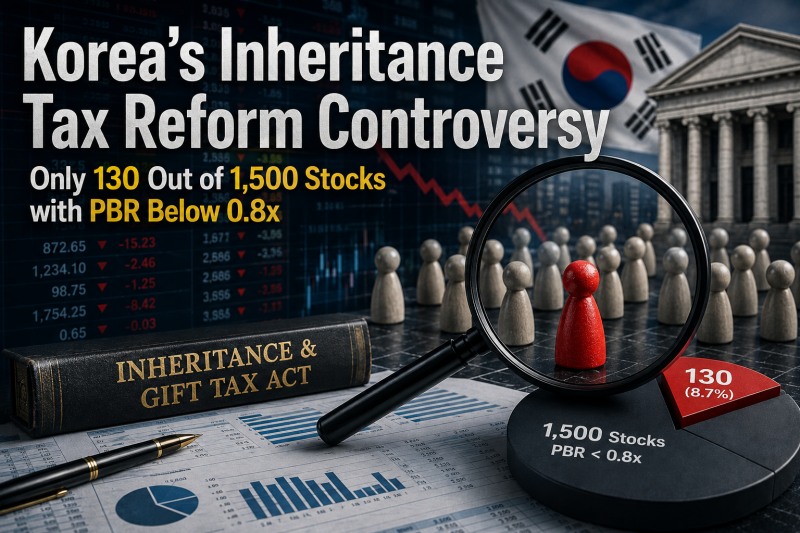
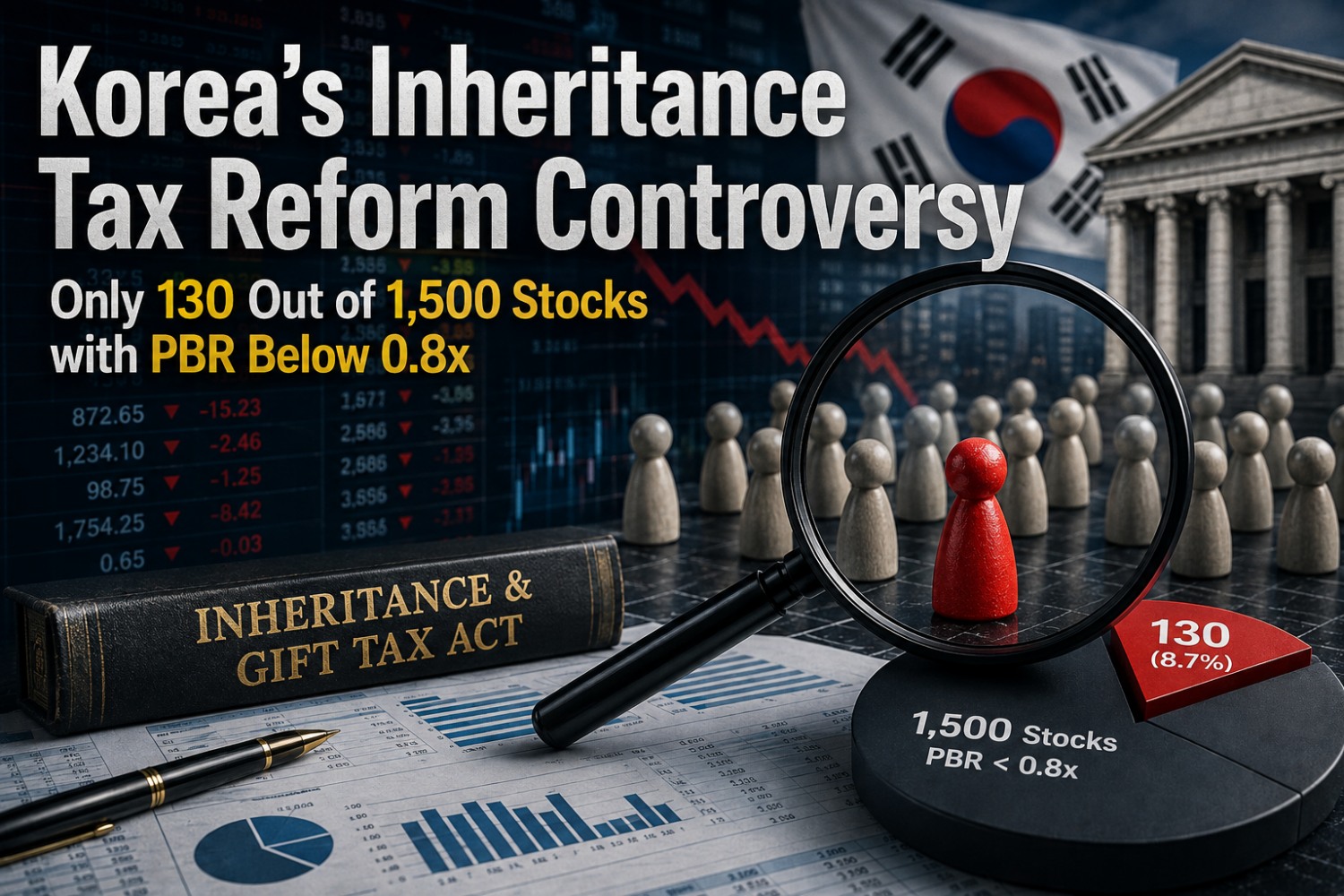
On Aug. 4, the Ministry of Economy and Finance announced that, as part of the tax reform package unveiled the previous day, it will significantly strengthen the standards for valuing listed shares held by taxpayers for inheritance and gift tax purposes through revisions to the Inheritance and Gift Tax Act. Dubbed the "stock price suppression prevention act," the measure is intended to root out cases in which major shareholders deliberately keep share prices low.
However, the "PBR below 0.8x" threshold proposed in the bill sponsored by Democratic Party of Korea lawmaker Lee So-young was dropped. Instead, companies whose price-to-book ratio (PBR) has remained in the bottom 25% of the KOSPI market or the bottom 10% of the KOSDAQ market over the past six years will be classified as "stock price suppression" companies.
Companies designated as such would have a 30% premium applied to their asset value when calculating inheritance or gift taxes.
The key point here is that the classification is done "by sector." Rather than ranking companies across the entire market, the bottom performers are identified separately within each of 11 industry sectors.
The Korea Corporate Governance Forum said in a commentary that its estimate of companies in the bottom PBR tier by sector came to 84 to 87 KOSPI-listed companies and 43 KOSDAQ-listed companies, for a total of roughly 130. It added that the average market capitalization of these companies is KRW 555.7 billion for KOSPI and KRW 117.3 billion for KOSDAQ, meaning large-cap and mid-cap companies are excluded from the measure.
The forum further noted that the average PBR of these companies is 0.27x, which, even with a 30% premium applied, comes to just 0.35x. It said that because the standard compares the six-year average closing price with the current valuation method plus a 30% premium and applies whichever figure is higher, the policy could actually create an incentive to keep stock prices depressed over the long term.
Over 1500 Companies With PBR Below 1x vs. Roughly 130 Under the "Stock Price Suppression Prevention Act"
What Activist Funds' Korean Targets Have in Common: Poor Capital AllocationInefficient Capital Allocation Holds Back Hyundai Motor's Stock Despite Record ProfitHyundai Poised to Buy Out SoftBank's Boston Dynamics Stake as Deadline LoomsWhy Asiana's Air Busan Bond Conversion Burdens Minority ShareholdersSK's Holding Subsidiaries Diverge: SK Discovery Falls Behind the Pack
According to THE COMPASS, an AI platform built in-house by the Korea Financial Times, 1,502 companies among all domestic listed firms currently have a PBR below 1x. Excluding the roughly 130 companies cited by the Korea Corporate Governance Forum, as many as 1,372 companies would fall outside the scope of the tax reform.
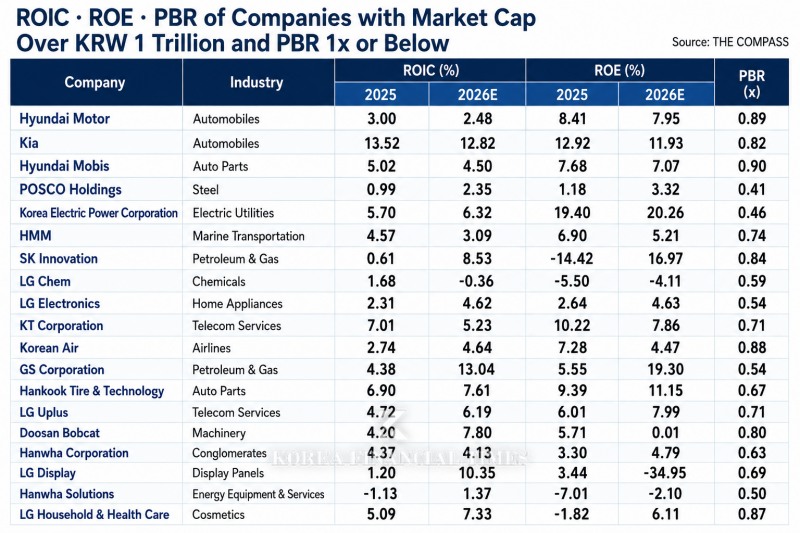
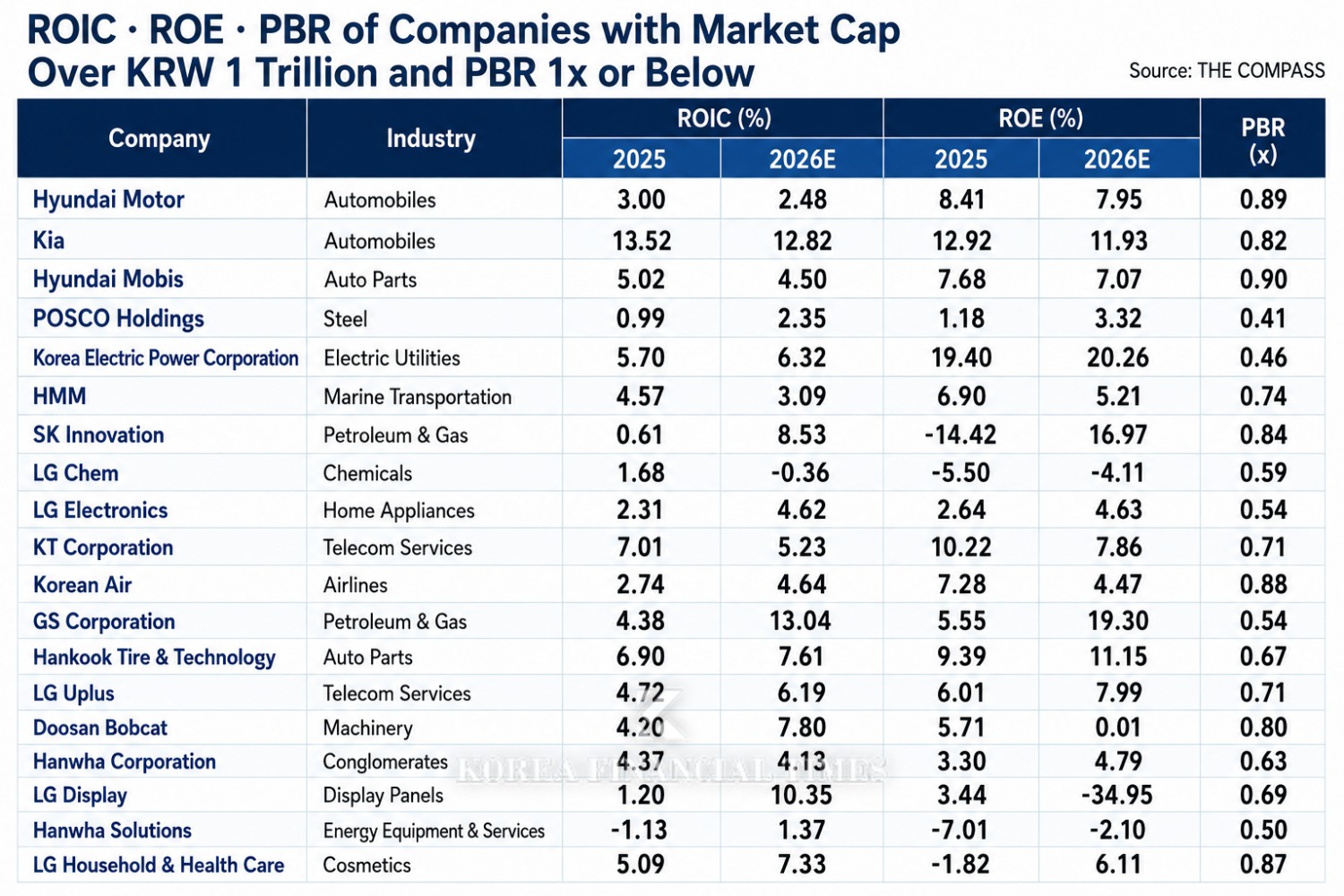
Among these, 76 companies with a market capitalization of KRW 1 trillion or more (combined market cap of KRW 483 trillion) have an average PBR of 0.618x. These large-cap firms account for 73.7% of the total market capitalization (KRW 655 trillion) of all companies with a PBR below 1x — meaning that even undervalued large companies are effectively exempted from the measure.
Return on equity (ROE) is generally regarded as a "function" of corporate value, meaning that higher ROE tends to correspond with higher PBR. However, among companies with "PBR below 1x and market cap above KRW 1 trillion," PBR showed a stronger correlation with return on invested capital (ROIC) than with ROE, based on 2026 annualized figures.
The correlation coefficient expresses the relationship between two variables on a scale from -1 to +1: values closer to -1 indicate a negative correlation, values closer to +1 indicate a positive correlation, and values near 0 indicate little to no relationship.
The calculated correlation with PBR was 0.43 for ROIC and 0.20 for ROE, indicating that ROE has relatively little influence on these companies' valuations.
ROIC measures how much operating profit a company generates relative to the capital invested in its business operations. Most of the companies in question had ROIC levels lower than their ROE, suggesting they have either failed to maximize returns from their core business or rely relatively heavily on debt.
Ultimately, all of this points to a deeper issue: the efficiency of capital allocation. The fact that a company's PBR falls below 1x is itself evidence that management and the board are failing to deploy capital effectively.
The Korea Corporate Governance Forum was similarly critical, stating that a PBR below 1x — regardless of industry — means the stock price is trading below liquidation value, which constitutes a serious disqualification for a listed company that is supposed to allocate capital efficiently in pursuit of overall shareholder value, and added that such companies "should not have gone public in the first place."
Lee Sungkyu (lsk0603@fntimes.com)











!['첫 연임' 신학기 vs '新리더십' 이형주…차기 수협은행장 선임 D-Day [2027 은행장 선임 레이스]](https://cfnimage.commutil.kr/phpwas/restmb_setimgmake.php?pp=006&w=69&h=45&m=5&simg=202609211608140057701b5a2213792211381469.jpg&nmt=18)

![진옥동號 신한금융, 후보군 공개·추천권 부여···관건은 '실효성' [은행권 승계 구조 점검]](https://cfnimage.commutil.kr/phpwas/restmb_setimgmake.php?pp=006&w=69&h=45&m=5&simg=20260922032554018380b4a7c6999c121131189150.jpg&nmt=18)


![[그래픽 뉴스] ‘순대’가 경제용어라고? 순(純)대외자산, 한국의 진짜 해외자산은 얼마일까?](https://cfnimage.commutil.kr/phpwas/restmb_setimgmake.php?pp=006&w=298&h=298&m=1&simg=202609021356075202de68fcbb3512411124362_0.jpg&nmt=18)
![[그래픽 뉴스] ISA 대개편! 나에게 유리한 계좌는?](https://cfnimage.commutil.kr/phpwas/restmb_setimgmake.php?pp=006&w=298&h=298&m=1&simg=202608041713155615de68fcbb3512411124362_0.jpg&nmt=18)
![[그래픽 뉴스] 미국 증시 새로운 키워드 'MANGOS'](https://cfnimage.commutil.kr/phpwas/restmb_setimgmake.php?pp=006&w=298&h=298&m=1&simg=202607291740382069de68fcbb3512411124362_0.jpg&nmt=18)

![[그래픽 뉴스] 은퇴후 30년 부모님 세대의 생존전략](https://cfnimage.commutil.kr/phpwas/restmb_setimgmake.php?pp=006&w=298&h=298&m=1&simg=202606301704439153de68fcbb3512411124362_0.jpg&nmt=18)
![[신간]은퇴연옥…김경록의 은퇴 후 삶의 나침반](https://cfnimage.commutil.kr/phpwas/restmb_setimgmake.php?pp=006&w=81&h=123&m=5&simg=20260414140833047280f8caa4a5ce12411124362.jpg&nmt=18)
![[신간] 물처럼 흐르고 원칙으로 서다…김용환의 통찰을 담다](https://cfnimage.commutil.kr/phpwas/restmb_setimgmake.php?pp=006&w=81&h=123&m=5&simg=20260409114249027860f8caa4a5ce12411124362.jpg&nmt=18)
![[안현정 서평] 플랫폼의 영지에서 ‘미학적 주권’을 선포하라...'K가 죽어야 K가 산다' 장준환 著](https://cfnimage.commutil.kr/phpwas/restmb_setimgmake.php?pp=006&w=81&h=123&m=5&simg=20260527121426063220c1c16452b012411124362.jpg&nmt=18)
![[서평] 추세 매매의 대가들...추세추종 투자전략의 대가 14인 인터뷰](https://cfnimage.commutil.kr/phpwas/restmb_setimgmake.php?pp=006&w=81&h=123&m=5&simg=2023102410444004986c1c16452b0175114235199.jpg&nmt=18)


![[머니무브 2026] “지금 사도 될까?” 답이 안 보인다면…하반기 투자, 4명의 전문가에게 물어보세요](https://cfnimage.commutil.kr/phpwas/restmb_setimgmake.php?pp=006&w=89&h=45&m=1&simg=202609151044050355302a735e27af12411124362.jpg&nmt=18)
![[AD] ‘PBV 라인업 확장’ 기아, 9월 독일서 ‘PV7’ 첫 공개](https://cfnimage.commutil.kr/phpwas/restmb_setimgmake.php?pp=006&w=89&h=45&m=1&simg=2026083111010602815074925877361231180222.jpg&nmt=18)
![[AD] 제네시스, 럭셔리 경험 더한 ‘2027 GV70’‧‘GV70 그래파이트’ 출시](https://cfnimage.commutil.kr/phpwas/restmb_setimgmake.php?pp=006&w=89&h=45&m=1&simg=20260702143546085600749258773622211122717.jpg&nmt=18)
![[AD] 개소세 혜택 종료…현대차, ‘썸머 페스타’로 고객 부담 완화](https://cfnimage.commutil.kr/phpwas/restmb_setimgmake.php?pp=006&w=89&h=45&m=1&simg=20260702142355004830749258773622211122717.jpg&nmt=18)
![[AD] 기아 ‘디 올 뉴 셀토스’, 인도 타임스 드라이브 어워즈서 ‘올해의 SUV’ 선정](https://cfnimage.commutil.kr/phpwas/restmb_setimgmake.php?pp=006&w=89&h=45&m=1&simg=202605071156400590007492587736124111243152.jpg&nmt=18)