






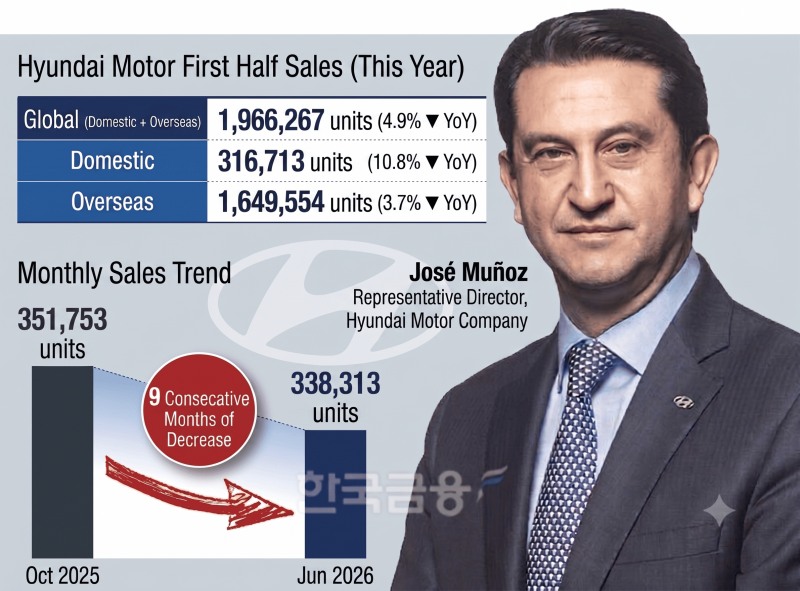
This infographic, originally published by Korea Financial Times, has been reconstructed using generative AI.
이미지 확대보기
Defending sales volume and lifting profitability amid a rapidly shifting global trade environment is his top-priority task.
In his first year in the role last year, Hyundai sold a total of 4,138,180 units worldwide — a decline of roughly 0.1% from the prior year, but a result that was regarded as a solid showing given uncertainties such as U.S. tariffs.
The problem is this year. While Hyundai has maintained sales in the North American market, sales figures in the domestic Korean and European markets are showing double-digit declines.
The company's position is especially unstable in the EV market. In Korea, Hyundai faces the risk of ceding market leadership to Tesla and BYD, both of which are leading with low-priced models.
Whether CEO Muñoz can produce a turnaround — by moving away from simple price competition and instead expanding the customer experience through design and performance — is drawing close attention.
Weakness at Home and Abroad Alike
According to Hyundai's global sales performance data, cumulative global sales from January through June this year totaled 1,966,267 units, a figure down 4.9% from the same period last year.Of that, cumulative domestic sales came to just 316,713 units, sharply down 10.8% from the same period a year earlier. This reflects both frozen consumer sentiment amid the economic downturn and reduced production stemming from parts-supply disruptions at some suppliers.
NVIDIA's Huang Visits Hyundai HQ, Hails "Hyundai's Time" in the Age of Physical AIHyundai Motor Group Chairman Mulls Deepening Boston Dynamics IPO DilemmaHyundai Wia Bets on Robots and EVs—With an Eye on SuccessionShareholder Returns or Succession Strategy? The Dual Purpose Behind Hyundai Motor and Kia's Payout PoliciesHyundai Motor Faces Massive Union Bonus Demand Exceeding Dividends Amid Heavy Tech Investments
The weakness is particularly painful in the EV market. As the generational-turnover cycle for core volume models such as the IONIQ series has lengthened, Hyundai appears to be ceding leadership to Chinese EV makers including Tesla and BYD.
Hyundai sold 39,575 electric vehicles in the domestic market in the first half of the year. This was up 46.5% from the same period last year, but it still lost face by trailing Tesla's January–May sales figure of 45,020 units. In particular, Tesla's Model Y alone sold 3,762 units this past May, becoming the first imported model ever to rank first in sales for a single model.
Compounding this is the fierce offensive from China's BYD, which has been expanding its domestic market territory on the strength of value-for-money pricing. BYD surpassed cumulative sales of 10,000 units roughly a year after its Korea launch, climbing all the way to fourth place among imported brands.
Hyundai now finds itself in a sandwich position in the domestic market — squeezed by Tesla's explosive dominance on one side and pursued by BYD's formidable value pricing on the other.
Overseas markets, the region that is CEO Muñoz's primary area of responsibility, are also underperforming. In the first half of this year, Hyundai's cumulative overseas sales excluding Korea came to 1,649,554 units, down 3.7% from the previous year.
The company performed especially poorly in the European market, which has emerged as a battleground for electrification centered on small EVs. According to the European Automobile Manufacturers' Association (ACEA), Hyundai's cumulative European sales from January through May this year totaled 197,308 units, down 10.1% from the same period last year. May alone saw an 18.8% plunge, widening the second-quarter decline.
Over the same period, the overall European auto market grew 4.5%. Sister company Kia grew 5.1% (237,656 units), but Hyundai slipped on its own. Hyundai's European market share also fell 0.5 percentage points, from 3.9% last year to 3.4% this year.
One consolation, however, is North America, Hyundai's core market, where strong hybrid sales helped push volume to 373,013 units, up 1% from the same period last year. Hyundai's hybrid model sales in North America rose 90% over the same period, setting an all-time record for monthly sales.
Did Muñoz Misjudge the Market?
Speculation is growing that a key factor behind Hyundai's poor sales performance is that CEO Muñoz misjudged the so-called chasm (the slowdown in EV demand).Last year, taking the EV chasm into account, CEO Muñoz moderated the pace of EV rollout and instead pushed to improve a hybrid-centered portfolio. Criticism has followed, however, that Hyundai failed to respond appropriately to changing conditions — including a surge in oil prices driven by Middle East instability and a recovery in demand centered on small cars and EVs that began in Europe.
Unlike Hyundai, Kia posted rising sales in Europe, which analysts attribute to the fact that mass-market models such as the compact electric SUV EV3, along with the EV4 and EV5, captured local electrification demand. Currently, the Casper EV is the only mass-market Hyundai EV sold in Europe.
The same holds true domestically. According to the Korea Automobile & Mobility Industry Association, domestic EV sales from January through May this year totaled roughly 160,000 units, roughly double the figure from the same period last year.
This is the result of imported brands such as Tesla and BYD stepping up their offensive amid high oil prices. Yet over the same period, Hyundai launched no new EV models domestically, nor did it carry out a generational model changeover.
For the second half of the year, CEO Muñoz plans to pursue a sales rebound by strengthening the existing hybrid lineup and rolling out new models.
For now, Hyundai expects that, alongside the launch of the New Grandeur — a mainstay of the domestic market — the effect of new models such as the global bestseller the All-New Avante (overseas name: Elantra) will kick in more fully starting in the second half. The company also plans to continue sales and marketing efforts to mainstream EV adoption.
In the overseas EV market, Hyundai is pinning its hopes on the upcoming IONIQ 3. The IONIQ 3, the first compact EV in Hyundai's dedicated IONIQ EV lineup, is slated to debut in the European market this year.
Notably, CEO Muñoz intends to break through head-on with a technology-centered "expansion of customer value," in contrast to rivals leading with value-for-money pricing in the EV market.
At the recently held Busan Mobility Show, addressing the global offensive from value-priced EV makers such as China's BYD, he declared: "Rather than simple price competition, we will compete on value by providing the best customer experience through design, performance and a digital ecosystem." This reflects his determination to compete on the strength of Hyundai's own product appeal alone.
One industry official said, "There is interest in how flexibly CEO Muñoz will deploy dealer-network incentive strategies in this time of crisis, and how he will defend against the offensive from foreign brands." The official added, "Whether he can overcome the first-half slump and achieve defense of the home-turf EV market, an improved global hybrid-centered mix, and results from the compact electrified IONIQ 3 will be the true test by which his management ability is judged."
Kim JaeHun (rlqm93@fntimes.com)











![[THE COMPASS] 한미사이언스 경영권 분쟁, 신동국이 주도하는 ‘종식’ 게임](https://cfnimage.commutil.kr/phpwas/restmb_setimgmake.php?pp=006&w=69&h=45&m=5&simg=20261008122108000710a837df649412411124362.jpg&nmt=18)
![영업익 53% 뛴다는데…대웅제약 몸값 누르는 두 가지 변수 [5대 제약사 3Q 실적 ④]](https://cfnimage.commutil.kr/phpwas/restmb_setimgmake.php?pp=006&w=69&h=45&m=5&simg=202610081106100618007fd637f543112168227135.jpg&nmt=18)


![[그래픽 뉴스] ‘순대’가 경제용어라고? 순(純)대외자산, 한국의 진짜 해외자산은 얼마일까?](https://cfnimage.commutil.kr/phpwas/restmb_setimgmake.php?pp=006&w=298&h=298&m=1&simg=202609021356075202de68fcbb3512411124362_0.jpg&nmt=18)
![[그래픽 뉴스] ISA 대개편! 나에게 유리한 계좌는?](https://cfnimage.commutil.kr/phpwas/restmb_setimgmake.php?pp=006&w=298&h=298&m=1&simg=202608041713155615de68fcbb3512411124362_0.jpg&nmt=18)
![[그래픽 뉴스] 미국 증시 새로운 키워드 'MANGOS'](https://cfnimage.commutil.kr/phpwas/restmb_setimgmake.php?pp=006&w=298&h=298&m=1&simg=202607291740382069de68fcbb3512411124362_0.jpg&nmt=18)

![[그래픽 뉴스] 은퇴후 30년 부모님 세대의 생존전략](https://cfnimage.commutil.kr/phpwas/restmb_setimgmake.php?pp=006&w=298&h=298&m=1&simg=202606301704439153de68fcbb3512411124362_0.jpg&nmt=18)
![[신간]은퇴연옥…김경록의 은퇴 후 삶의 나침반](https://cfnimage.commutil.kr/phpwas/restmb_setimgmake.php?pp=006&w=81&h=123&m=5&simg=20260414140833047280f8caa4a5ce12411124362.jpg&nmt=18)
![[신간] 물처럼 흐르고 원칙으로 서다…김용환의 통찰을 담다](https://cfnimage.commutil.kr/phpwas/restmb_setimgmake.php?pp=006&w=81&h=123&m=5&simg=20260409114249027860f8caa4a5ce12411124362.jpg&nmt=18)
![[안현정 서평] 플랫폼의 영지에서 ‘미학적 주권’을 선포하라...'K가 죽어야 K가 산다' 장준환 著](https://cfnimage.commutil.kr/phpwas/restmb_setimgmake.php?pp=006&w=81&h=123&m=5&simg=20260527121426063220c1c16452b012411124362.jpg&nmt=18)
![[서평] 추세 매매의 대가들...추세추종 투자전략의 대가 14인 인터뷰](https://cfnimage.commutil.kr/phpwas/restmb_setimgmake.php?pp=006&w=81&h=123&m=5&simg=2023102410444004986c1c16452b0175114235199.jpg&nmt=18)


![[머니무브 2026] “지금 사도 될까?” 답이 안 보인다면…하반기 투자, 4명의 전문가에게 물어보세요](https://cfnimage.commutil.kr/phpwas/restmb_setimgmake.php?pp=006&w=89&h=45&m=1&simg=202609151044050355302a735e27af12411124362.jpg&nmt=18)
![[AD] ‘PBV 라인업 확장’ 기아, 9월 독일서 ‘PV7’ 첫 공개](https://cfnimage.commutil.kr/phpwas/restmb_setimgmake.php?pp=006&w=89&h=45&m=1&simg=2026083111010602815074925877361231180222.jpg&nmt=18)
![[AD] 제네시스, 럭셔리 경험 더한 ‘2027 GV70’‧‘GV70 그래파이트’ 출시](https://cfnimage.commutil.kr/phpwas/restmb_setimgmake.php?pp=006&w=89&h=45&m=1&simg=20260702143546085600749258773622211122717.jpg&nmt=18)