






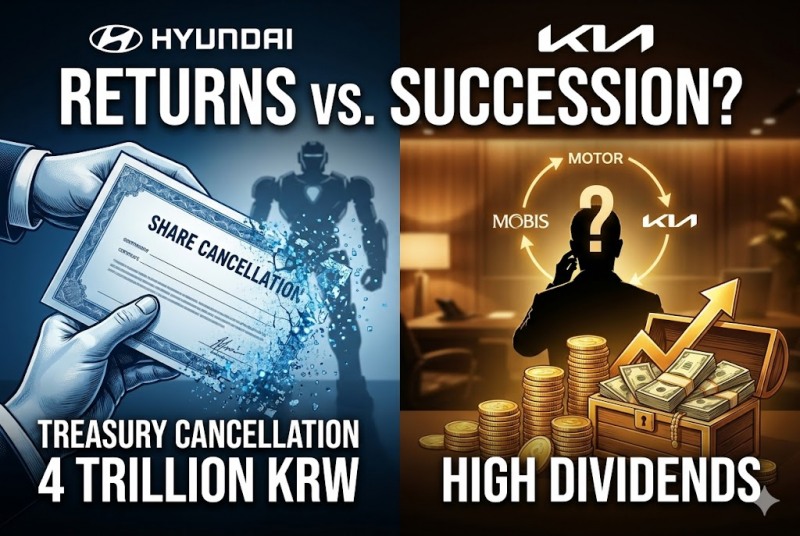
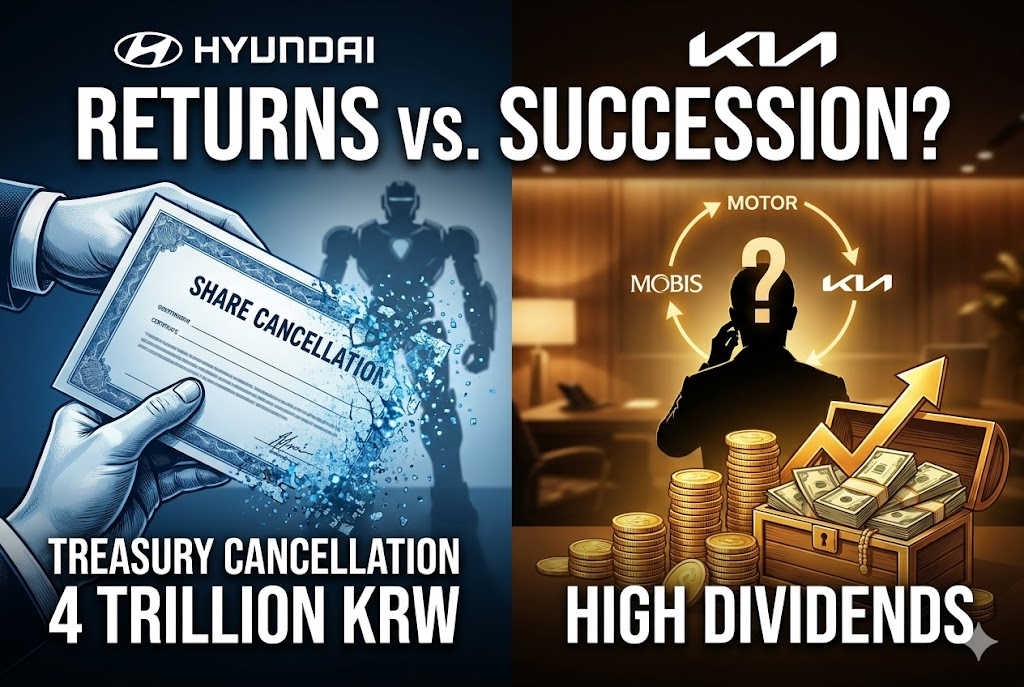
The two companies, however, differ in their approaches to achieving this target. While Hyundai Motor is centered on treasury share buybacks and cancellations, Kia places greater weight on its dividend policy. Although both policies are fundamentally designed to maximize shareholder returns, industry observers also detect a strategic dimension: a coordinated plan to unwind the Hyundai Motor Group's circular cross-shareholding structure.
Hyundai Motor to Cancel KRW 4 Trillion in Treasury Shares
According to Hyundai Motor, the company is implementing a value-up program to purchase and fully cancel a total of KRW 4 trillion in newly acquired treasury shares over the three-year period from 2025 to 2027. This year alone, the company plans to buy and fully cancel approximately KRW 400 billion worth of treasury shares.When treasury shares are cancelled, the number of shares in circulation decreases accordingly, raising the value of each remaining share. Treasury share buybacks and cancellations are therefore considered among the most representative shareholder return policies. The government, as part of broader minority shareholder protections, also recently passed the third amendment to the Commercial Act, mandating that companies cancel all treasury shares in their possession.
Hyundai Motor's treasury share policy stands out when compared to major conglomerates such as Samsung Electronics and SK Group, particularly in its focus on maximizing the cancellation effect.
Samsung Electronics announced the cancellation of approximately KRW 16 trillion in treasury shares — the largest ever by a single domestic company. SK Inc., the holding company of SK Group, announced a treasury share cancellation plan worth approximately KRW 5.16 trillion, the largest among domestic holding companies.
Both Samsung Electronics and SK Inc. announced cancellations at a greater cost than Hyundai Motor, even after accounting for their respective shares in circulation. The critical distinction, however, is that Hyundai Motor is purchasing new treasury shares specifically for cancellation, whereas Samsung Electronics and SK Inc. are primarily cancelling shares already held in their possession — an approach closer to a tidying-up exercise.
The timing of treasury share purchases has the greatest bearing on share value, and shares that are bought but not subsequently cancelled can dilute that value. This is precisely why the government's amendment to the Commercial Act now mandates cancellation of all treasury shares already held.
Hyundai Motor Shifts Gear: From Automaker to Advanced Mobility CompanySix Years Locked Away: What Will Hyundai Steel Decide on Its Treasury Shares at This AGM?Robot Joints, 80%-a-Year Growth: Hyundai Mobis, Samsung Electro-Mechanics Lead Korea's Actuator Rush [K-Humanoid Wars ④]Tesla's Humanoid Rival Has Arrived — Boston Dynamics Eyes $70 Billion Valuation [K-Humanoid Wars, Part 1]
Prior to this latest round of new treasury share purchases and cancellations, Hyundai Motor announced a mid-to-long-term shareholder return policy in 2023, pledging to cancel treasury shares equivalent to 3% of total shares issued — at a rate of 1% per year over three years. This included cancelling existing treasury shares, with the aim of enhancing share value and improving shareholders' capital gains.
In addition, Hyundai Motor is leading its future business expansion this year through Boston Dynamics' humanoid robot Atlas, driving the group's robotics transformation and supporting its share price. Indeed, Hyundai Motor's stock, which had been rangebound in the KRW 200,000–300,000 band through the end of last year, surged to the KRW 500,000 level following Atlas's public debut in January.
Kia Favors Dividends Over Treasury Share Buybacks
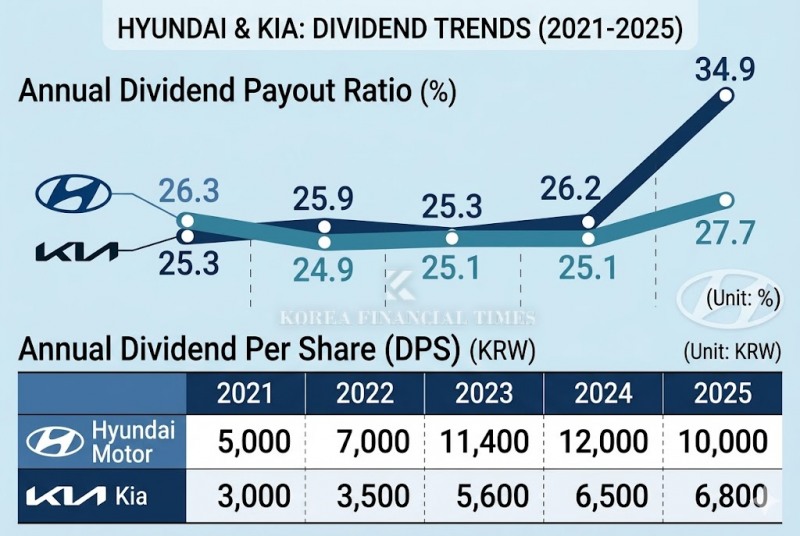
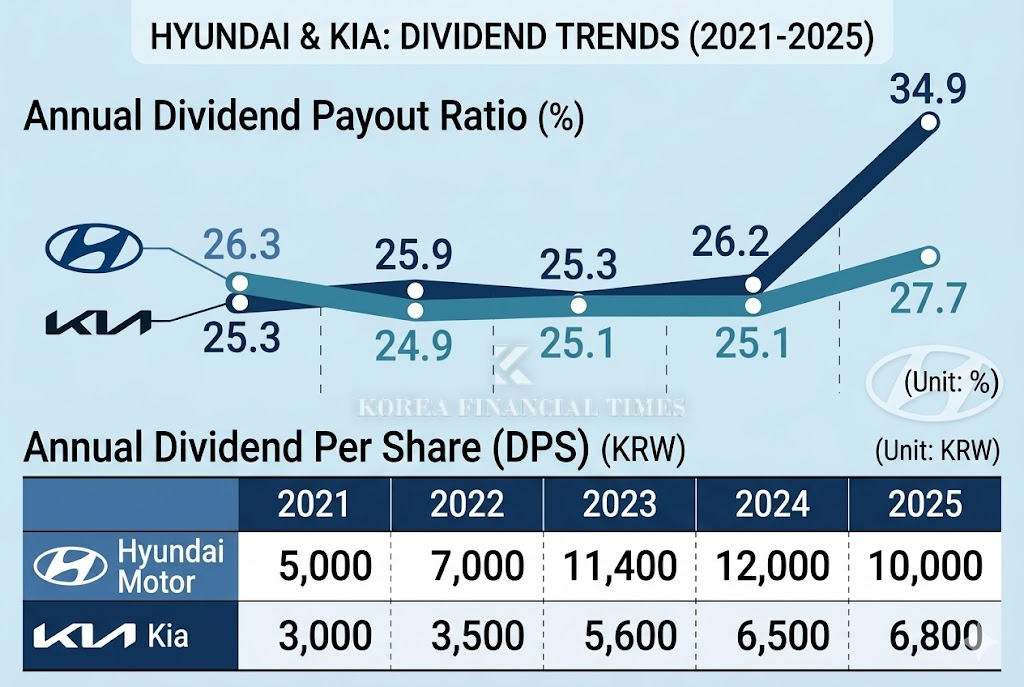
While Hyundai Motor seeks to boost shareholders' capital gains through aggressive treasury share buybacks and cancellations, Kia is winning shareholder favor with a high-dividend policy that returns tangible cash to investors.Indeed, Kia's dividend generosity exceeds that of Hyundai Motor. Kia set last year's dividend per share at KRW 6,800, up from KRW 6,500 in 2024, marking five consecutive years of dividend increases since 2021 (KRW 3,000 per share). By comparison, Hyundai Motor's dividend per share last year was KRW 10,000, down from KRW 12,000 in 2024.
Kia's dividend payout ratio is also comparatively higher. Kia maintained an average payout ratio of approximately 25%, recording 25.3% in 2021, 25.9% in 2022, 25.3% in 2023, and 26.2% in 2024. Last year, the ratio jumped sharply to 34.9%, up approximately 10 percentage points.
Hyundai Motor's payout ratio stood at 26.3% in 2021, 24.9% in 2022, 25.1% in 2023, 25.1% in 2024, and 27.7% last year. The dividend yield on common shares last year was 1.9% for Hyundai Motor — the lowest in the past five years — while Kia recorded 4.2%.
Kia's high-dividend policy is understood to stem from the differing roles the two companies play within the group. As the group's lead company, Hyundai Motor shoulders relatively heavier expenditures for future investments — meaning its capacity for shareholder returns, including dividends, may be constrained by its investment burden.
A representative example is the 2020 establishment of a KRW 2.5 trillion autonomous driving joint venture with Aptiv (Motional), in which Hyundai Motor, Kia, and Hyundai Mobis participated in a ratio of 2.6:1.4:1. Likewise, in Boston Dynamics' KRW 1.3 trillion rights offering in August last year, Hyundai Motor contributed the largest share at KRW 362.6 billion, followed by Kia at KRW 223.4 billion and Hyundai Mobis at KRW 146.5 billion.
With a comparatively lighter group investment burden, Kia naturally benefits as investment outcomes — such as those from robotics — are reflected in its share price. In fact, Kia's stock reached an all-time high of KRW 212,500 within approximately one month of Atlas's unveiling in January.
Kia also pursues treasury share cancellations in parallel. The company implements a policy of purchasing KRW 500 billion worth of treasury shares annually and cancelling KRW 250 billion of that amount to enhance shareholder value.
Shareholder Returns and Succession — Two Goals, One Strategy?
Industry observers interpret the two companies' divergent shareholder return policies not only as a reflection of their respective circumstances, but also as strategic groundwork for dismantling the Hyundai Motor Group's circular cross-shareholding structure and securing funding for leadership succession.The analysis holds that the policies serve a dual function: preventing shareholder value erosion that could arise during the process of unwinding the circular shareholding structure, while also supporting corporate value enhancement and a smooth succession for both companies.
To understand this interpretation, one must first examine the Hyundai Motor Group's ownership structure. The group's governance is organized in a circular cross-shareholding arrangement: Hyundai Mobis → Hyundai Motor → Kia → Hyundai Mobis.
The most widely cited scenario at present is to elevate Hyundai Mobis to the status of a full holding company, creating a linear structure of Hyundai Mobis → Hyundai Motor → Kia. If Chairman Chung Eui-sun can sufficiently strengthen his influence over Hyundai Mobis, he would be able to exercise stable control over the entire group.
To that end, based on end-2025 shareholding data, Chairman Chung must acquire the Hyundai Mobis stakes held by his father, Honorary Chairman Chung Mong-koo (7.47%) and those held by Kia (18.10%), among others, securing a stable threshold of approximately 25%. Chairman Chung Eui-sun himself, however, holds only approximately 0.33% of Hyundai Mobis shares.
Against this backdrop, how do Hyundai Motor and Kia's shareholder return policies connect to Chairman Chung Eui-sun's succession?
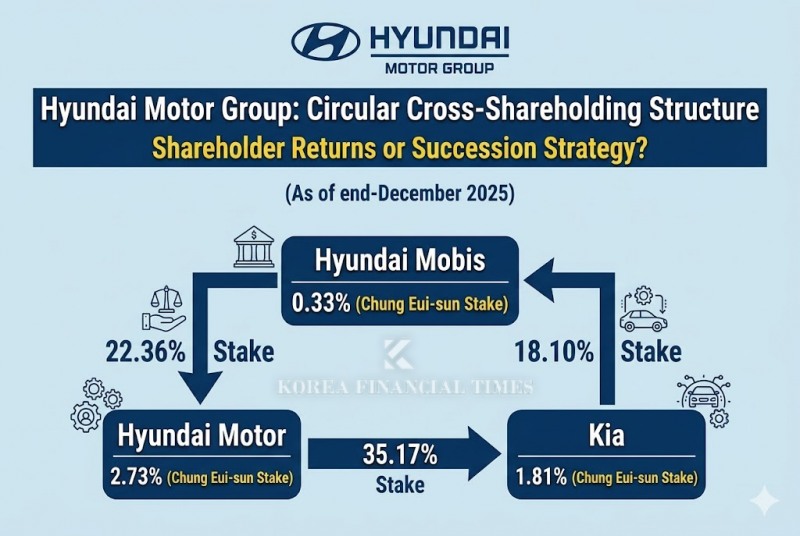
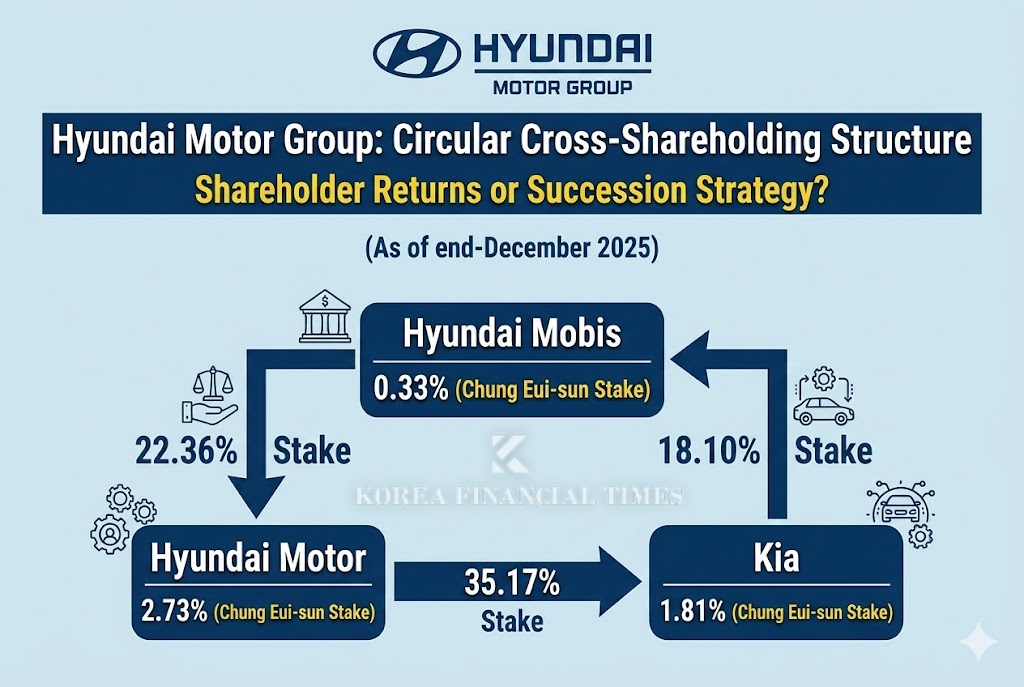
Consider first the link to Kia's shareholder return policy. The rationale is that Kia's emphasis on a higher dividend payout ratio, rather than share price gains alone, helps fund Chairman Chung's succession. Chairman Chung holds approximately 1.81% of Kia shares and is estimated to receive more than KRW 45 billion in annual dividends.
Beyond dividends, Kia has been a significant source of financial support for Chairman Chung. After being appointed as a Kia inside director in 2019, he went without any compensation through 2024, before receiving remuneration for the first time last year.
As a result, Chairman Chung Eui-sun's total compensation last year amounted to KRW 17.461 billion — an increase of approximately 51.5% compared to 2024, and the highest annual remuneration since he assumed the chairmanship in 2020.
How, then, does Hyundai Motor's shareholder return policy connect to the succession? The analysis holds that enhancing Hyundai Motor's share value serves to strengthen the group control exercised by Hyundai Mobis, which is slated to become the holding company.
As of last year, Hyundai Mobis is Hyundai Motor's largest shareholder with a 22.36% stake. The cancellation of Hyundai Motor's treasury shares can therefore amplify Hyundai Mobis's effective control over this core group affiliate without requiring the acquisition of additional shares.
Moreover, the value of Chairman Chung Eui-sun's own 2.73% stake in Hyundai Motor would also appreciate as a result. An increase in the value of that holding could potentially provide succession funding in the future through a sale or share swap, among other mechanisms.
Kim JaeHun (rlqm93@fntimes.com)












![24개월 최고 연 4.00%…제주은행 'J정기예금(만기지급식)' [이주의 은행 예금금리-10월 4주]](https://cfnimage.commutil.kr/phpwas/restmb_setimgmake.php?pp=006&w=69&h=45&m=5&simg=202610231018530270305e6e69892f222110224119.jpg&nmt=18)
![기관 '한화오션'·외인 '삼성전자'·개인 '삼성전기' 1위 [주간 코스피 순매수- 2026년 10월19일~10월23일]](https://cfnimage.commutil.kr/phpwas/restmb_setimgmake.php?pp=006&w=69&h=45&m=5&simg=20261024171622010220179ad4390711823574140.jpg&nmt=18)
![12개월 최고 연 7.00%…경남은행 '오면우대! 하면우대! 정기적금' [이주의 은행 적금금리-10월 4주]](https://cfnimage.commutil.kr/phpwas/restmb_setimgmake.php?pp=006&w=69&h=45&m=5&simg=202610231103420840305e6e69892f222110224119.jpg&nmt=18)
![24개월 최고 연 4.10%…OK저축은행 'OK e-안심정기예금'[이주의 저축은행 예금금리-10월 4주]](https://cfnimage.commutil.kr/phpwas/restmb_setimgmake.php?pp=006&w=69&h=45&m=5&simg=202610241739030963907c96e7978011215281239.jpg&nmt=18)
![12개월 최고 연 4.10%…경남은행 'The든든예금(시즌2)' [이주의 은행 예금금리-10월 4주]](https://cfnimage.commutil.kr/phpwas/restmb_setimgmake.php?pp=006&w=69&h=45&m=5&simg=202610231017430908005e6e69892f222110224119.jpg&nmt=18)


![[그래픽 뉴스] ‘순대’가 경제용어라고? 순(純)대외자산, 한국의 진짜 해외자산은 얼마일까?](https://cfnimage.commutil.kr/phpwas/restmb_setimgmake.php?pp=006&w=298&h=298&m=1&simg=202609021356075202de68fcbb3512411124362_0.jpg&nmt=18)
![[그래픽 뉴스] ISA 대개편! 나에게 유리한 계좌는?](https://cfnimage.commutil.kr/phpwas/restmb_setimgmake.php?pp=006&w=298&h=298&m=1&simg=202608041713155615de68fcbb3512411124362_0.jpg&nmt=18)
![[그래픽 뉴스] 미국 증시 새로운 키워드 'MANGOS'](https://cfnimage.commutil.kr/phpwas/restmb_setimgmake.php?pp=006&w=298&h=298&m=1&simg=202607291740382069de68fcbb3512411124362_0.jpg&nmt=18)

![[그래픽 뉴스] 은퇴후 30년 부모님 세대의 생존전략](https://cfnimage.commutil.kr/phpwas/restmb_setimgmake.php?pp=006&w=298&h=298&m=1&simg=202606301704439153de68fcbb3512411124362_0.jpg&nmt=18)
![[신간] 장애가 가르쳐준 삶의 의미...목진석 9단 아버지 목이균씨의 자서전](https://cfnimage.commutil.kr/phpwas/restmb_setimgmake.php?pp=006&w=81&h=123&m=5&simg=20261023093852062530f8caa4a5ce12411124362.jpg&nmt=18)
![[신간]은퇴연옥…김경록의 은퇴 후 삶의 나침반](https://cfnimage.commutil.kr/phpwas/restmb_setimgmake.php?pp=006&w=81&h=123&m=5&simg=20260414140833047280f8caa4a5ce12411124362.jpg&nmt=18)
![[안현정 서평] 플랫폼의 영지에서 ‘미학적 주권’을 선포하라...'K가 죽어야 K가 산다' 장준환 著](https://cfnimage.commutil.kr/phpwas/restmb_setimgmake.php?pp=006&w=81&h=123&m=5&simg=20260527121426063220c1c16452b012411124362.jpg&nmt=18)
![[서평] 추세 매매의 대가들...추세추종 투자전략의 대가 14인 인터뷰](https://cfnimage.commutil.kr/phpwas/restmb_setimgmake.php?pp=006&w=81&h=123&m=5&simg=2023102410444004986c1c16452b0175114235199.jpg&nmt=18)


![[머니무브 2026] “지금 사도 될까?” 답이 안 보인다면…하반기 투자, 4명의 전문가에게 물어보세요](https://cfnimage.commutil.kr/phpwas/restmb_setimgmake.php?pp=006&w=89&h=45&m=1&simg=202609151044050355302a735e27af12411124362.jpg&nmt=18)
![[AD] ‘PBV 라인업 확장’ 기아, 9월 독일서 ‘PV7’ 첫 공개](https://cfnimage.commutil.kr/phpwas/restmb_setimgmake.php?pp=006&w=89&h=45&m=1&simg=2026083111010602815074925877361231180222.jpg&nmt=18)
![[AD] 제네시스, 럭셔리 경험 더한 ‘2027 GV70’‧‘GV70 그래파이트’ 출시](https://cfnimage.commutil.kr/phpwas/restmb_setimgmake.php?pp=006&w=89&h=45&m=1&simg=20260702143546085600749258773622211122717.jpg&nmt=18)