






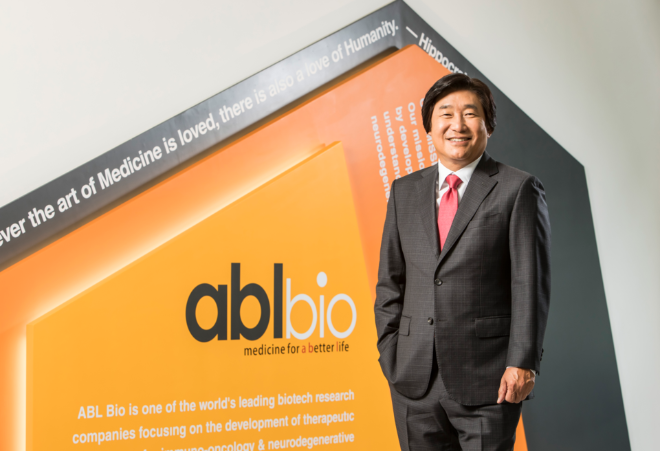
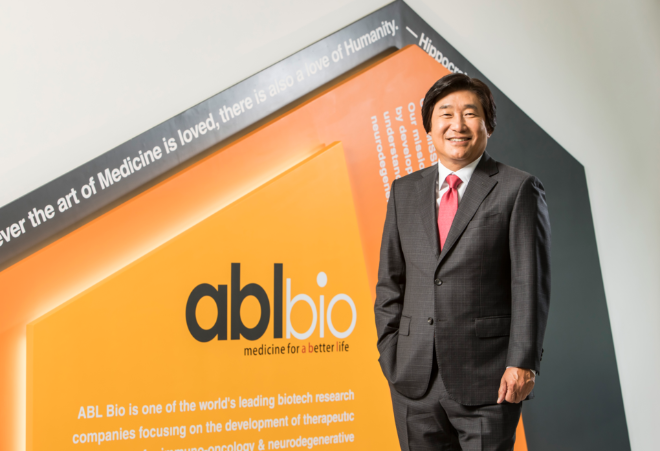
According to industry sources on April 15, ABL Bio signed a licensing agreement on the 7th with UK-based global pharmaceutical giant GlaxoSmithKline (GSK), transferring Grabody-B in a deal worth GBP 2.14 billion (approximately KRW 4.1 trillion). This marks the second-largest licensing-out agreement ever by a Korean biotech firm, following Alteogen’s KRW 4.7 trillion deal with Merck in 2020.
Grabody-B is a platform that enables drug delivery across the blood-brain barrier (BBB). The BBB, which protects the brain by blocking most substances, has long been a major hurdle for therapeutics targeting brain diseases. Grabody-B uses the insulin-like growth factor 1 receptor (IGF1R) to guide drugs effectively across the barrier. GSK will use ABL Bio’s Grabody-B platform exclusively to develop new drug candidates targeting neurodegenerative diseases.
Under the deal, ABL Bio will receive GBP 77.1 million (approximately KRW 148.1 billion) in non-refundable upfront and short-term milestone payments. The upfront payment alone amounts to GBP 38.5 million (KRW 73.9 billion). Additional milestone payments of up to GBP 2.063 billion (KRW 3.9623 trillion) are contingent upon clinical trials, regulatory approval, and commercialization. ABL Bio will also receive royalties based on net sales.
Notably, this is a platform deal, not one involving a specific candidate molecule. Back in 2022, ABL Bio licensed a candidate developed using Grabody-B to Sanofi of France for USD 1.06 billion (approximately KRW 1.272 trillion). Despite platform deals typically being smaller than candidate-specific ones, ABL Bio has now secured a deal larger than its previous one with Sanofi.
This LO is expected to help ABL Bio escape the string of losses it has suffered since 2023. That year, the company posted KRW 63.6 billion in revenue and KRW 2.6 billion in operating loss on a consolidated basis. In 2024, revenue fell to KRW 33.4 billion, with operating losses widening to KRW 59.4 billion.
However, with the upfront and near-term milestone payments from GSK, ABL Bio is expected to quickly cover its losses. As of the end of last year, the upfront payment alone would boost the company’s liquidity by more than KRW 210 billion.
Notably, ABL Bio will bear virtually no R&D expenses under this licensing agreement. GSK will be responsible for all stages from preclinical to clinical development, manufacturing, and commercialization. ABL Bio will transfer the related technology and know-how for Grabody-B.
Intensified Competition, Trump Risk, and Oversupply... Samsung Biologics CEO John Rim Faces Mounting Challenges Amid UncertaintyJohn Rim’s 4 Years That Changed the Bio Landscape: From Latecomer to ‘Samsung’s Savior’Last Year’s Jackpot, Pharma Firms Bet Everything on the Next Blockbuster DrugPharmaceutical DNA in Kolmar Korea and COSMAX... True Commitment to R&DYuhan Corporation Becomes First Korean Pharma to Join the '2 Trillion Won Club'—Will There Be a 'Next Leclaza' This Year?
Going forward, ABL Bio plans to secure additional capital through future licensing deals and reinvest it into its in-house pipeline. The company currently has several candidates under development, including the bile duct cancer treatment “ABL001” and multiple bispecific antibody-drug conjugates (ADCs). Among them, ABL001 is expected to release top-line data by the end of this year and receive second-line treatment approval.
The company’s confidence in securing additional contracts stems from the scalability of Grabody-B. The platform is highly versatile, potentially applicable not only to antibodies but also to gene therapies and other modalities.
For this reason, GSK had initially sought to apply Grabody-B to various modalities, including siRNA (small interfering RNA). However, after negotiations, ABL Bio excluded amyloid beta and tau proteins from the exclusive license scope. This means ABL Bio retains the right to pursue separate deals targeting those proteins with other global pharmaceutical companies. Amyloid beta and tau proteins are known as key targets for Alzheimer’s treatment.
ABL Bio CEO Lee Sang-hoon stated, “The contract with GSK was concluded just three months after meetings at the J.P. Morgan Healthcare Conference earlier this year,” and added, “Regarding amyloid beta and tau, which are major Alzheimer’s targets, the agreement is non-exclusive based on epitopes.”
He also said, “Future deals can be executed even without a material transfer agreement (MTA),” expressing confidence that “additional licensing-out agreements will be signed later this year.”
Kim Nayoung, Korea Finacial Times (steaming@fntimes.com)











![유한양행, 영업익 35%↑ 예고…‘수장 교체기’ 실탄 다진다 [5대 제약사 3Q 실적 ①]](https://cfnimage.commutil.kr/phpwas/restmb_setimgmake.php?pp=006&w=69&h=45&m=5&simg=202610021114080076807fd637f543112168227135.jpg&nmt=18)
![서초구 '래미안원베일리' 44평, 9억 오른 94억원에 거래 [일일 신고가]](https://cfnimage.commutil.kr/phpwas/restmb_setimgmake.php?pp=006&w=69&h=45&m=5&simg=2025053017540607971e41d7fc6c2183101242202.jpg&nmt=18)


![[THE COMPASS] 한화오션, 수주잔고 증가 불구 주가 짓누르는 ‘무배당 기조’](https://cfnimage.commutil.kr/phpwas/restmb_setimgmake.php?pp=006&w=69&h=45&m=5&simg=20261002141710004730a837df649412411124362.jpg&nmt=18)


![[그래픽 뉴스] ‘순대’가 경제용어라고? 순(純)대외자산, 한국의 진짜 해외자산은 얼마일까?](https://cfnimage.commutil.kr/phpwas/restmb_setimgmake.php?pp=006&w=298&h=298&m=1&simg=202609021356075202de68fcbb3512411124362_0.jpg&nmt=18)
![[그래픽 뉴스] ISA 대개편! 나에게 유리한 계좌는?](https://cfnimage.commutil.kr/phpwas/restmb_setimgmake.php?pp=006&w=298&h=298&m=1&simg=202608041713155615de68fcbb3512411124362_0.jpg&nmt=18)
![[그래픽 뉴스] 미국 증시 새로운 키워드 'MANGOS'](https://cfnimage.commutil.kr/phpwas/restmb_setimgmake.php?pp=006&w=298&h=298&m=1&simg=202607291740382069de68fcbb3512411124362_0.jpg&nmt=18)

![[그래픽 뉴스] 은퇴후 30년 부모님 세대의 생존전략](https://cfnimage.commutil.kr/phpwas/restmb_setimgmake.php?pp=006&w=298&h=298&m=1&simg=202606301704439153de68fcbb3512411124362_0.jpg&nmt=18)
![[신간]은퇴연옥…김경록의 은퇴 후 삶의 나침반](https://cfnimage.commutil.kr/phpwas/restmb_setimgmake.php?pp=006&w=81&h=123&m=5&simg=20260414140833047280f8caa4a5ce12411124362.jpg&nmt=18)
![[신간] 물처럼 흐르고 원칙으로 서다…김용환의 통찰을 담다](https://cfnimage.commutil.kr/phpwas/restmb_setimgmake.php?pp=006&w=81&h=123&m=5&simg=20260409114249027860f8caa4a5ce12411124362.jpg&nmt=18)
![[안현정 서평] 플랫폼의 영지에서 ‘미학적 주권’을 선포하라...'K가 죽어야 K가 산다' 장준환 著](https://cfnimage.commutil.kr/phpwas/restmb_setimgmake.php?pp=006&w=81&h=123&m=5&simg=20260527121426063220c1c16452b012411124362.jpg&nmt=18)
![[서평] 추세 매매의 대가들...추세추종 투자전략의 대가 14인 인터뷰](https://cfnimage.commutil.kr/phpwas/restmb_setimgmake.php?pp=006&w=81&h=123&m=5&simg=2023102410444004986c1c16452b0175114235199.jpg&nmt=18)


![[머니무브 2026] “지금 사도 될까?” 답이 안 보인다면…하반기 투자, 4명의 전문가에게 물어보세요](https://cfnimage.commutil.kr/phpwas/restmb_setimgmake.php?pp=006&w=89&h=45&m=1&simg=202609151044050355302a735e27af12411124362.jpg&nmt=18)
![[AD] ‘PBV 라인업 확장’ 기아, 9월 독일서 ‘PV7’ 첫 공개](https://cfnimage.commutil.kr/phpwas/restmb_setimgmake.php?pp=006&w=89&h=45&m=1&simg=2026083111010602815074925877361231180222.jpg&nmt=18)
![[AD] 제네시스, 럭셔리 경험 더한 ‘2027 GV70’‧‘GV70 그래파이트’ 출시](https://cfnimage.commutil.kr/phpwas/restmb_setimgmake.php?pp=006&w=89&h=45&m=1&simg=20260702143546085600749258773622211122717.jpg&nmt=18)