






According to the Ministry of Food and Drug Safety on the 3rd, Onconic Therapeutics’ 'JAQBO' tablet and Vivozon Pharma’s 'Anapraju' were designated as the 37th and 38th domestically developed new drugs last year. This achievement comes two years after Daewoong Pharmaceutical’s Enblo was recognized as a new drug in 2022.
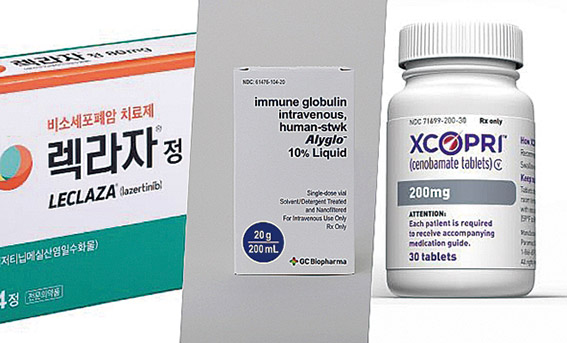
The global market performance was even more remarkable. In August 2024, Yuhan Corporation successfully obtained U.S. Food and Drug Administration (FDA) approval for 'Leclaza,' a treatment for non-small cell lung cancer. The company, which once focused primarily on distributing imported products, has now pivoted towards research and development (R&D), yielding substantial results.
This shift has significantly boosted Yuhan’s financial performance. The company’s annual revenue surpassed KRW 2 trillion last year, making it the first South Korean pharmaceutical firm to enter the 'KRW 2 Trillion Club.' Its revenue increased by 11.2% from KRW 1.859 trillion in 2023 to KRW 2.0678 trillion in 2024.
GC Biopharma also saw a major breakthrough. In December 2023, it secured FDA approval for 'Alyglo,' a treatment for immunodeficiency disorders, after three attempts since 2015. Since August last year, the company has been directly selling Alyglo through its U.S. subsidiary, GC Biopharma USA.
'Alyglo' contributed to the company’s expansion, generating KRW 48 billion in revenue in the fourth quarter alone. GC Biopharma’s total consolidated revenue in 2024 reached KRW 1.6799 trillion, a 3.3% increase from the previous year. The company expects Alyglo to generate annual sales of USD 300 million (approximately KRW 410 billion) by 2028.
SK Biopharm has also been making strides in the global market. Since obtaining FDA approval in 2019, the company has been directly selling its epilepsy new drug cenobamate under the brand name 'Xcopri' in the U.S. The drug, developed entirely in-house over a decade, has seen substantial growth in market presence.
In 2024, cenobamate’s prescription numbers in the U.S. surged. Monthly prescriptions rose from 26,283 in January to 35,516 in December, reflecting a 35.1% increase. Revenue also climbed sharply, from KRW 90.9 billion in Q1 to KRW 129.3 billion in Q4, marking a 42.2% jump. Since Q2 2024, Xcopri’s revenue has exceeded SK Biopharm’s total selling, general, and administrative (SG&A) expenses, driving overall profitability.
Pharmaceutical DNA in Kolmar Korea and COSMAX... True Commitment to R&DYuhan Corporation Becomes First Korean Pharma to Join the '2 Trillion Won Club'—Will There Be a 'Next Leclaza' This Year?Samsung Biologics Replaces CFO and R&D Head... Will It Find New Momentum This Year?K-PharmaBio’s First 'KRW 4 Trillion Club' Member – Samsung Biologics Eyes KRW 5 Trillion with Unmatched Excellence in Capacity'COVID-19 bad times over' Youngjin Pharmaceuticals' operating profit soars 180% last year...'What's the secret to its rapid growth?
The Challenge of Developing the Next Pipeline
The challenge now is securing the next successful drug. Patent protection for new drugs typically lasts about a decade. Once patents expire, generic competition emerges, making sustained revenue growth difficult. This underscores the importance of preparing successor drugs well in advance, as the entire process—from discovering candidate substances to clinical trials and regulatory approvals—takes an average of 10 to 15 years.To address this, Yuhan Corporation is following the same strategy that led to Leclaza’s success. It is leveraging open innovation by licensing promising candidate substances from biotech firms, conducting early-stage clinical trials, and subsequently out-licensing them to global pharmaceutical giants. Leclaza itself was developed using a candidate substance sourced from Oscotec and later licensed to Johnson & Johnson’s Janssen division.
The company is currently exploring various candidate substances, with the most promising being YH35324, an allergy treatment. YH35324, which Yuhan acquired from GI Innovation, is undergoing early clinical trials. It has demonstrated superior therapeutic efficacy compared to existing allergy treatments, attracting interest from multiple multinational pharmaceutical firms for potential technology transfer agreements.
GC Biopharma is also accelerating efforts to develop the next Alyglo. The company is adopting a strategy of collaborating with pharmaceutical firms that possess strong R&D capabilities.
One prominent example is its partnership with Hanmi Pharmaceutical to develop 'LA-GLA (GC1134A),' an innovative treatment for Fabry disease. LA-GLA has been recognized for its efficacy and convenience, making it a closely watched product by regulatory agencies worldwide. The FDA approved its Phase 1/2 clinical trials in August 2024, and South Korea’s Ministry of Food and Drug Safety granted approval for local trials in January this year.
SK Biopharm, on the other hand, is utilizing artificial intelligence (AI) technology in its search for the next breakthrough drug. The company is leveraging its AI-based drug research and development platform, 'Hubble Plus,' to identify potential successors to cenobamate.
Hubble Plus is designed to enhance efficiency in various areas of new drug R&D, including radiopharmaceuticals (RPT) and targeted protein degradation (TPD). In June 2024, SK Biopharm recruited AI drug development expert Dr. Shin Bong-keun to further refine its AI-driven approach.
Lee Dong-hoon, CEO of SK Biopharm, stated, "We have been contemplating the use of AI technology for a much longer period than is publicly known. By leveraging Dr. Shin’s expertise and experience, we aim to enhance SK Biopharm’s existing AI-driven drug development platform and accelerate our digital healthcare initiatives.”
Kim Nayoung, Korea Finacial Times (steaming@fntimes.com)











![기관 '주성엔지니어링'·외인 '알테오젠'·개인 '알테오젠' 1위 [주간 코스닥 순매수- 2026년 9월7일~9월11일]](https://cfnimage.commutil.kr/phpwas/restmb_setimgmake.php?pp=006&w=69&h=45&m=5&simg=20260912015140019820179ad4390711823512161.jpg&nmt=18)
![12개월 최고 연 7.00%…카카오뱅크 '우리아이적금' [이주의 은행 적금금리-9월 3주]](https://cfnimage.commutil.kr/phpwas/restmb_setimgmake.php?pp=006&w=69&h=45&m=5&simg=202609111245270848705e6e69892f222110224112.jpg&nmt=18)

![12개월 최고 연 3.85%…경남은행 'The든든예금(시즌2)' [이주의 은행 예금금리-9월 3주]](https://cfnimage.commutil.kr/phpwas/restmb_setimgmake.php?pp=006&w=69&h=45&m=5&simg=202609111227290077405e6e69892f222110224112.jpg&nmt=18)
![12개월 최고 연 4.02%…참저축은행 e-회전정기예금[이주의 저축은행 예금금리-9월 2주]](https://cfnimage.commutil.kr/phpwas/restmb_setimgmake.php?pp=006&w=69&h=45&m=5&simg=202609130113300929407c96e797801121481643.jpg&nmt=18)


![[그래픽 뉴스] ‘순대’가 경제용어라고? 순(純)대외자산, 한국의 진짜 해외자산은 얼마일까?](https://cfnimage.commutil.kr/phpwas/restmb_setimgmake.php?pp=006&w=298&h=298&m=1&simg=202609021356075202de68fcbb3512411124362_0.jpg&nmt=18)
![[그래픽 뉴스] ISA 대개편! 나에게 유리한 계좌는?](https://cfnimage.commutil.kr/phpwas/restmb_setimgmake.php?pp=006&w=298&h=298&m=1&simg=202608041713155615de68fcbb3512411124362_0.jpg&nmt=18)
![[그래픽 뉴스] 미국 증시 새로운 키워드 'MANGOS'](https://cfnimage.commutil.kr/phpwas/restmb_setimgmake.php?pp=006&w=298&h=298&m=1&simg=202607291740382069de68fcbb3512411124362_0.jpg&nmt=18)

![[그래픽 뉴스] 은퇴후 30년 부모님 세대의 생존전략](https://cfnimage.commutil.kr/phpwas/restmb_setimgmake.php?pp=006&w=298&h=298&m=1&simg=202606301704439153de68fcbb3512411124362_0.jpg&nmt=18)
![[신간]은퇴연옥…김경록의 은퇴 후 삶의 나침반](https://cfnimage.commutil.kr/phpwas/restmb_setimgmake.php?pp=006&w=81&h=123&m=5&simg=20260414140833047280f8caa4a5ce12411124362.jpg&nmt=18)
![[신간] 물처럼 흐르고 원칙으로 서다…김용환의 통찰을 담다](https://cfnimage.commutil.kr/phpwas/restmb_setimgmake.php?pp=006&w=81&h=123&m=5&simg=20260409114249027860f8caa4a5ce12411124362.jpg&nmt=18)
![[안현정 서평] 플랫폼의 영지에서 ‘미학적 주권’을 선포하라...'K가 죽어야 K가 산다' 장준환 著](https://cfnimage.commutil.kr/phpwas/restmb_setimgmake.php?pp=006&w=81&h=123&m=5&simg=20260527121426063220c1c16452b012411124362.jpg&nmt=18)
![[서평] 추세 매매의 대가들...추세추종 투자전략의 대가 14인 인터뷰](https://cfnimage.commutil.kr/phpwas/restmb_setimgmake.php?pp=006&w=81&h=123&m=5&simg=2023102410444004986c1c16452b0175114235199.jpg&nmt=18)


![[AD] ‘PBV 라인업 확장’ 기아, 9월 독일서 ‘PV7’ 첫 공개](https://cfnimage.commutil.kr/phpwas/restmb_setimgmake.php?pp=006&w=89&h=45&m=1&simg=2026083111010602815074925877361231180222.jpg&nmt=18)
![[AD] 제네시스, 럭셔리 경험 더한 ‘2027 GV70’‧‘GV70 그래파이트’ 출시](https://cfnimage.commutil.kr/phpwas/restmb_setimgmake.php?pp=006&w=89&h=45&m=1&simg=20260702143546085600749258773622211122717.jpg&nmt=18)
![[AD] 개소세 혜택 종료…현대차, ‘썸머 페스타’로 고객 부담 완화](https://cfnimage.commutil.kr/phpwas/restmb_setimgmake.php?pp=006&w=89&h=45&m=1&simg=20260702142355004830749258773622211122717.jpg&nmt=18)
![[AD] 기아 ‘디 올 뉴 셀토스’, 인도 타임스 드라이브 어워즈서 ‘올해의 SUV’ 선정](https://cfnimage.commutil.kr/phpwas/restmb_setimgmake.php?pp=006&w=89&h=45&m=1&simg=202605071156400590007492587736124111243152.jpg&nmt=18)
![[AD]‘그랜저 잡자’ 기아, 상품성 더한 ‘The 2027 K8’ 출시](https://cfnimage.commutil.kr/phpwas/restmb_setimgmake.php?pp=006&w=89&h=45&m=1&simg=2026042110193702730074925877361211627527.jpg&nmt=18)