




Still, one cannot invest in both companies simultaneously — and if a strategic choice must be made, which one should investors pick? The instinctive answer from many is LG Energy Solution — after all, isn't it South Korea's top battery maker?
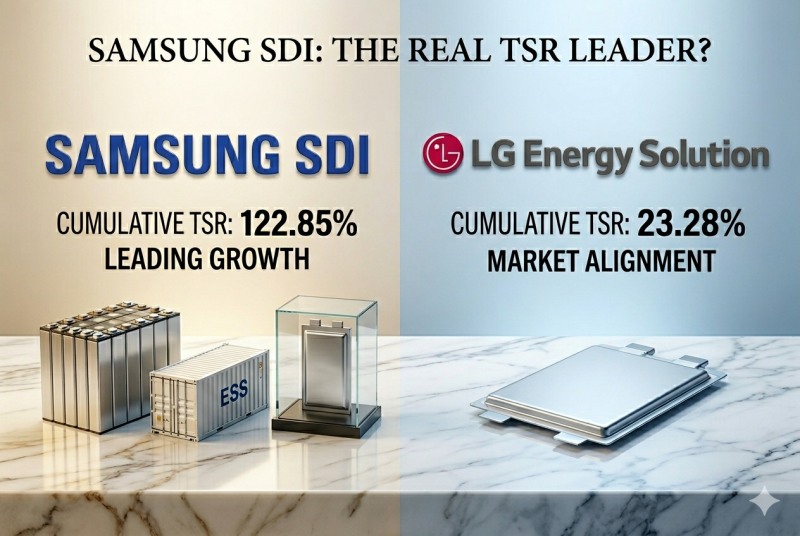
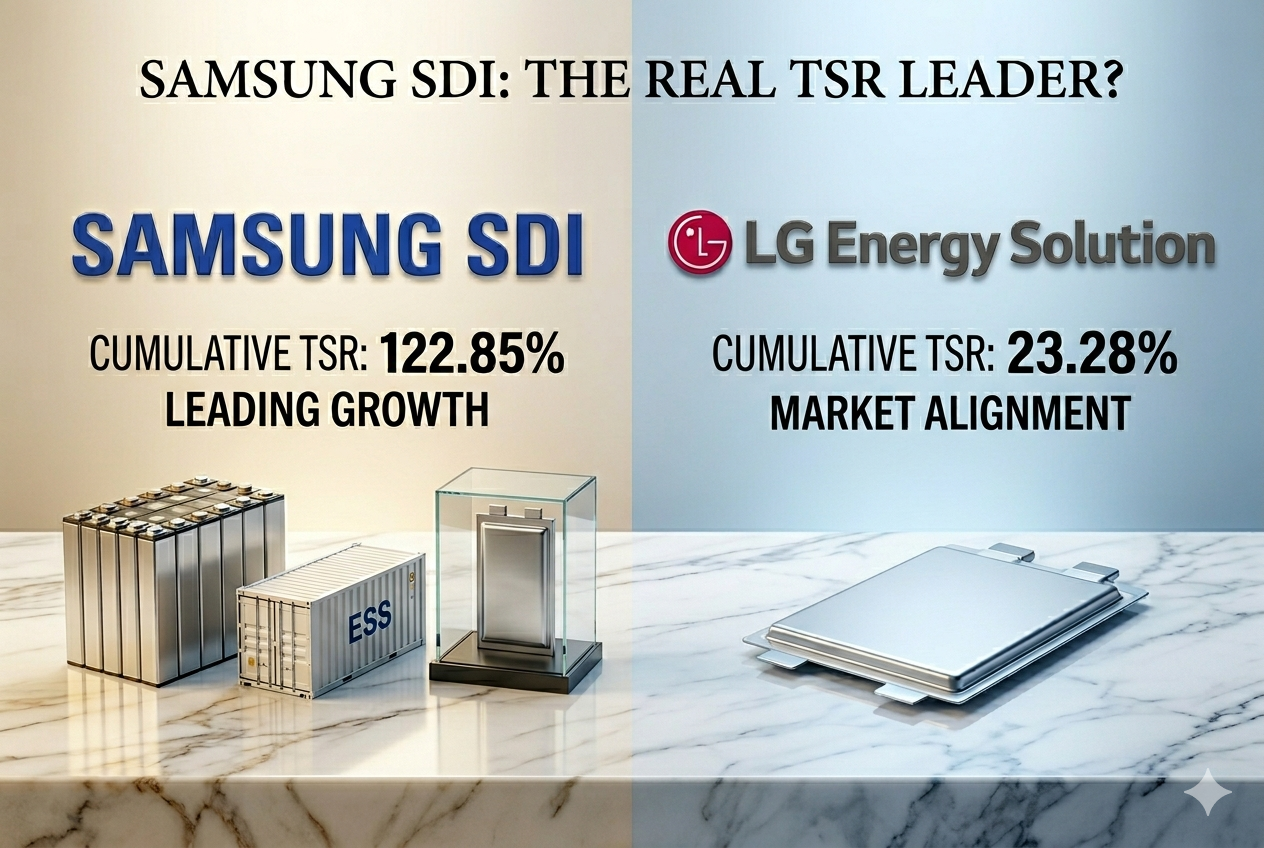
But the reality is a bit different. Shareholder returns at Samsung SDI have been running roughly six times higher than those at LG Energy Solution.
The gap between the two companies widened primarily through differences in share price performance. Analysts attribute this divergence to differing levels of market anticipation regarding ESS (Energy Storage Systems) and the commercialization of all-solid-state batteries — two factors that have been driving the recent rally in battery stocks — as well as contrasting market narratives surrounding each company.
'Revaluation' vs. 'Expectation Reset'
Korea Financial Times calculated the cumulative Total Shareholder Return (TSR) for both Samsung SDI and LG Energy Solution using a corporate data platform. TSR is a metric that reflects the total return an investor can earn from holding a company's stock over a given period — calculated by adding the share price change rate and dividend yield, then dividing by market capitalization.The measurement period runs from the first trading day of 2025 (January 2) through April 20 of this year, spanning approximately one year and four months.
The results showed cumulative TSR of 122.85% for Samsung SDI and 23.28% for LG Energy Solution. In other words, an investor who put KRW 10 million into each company would now hold approximately KRW 22.29 million from Samsung SDI, versus approximately KRW 12.33 million from LG Energy Solution — a sixfold difference in return. This is an unusual divergence, given that both companies are flagship stocks within the same battery sector.
In general, the capital-intensive nature of the battery industry means dividend contributions to TSR tend to be modest. Indeed, LG Energy Solution has never paid a cash dividend since its listing, while Samsung SDI's dividend yield stands at only 0.83%.
Ultimately, the decisive factor determining each company's returns was share price performance. Battery stocks broadly have been rising this year on expectations of an EV demand recovery tied to sharp gains in oil prices, as well as growing optimism around expanding ESS businesses. The question, then, is what caused the two companies' stock price gains to diverge so markedly.
To understand this, it is necessary to examine how the market has been viewing each company. Samsung SDI's share price traded around KRW 700,000 in 2023, but suffered a significant correction in 2024 due to the EV demand slowdown and a rights offering. Following the rights offering in March last year in particular, the stock slid to around KRW 100,000, cementing a perception in the market that it had become deeply oversold.
LG Energy Solution, by contrast, experienced a less severe decline than Samsung SDI over the same EV slowdown period, as its share price retained a premium reflecting optimism around expanded North American investment and anticipated benefits from the Inflation Reduction Act (IRA). However, concerns this year over its heavy subsidy-dependent earnings structure and inventory adjustment issues at EV customers in the United States and Europe have limited near-term upside momentum.
This dynamic was reflected in LG Energy Solution's first-quarter results. According to preliminary earnings disclosed on April 8, the company posted revenue of KRW 6.5550 trillion and an operating loss of KRW 207.8 billion for the first quarter of this year. Revenue exceeded the market consensus estimate of KRW 5.8624 trillion, but the operating loss was wider than the expected KRW 121.0 billion. The Advanced Manufacturing Production Credit (AMPC) tax credit came in at KRW 189.7 billion, a decline of approximately 43% from the prior quarter.
One investment banking industry source offered this assessment: "If LG Energy Solution was seen in the market as 'a growth stock with catalysts already priced in,' Samsung SDI was 'a stock awaiting revaluation.' That distinction became the starting point for the gap in share price performance."
Samsung SDI's New Momentum Strengths
The divergence in share price performance between Samsung SDI and LG Energy Solution has been particularly pronounced this year. Samsung SDI's share price surged approximately 100% from the first trading day of the year through April 20, while LG Energy Solution gained only around 16% over the same period.Industry observers interpret this as carrying significance beyond a simple return gap. Stock prices tend to front-run changes in expectations rather than reported results, and companies perceived as "improving" command larger premiums than those already viewed as "excellent."
This suggests that Samsung SDI is receiving stronger marks in ESS order potential and its solid-state battery commercialization roadmap — two key momentum drivers for battery stocks of late.
Starting with ESS: given the structural need to stack large numbers of battery cells, ESS applications rely on prismatic battery formats — precisely the area where Samsung SDI has a competitive edge. Among Korea's three major battery manufacturers, Samsung SDI holds the largest portfolio of prismatic battery-related patents.
In addition, the company has been proactive in converting its production lines toward ESS ahead of competitors in the United States, the world's largest ESS market. At present, Samsung SDI is the only non-Chinese supplier of prismatic batteries for ESS applications in North America.
Samsung SDI plans to leverage its advantages in prismatic batteries — including durability superiority over pouch-type cells, fire safety technology, and proven reliability — to capture growing ESS demand from U.S. energy companies.
Samsung SDI is also regarded as the most advanced of its peers in all-solid-state battery commercialization, a technology that has come back into the spotlight with the full-scale emergence of humanoid robots this year. Solid-state batteries — which replace conventional liquid electrolytes with solid electrolytes to maximize safety and performance — are often called the "dream battery."
Their applications extend well beyond EVs to future mobility sectors such as humanoid robots and Urban Air Mobility (UAM), making early market leadership particularly valuable.
Samsung SDI has been building a solid-state pilot production line since 2023 and has been conducting sample testing with customer companies. Its target date for full-scale solid-state battery production is the second half of 2027 — the earliest among South Korea's battery manufacturers. Rivals LG Energy Solution and SK On have both set 2029 as their mass production targets.
Beyond that, Samsung SDI secured an EV customer win on April 20, signing a multi-year contract with Mercedes-Benz for the supply of next-generation EV batteries — the first time Samsung SDI will supply batteries to Mercedes-Benz. Going forward, the two companies plan to deepen their collaboration, including discussions on solid-state battery development and supply.
Lee Jin-myung, an analyst at Shinhan Investment & Securities, said of Samsung SDI: "Its proactive response to the U.S. ESS market — including preemptive line conversions from EV batteries to ESS — makes additional order wins highly likely." He added that solid-state batteries, with mass production targeted for the second half of 2027, are expected to serve as an additional upside catalyst.
Kim JaeHun (rlqm93@fntimes.com)








![[기자수첩] 보험사 품는 사모펀드, 대주주 심사 재고해야](https://cfnimage.commutil.kr/phpwas/restmb_setimgmake.php?pp=006&w=69&h=45&m=5&simg=20260913173909069220ed56b8e1f814379898.jpg&nmt=18)
![[Z-스코어 기업가치 바로 보기] 차입이냐 자기자본이냐…LG엔솔 vs 삼성SDI ‘명암ʼ](https://cfnimage.commutil.kr/phpwas/restmb_setimgmake.php?pp=006&w=69&h=45&m=5&simg=20260912004753014480dd55077bc212411124362.jpg&nmt=18)


![[그래픽 뉴스] ‘순대’가 경제용어라고? 순(純)대외자산, 한국의 진짜 해외자산은 얼마일까?](https://cfnimage.commutil.kr/phpwas/restmb_setimgmake.php?pp=006&w=298&h=298&m=1&simg=202609021356075202de68fcbb3512411124362_0.jpg&nmt=18)
![[그래픽 뉴스] ISA 대개편! 나에게 유리한 계좌는?](https://cfnimage.commutil.kr/phpwas/restmb_setimgmake.php?pp=006&w=298&h=298&m=1&simg=202608041713155615de68fcbb3512411124362_0.jpg&nmt=18)
![[그래픽 뉴스] 미국 증시 새로운 키워드 'MANGOS'](https://cfnimage.commutil.kr/phpwas/restmb_setimgmake.php?pp=006&w=298&h=298&m=1&simg=202607291740382069de68fcbb3512411124362_0.jpg&nmt=18)
![[그래픽 뉴스] 은퇴후 30년 부모님 세대의 생존전략](https://cfnimage.commutil.kr/phpwas/restmb_setimgmake.php?pp=006&w=298&h=298&m=1&simg=202606301704439153de68fcbb3512411124362_0.jpg&nmt=18)
![[신간]은퇴연옥…김경록의 은퇴 후 삶의 나침반](https://cfnimage.commutil.kr/phpwas/restmb_setimgmake.php?pp=006&w=81&h=123&m=5&simg=20260414140833047280f8caa4a5ce12411124362.jpg&nmt=18)
![[신간] 물처럼 흐르고 원칙으로 서다…김용환의 통찰을 담다](https://cfnimage.commutil.kr/phpwas/restmb_setimgmake.php?pp=006&w=81&h=123&m=5&simg=20260409114249027860f8caa4a5ce12411124362.jpg&nmt=18)
![[안현정 서평] 플랫폼의 영지에서 ‘미학적 주권’을 선포하라...'K가 죽어야 K가 산다' 장준환 著](https://cfnimage.commutil.kr/phpwas/restmb_setimgmake.php?pp=006&w=81&h=123&m=5&simg=20260527121426063220c1c16452b012411124362.jpg&nmt=18)
![[서평] 추세 매매의 대가들...추세추종 투자전략의 대가 14인 인터뷰](https://cfnimage.commutil.kr/phpwas/restmb_setimgmake.php?pp=006&w=81&h=123&m=5&simg=2023102410444004986c1c16452b0175114235199.jpg&nmt=18)


![[머니무브 2026] “지금 사도 될까?” 답이 안 보인다면…하반기 투자, 4명의 전문가에게 물어보세요](https://cfnimage.commutil.kr/phpwas/restmb_setimgmake.php?pp=006&w=89&h=45&m=1&simg=202609151044050355302a735e27af12411124362.jpg&nmt=18)
![[AD] ‘PBV 라인업 확장’ 기아, 9월 독일서 ‘PV7’ 첫 공개](https://cfnimage.commutil.kr/phpwas/restmb_setimgmake.php?pp=006&w=89&h=45&m=1&simg=2026083111010602815074925877361231180222.jpg&nmt=18)
![[AD] 제네시스, 럭셔리 경험 더한 ‘2027 GV70’‧‘GV70 그래파이트’ 출시](https://cfnimage.commutil.kr/phpwas/restmb_setimgmake.php?pp=006&w=89&h=45&m=1&simg=20260702143546085600749258773622211122717.jpg&nmt=18)
![[AD] 개소세 혜택 종료…현대차, ‘썸머 페스타’로 고객 부담 완화](https://cfnimage.commutil.kr/phpwas/restmb_setimgmake.php?pp=006&w=89&h=45&m=1&simg=20260702142355004830749258773622211122717.jpg&nmt=18)
![[AD] 기아 ‘디 올 뉴 셀토스’, 인도 타임스 드라이브 어워즈서 ‘올해의 SUV’ 선정](https://cfnimage.commutil.kr/phpwas/restmb_setimgmake.php?pp=006&w=89&h=45&m=1&simg=202605071156400590007492587736124111243152.jpg&nmt=18)