






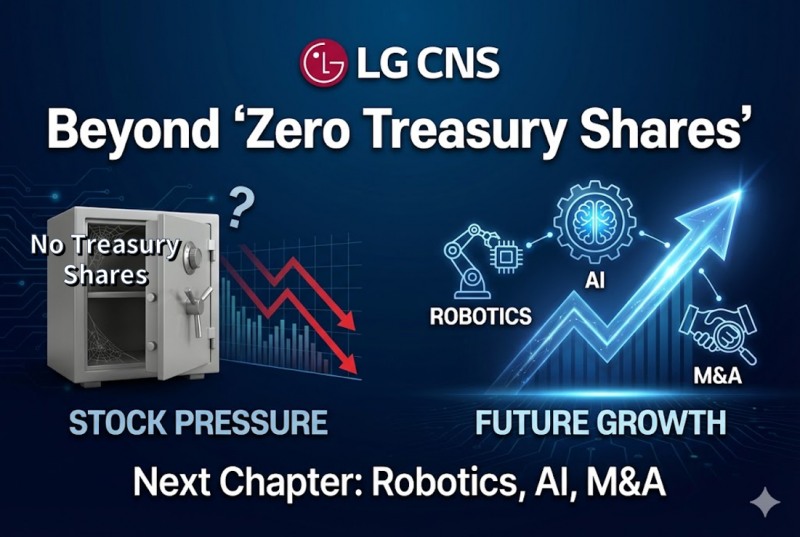
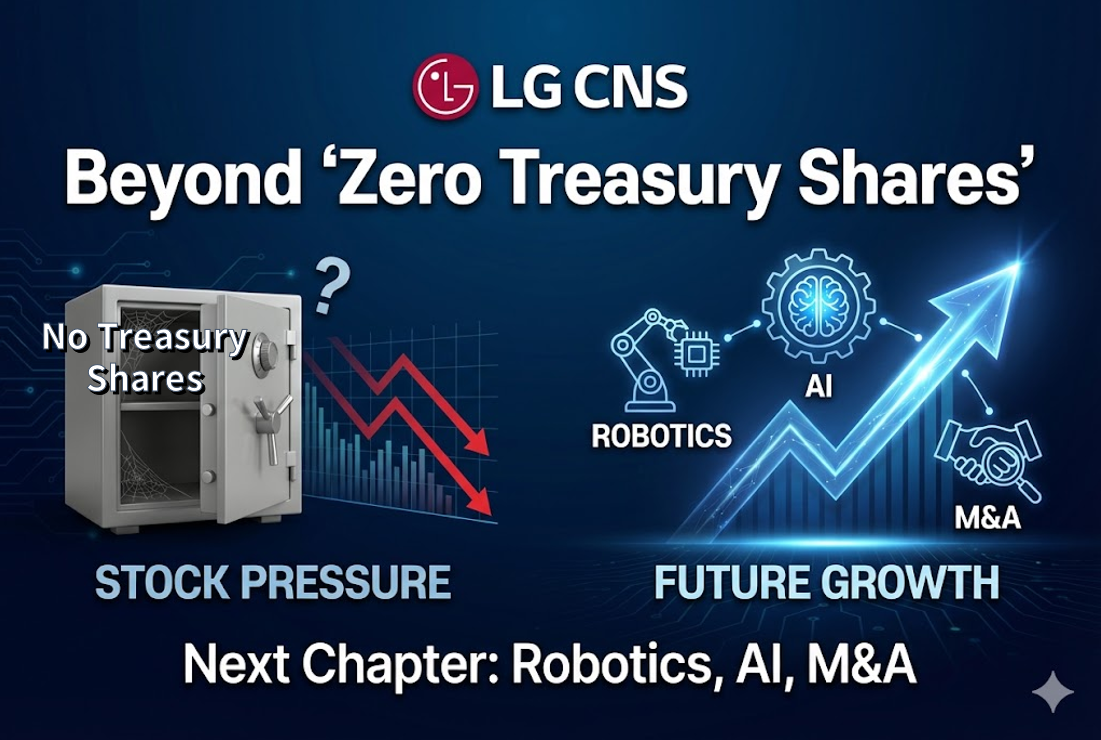
The Market LG CNS Faces With Zero Treasury Shares: A Paradox
According to LG CNS, as of end of last year, the company holds zero treasury shares out of a total of 96,885,948 shares in circulation.As a result, LG CNS is free from the mandatory cancellation requirements under the third round of proposed Commercial Act amendments. Under the proposed revision, newly acquired treasury shares must be cancelled or disposed of within one year of acquisition, while shares already held must be cancelled or disposed of within 18 months of the effective date.
While this may appear to position LG CNS favorably from a regulatory standpoint, the market's reading is somewhat different.
Treasury shares are not simply an accounting item — they function as the fastest shareholder return tool management can deploy when a stock comes under pressure. With no existing holdings, LG CNS would have to purchase treasury shares from scratch to defend its share price, inevitably requiring a cash outlay.
CEO Hyun Shin-kyun's personal open-market purchase of 2,500 shares (KRW 150 million) on the 3rd of this month has been interpreted as a signal of responsible management, but it does nothing to address the structural limitation of zero corporate-level treasury shares. Moreover, the purchase represents just 0.0026% of the total 96.88 million shares outstanding, making any meaningful price support effect negligible.
In short, being free from cancellation obligations does not translate directly into greater capacity to boost the stock price. If anything, the market interprets the situation as a shortage of immediate tools to underpin the share price.
Netmarble: Undervalued on Assets, Overvalued on Earnings — or Is It?SK Hynix Weighs Growth Over Governance in Treasury Share Strategy [Treasury Share Report]Celltrion's Share Cancellation Undercut by New Issuance Plan [Treasury Share Report]Kumho Petrochemical's Treasury Shares Face Governance Test After 20 Years [Treasury Share Report]Samsung Eyes Record KRW 90 Trillion Shareholder Payout as Chip Supercycle Ignites Earnings [Treasury Stock Report]
The fact that LG CNS is structurally unable to deploy such tools represents a clear vulnerability in the eyes of investors.
Strong Earnings, but Stock Price Cut in Half
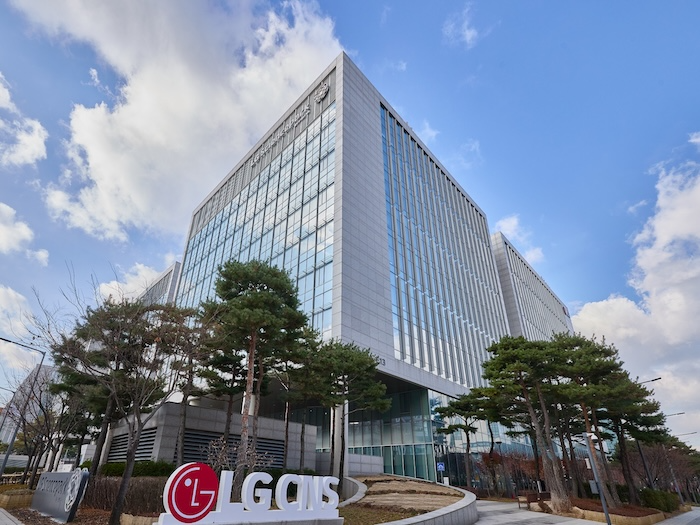
The company's fundamentals are solid. LG CNS has maintained a consistent growth trajectory since CEO Hyun Shin-kyun took office in March 2023.
In particular, the company posted record-high results last year on a consolidated basis, with revenue of KRW 6.1295 trillion and operating profit of KRW 555.8 billion — increases of 2.5% and 8.4%, respectively, from the prior year. Expanding demand for cloud migration and growth in industrial AI-based system integration (SI) business have jointly contributed to continued improvements in operating margin. LG CNS's operating margin surpassed 9% last year, up 0.5 percentage points from the prior year.
The year-end dividend was reduced somewhat — from KRW 1,672 per share (totaling KRW 145.8 billion) for fiscal year 2024 to KRW 1,100 per share (totaling KRW 106.5 billion) for fiscal year 2025 — but the company continues to maintain a stable dividend yield of 1.6%.
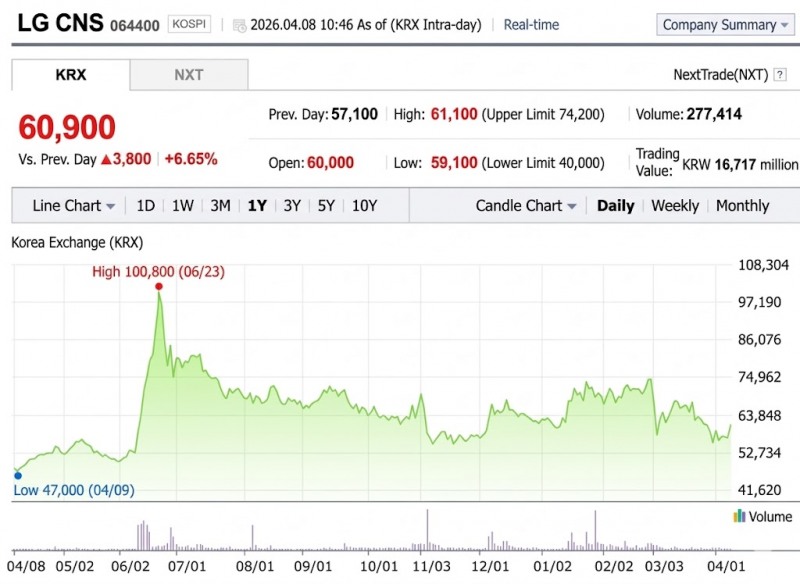
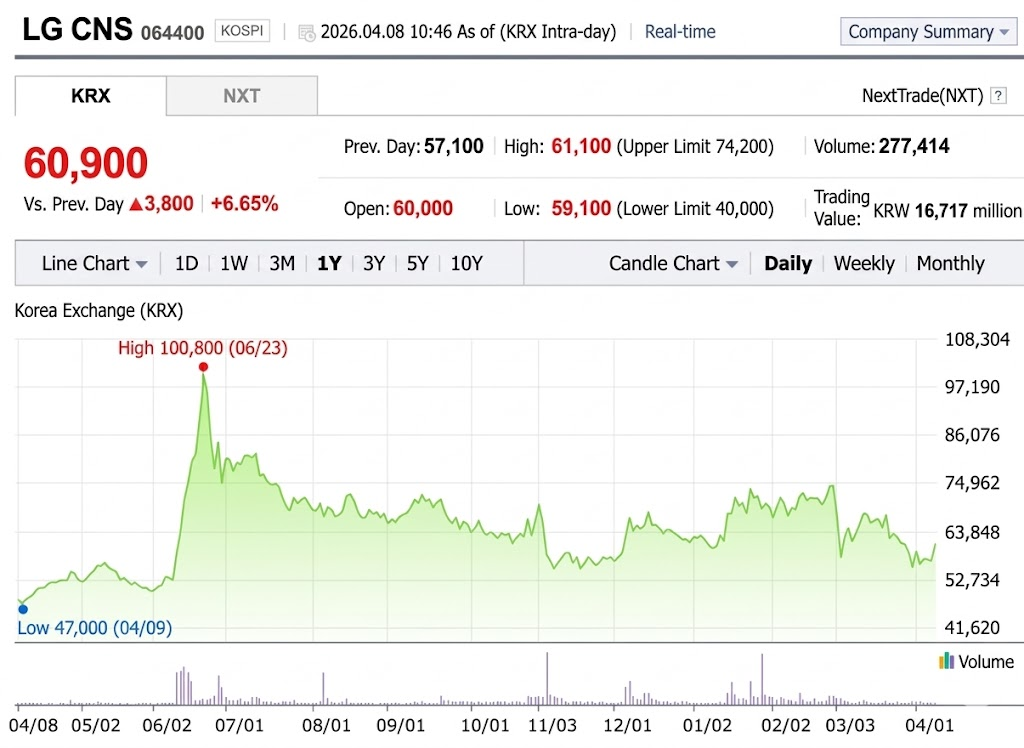
The problem is a structural disconnect between earnings and stock performance. After reaching an intraday high of KRW 100,800 in late June last year, the share price has since fallen to the low KRW 60,000s — below the IPO price of KRW 61,900 at the time of its KOSPI listing in February last year.
This disconnect stems in part from the structural absence of treasury shares. When a stock comes under pressure, companies typically deploy buybacks and cancellations to restore market confidence and stabilize the price. LG CNS, however, holds no existing shares and is therefore unable to respond in this manner immediately. For investors, the takeaway is that — beyond dividends — there are few visible shareholder return mechanisms available.
Responding With Value Creation Through M&A and Physical AI
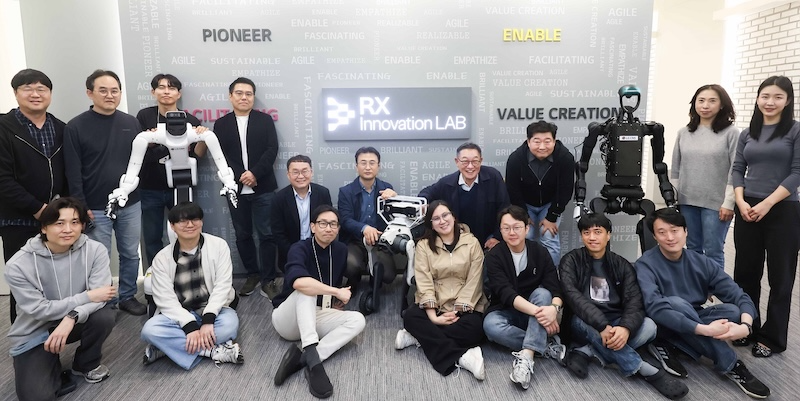
Employees pose for a commemorative photo at the launch ceremony of the LG CNS RX Innovation Lab. Pictured in the back row: Hyun Shin-kyun, CEO of LG CNS (4th from right); Lee Jun-ho, EVP and Head of Smart Logistics & City Division (5th from left); Park Sang-yeop, CTO and Senior Vice President (3rd from right); Myeong Chang-guk, Senior Vice President in charge of Smart Logistics Center/Robotics (4th from left)./ Photo = LG CNS
이미지 확대보기
For the time being, LG CNS plans to focus on business expansion rather than treasury shares.
At the annual general shareholders' meeting on March 24, CEO Hyun Shin-kyun stated that the company is "continuously reviewing M&A targets in the areas of smart engineering, smart factory, smart finance, and AI."
The company is also placing considerable emphasis on robotics and physical AI as future growth drivers. LG CNS recently launched the "RX (Robot Transformation) Innovation Lab," a client-tailored robotics consulting unit.
The company is also already collaborating with U.S.-based firms Skilled AI and Contiq to advance its industry-specific robotics foundation model (RFM). This year, LG CNS made a strategic investment in U.S. humanoid robotics company Dexterous, as it moves to secure hardware design capabilities.
CEO Hyun Shin-kyun said, "We are currently conducting proof-of-concept (PoC) tests at industrial sites for robotics applications," adding that "we are also reviewing M&A opportunities across a range of fields, including this area."
Encouragingly, the market has already begun to express optimism about LG CNS's earnings outlook for this year. The company's introduction of the RX strategy as a new growth driver was also met with positive reception. On January 13 — the day CEO Hyun Shin-kyun's strategy was disclosed — LG CNS shares rose 3.97% from the previous session to close at KRW 62,800.
An industry official noted, "While the absence of treasury shares makes short-term price defense difficult, LG CNS's industrial data assets and its position within the LG Group AI ecosystem could become an unmatched competitive advantage in the physical AI market." The official added, "If CEO Hyun Shin-kyun's tenure delivers visible results from the RX full-stack service strategy, a more active discussion of the stock's undervaluation relative to its earnings could well take center stage."
Jeong Chaeyun (chaeyun@fntimes.com)











![이성훈 LH 사장 다주택·대출 규제 발언 도마…여야 의원 잇단 지적 [2026 국감]](https://cfnimage.commutil.kr/phpwas/restmb_setimgmake.php?pp=006&w=69&h=45&m=5&simg=20261012163012026870048b718333218159227151.jpg&nmt=18)

![12개월 최고 연 6.00%…BNK저축은행 'BNK동행적금'[이주의 저축은행 적금금리-10월 2주]](https://cfnimage.commutil.kr/phpwas/restmb_setimgmake.php?pp=006&w=69&h=45&m=5&simg=202610110103170668607c96e797801121481643.jpg&nmt=18)

![12개월 최고 연 4.10%…OK저축은행 'OK e-안심앱플러스정기예금6'[이주의 저축은행 예금금리-10월 2주]](https://cfnimage.commutil.kr/phpwas/restmb_setimgmake.php?pp=006&w=69&h=45&m=5&simg=202610110051040059207c96e797801121481643.jpg&nmt=18)


![[그래픽 뉴스] ‘순대’가 경제용어라고? 순(純)대외자산, 한국의 진짜 해외자산은 얼마일까?](https://cfnimage.commutil.kr/phpwas/restmb_setimgmake.php?pp=006&w=298&h=298&m=1&simg=202609021356075202de68fcbb3512411124362_0.jpg&nmt=18)
![[그래픽 뉴스] ISA 대개편! 나에게 유리한 계좌는?](https://cfnimage.commutil.kr/phpwas/restmb_setimgmake.php?pp=006&w=298&h=298&m=1&simg=202608041713155615de68fcbb3512411124362_0.jpg&nmt=18)
![[그래픽 뉴스] 미국 증시 새로운 키워드 'MANGOS'](https://cfnimage.commutil.kr/phpwas/restmb_setimgmake.php?pp=006&w=298&h=298&m=1&simg=202607291740382069de68fcbb3512411124362_0.jpg&nmt=18)

![[그래픽 뉴스] 은퇴후 30년 부모님 세대의 생존전략](https://cfnimage.commutil.kr/phpwas/restmb_setimgmake.php?pp=006&w=298&h=298&m=1&simg=202606301704439153de68fcbb3512411124362_0.jpg&nmt=18)
![[신간]은퇴연옥…김경록의 은퇴 후 삶의 나침반](https://cfnimage.commutil.kr/phpwas/restmb_setimgmake.php?pp=006&w=81&h=123&m=5&simg=20260414140833047280f8caa4a5ce12411124362.jpg&nmt=18)
![[신간] 물처럼 흐르고 원칙으로 서다…김용환의 통찰을 담다](https://cfnimage.commutil.kr/phpwas/restmb_setimgmake.php?pp=006&w=81&h=123&m=5&simg=20260409114249027860f8caa4a5ce12411124362.jpg&nmt=18)
![[안현정 서평] 플랫폼의 영지에서 ‘미학적 주권’을 선포하라...'K가 죽어야 K가 산다' 장준환 著](https://cfnimage.commutil.kr/phpwas/restmb_setimgmake.php?pp=006&w=81&h=123&m=5&simg=20260527121426063220c1c16452b012411124362.jpg&nmt=18)
![[서평] 추세 매매의 대가들...추세추종 투자전략의 대가 14인 인터뷰](https://cfnimage.commutil.kr/phpwas/restmb_setimgmake.php?pp=006&w=81&h=123&m=5&simg=2023102410444004986c1c16452b0175114235199.jpg&nmt=18)


![[머니무브 2026] “지금 사도 될까?” 답이 안 보인다면…하반기 투자, 4명의 전문가에게 물어보세요](https://cfnimage.commutil.kr/phpwas/restmb_setimgmake.php?pp=006&w=89&h=45&m=1&simg=202609151044050355302a735e27af12411124362.jpg&nmt=18)
![[AD] ‘PBV 라인업 확장’ 기아, 9월 독일서 ‘PV7’ 첫 공개](https://cfnimage.commutil.kr/phpwas/restmb_setimgmake.php?pp=006&w=89&h=45&m=1&simg=2026083111010602815074925877361231180222.jpg&nmt=18)
![[AD] 제네시스, 럭셔리 경험 더한 ‘2027 GV70’‧‘GV70 그래파이트’ 출시](https://cfnimage.commutil.kr/phpwas/restmb_setimgmake.php?pp=006&w=89&h=45&m=1&simg=20260702143546085600749258773622211122717.jpg&nmt=18)