






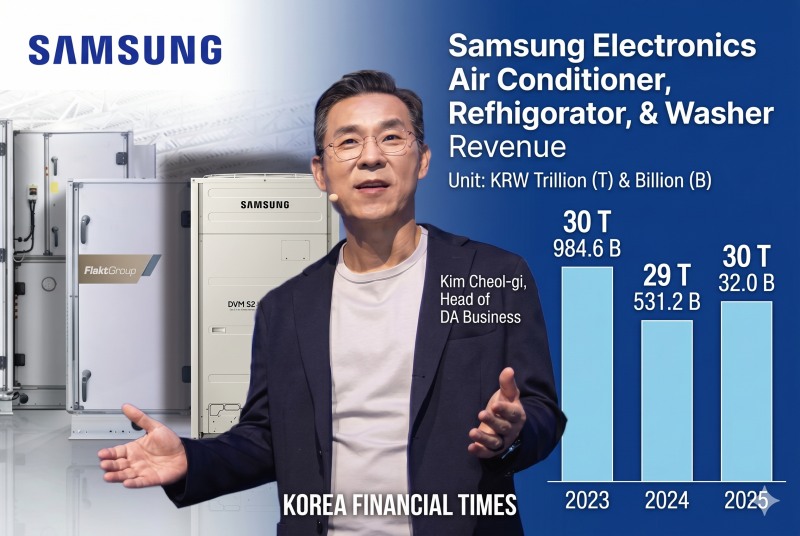
This infographic, originally published by Korea Financial Times, has been reconstructed using generative AI (Gemini).
이미지 확대보기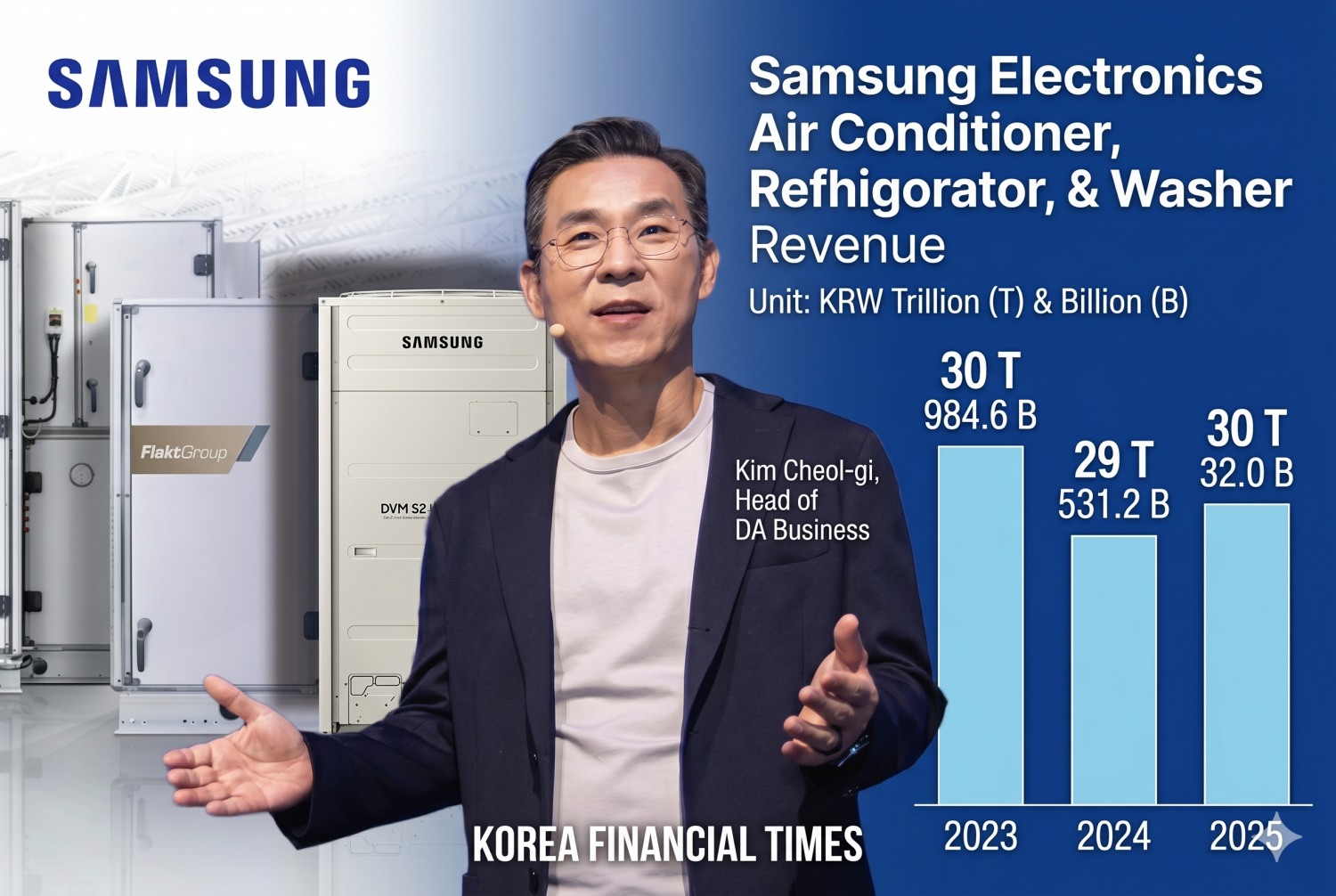
Through a recent organizational restructuring, the company elevated its related business team to a core unit led by executive vice presidents, and with the acquisition of Flaktgroup — a leading European HVAC company — as a springboard, it is now moving in earnest beyond the residential market and into the data center segment.
This strategic move is interpreted as Samsung's effort to seize leadership in the rapidly growing thermal management solutions market fueled by expanding AI infrastructure, while also securing a new growth engine for its stagnant home appliance revenue.
Organizational Overhaul: A Team That Tripled Its Executive Roster in One Year
In a year-end organizational restructuring last year, Samsung Electronics significantly reinforced the Air Solution Business Team within the DA (Digital Appliances) Business Unit of its DX (Device eXperience) Division. According to Samsung Electronics' business report, the Air Solution Business Team is now composed of six executives: Executive Vice Presidents (EVPs) Im Sung-taek, Kang Sang-yong, and Choi Hang-seok, along with Vice Presidents (VPs) Baek Hye-sung, Shin Mun-sun, and Lee Tae-yong.It would be an overstatement to call the Air Solution Business Team definitively one of Samsung Electronics' core units — the company has more than 360 executives at the EVP level or above. Nevertheless, the transformation of a unit that had only two VP-level executives a year ago into a six-executive team including three EVPs in the span of just one year is a remarkable organizational shift. It is widely interpreted as a clear signal of Samsung's intent to nurture the air solution business as a future revenue driver capable of breaking through the stagnation in the home appliance market.
Im Sung-taek (born 1970), who was promoted to EVP in Samsung's 2024 personnel review, was appointed head of the Air Solution Business Team. He is recognized as an expert in component development, drawing on convergent expertise in mechanical, electrical, and electronic engineering, and has been credited for contributing to the development of products such as air conditioners and air purifiers.
Choi Hang-seok, who previously headed the Air Solution Business Team, was promoted to EVP in Samsung's 2026 regular personnel review. Recruited from LG Electronics in 2023, Choi is a seasoned veteran with deep expertise in global HVAC sales — a hire that itself stands as evidence of how far Samsung is willing to go to expand its air conditioning business.
From Ductless to Central: The Data Center Push
The Air Solution Business Unit currently focuses primarily on ductless (individual) air conditioning systems, including residential air conditioners and commercial system air conditioners installed in buildings. While Samsung Electronics does not separately disclose air conditioner revenue, the combined annual sales of air conditioners, refrigerators, and washing machines — excluding smartphones, TVs, and monitors — are estimated at approximately KRW 30 trillion.
Exynos Reborn: How Samsung Is Betting Its Chip Future on On-Device AISamsung Foundry Eyes Turnaround After Years of LossesSamsung Electronics and SK Hynix Engage in High-Stakes AI Chip War [KFT Topic]SK hynix Eyes KRW 40 Trillion in Q1 Operating Profit — Is AI Ushering in a Long-Term Boom?From iPhones to Humanoids: LG Innotek Bets Big on Robotics and AI
While by no means a small figure, this accounts for only about 8% of Samsung Electronics' total revenue. Sales in this product category have been stagnant for the past three years, and last year's U.S. tariff headwinds are believed to have significantly dented profitability.
The market Samsung Electronics has identified as its next frontier for HVAC expansion is central air conditioning. The company has articulated a vision of becoming a "global top HVAC" enterprise, with data center cooling solutions positioned as its core future growth driver.
Global big tech companies are competing aggressively to invest in data centers in the race for AI supremacy. Efficient thermal management systems are considered a fundamental prerequisite for data centers that operate around the clock and generate enormous amounts of heat.
According to Samsung Electronics, the central HVAC market is projected to grow at a compound annual growth rate (CAGR) of 8% to USD 99 billion by 2030. The data center segment, however, is expected to expand even faster, at a CAGR of 18%, reaching USD 41.1 billion — a scale comparable to the global smartphone application processor (AP) market, which stood at approximately USD 37 billion as of 2025.
Flaktgroup Acquisition: Samsung's Largest M&A in Eight Years
To pursue this vision, Samsung Electronics completed the acquisition of Flaktgroup, Europe's largest HVAC equipment company, in November last year. The deal involved acquiring a 100% stake in Flaktgroup from British private equity firm Triton for EUR 1.5 billion (approximately KRW 2.6 trillion). It is considered Samsung Electronics' largest M&A in eight years, since its acquisition of Harman for approximately KRW 9.3 trillion in 2017.Founded in the early 1900s, Flaktgroup is a dominant force in the commercial and industrial HVAC sector with over a century of operational history.
The company is also reported to be participating in Stargate — a massive AI infrastructure construction project led by OpenAI. This development also signals the expansion of Samsung Electronics' HVAC business — traditionally strong in the business-to-consumer (B2C) segment — into business-to-business (B2B) territory.
"We intend to aggressively target the high-growth data center market by leveraging Flaktgroup's central HVAC technology," said Kim Cheol-gi, EVP and head of Samsung Electronics' DA Business Unit. "We will also generate synergies by integrating system air conditioning and central HVAC in a combined hybrid solution."
Flaktgroup has production and sales networks not only across Europe but also in emerging markets including Turkey, the United Arab Emirates (UAE), and India. It is also planning facility investments in South Korea to maximize synergies with Samsung Electronics.
David Dohni, appointed as Flaktgroup's new CEO upon the company's integration into Samsung Group, disclosed in an interview with Samsung Electronics in January that "a new factory — which will serve as a standard model for the factory of the future — is scheduled to be established in 2026."
The leading candidate site is the Samsung Electronics Plant 3 location within the Gwangju Advanced Industrial Complex. Working-level consultations with Gwangju Metropolitan City were concluded last month, but the signing of an investment agreement has been tentatively postponed at Samsung's request. The specific reason for the delay has not been disclosed, though the company is believed to be deliberating over the scale of the investment.
Upgrading the Core Business: SmartThings, AI, and Lennox
Meanwhile, Samsung Electronics is also working to upgrade its existing air conditioning business. In 2024, it established a joint venture with U.S. HVAC company Lennox International in Texas, expanding its local distribution network and product lineup.Another key priority is service enhancement through the integration of SmartThings and SmartThings Energy — inter-device connectivity platforms — into its individual air conditioning products. Remote maintenance is becoming increasingly important as energy demand rises and the need for power efficiency intensifies.
Indeed, the recently unveiled commercial air conditioner DVM S2+ is equipped with on-device AI technology that learns its environment in real time to deliver energy savings. Samsung's strategy is to lead with this lineup of high-efficiency, AI-powered products — and in doing so, reshape the competitive dynamics of the global HVAC market.
Gwak Horyung (horr@fntimes.com)










![[기자수첩] 보험사 품는 사모펀드, 대주주 심사 재고해야](https://cfnimage.commutil.kr/phpwas/restmb_setimgmake.php?pp=006&w=69&h=45&m=5&simg=20260913173909069220ed56b8e1f814379898.jpg&nmt=18)
![[Z-스코어 기업가치 바로 보기] 차입이냐 자기자본이냐…LG엔솔 vs 삼성SDI ‘명암ʼ](https://cfnimage.commutil.kr/phpwas/restmb_setimgmake.php?pp=006&w=69&h=45&m=5&simg=20260912004753014480dd55077bc212411124362.jpg&nmt=18)


![[그래픽 뉴스] ‘순대’가 경제용어라고? 순(純)대외자산, 한국의 진짜 해외자산은 얼마일까?](https://cfnimage.commutil.kr/phpwas/restmb_setimgmake.php?pp=006&w=298&h=298&m=1&simg=202609021356075202de68fcbb3512411124362_0.jpg&nmt=18)
![[그래픽 뉴스] ISA 대개편! 나에게 유리한 계좌는?](https://cfnimage.commutil.kr/phpwas/restmb_setimgmake.php?pp=006&w=298&h=298&m=1&simg=202608041713155615de68fcbb3512411124362_0.jpg&nmt=18)
![[그래픽 뉴스] 미국 증시 새로운 키워드 'MANGOS'](https://cfnimage.commutil.kr/phpwas/restmb_setimgmake.php?pp=006&w=298&h=298&m=1&simg=202607291740382069de68fcbb3512411124362_0.jpg&nmt=18)

![[그래픽 뉴스] 은퇴후 30년 부모님 세대의 생존전략](https://cfnimage.commutil.kr/phpwas/restmb_setimgmake.php?pp=006&w=298&h=298&m=1&simg=202606301704439153de68fcbb3512411124362_0.jpg&nmt=18)
![[신간]은퇴연옥…김경록의 은퇴 후 삶의 나침반](https://cfnimage.commutil.kr/phpwas/restmb_setimgmake.php?pp=006&w=81&h=123&m=5&simg=20260414140833047280f8caa4a5ce12411124362.jpg&nmt=18)
![[신간] 물처럼 흐르고 원칙으로 서다…김용환의 통찰을 담다](https://cfnimage.commutil.kr/phpwas/restmb_setimgmake.php?pp=006&w=81&h=123&m=5&simg=20260409114249027860f8caa4a5ce12411124362.jpg&nmt=18)
![[안현정 서평] 플랫폼의 영지에서 ‘미학적 주권’을 선포하라...'K가 죽어야 K가 산다' 장준환 著](https://cfnimage.commutil.kr/phpwas/restmb_setimgmake.php?pp=006&w=81&h=123&m=5&simg=20260527121426063220c1c16452b012411124362.jpg&nmt=18)
![[서평] 추세 매매의 대가들...추세추종 투자전략의 대가 14인 인터뷰](https://cfnimage.commutil.kr/phpwas/restmb_setimgmake.php?pp=006&w=81&h=123&m=5&simg=2023102410444004986c1c16452b0175114235199.jpg&nmt=18)


![[머니무브 2026] “지금 사도 될까?” 답이 안 보인다면…하반기 투자, 4명의 전문가에게 물어보세요](https://cfnimage.commutil.kr/phpwas/restmb_setimgmake.php?pp=006&w=89&h=45&m=1&simg=202609151044050355302a735e27af12411124362.jpg&nmt=18)
![[AD] ‘PBV 라인업 확장’ 기아, 9월 독일서 ‘PV7’ 첫 공개](https://cfnimage.commutil.kr/phpwas/restmb_setimgmake.php?pp=006&w=89&h=45&m=1&simg=2026083111010602815074925877361231180222.jpg&nmt=18)
![[AD] 제네시스, 럭셔리 경험 더한 ‘2027 GV70’‧‘GV70 그래파이트’ 출시](https://cfnimage.commutil.kr/phpwas/restmb_setimgmake.php?pp=006&w=89&h=45&m=1&simg=20260702143546085600749258773622211122717.jpg&nmt=18)
![[AD] 개소세 혜택 종료…현대차, ‘썸머 페스타’로 고객 부담 완화](https://cfnimage.commutil.kr/phpwas/restmb_setimgmake.php?pp=006&w=89&h=45&m=1&simg=20260702142355004830749258773622211122717.jpg&nmt=18)
![[AD] 기아 ‘디 올 뉴 셀토스’, 인도 타임스 드라이브 어워즈서 ‘올해의 SUV’ 선정](https://cfnimage.commutil.kr/phpwas/restmb_setimgmake.php?pp=006&w=89&h=45&m=1&simg=202605071156400590007492587736124111243152.jpg&nmt=18)