






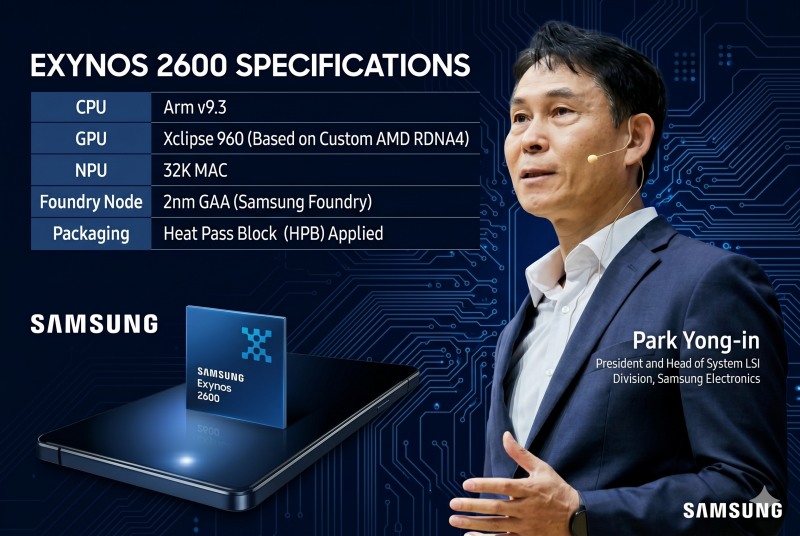
This infographic, originally published by Korea Financial Times, has been reconstructed using generative AI (Gemini).
이미지 확대보기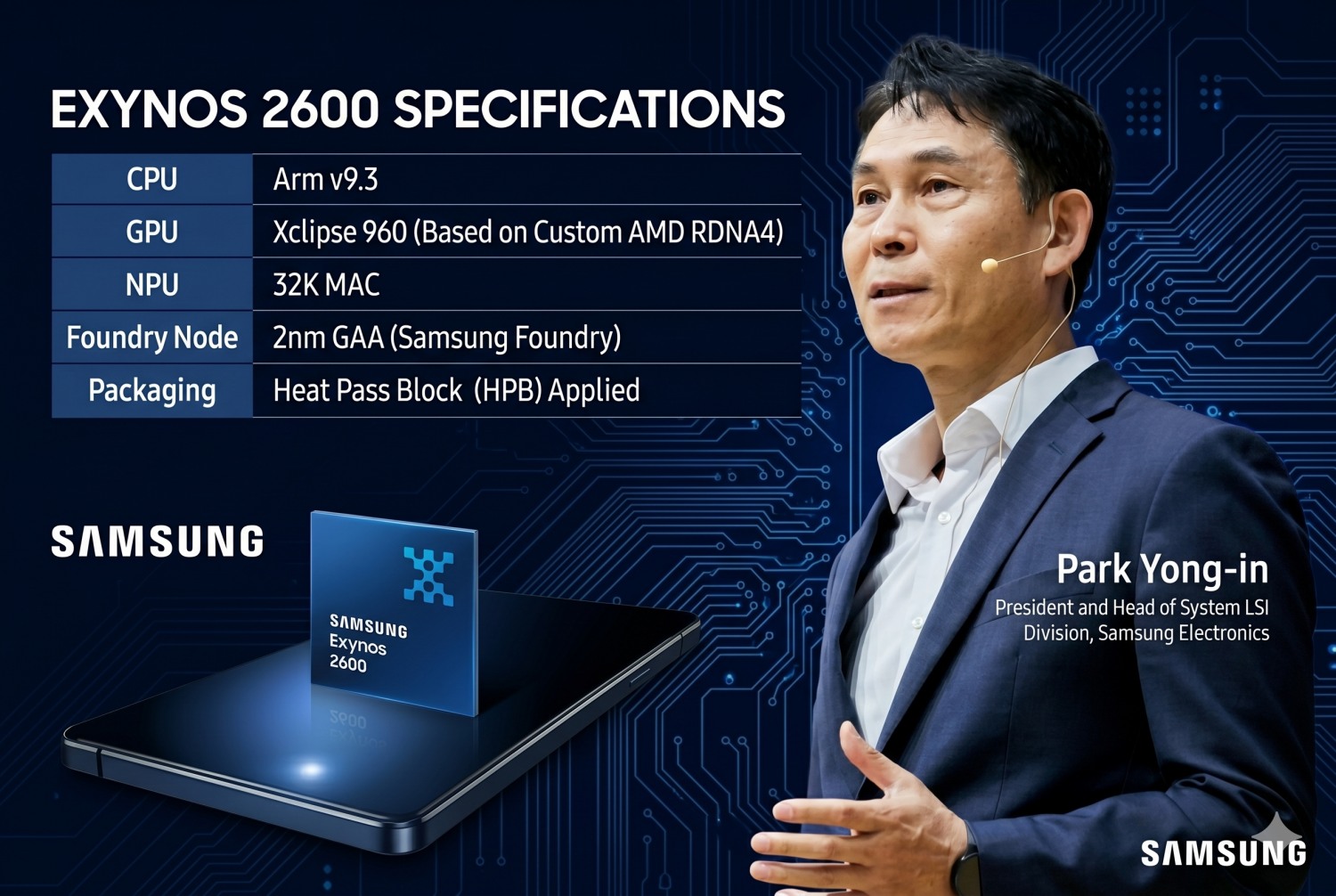
The System LSI Division is the dedicated unit within Samsung Electronics responsible for developing system (non-memory) semiconductors that handle logical information processing such as computation and inference. The division is broadly organized into three business teams: the SoC Business Team, which spearheads development of the Exynos application processor (AP) for mobile and automotive use; the Sensor Business Team, which oversees ISOCELL, Samsung's image sensor brand that converts visual information captured by cameras into digital data; and the LSI Business Team, which develops display driver ICs (DDIs) and other components.
According to Samsung Electronics' business report released on April 19, the System LSI Division has a total of 45 executives, of whom approximately half — 22 — are assigned to the SoC Business Team.
In terms of organizational structure and revenue composition, the division is heavily reliant on the Galaxy series produced by Samsung's in-house MX (Mobile Experience) Division. While this provides a stable sales base that is conducive to business development, it has also worked against the division in attracting external customers. In an attempt to overcome this limitation, the division entered the automotive market and collaborated with NAVER on AI accelerator development, though neither initiative has produced significant results.
Adding to the division's difficulties, last year it suffered a blow to its reputation when the Exynos 2500 failed to be incorporated into the Galaxy S25 series. Poor foundry yield rates were cited as the primary cause, but the setback dealt a considerable blow to the Exynos brand's credibility and the division's overall performance. Samsung Electronics' share of the global mobile AP market, which stood at 12% in the first half of 2021, fell to between 5% and 6% in the first half of last year, leaving it ranked fifth worldwide.
This year, after intense internal reflection and a determined recovery effort, the division succeeded in equipping the standard and Plus models of the Galaxy S26 — for the South Korean and European markets — with the Exynos 2600. While Qualcomm's Snapdragon still accounts for the largest share through its inclusion in the Galaxy S26 Ultra, the achievement is seen as a meaningful re-demonstration of the division's technological capability.
The System LSI Division placed particular emphasis on enhancing AI performance. The Exynos 2600 features an in-house developed neural processing unit (NPU) called the "32K MAC," with generative AI performance reportedly improved by 113% compared to its predecessor.
Samsung Electronics' focus on mobile APs goes beyond simply boosting market share or improving the division's short-term profitability. It represents a strategic move ultimately aimed at securing dominance in the on-device AI market.
Samsung Electronics and SK Hynix Engage in High-Stakes AI Chip War [KFT Topic]Samsung Eyes Record KRW 90 Trillion Shareholder Payout as Chip Supercycle Ignites Earnings [Treasury Stock Report]'Samsung's Bet on the Future' — Rainbow Robotics, Korea's Humanoid Pioneer [K-Humanoid Wars, Part 2]SK hynix Eyes KRW 40 Trillion in Q1 Operating Profit — Is AI Ushering in a Long-Term Boom?From iPhones to Humanoids: LG Innotek Bets Big on Robotics and AI
To resolve the data bottleneck and latency issues that inevitably arise when large language model processing requires data to be repeatedly transmitted to external clouds or data centers, the ability to process data instantly on the device itself becomes essential.
Accordingly, advanced system-on-chip (SoC) technology — in which functions such as CPU, GPU, and NPU are all implemented on a single chip — is expected to become a decisive competitive differentiator, serving as the brain of not just smartphones but of all high-tech devices including autonomous vehicles and intelligent robots.
Park Yong-in, President and Head of Samsung Electronics' System LSI Division, stated: "Once infrastructure such as data centers is fully built out, the era of on-device AI will arrive. The completion of the on-device AI era depends on integrated technology, not on individual components, and Samsung Electronics is the only company equipped with the total solution supply capability encompassing SoC, camera sensors, and DDIs."
In the near term, Samsung Electronics is expected to focus on optimizing the performance of the Exynos 2700 and Exynos 2800, slated for sequential unveiling at the end of this year and the end of next year, respectively.
In benchmark tests, Exynos has achieved near-parity performance with Qualcomm's latest Snapdragon 8 Elite. However, observers note that the chip still lags significantly behind Snapdragon in terms of power efficiency.
GPU independence is another focal point to watch. The current Exynos features a GPU called Xclipse, designed by Samsung Electronics' System LSI Division based on AMD architecture. Samsung Electronics is also reportedly in the exploratory stages of developing a GPU using its own intellectual property.
Park Yong-in has led Samsung Electronics' System LSI Division since December 2021, making him the longest-serving executive within Samsung's semiconductor (Device Solutions, or DS) leadership. Jun Young-hyun, who concurrently serves as head of the DS Division and head of the Memory Business Division, and Han Jin-man, President of the Foundry Business Division, were both appointed in 2024. With the exception of Noh Tae-moon — President and head of the DX Division, who has led the MX Division since 2020 — Park is the longest-serving executive across Samsung Electronics as a whole.
Born in 1964, Park Yong-in — like Jun Young-hyun — is not a career Samsung insider. He earned his bachelor's and master's degrees in electrical engineering from Yonsei University, and began his career at LG Semiconductor (now SK Hynix). He subsequently served at Texas Instruments and as CEO of Dongbu HiTek (now DB HiTek) before joining Samsung Electronics in 2014. Within Samsung Electronics, he has held roles including head of the System LSI Division's Next-Generation Product Development Team, Sensor Product Development Team, LSI Development Office, and Sensor Business Team.
His continued reappointment is widely attributed to the consistent performance delivered by the image sensor (CIS) segment within the System LSI Division.
It has been reported that last year the System LSI Division successfully secured a supply contract for image sensors destined for Apple's iPhone — a market previously monopolized by Japan's Sony. Samsung Electronics is expected to begin supplying image sensors starting from the iPhone 18, projected for launch around 2027.
According to market research firm Omdia, as of last year, Sony holds the top position in the global image sensor market with a 52% share, while Samsung Electronics ranks second with 15.4%.
Gwak Horyung (horr@fntimes.com)










![24개월 최고 연 4.00%…제주은행 'J정기예금(만기지급식)' [이주의 은행 예금금리-10월 4주]](https://cfnimage.commutil.kr/phpwas/restmb_setimgmake.php?pp=006&w=69&h=45&m=5&simg=202610231018530270305e6e69892f222110224119.jpg&nmt=18)
![기관 '한화오션'·외인 '삼성전자'·개인 '삼성전기' 1위 [주간 코스피 순매수- 2026년 10월19일~10월23일]](https://cfnimage.commutil.kr/phpwas/restmb_setimgmake.php?pp=006&w=69&h=45&m=5&simg=20261024171622010220179ad4390711823574140.jpg&nmt=18)
![12개월 최고 연 7.00%…경남은행 '오면우대! 하면우대! 정기적금' [이주의 은행 적금금리-10월 4주]](https://cfnimage.commutil.kr/phpwas/restmb_setimgmake.php?pp=006&w=69&h=45&m=5&simg=202610231103420840305e6e69892f222110224119.jpg&nmt=18)
![24개월 최고 연 4.10%…OK저축은행 'OK e-안심정기예금'[이주의 저축은행 예금금리-10월 4주]](https://cfnimage.commutil.kr/phpwas/restmb_setimgmake.php?pp=006&w=69&h=45&m=5&simg=202610241739030963907c96e7978011215281239.jpg&nmt=18)
![12개월 최고 연 4.10%…경남은행 'The든든예금(시즌2)' [이주의 은행 예금금리-10월 4주]](https://cfnimage.commutil.kr/phpwas/restmb_setimgmake.php?pp=006&w=69&h=45&m=5&simg=202610231017430908005e6e69892f222110224119.jpg&nmt=18)


![[그래픽 뉴스] ‘순대’가 경제용어라고? 순(純)대외자산, 한국의 진짜 해외자산은 얼마일까?](https://cfnimage.commutil.kr/phpwas/restmb_setimgmake.php?pp=006&w=298&h=298&m=1&simg=202609021356075202de68fcbb3512411124362_0.jpg&nmt=18)
![[그래픽 뉴스] ISA 대개편! 나에게 유리한 계좌는?](https://cfnimage.commutil.kr/phpwas/restmb_setimgmake.php?pp=006&w=298&h=298&m=1&simg=202608041713155615de68fcbb3512411124362_0.jpg&nmt=18)
![[그래픽 뉴스] 미국 증시 새로운 키워드 'MANGOS'](https://cfnimage.commutil.kr/phpwas/restmb_setimgmake.php?pp=006&w=298&h=298&m=1&simg=202607291740382069de68fcbb3512411124362_0.jpg&nmt=18)
![[그래픽 뉴스] 은퇴후 30년 부모님 세대의 생존전략](https://cfnimage.commutil.kr/phpwas/restmb_setimgmake.php?pp=006&w=298&h=298&m=1&simg=202606301704439153de68fcbb3512411124362_0.jpg&nmt=18)
![[신간] 장애가 가르쳐준 삶의 의미...목진석 9단 아버지 목이균씨의 자서전](https://cfnimage.commutil.kr/phpwas/restmb_setimgmake.php?pp=006&w=81&h=123&m=5&simg=20261023093852062530f8caa4a5ce12411124362.jpg&nmt=18)
![[신간]은퇴연옥…김경록의 은퇴 후 삶의 나침반](https://cfnimage.commutil.kr/phpwas/restmb_setimgmake.php?pp=006&w=81&h=123&m=5&simg=20260414140833047280f8caa4a5ce12411124362.jpg&nmt=18)
![[안현정 서평] 플랫폼의 영지에서 ‘미학적 주권’을 선포하라...'K가 죽어야 K가 산다' 장준환 著](https://cfnimage.commutil.kr/phpwas/restmb_setimgmake.php?pp=006&w=81&h=123&m=5&simg=20260527121426063220c1c16452b012411124362.jpg&nmt=18)
![[서평] 추세 매매의 대가들...추세추종 투자전략의 대가 14인 인터뷰](https://cfnimage.commutil.kr/phpwas/restmb_setimgmake.php?pp=006&w=81&h=123&m=5&simg=2023102410444004986c1c16452b0175114235199.jpg&nmt=18)


![[머니무브 2026] “지금 사도 될까?” 답이 안 보인다면…하반기 투자, 4명의 전문가에게 물어보세요](https://cfnimage.commutil.kr/phpwas/restmb_setimgmake.php?pp=006&w=89&h=45&m=1&simg=202609151044050355302a735e27af12411124362.jpg&nmt=18)
![[AD] ‘PBV 라인업 확장’ 기아, 9월 독일서 ‘PV7’ 첫 공개](https://cfnimage.commutil.kr/phpwas/restmb_setimgmake.php?pp=006&w=89&h=45&m=1&simg=2026083111010602815074925877361231180222.jpg&nmt=18)
![[AD] 제네시스, 럭셔리 경험 더한 ‘2027 GV70’‧‘GV70 그래파이트’ 출시](https://cfnimage.commutil.kr/phpwas/restmb_setimgmake.php?pp=006&w=89&h=45&m=1&simg=20260702143546085600749258773622211122717.jpg&nmt=18)