






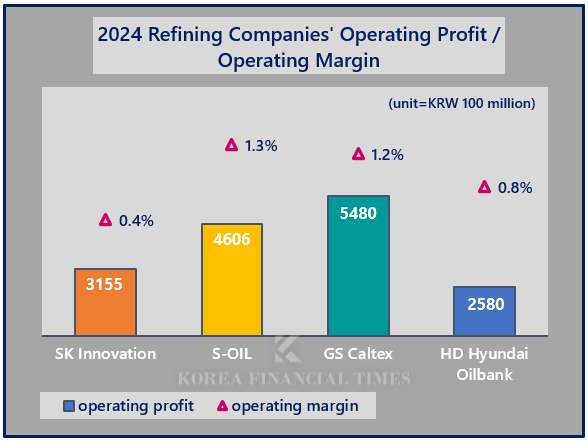
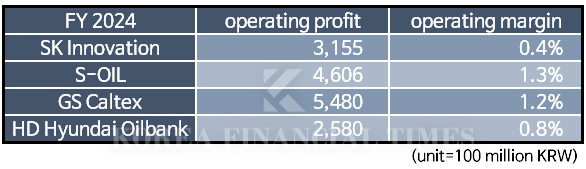
The combined annual operating profit of South Korea’s four major refiners stood at approximately KRW 1.58 trillion in 2024, a sharp decline to nearly one-third of the KRW 4.47 trillion recorded in 2023.
Looking back over the past year, all four companies were in the red in the wake of the economic slowdown that began in earnest in the second quarter and the plunge in oil prices in the third quarter, before rebounding in the fourth quarter on the back of a recovery driven by winter heating demand.
Graphic & Table Creation=Korea Financial Times / Data Source=Each company
GS Caltex Leads the Industry in Profitability ... S-OIL Invests in Petrochemical Expansion
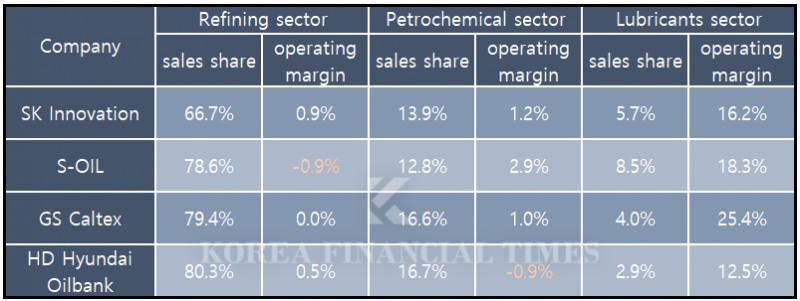
GS Caltex recorded the highest operating profit among its peers, posting KRW 548 billion. The company’s lubricant business has consistently delivered strong margins, standing out from competitors. While rivals in the sector maintain an average operating margin of around 15%, GS Caltex surpassed 25%. This success is attributed to the company’s strategic focus on high-value automotive lubricant finished products.S-OIL recorded the highest operating margin (1.3%) among the four major refiners. Although it was the only company in the sector to post a deficit in its refining operations, its relatively strong performance in the struggling petrochemical sector helped offset losses. It was the only one of the four to post a loss in its refining business, but it offset this with relatively solid profitability in petrochemicals, where all were struggling.
S-Oil plans to start the Shahine Project in Ulsan in 2026, investing KRW 9 trillion to build a large-scale petrochemical complex. It is expected that the project will disrupt the domestic petrochemical landscape, leveraging the raw material prices and technological competitiveness of its parent company, Saudi Aramco. S-OIL plans to nearly double the proportion of its revenue derived from petrochemicals, increasing it from the current 12-13%.
* Excluding consolidation adjustments such as HD Hyundai Oil Bank's internal transactions / Data Source=Each company
이미지 확대보기
HD Hyundai Oilbank and SK Innovation Face Challenges
HD Hyundai Oilbank struggled due to setbacks in its petrochemical business. Its joint venture with Lotte Chemical, HD Hyundai Chemical, posted an operating loss of KRW 70 billion.
LG Energy Solution, Samsung SDI, SK On Brace for Prolonged EV Battery SlumpHD Hyundai Oil Bank, Low Profitability but High Dividend Reason...SK Innovation KRW -160 billion, S-Oil KRW -430 billion... Earnings shock predicted for refinery business'Reacting' to falling interest rates... S-Oil, Samsung C&T, etc. rush to issue high-grade bonds [Debt Capital Markets]
Meanwhile, SK Innovation delivered relatively stable results in its traditional oil-based businesses. However, it suffered a substantial KRW 1.4 trillion deficit in its battery and battery materials divisions. The company did alleviate some financial pressure through its Q4 merger with E&S.
Outlook for 2025: Cautious Optimism Amid Global Uncertainty
The industry outlook for this year is expected to be similar to last year. Global economic sluggishness and stable international oil prices are anticipated to continue.There is, however, a variable: former U.S. President Donald Trump. The domestic industry holds mixed feelings of “half expectation, half concern.”
If the Trump administration enforces a policy of strengthening tariffs, it could have a positive impact on the domestic refining industry. The increase in the proportion of expensive U.S. refineries could raise margins for oil products overall. However, uncertainty surrounding implementation and potential side effect of a global trade reduction make it difficult to gauge the actual impact on the industry.
Gwak Horyung (horr@fntimes.com)











![[기자수첩] 보험사 품는 사모펀드, 대주주 심사 재고해야](https://cfnimage.commutil.kr/phpwas/restmb_setimgmake.php?pp=006&w=69&h=45&m=5&simg=20260913173909069220ed56b8e1f814379898.jpg&nmt=18)


![[그래픽 뉴스] ‘순대’가 경제용어라고? 순(純)대외자산, 한국의 진짜 해외자산은 얼마일까?](https://cfnimage.commutil.kr/phpwas/restmb_setimgmake.php?pp=006&w=298&h=298&m=1&simg=202609021356075202de68fcbb3512411124362_0.jpg&nmt=18)
![[그래픽 뉴스] ISA 대개편! 나에게 유리한 계좌는?](https://cfnimage.commutil.kr/phpwas/restmb_setimgmake.php?pp=006&w=298&h=298&m=1&simg=202608041713155615de68fcbb3512411124362_0.jpg&nmt=18)
![[그래픽 뉴스] 미국 증시 새로운 키워드 'MANGOS'](https://cfnimage.commutil.kr/phpwas/restmb_setimgmake.php?pp=006&w=298&h=298&m=1&simg=202607291740382069de68fcbb3512411124362_0.jpg&nmt=18)

![[그래픽 뉴스] 은퇴후 30년 부모님 세대의 생존전략](https://cfnimage.commutil.kr/phpwas/restmb_setimgmake.php?pp=006&w=298&h=298&m=1&simg=202606301704439153de68fcbb3512411124362_0.jpg&nmt=18)
![[신간]은퇴연옥…김경록의 은퇴 후 삶의 나침반](https://cfnimage.commutil.kr/phpwas/restmb_setimgmake.php?pp=006&w=81&h=123&m=5&simg=20260414140833047280f8caa4a5ce12411124362.jpg&nmt=18)
![[신간] 물처럼 흐르고 원칙으로 서다…김용환의 통찰을 담다](https://cfnimage.commutil.kr/phpwas/restmb_setimgmake.php?pp=006&w=81&h=123&m=5&simg=20260409114249027860f8caa4a5ce12411124362.jpg&nmt=18)
![[안현정 서평] 플랫폼의 영지에서 ‘미학적 주권’을 선포하라...'K가 죽어야 K가 산다' 장준환 著](https://cfnimage.commutil.kr/phpwas/restmb_setimgmake.php?pp=006&w=81&h=123&m=5&simg=20260527121426063220c1c16452b012411124362.jpg&nmt=18)
![[서평] 추세 매매의 대가들...추세추종 투자전략의 대가 14인 인터뷰](https://cfnimage.commutil.kr/phpwas/restmb_setimgmake.php?pp=006&w=81&h=123&m=5&simg=2023102410444004986c1c16452b0175114235199.jpg&nmt=18)


![[머니무브 2026] “지금 사도 될까?” 답이 안 보인다면…하반기 투자, 4명의 전문가에게 물어보세요](https://cfnimage.commutil.kr/phpwas/restmb_setimgmake.php?pp=006&w=89&h=45&m=1&simg=202609151044050355302a735e27af12411124362.jpg&nmt=18)
![[AD] ‘PBV 라인업 확장’ 기아, 9월 독일서 ‘PV7’ 첫 공개](https://cfnimage.commutil.kr/phpwas/restmb_setimgmake.php?pp=006&w=89&h=45&m=1&simg=2026083111010602815074925877361231180222.jpg&nmt=18)
![[AD] 제네시스, 럭셔리 경험 더한 ‘2027 GV70’‧‘GV70 그래파이트’ 출시](https://cfnimage.commutil.kr/phpwas/restmb_setimgmake.php?pp=006&w=89&h=45&m=1&simg=20260702143546085600749258773622211122717.jpg&nmt=18)
![[AD] 개소세 혜택 종료…현대차, ‘썸머 페스타’로 고객 부담 완화](https://cfnimage.commutil.kr/phpwas/restmb_setimgmake.php?pp=006&w=89&h=45&m=1&simg=20260702142355004830749258773622211122717.jpg&nmt=18)
![[AD] 기아 ‘디 올 뉴 셀토스’, 인도 타임스 드라이브 어워즈서 ‘올해의 SUV’ 선정](https://cfnimage.commutil.kr/phpwas/restmb_setimgmake.php?pp=006&w=89&h=45&m=1&simg=202605071156400590007492587736124111243152.jpg&nmt=18)