






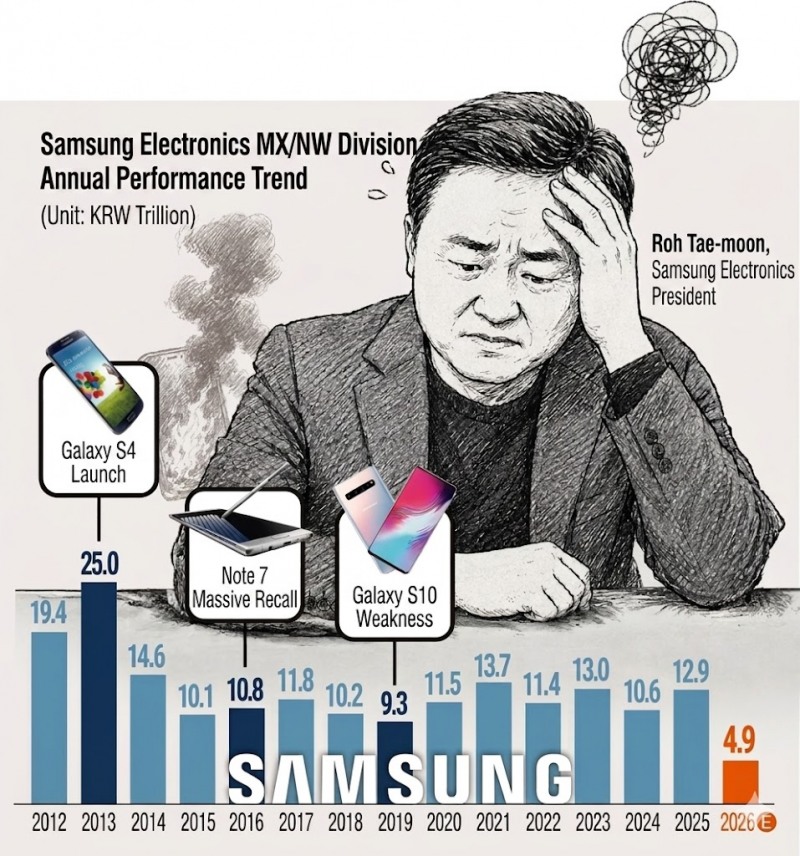
This infographic, originally published by Korea Financial Times, has been reconstructed using generative AI (Gemini).
이미지 확대보기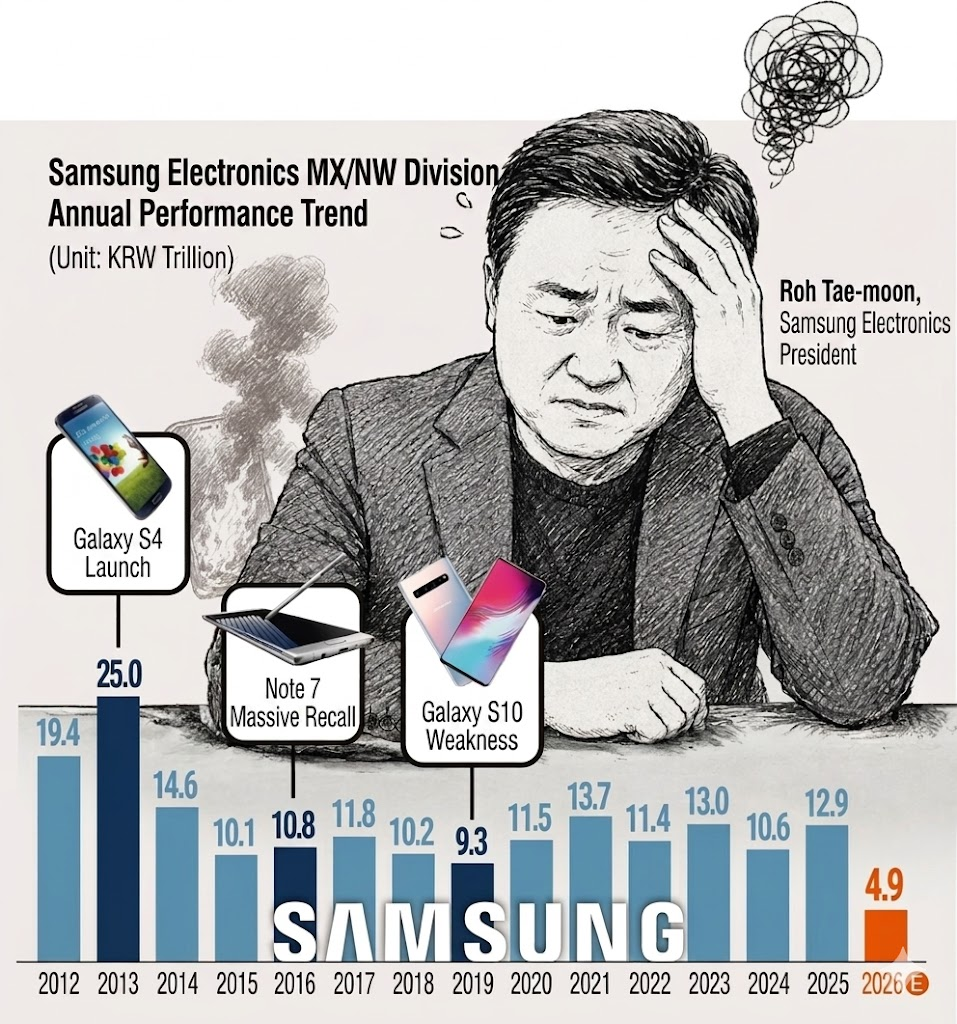
In a message sent to employees on May 27, President Roh stated, "I believe many of you felt alienated and deprived through the recent wage negotiation process and its outcome," adding, "We will restore the competitiveness of the DX Division and create a renewed trajectory of growth." The message was delivered immediately after the "2026 Tentative Wage Agreement" was approved by a majority (73.7%) of union members in favor. President Roh heads the DX Division and the MX Division, the DX Division's core organization.
This year's wage agreement was centered on the DS (Device Solutions/semiconductor) Division. As a result, an uncapped "special management incentive," funded by 10.5% of business performance (operating profit), will be applied exclusively to the DS Division for the next 10 years. Based on this year's projected DS operating profit of KRW 300 trillion, each employee is expected to receive treasury shares worth an average of approximately KRW 600 million.
DX employees, meanwhile, are set to receive treasury shares worth KRW 6 million under the banner of "win-win cooperation." That is a staggering 100-fold difference. This is why some are speaking of "one roof, two Samsungs." As disappointment erupted within DX over this incentive gap, President Roh is understood to have issued the message directly in an effort to soothe the organizational mood.
Samsung Electronics' mobile business has served as a key cash cow, earning roughly KRW 10 trillion in operating profit each year since the Galaxy S series debuted in 2010. In particular, at the peak of the "smartphone revolution" in 2013, it posted operating profit of nearly KRW 25 trillion, led by the Galaxy S4.
However, the global mobile business has left behind its era of explosive growth and has experienced stagnation for several years. Among the reasons cited are the leveling-up of technology across the board, the lengthening of product replacement cycles due to economic downturn, and weakness in emerging markets.
In response, the company's management made the strategic decision to concentrate capital on the semiconductor business. Samsung Electronics executed approximately KRW 52.7 trillion in capital expenditure last year, of which about 90%, or KRW 47.5 trillion, was poured into the DS Division.
Forecasts suggest the MX Division's earnings this year will be the worst since the smartphone business began. Taking the arithmetic mean of the 2026 average operating profit estimates for the MX Division (including Networks) released by seven securities firms (Samsung, Shinhan, Kiwoom, Hanwha, Korea Investment, iM, and Meritz), the figure came to KRW 4.9 trillion. That represents a 62% decline from 2025 (KRW 12.9 trillion). Some securities firms also raised the possibility of a quarterly loss during the third or fourth quarter.
Samsung Electronics Surpasses 30% NAND Market Share, Bolsters 'Super-Gap' Lead Through NVIDIA AllianceSamsung's Harman: From High-End Audio to the Brain of Future MobilitySamsung's EUR 1.5 Billion Cooling Systems Bet: From Home Appliances to AI Data CentersExynos Reborn: How Samsung Is Betting Its Chip Future on On-Device AISamsung Foundry Eyes Turnaround After Years of Losses
The lowest quarterly operating profit the MX Division ever recorded was in the third quarter of 2016. At that time, due to the impact of massive recall provisions related to the Galaxy Note 7 battery fire incident, it posted operating profit of KRW 100 billion. Even then, it did not fall into a loss, and it rebounded immediately the following quarter on strong sales of flagship models such as the Galaxy S7.
This year, however, a sense of crisis unlike anything in the past is being detected. Samsung Electronics' MX Division posted operating profit of KRW 2.8 trillion in the first quarter, exceeding expectations. Even so, at the earnings briefing, the MX Division maintained a negative outlook on its earnings prospects from the second quarter onward. Cho Sung-hyuk, Executive Vice President and Head of the MX Strategy & Marketing Office, said, "A decline in profitability in the second quarter will be unavoidable," adding, "Although the cost burden will mount, we will strive to minimize the drop in profitability by securing cost competitiveness."
Earlier, President Roh Tae-moon is also known to have heightened tension within the organization by mentioning the possibility of the DX Division turning to an annual loss at an executive meeting.
The core cause of the MX Division's weak profitability is the sharp rise in the price of memory semiconductors, a key component of smartphones. According to market research firm Counterpoint Research, DRAM and NAND flash prices in the first quarter surged to about 50% and 90% higher, respectively, than the previous quarter. The proportion of total cost accounted for by memory semiconductors within a smartphone is also estimated to soar from the existing 25–30% to as much as 40–50%.
To partially offset the semiconductor cost burden, the company raised the price of the Galaxy S26 by 16–20% compared with its predecessor, the S25.
By contrast, rival Apple is pursuing aggressive marketing by increasing memory capacity in its budget model, the iPhone 17e, while freezing its price. This could have a negative impact on Samsung Electronics' Galaxy sales.
In fact, the three mobile carriers and some retailers carried out unusual discounts just two months after the Galaxy S26's release, which is interpreted as a signal that sales of the product have been weaker than expected.
Meanwhile, the MX Division's Overall Performance Incentive (OPI) for this year is also expected to be sharply cut. The MX Division has received the OPI ceiling of 50% for three consecutive years. If annual operating profit ends up only in the high KRW 4 trillion range, a simple estimate puts the OPI payout rate in the high 10% range. Because the calculation of economic value added (EVA), which serves as the basis for determining OPI, reflects the cost of capital (WACC) tied to rising costs, the actual payout rate could fall even lower than this.
Gwak Horyung (horr@fntimes.com)











![서초구 '아크로리버파크' 34평, 10억 오른 74억원에 거래 [일일 신고가]](https://cfnimage.commutil.kr/phpwas/restmb_setimgmake.php?pp=006&w=69&h=45&m=5&simg=20260624115142011110dd55077bc212411124362.jpg&nmt=18)
!['첫 연임' 신학기 vs '新리더십' 이형주…차기 수협은행장 선임 D-Day [2027 은행장 선임 레이스]](https://cfnimage.commutil.kr/phpwas/restmb_setimgmake.php?pp=006&w=69&h=45&m=5&simg=202609211608140057701b5a2213792211381469.jpg&nmt=18)


![[그래픽 뉴스] ‘순대’가 경제용어라고? 순(純)대외자산, 한국의 진짜 해외자산은 얼마일까?](https://cfnimage.commutil.kr/phpwas/restmb_setimgmake.php?pp=006&w=298&h=298&m=1&simg=202609021356075202de68fcbb3512411124362_0.jpg&nmt=18)
![[그래픽 뉴스] ISA 대개편! 나에게 유리한 계좌는?](https://cfnimage.commutil.kr/phpwas/restmb_setimgmake.php?pp=006&w=298&h=298&m=1&simg=202608041713155615de68fcbb3512411124362_0.jpg&nmt=18)
![[그래픽 뉴스] 미국 증시 새로운 키워드 'MANGOS'](https://cfnimage.commutil.kr/phpwas/restmb_setimgmake.php?pp=006&w=298&h=298&m=1&simg=202607291740382069de68fcbb3512411124362_0.jpg&nmt=18)

![[그래픽 뉴스] 은퇴후 30년 부모님 세대의 생존전략](https://cfnimage.commutil.kr/phpwas/restmb_setimgmake.php?pp=006&w=298&h=298&m=1&simg=202606301704439153de68fcbb3512411124362_0.jpg&nmt=18)
![[신간]은퇴연옥…김경록의 은퇴 후 삶의 나침반](https://cfnimage.commutil.kr/phpwas/restmb_setimgmake.php?pp=006&w=81&h=123&m=5&simg=20260414140833047280f8caa4a5ce12411124362.jpg&nmt=18)
![[신간] 물처럼 흐르고 원칙으로 서다…김용환의 통찰을 담다](https://cfnimage.commutil.kr/phpwas/restmb_setimgmake.php?pp=006&w=81&h=123&m=5&simg=20260409114249027860f8caa4a5ce12411124362.jpg&nmt=18)
![[안현정 서평] 플랫폼의 영지에서 ‘미학적 주권’을 선포하라...'K가 죽어야 K가 산다' 장준환 著](https://cfnimage.commutil.kr/phpwas/restmb_setimgmake.php?pp=006&w=81&h=123&m=5&simg=20260527121426063220c1c16452b012411124362.jpg&nmt=18)
![[서평] 추세 매매의 대가들...추세추종 투자전략의 대가 14인 인터뷰](https://cfnimage.commutil.kr/phpwas/restmb_setimgmake.php?pp=006&w=81&h=123&m=5&simg=2023102410444004986c1c16452b0175114235199.jpg&nmt=18)


![[머니무브 2026] “지금 사도 될까?” 답이 안 보인다면…하반기 투자, 4명의 전문가에게 물어보세요](https://cfnimage.commutil.kr/phpwas/restmb_setimgmake.php?pp=006&w=89&h=45&m=1&simg=202609151044050355302a735e27af12411124362.jpg&nmt=18)
![[AD] ‘PBV 라인업 확장’ 기아, 9월 독일서 ‘PV7’ 첫 공개](https://cfnimage.commutil.kr/phpwas/restmb_setimgmake.php?pp=006&w=89&h=45&m=1&simg=2026083111010602815074925877361231180222.jpg&nmt=18)
![[AD] 제네시스, 럭셔리 경험 더한 ‘2027 GV70’‧‘GV70 그래파이트’ 출시](https://cfnimage.commutil.kr/phpwas/restmb_setimgmake.php?pp=006&w=89&h=45&m=1&simg=20260702143546085600749258773622211122717.jpg&nmt=18)
![[AD] 개소세 혜택 종료…현대차, ‘썸머 페스타’로 고객 부담 완화](https://cfnimage.commutil.kr/phpwas/restmb_setimgmake.php?pp=006&w=89&h=45&m=1&simg=20260702142355004830749258773622211122717.jpg&nmt=18)
![[AD] 기아 ‘디 올 뉴 셀토스’, 인도 타임스 드라이브 어워즈서 ‘올해의 SUV’ 선정](https://cfnimage.commutil.kr/phpwas/restmb_setimgmake.php?pp=006&w=89&h=45&m=1&simg=202605071156400590007492587736124111243152.jpg&nmt=18)