






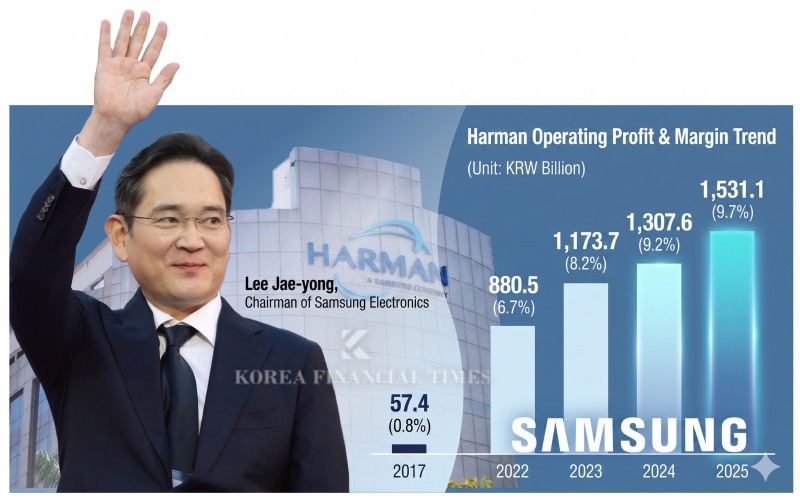
This infographic, originally published by Korea Financial Times, has been reconstructed using generative AI (Gemini).
이미지 확대보기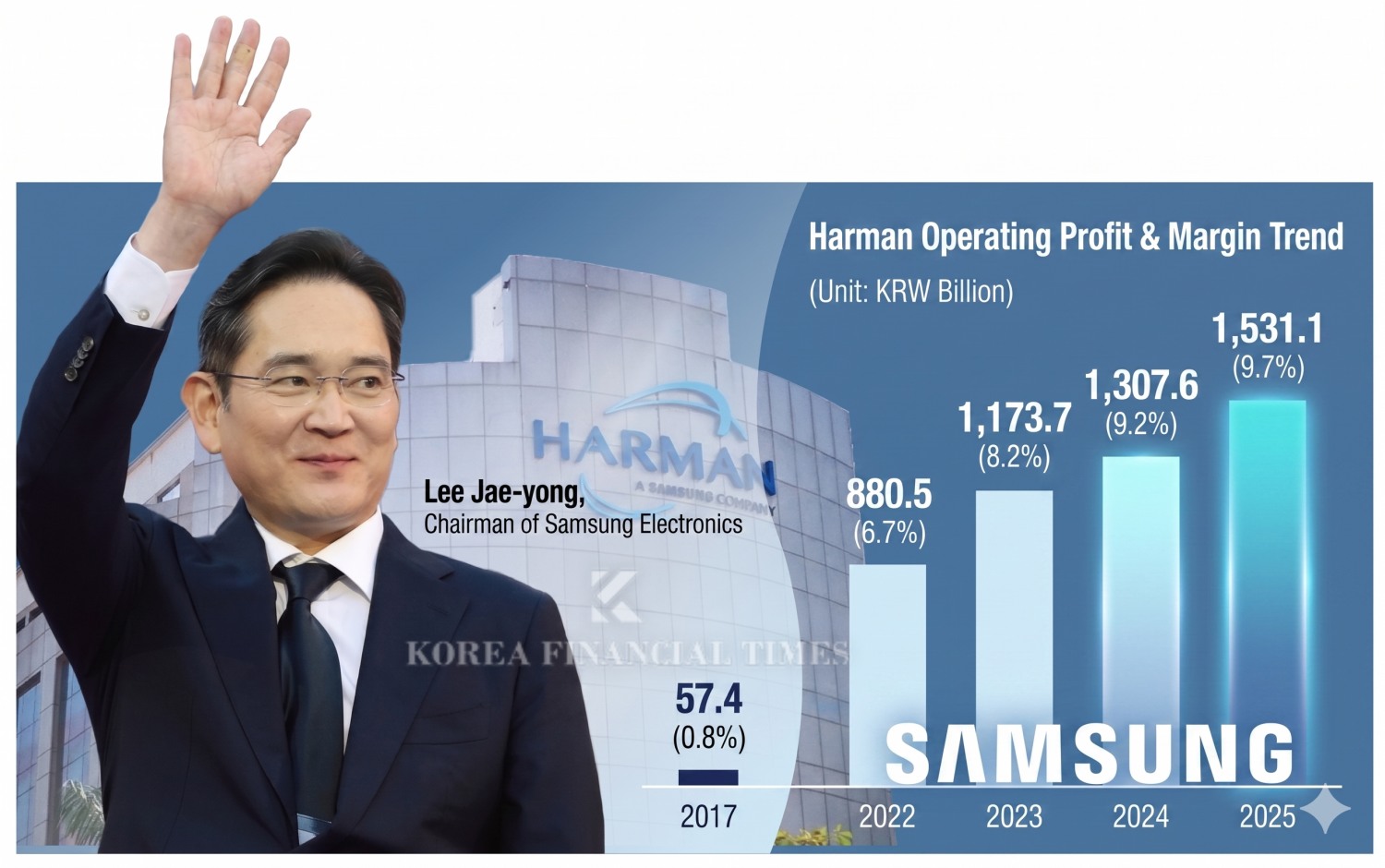
The acquisition of Harman is regarded as a landmark deal representing the "Lee Jae-yong era." It was the first major merger and acquisition (M&A) following his appointment as a registered director in 2016. The acquisition price was KRW 9.38 trillion at the time—a record that remains the largest overseas M&A ever conducted by a Korean company.
At the time, Samsung Electronics stated in a press release that it had been "preparing for the automotive electronics business centered on semiconductors and displays," adding that it aimed to "leap forward as a total solutions provider through Harman, a global leader in infotainment and telematics."
Now entering its tenth year under Samsung’s wing, Harman's transformation is remarkable. According to Samsung Electronics' business reports, Harman broke its own records last year, recording revenue of KRW 15.7833 trillion and an operating profit of KRW 1.5311 trillion.
Revenue grew by 10.6% year-on-year, while operating profit rose by 17.1%. Compared to the KRW 7.1034 trillion in revenue recorded in 2017—the first year of the acquisition—the figure has more than doubled. Operating profit has surpassed the KRW 1 trillion mark for three consecutive years, with operating margins nearing 10%.
What results are being yielded by the synergy between Samsung Electronics and Harman in automotive components? Chairman Lee Jae-yong identified "smart cars" as a future growth engine and led the acquisition of Harman for its strengths in automotive electronics. Rather than entering car manufacturing directly, the decision was based on leveraging synergies with Samsung’s existing businesses in semiconductors, displays, and batteries.
Harman’s business is largely divided into two sectors: automotive components and consumer audio. Its consumer audio division houses premium brands such as JBL, AKG, and Harman Kardon.
While the automotive component division is the flagship business accounting for 65% to 70% of revenue, the audio segment remains significant. Harman holds the global number one position in car audio, supplying luxury brands like Lexus, Lincoln, Genesis, and Rolls-Royce with brands such as Mark Levinson, Revel, and Lexicon.
The digital cockpit (integrated infotainment system) represents the intersection of Samsung’s technological prowess and Harman’s industry expertise. In recent years, Harman has shifted its focus from volume expansion to qualitative profitability in this sector.
Last year, Harman’s digital cockpit production reached approximately 5.897 million units, a 29% decrease from 8.334 million units in 2022. Total production capacity was also reduced by 31%, from 11.257 million to 7.815 million units.
During the same period, its global market share (based on sales value) fell by 5.1 percentage points, from 17.9% to 12.8%. This is viewed as a strategic decision to restructure for profitability amid the "EV chasm" (a temporary stall in electric vehicle demand) and a shifting market where specialized EV makers are internalizing technology.
While Harman’s performance continues an upward trajectory, its contribution to Samsung Electronics as a whole remains modest at 4.7% of total revenue and 3.5% of operating profit. The premium paid for the acquisition has yet to be fully recouped, leaving room for the criticism: "Did we just buy an audio company?"
In response, Harman placed a significant bet on future vehicles starting last year. In December, Harman announced the acquisition of the Advanced Driver Assistance Systems (ADAS) business unit of Germany’s ZF, a leader in smart cameras for ADAS. The deal is valued at approximately KRW 2.6 trillion and marks the first major automotive M&A within Samsung since the Harman acquisition eight years ago.
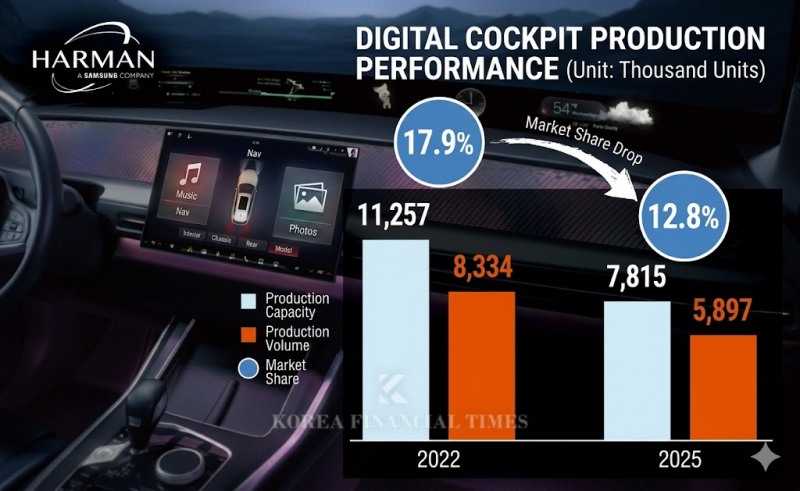
This infographic, originally published by Korea Financial Times, has been reconstructed using generative AI (Gemini).
이미지 확대보기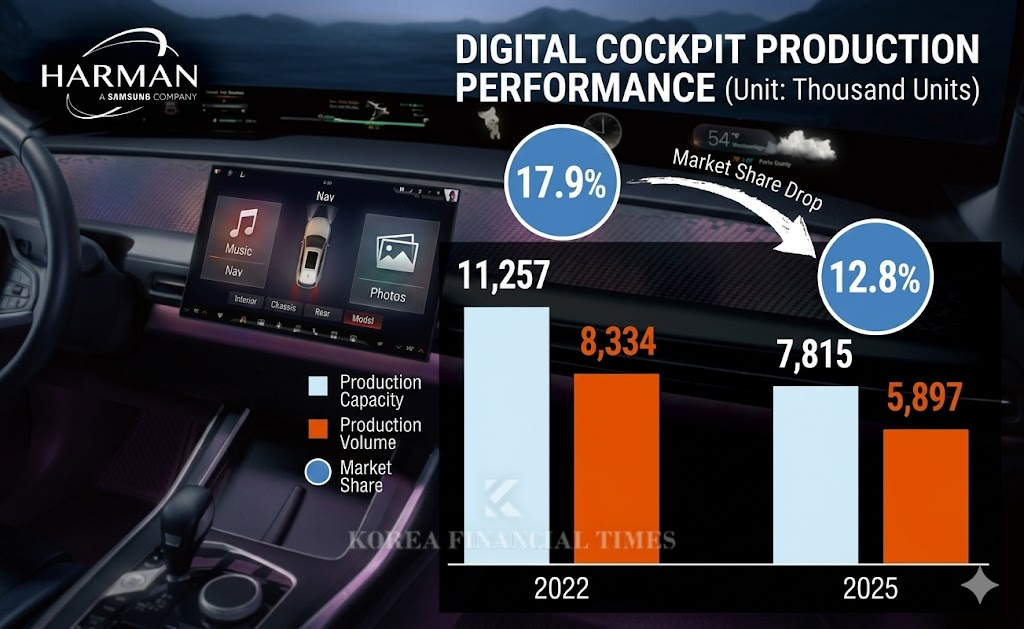
Harman stated the deal aims to establish a "centralized controller" through ADAS devices—responsible for core autonomous driving assistance—within its digital cockpit products. Centralized vehicle systems are considered a leading technology for future mobility, including autonomous driving and Software-Defined Vehicles (SDV). In particular, this is expected to trigger full-scale synergy between Samsung's semiconductor and automotive electronics businesses.
Harman is also focusing on "selection and concentration" by divesting non-core units. Last year, it sold eight subsidiaries of "Harman Connected Services" worldwide to Indian IT firm Wipro for approximately KRW 520 billion. As this business unit overlapped with Samsung Electronics' DX division and Samsung SDS, the move was seen as eliminating redundant investment.
Further M&As to expand the automotive business are anticipated. In March, Samsung Electronics announced through a corporate value enhancement plan that it would "pursue M&As of a meaningful scale." Mentioned sectors included advanced robotics, meditech, HVAC, and automotive electronics.
Significantly, Ahn Jung-hyun, President of Samsung Electronics and a key architect of the Harman deal, was appointed head of the newly established M&A team within the Business Support Office. President Ahn is a portfolio strategy expert who facilitated over 50 M&As at the Future Strategy Office since 2010. He continues to serve on Harman’s board of directors.
Gwak Horyung (horr@fntimes.com)











![유한양행, 영업익 35%↑ 예고…‘수장 교체기’ 실탄 다진다 [5대 제약사 3Q 실적 ①]](https://cfnimage.commutil.kr/phpwas/restmb_setimgmake.php?pp=006&w=69&h=45&m=5&simg=202610021114080076807fd637f543112168227135.jpg&nmt=18)

![서초구 '래미안원베일리' 44평, 9억 오른 94억원에 거래 [일일 신고가]](https://cfnimage.commutil.kr/phpwas/restmb_setimgmake.php?pp=006&w=69&h=45&m=5&simg=2025053017540607971e41d7fc6c2183101242202.jpg&nmt=18)

![[THE COMPASS] 한화오션, 수주잔고 증가 불구 주가 짓누르는 ‘무배당 기조’](https://cfnimage.commutil.kr/phpwas/restmb_setimgmake.php?pp=006&w=69&h=45&m=5&simg=20261002141710004730a837df649412411124362.jpg&nmt=18)


![[그래픽 뉴스] ‘순대’가 경제용어라고? 순(純)대외자산, 한국의 진짜 해외자산은 얼마일까?](https://cfnimage.commutil.kr/phpwas/restmb_setimgmake.php?pp=006&w=298&h=298&m=1&simg=202609021356075202de68fcbb3512411124362_0.jpg&nmt=18)
![[그래픽 뉴스] ISA 대개편! 나에게 유리한 계좌는?](https://cfnimage.commutil.kr/phpwas/restmb_setimgmake.php?pp=006&w=298&h=298&m=1&simg=202608041713155615de68fcbb3512411124362_0.jpg&nmt=18)
![[그래픽 뉴스] 미국 증시 새로운 키워드 'MANGOS'](https://cfnimage.commutil.kr/phpwas/restmb_setimgmake.php?pp=006&w=298&h=298&m=1&simg=202607291740382069de68fcbb3512411124362_0.jpg&nmt=18)

![[그래픽 뉴스] 은퇴후 30년 부모님 세대의 생존전략](https://cfnimage.commutil.kr/phpwas/restmb_setimgmake.php?pp=006&w=298&h=298&m=1&simg=202606301704439153de68fcbb3512411124362_0.jpg&nmt=18)
![[신간]은퇴연옥…김경록의 은퇴 후 삶의 나침반](https://cfnimage.commutil.kr/phpwas/restmb_setimgmake.php?pp=006&w=81&h=123&m=5&simg=20260414140833047280f8caa4a5ce12411124362.jpg&nmt=18)
![[신간] 물처럼 흐르고 원칙으로 서다…김용환의 통찰을 담다](https://cfnimage.commutil.kr/phpwas/restmb_setimgmake.php?pp=006&w=81&h=123&m=5&simg=20260409114249027860f8caa4a5ce12411124362.jpg&nmt=18)
![[안현정 서평] 플랫폼의 영지에서 ‘미학적 주권’을 선포하라...'K가 죽어야 K가 산다' 장준환 著](https://cfnimage.commutil.kr/phpwas/restmb_setimgmake.php?pp=006&w=81&h=123&m=5&simg=20260527121426063220c1c16452b012411124362.jpg&nmt=18)
![[서평] 추세 매매의 대가들...추세추종 투자전략의 대가 14인 인터뷰](https://cfnimage.commutil.kr/phpwas/restmb_setimgmake.php?pp=006&w=81&h=123&m=5&simg=2023102410444004986c1c16452b0175114235199.jpg&nmt=18)


![[머니무브 2026] “지금 사도 될까?” 답이 안 보인다면…하반기 투자, 4명의 전문가에게 물어보세요](https://cfnimage.commutil.kr/phpwas/restmb_setimgmake.php?pp=006&w=89&h=45&m=1&simg=202609151044050355302a735e27af12411124362.jpg&nmt=18)
![[AD] ‘PBV 라인업 확장’ 기아, 9월 독일서 ‘PV7’ 첫 공개](https://cfnimage.commutil.kr/phpwas/restmb_setimgmake.php?pp=006&w=89&h=45&m=1&simg=2026083111010602815074925877361231180222.jpg&nmt=18)
![[AD] 제네시스, 럭셔리 경험 더한 ‘2027 GV70’‧‘GV70 그래파이트’ 출시](https://cfnimage.commutil.kr/phpwas/restmb_setimgmake.php?pp=006&w=89&h=45&m=1&simg=20260702143546085600749258773622211122717.jpg&nmt=18)