





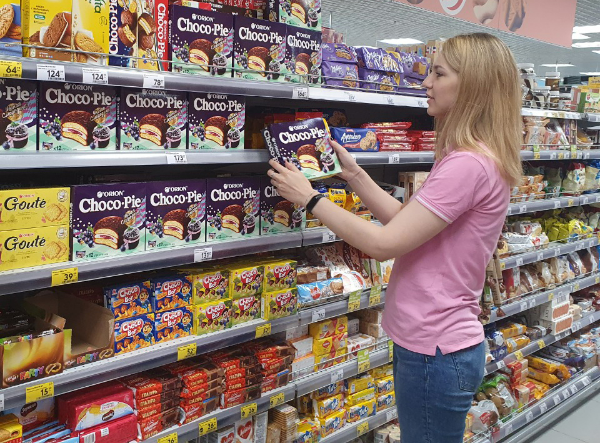
Orion products displayed in a local store in Russia / Photo courtesy of Orion
According to industry sources on April 17, Orion’s board of directors approved on the 15th a plan to invest KRW 460 billion in constructing an integrated production, packaging, and logistics center at the Technopolis Industrial Complex in Jincheon-gun, Chungcheongbuk-do. This marks the largest domestic investment by a food company in the past five years.
The Jincheon Integrated Center will be built on a 188,000㎡ site—equivalent to 26 soccer fields—with a total floor area of 149,000㎡. It will serve as a one-stop production base, integrating manufacturing, packaging, and logistics, and is scheduled for completion in 2027. Construction will begin in the middle of this year, and the center will supply both domestic and export volumes. Upon completion, Orion’s domestic production capacity will reach up to KRW 2.3 trillion.
Orion is also investing in its overseas production facilities, particularly in Russia and Vietnam. Orion’s Russian subsidiary recorded sales of KRW 230.5 billion last year, up 15.1% from the previous year (KRW 200.3 billion). Orion has taken note of the fact that its local sales volume in Russia has continued to grow at a double-digit rate for the past six consecutive years. With the current factory operation rate in Russia exceeding 120% and a shortage in Choco Pie supply, the company has decided to build a new production facility within its Tver plant. This comes just three years after Orion began operations at the new Tver plant in 2022.
Russia has a cultural tradition of enjoying tea in daily life, which leads to a strong preference for snacks like Choco Pies. Orion will invest KRW 240 billion to add 16 production lines for pies, biscuits, snacks, and jellies, doubling Russia’s production capacity to KRW 750 billion.
In Vietnam, Orion’s subsidiary posted sales of KRW 514.5 billion last year, an 8.2% increase from the previous year’s KRW 475.5 billion. Orion plans to invest KRW 130 billion in Vietnam to solidify its position as the top local food company. Later this year, Orion will expand its Yen Phong plant in Hanoi to add a rice snack production line. Orion’s rice snacks are on the verge of becoming the market leader in Vietnam this year, just six years after their launch.
The company will also expand production lines for candies, pies, and jellies. If all goes according to plan, Vietnam’s production capacity will reach KRW 900 billion. The third Hanoi plant, which will house logistics and packaging facilities, will break ground this year and is slated for completion next year.
Including these projects, Orion’s investment in expanding domestic and overseas plants totals KRW 830 billion. With this aggressive investment, Orion has set ambitious targets of KRW 5 trillion in sales and KRW 1 trillion in operating profit.
Trump’s Wavering Tariffs... Korean Food and Beauty Industries in Deep Concern Over CountermeasuresLast Year’s Jackpot, Pharma Firms Bet Everything on the Next Blockbuster DrugPharmaceutical DNA in Kolmar Korea and COSMAX... True Commitment to R&D"A Spectacular Comeback"—CJ CheilJedang’s Kang Shin-ho Expands K-Food Influence Overseas
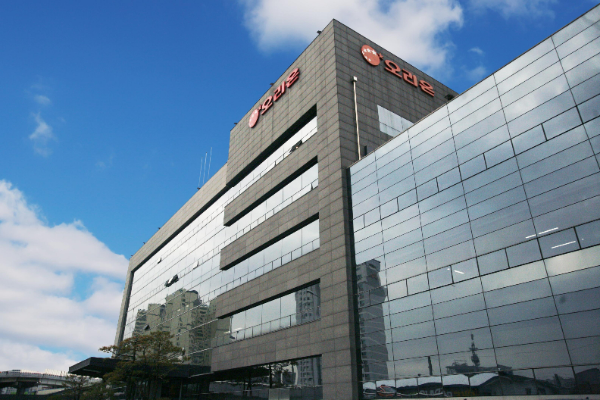
Orion Headquarters / Photo courtesy of Orion
Orion’s bold investments are underpinned by rapid overseas growth. Last year, the company posted record consolidated sales of KRW 3.1043 trillion and operating profit of KRW 543.6 billion, achieving an operating margin of 17.5%. It marks a historic milestone for the company, not only surpassing 3 trillion KRW in annual sales for the first time but also achieving its highest-ever operating profit margin.
Overseas sales reached KRW 2.0441 trillion, up 8.9% from the previous year’s KRW 1.8766 trillion, raising Orion’s global sales ratio to over 66%. In contrast, competitors such as Lotte Wellfood have an overseas sales ratio of just under 20%, while Crown Confectionery and Haitai Confectionery & Foods remain below 10%. While domestic food companies struggle with stagnating local demand, Orion continues to post strong results.
Orion currently operates subsidiaries in six countries: China, Vietnam, Russia, India, Indonesia, and the United States. Major production facilities are located in South Korea, China, Vietnam, Russia, and India, totaling 17 plants. China accounts for more than half of Orion’s overseas sales, with last year’s revenue at KRW 1.2701 trillion, representing 62.1% of the company’s international business. This growth is largely attributed to Orion’s strategy of focusing its sales network on 'Jingxiaoshang' to better align with the Chinese local market.
A “Jingxiaoshang” in China is similar to a reseller or intermediary distributor in Korea. These individuals or businesses receive products directly from manufacturers and sell them under their own name through local distribution networks in China. As small-scale retail channels—like snack shops—have grown in popularity across China, the role of Jingxiaoshang has become increasingly important. Given China's vast territory, these resellers help extend product reach to even the most remote regions. Orion has focused on identifying and partnering with such distributors, which has enabled popular products like Choco Pie and Mygummy to be sold across the entire country.
Thanks to its strong performance, Orion’s cash reserves have also grown. Last year, the company’s cash and cash equivalents reached KRW 451.3 billion, up 23.4% from the previous year’s KRW 365.8 billion. During the same period, Orion’s total assets jumped 22.3%, rising from 3.5214 trillion KRW the previous year to 4.3084 trillion KRW. Orion has used dividends from its overseas subsidiaries to fund new plant construction, securing a total of KRW 640 billion in dividends over the past three years, which have been reinvested in its food business and used for shareholder returns.
In addition, Orion made a rare move last year by acquiring LigaChem Biosciences, Inc., a biotechnology company, for KRW 550 billion. This was Orion’s first major M&A since acquiring Jeju Yongamsoo in 2016. With a 25.73% stake, Orion became the largest shareholder of LigaChem Biosciences, which specializes in antibody-drug conjugate (ADC) technology for new drug development. Dam Seo-won, Executive Director of Management and the eldest son of Orion’s Chairman Dam Chul-gon and Vice Chairwoman Lee Hwa-kyung, joined the board of LigaChem Biosciences as an inside director.
Ultimately, Orion’s strategy is to simultaneously grow its K-snack and K-pharmaceutical businesses, transforming into a global food and bio company—a vision supported by its more than KRW 1 trillion in investments over the past year.
At the regular shareholders’ meeting last month, Lee Seung-jun, CEO of Orion, stated, “We will not only expand domestic supply but also strengthen our ability to supply products for export to the United States, China, Australia, Europe, and other markets. LigaChem Biosciences possesses world-class next-generation ADC cancer drug development capabilities, and by leveraging our Boston subsidiary’s clinical capabilities, we aim to become a leading global biotech company.”
Son Wontae (tellme@fntimes.com)