






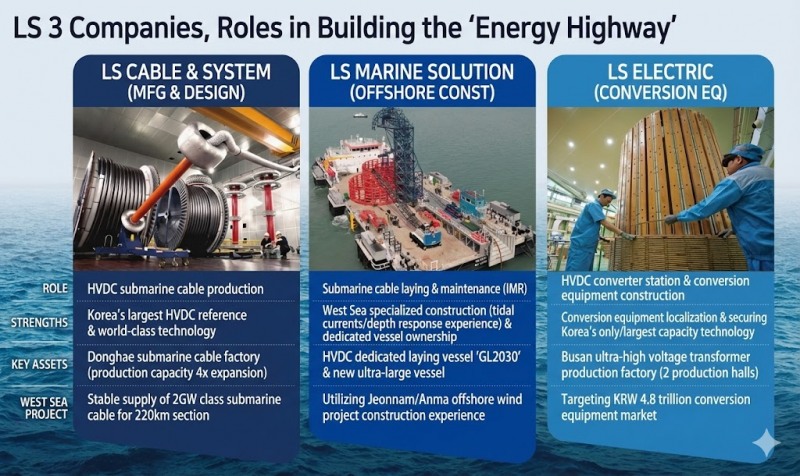
This graphic, originally published by Korea Financial Times, has been reconstructed using generative AI (Gemini).
이미지 확대보기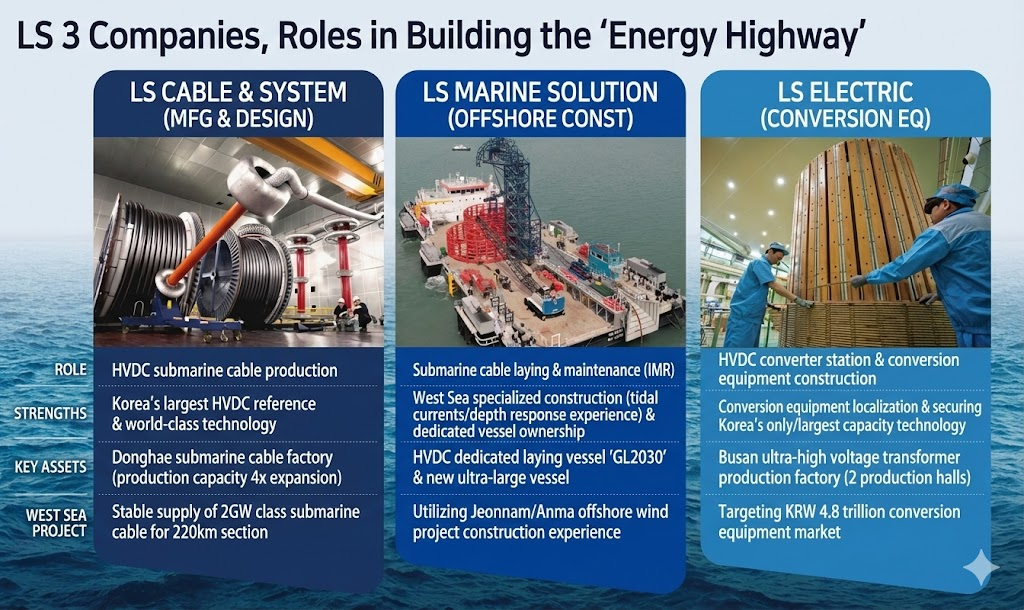
By building a vertically integrated structure covering the entire process — from cable manufacturing and offshore construction to conversion equipment — the three companies are squarely targeting the massive project, estimated at approximately KRW 12 trillion.
Total Project Cost: KRW 11.5 Trillion
The Energy Highway is a national power grid construction project designed to connect renewable energy production sites with large-scale power consumption centers, aimed at resolving persistent grid bottleneck issues. Domestic renewable energy generation facilities are concentrated in the southwestern coastal regions such as South Jeolla (Jeonnam) and North Jeolla (Jeonbuk), while electricity demand is heavily concentrated in the Seoul metropolitan area and major industrial complexes.The West Sea Energy Highway aims to directly transmit solar and offshore wind power generated in the Honam region to the metropolitan area, resolving the inter-regional power supply-demand imbalance. The project entails constructing two round-trip circuits of 2GW-class High Voltage Direct Current (HVDC) submarine cables along an approximately 220-kilometer offshore route from Saemangeum in North Jeolla to Hwaseong in Gyeonggi Province, with total project costs estimated at KRW 11.5 trillion.
The government's 11th Basic Plan for Electricity Supply and Demand had originally set the target completion date for the Yellow Sea submarine transmission network at 2036, but with the pace of renewable energy expansion and power demand growth exceeding expectations, the timeline has been advanced by six years to 2030.
The plan calls for completing the Yellow Sea submarine transmission network by 2030, followed by the completion of a U-shaped national offshore power grid connecting the South Sea and East Sea by 2040. "For the project to break ground in 2027, the announcement for selection of the primary contractor must be issued within the first half of this year," an industry official said.
The core technology for this project is HVDC, which converts alternating current (AC) electricity generated at power plants into direct current (DC) for transmission, then converts it back to AC. It incurs less power loss compared to conventional High Voltage Alternating Current (HVAC) transmission. In particular, HVDC can transmit three times more power than AC using towers of the same size, allowing for a reduction in the number and size of towers and thereby improving social acceptability in areas where new or expanded facilities are difficult to install.
While initial construction costs are higher, HVDC requires no reactive power compensation devices, and its economic viability increases over longer distances. It becomes more cost-effective than conventional methods for underground routes of 300–400 km or more and submarine routes of 30–50 km or more, making it virtually indispensable for large-scale offshore wind power or cross-border grid interconnections. It also enables stable control of the intermittent power output characteristic of renewable energy sources.
Technical Capability and Track Record Are Key
As the success of the West Sea Energy Highway project hinges on submarine HVDC technical capability and execution experience, LS Group — encompassing manufacturing, construction, and conversion equipment — is expected to play a pivotal role. In particular, combining LS Cable & System's cable manufacturing capabilities with LS Marine Solution's submarine construction experience would enable a "turnkey" delivery covering everything from design and construction to maintenance.LS Cable & System holds the most commercial HVDC cable references domestically and is cited as a key supplier for this project. The company has demonstrated its large-capacity transmission technology by applying the world's first 500kV 90°C high-temperature HVDC cables on the Jeju–Jindo and Jeju–Singapyeong routes. The company has also expanded its production infrastructure, commissioning five submarine cable factory buildings in Donghae City, Gangwon Province, increasing HVDC submarine cable production capacity more than fourfold. It has secured the capacity to stably supply the volumes required for large-scale projects. Its ability to handle the full lifecycle of power grid projects — encompassing design, manufacturing, and operations and maintenance (O&M) including inspection, maintenance, and repair (IMR) — is also cited as a key strength.
LS Marine Solution is the No. 1 submarine cable installation specialist in South Korea. Drawing on its accumulated construction experience in domestic submarine cable laying, it is regarded as a core pillar of project execution. Having carried out submarine cable laying for an offshore wind project in South Jeolla Province, the company has built up construction capabilities in the challenging conditions unique to the Yellow Sea, including tidal currents, water depth, and seabed topography. It is also slated to perform submarine cable laying for the Anma Offshore Wind project.
The company operates South Korea's first HVDC-dedicated submarine cable laying vessel, the "GL2030," and is currently constructing an ultra-large HVDC-dedicated laying vessel with a cable loading capacity of 13,000 tonnes. This is expected to significantly enhance the efficiency and stability of future large-scale submarine transmission project execution. The company has also invested KRW 72 billion to develop an offshore wind installation port, securing a hub for offshore power infrastructure.
Conversion equipment represents another critical element in the HVDC transmission network. LS Electric has secured technical capability and production infrastructure across both current-source and voltage-source HVDC conversion equipment in preparation for market expansion.
LS Electric recently completed development of a 500MW-class voltage-source HVDC conversion transformer and is on the verge of commercialization. This represents the largest domestic capacity of its kind and is set to be applied to the Sinbupyeong HVDC converter station being pursued by Korea Electric Power Corporation (KEPCO). LS Electric also holds extensive experience executing current-source HVDC conversion transformer projects, and is regarded as having high stability in executing large-scale HVDC projects.
Since 2014, the company has secured a total of four HVDC conversion transformer projects with a combined contract value of approximately KRW 900 billion. In the valve segment — a critical HVDC component — it has completed development of current-source thyristor valves and is also pursuing domestic localization of voltage-source valves in collaboration with GE Vernova.
The government estimates that approximately KRW 4.8 trillion will be invested in conversion equipment alone during the construction of the West Sea Energy Highway. With the completion of a voltage-source HVDC conversion transformer production plant at its Busan facility imminent, LS Electric is assessed to be at least two years ahead of competitors in terms of production readiness.
Shin Haeju (hjs0509@fntimes.com)











![이성훈 LH 사장 다주택·대출 규제 발언 도마…여야 의원 잇단 지적 [2026 국감]](https://cfnimage.commutil.kr/phpwas/restmb_setimgmake.php?pp=006&w=69&h=45&m=5&simg=20261012163012026870048b718333218159227151.jpg&nmt=18)

![12개월 최고 연 6.00%…BNK저축은행 'BNK동행적금'[이주의 저축은행 적금금리-10월 2주]](https://cfnimage.commutil.kr/phpwas/restmb_setimgmake.php?pp=006&w=69&h=45&m=5&simg=202610110103170668607c96e797801121481643.jpg&nmt=18)

![12개월 최고 연 4.10%…OK저축은행 'OK e-안심앱플러스정기예금6'[이주의 저축은행 예금금리-10월 2주]](https://cfnimage.commutil.kr/phpwas/restmb_setimgmake.php?pp=006&w=69&h=45&m=5&simg=202610110051040059207c96e797801121481643.jpg&nmt=18)


![[그래픽 뉴스] ‘순대’가 경제용어라고? 순(純)대외자산, 한국의 진짜 해외자산은 얼마일까?](https://cfnimage.commutil.kr/phpwas/restmb_setimgmake.php?pp=006&w=298&h=298&m=1&simg=202609021356075202de68fcbb3512411124362_0.jpg&nmt=18)
![[그래픽 뉴스] ISA 대개편! 나에게 유리한 계좌는?](https://cfnimage.commutil.kr/phpwas/restmb_setimgmake.php?pp=006&w=298&h=298&m=1&simg=202608041713155615de68fcbb3512411124362_0.jpg&nmt=18)
![[그래픽 뉴스] 미국 증시 새로운 키워드 'MANGOS'](https://cfnimage.commutil.kr/phpwas/restmb_setimgmake.php?pp=006&w=298&h=298&m=1&simg=202607291740382069de68fcbb3512411124362_0.jpg&nmt=18)

![[그래픽 뉴스] 은퇴후 30년 부모님 세대의 생존전략](https://cfnimage.commutil.kr/phpwas/restmb_setimgmake.php?pp=006&w=298&h=298&m=1&simg=202606301704439153de68fcbb3512411124362_0.jpg&nmt=18)
![[신간]은퇴연옥…김경록의 은퇴 후 삶의 나침반](https://cfnimage.commutil.kr/phpwas/restmb_setimgmake.php?pp=006&w=81&h=123&m=5&simg=20260414140833047280f8caa4a5ce12411124362.jpg&nmt=18)
![[신간] 물처럼 흐르고 원칙으로 서다…김용환의 통찰을 담다](https://cfnimage.commutil.kr/phpwas/restmb_setimgmake.php?pp=006&w=81&h=123&m=5&simg=20260409114249027860f8caa4a5ce12411124362.jpg&nmt=18)
![[안현정 서평] 플랫폼의 영지에서 ‘미학적 주권’을 선포하라...'K가 죽어야 K가 산다' 장준환 著](https://cfnimage.commutil.kr/phpwas/restmb_setimgmake.php?pp=006&w=81&h=123&m=5&simg=20260527121426063220c1c16452b012411124362.jpg&nmt=18)
![[서평] 추세 매매의 대가들...추세추종 투자전략의 대가 14인 인터뷰](https://cfnimage.commutil.kr/phpwas/restmb_setimgmake.php?pp=006&w=81&h=123&m=5&simg=2023102410444004986c1c16452b0175114235199.jpg&nmt=18)


![[머니무브 2026] “지금 사도 될까?” 답이 안 보인다면…하반기 투자, 4명의 전문가에게 물어보세요](https://cfnimage.commutil.kr/phpwas/restmb_setimgmake.php?pp=006&w=89&h=45&m=1&simg=202609151044050355302a735e27af12411124362.jpg&nmt=18)
![[AD] ‘PBV 라인업 확장’ 기아, 9월 독일서 ‘PV7’ 첫 공개](https://cfnimage.commutil.kr/phpwas/restmb_setimgmake.php?pp=006&w=89&h=45&m=1&simg=2026083111010602815074925877361231180222.jpg&nmt=18)
![[AD] 제네시스, 럭셔리 경험 더한 ‘2027 GV70’‧‘GV70 그래파이트’ 출시](https://cfnimage.commutil.kr/phpwas/restmb_setimgmake.php?pp=006&w=89&h=45&m=1&simg=20260702143546085600749258773622211122717.jpg&nmt=18)