






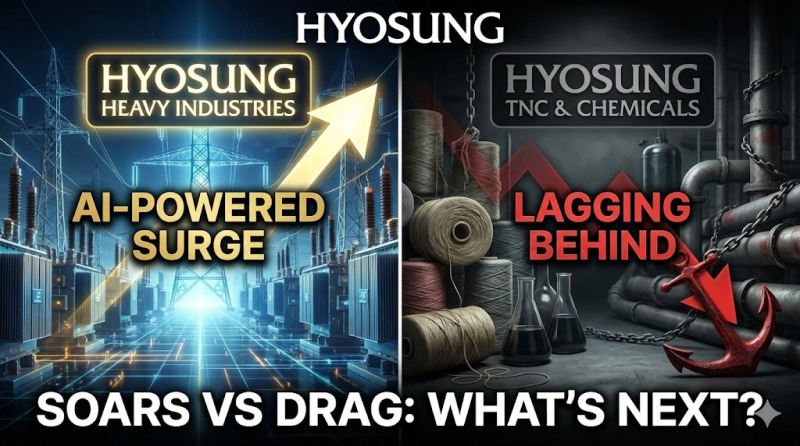
Hyosung's One-Engine Problem: Heavy Industries Soars While Textiles and Chemicals Drag / AI generated
이미지 확대보기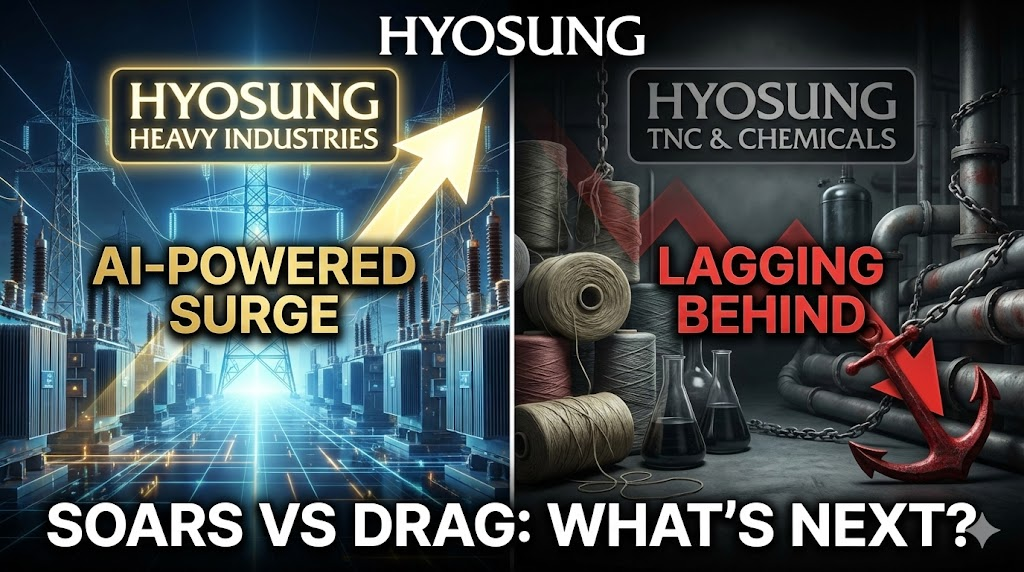
Heavy Industries Rides the AI Wave
Hyosung, the holding company of Hyosung Group, posted consolidated revenue of KRW 2.4317 trillion and operating profit of KRW 393 billion in 2025. Revenue and operating profit rose 7% and 77.7%, respectively, year-on-year. The group has now achieved two consecutive years of performance improvement since bottoming out in 2023, following a one-time surge driven by COVID-era demand in 2021.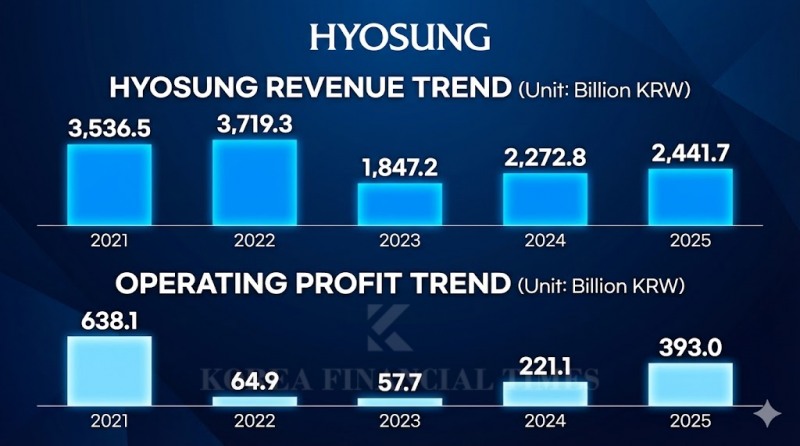
This infographic, originally published by Korea Financial Times, has been reconstructed using generative AI (Gemini).
이미지 확대보기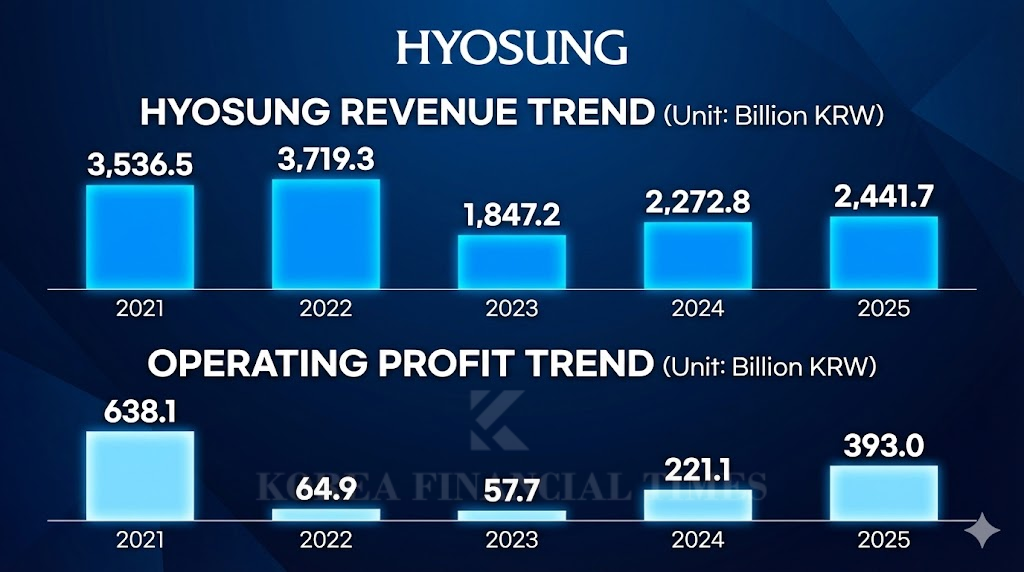
T&C: Hopes for Oversupply Resolution
The persistent underperformance of the textile and chemical subsidiaries, however, remains a source of concern.Hyosung TNC, whose core product is spandex — a segment in which it holds a 30% global market share and ranks first worldwide — reported operating profit of KRW 251.5 billion last year, down 7.1% from the prior year. Net profit fell 79.2% over the same period to KRW 38.2 billion. The financial strain is attributed to the large-scale acquisition financing raised to acquire Hyosung Chemical's specialty gas division (Hyosung Neokem), which has been accumulating losses.
On a positive note, expectations for Hyosung TNC's performance are growing this year amid improving sentiment in the spandex market. According to industry sources, Huahai, China's third-largest spandex producer, filed for bankruptcy at a local court last month. Analysts note that expectations for easing supply pressure are driving selling price increases. Reflecting these developments, Hyosung TNC's share price has surged 79.7% so far this year.
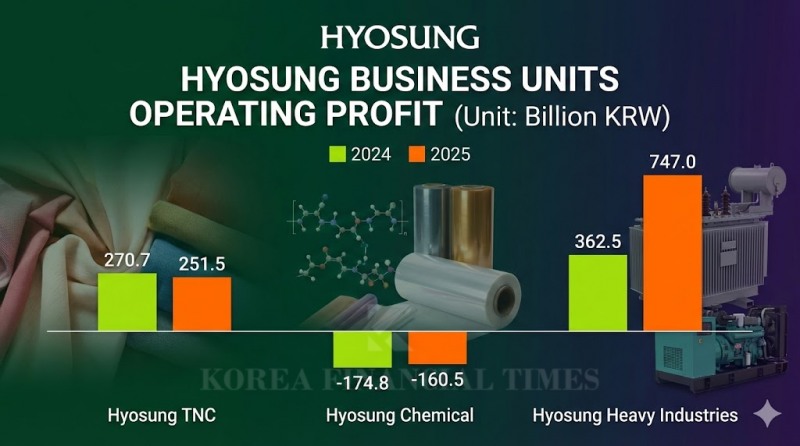
This infographic, originally published by Korea Financial Times, has been reconstructed using generative AI (Gemini).
이미지 확대보기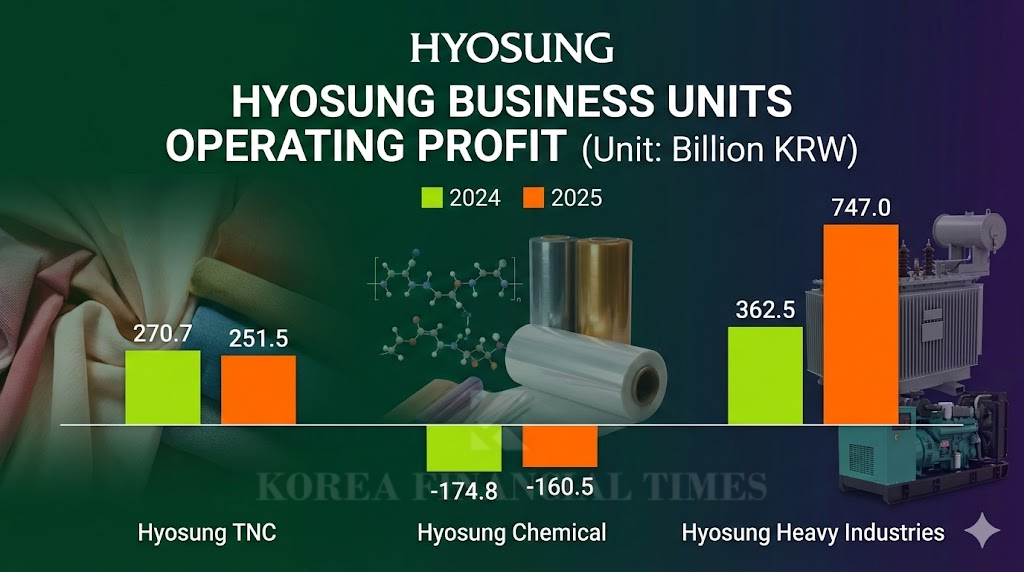
Hyosung Chemical posted an operating loss of KRW 160.5 billion last year, narrowing its deficit by approximately 8% year-on-year. However, prospects for a recovery remain subdued, as the company recorded an operating loss of KRW 73.3 billion in the fourth quarter alone. While the company averted the risk of capital impairment through various asset divestitures last year, its net debt-to-equity ratio stood at 235.5% at year-end, indicating that its financial burden remains excessive.
Dividends That Cannot Be Paused Despite Deteriorating Profitability
Hyosung, Hyosung TNC, Hyosung Heavy Industries, and Hyosung Chemical have yet to resolve their dividend proposals for fiscal year 2025.Hyosung, Hyosung Heavy Industries, and Hyosung Chemical do not have separate dividend policies. Hyosung TNC is the only entity that has committed to a policy of "reviewing dividends of 20% or more of net profit," but last year's poor earnings make it difficult to expect a meaningful payout under that criterion.
Nevertheless, there is a prevailing view that the group will maintain a high-dividend policy — excluding Hyosung Chemical, which has suspended dividends due to its losses. The rationale is that Chairman Cho Hyun-joon, who inherited the estate of Honorary Chairman Cho Suk-rai in 2024, will need to secure funding for inheritance tax obligations. Chairman Cho directly holds stakes of 41.02% in Hyosung, 20.73% in Hyosung TNC, and 10% in Hyosung Heavy Industries. He can also benefit from dividends through Hyosung's holdings of 20.78% in Hyosung TNC and 32.47% in Hyosung Heavy Industries.
The dividend decision at Hyosung Heavy Industries is of particular significance, given its strong earnings momentum. Hyosung Heavy Industries, which paid its first-ever dividend in 2023, has been on an upward trajectory, roughly doubling its total dividend payout from KRW 23.3 billion in 2023 to KRW 46.6 billion in 2024.
In the case of Hyosung TNC, the company has distributed KRW 43.2 billion in dividends annually for the past three consecutive years, regardless of its financial performance. If the same dividend amount is maintained in 2025, the payout ratio would reach 113%, far exceeding the company's own stated threshold of 20%.
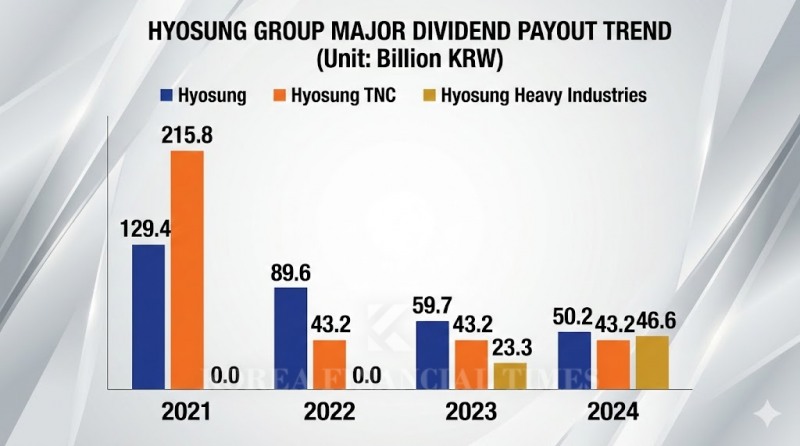
This infographic, originally published by Korea Financial Times, has been reconstructed using generative AI (Gemini).
이미지 확대보기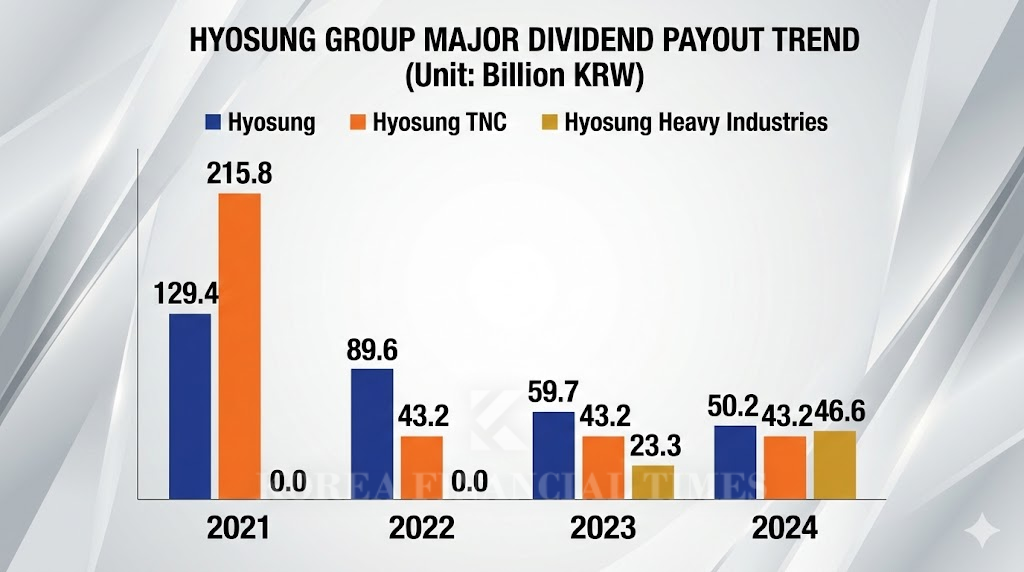
Gwak Horyung (horr@fntimes.com)











![이성훈 LH 사장 다주택·대출 규제 발언 도마…여야 의원 잇단 지적 [2026 국감]](https://cfnimage.commutil.kr/phpwas/restmb_setimgmake.php?pp=006&w=69&h=45&m=5&simg=20261012163012026870048b718333218159227151.jpg&nmt=18)

![12개월 최고 연 6.00%…BNK저축은행 'BNK동행적금'[이주의 저축은행 적금금리-10월 2주]](https://cfnimage.commutil.kr/phpwas/restmb_setimgmake.php?pp=006&w=69&h=45&m=5&simg=202610110103170668607c96e797801121481643.jpg&nmt=18)

![12개월 최고 연 4.10%…OK저축은행 'OK e-안심앱플러스정기예금6'[이주의 저축은행 예금금리-10월 2주]](https://cfnimage.commutil.kr/phpwas/restmb_setimgmake.php?pp=006&w=69&h=45&m=5&simg=202610110051040059207c96e797801121481643.jpg&nmt=18)


![[그래픽 뉴스] ‘순대’가 경제용어라고? 순(純)대외자산, 한국의 진짜 해외자산은 얼마일까?](https://cfnimage.commutil.kr/phpwas/restmb_setimgmake.php?pp=006&w=298&h=298&m=1&simg=202609021356075202de68fcbb3512411124362_0.jpg&nmt=18)
![[그래픽 뉴스] ISA 대개편! 나에게 유리한 계좌는?](https://cfnimage.commutil.kr/phpwas/restmb_setimgmake.php?pp=006&w=298&h=298&m=1&simg=202608041713155615de68fcbb3512411124362_0.jpg&nmt=18)
![[그래픽 뉴스] 미국 증시 새로운 키워드 'MANGOS'](https://cfnimage.commutil.kr/phpwas/restmb_setimgmake.php?pp=006&w=298&h=298&m=1&simg=202607291740382069de68fcbb3512411124362_0.jpg&nmt=18)

![[그래픽 뉴스] 은퇴후 30년 부모님 세대의 생존전략](https://cfnimage.commutil.kr/phpwas/restmb_setimgmake.php?pp=006&w=298&h=298&m=1&simg=202606301704439153de68fcbb3512411124362_0.jpg&nmt=18)
![[신간]은퇴연옥…김경록의 은퇴 후 삶의 나침반](https://cfnimage.commutil.kr/phpwas/restmb_setimgmake.php?pp=006&w=81&h=123&m=5&simg=20260414140833047280f8caa4a5ce12411124362.jpg&nmt=18)
![[신간] 물처럼 흐르고 원칙으로 서다…김용환의 통찰을 담다](https://cfnimage.commutil.kr/phpwas/restmb_setimgmake.php?pp=006&w=81&h=123&m=5&simg=20260409114249027860f8caa4a5ce12411124362.jpg&nmt=18)
![[안현정 서평] 플랫폼의 영지에서 ‘미학적 주권’을 선포하라...'K가 죽어야 K가 산다' 장준환 著](https://cfnimage.commutil.kr/phpwas/restmb_setimgmake.php?pp=006&w=81&h=123&m=5&simg=20260527121426063220c1c16452b012411124362.jpg&nmt=18)
![[서평] 추세 매매의 대가들...추세추종 투자전략의 대가 14인 인터뷰](https://cfnimage.commutil.kr/phpwas/restmb_setimgmake.php?pp=006&w=81&h=123&m=5&simg=2023102410444004986c1c16452b0175114235199.jpg&nmt=18)


![[머니무브 2026] “지금 사도 될까?” 답이 안 보인다면…하반기 투자, 4명의 전문가에게 물어보세요](https://cfnimage.commutil.kr/phpwas/restmb_setimgmake.php?pp=006&w=89&h=45&m=1&simg=202609151044050355302a735e27af12411124362.jpg&nmt=18)
![[AD] ‘PBV 라인업 확장’ 기아, 9월 독일서 ‘PV7’ 첫 공개](https://cfnimage.commutil.kr/phpwas/restmb_setimgmake.php?pp=006&w=89&h=45&m=1&simg=2026083111010602815074925877361231180222.jpg&nmt=18)
![[AD] 제네시스, 럭셔리 경험 더한 ‘2027 GV70’‧‘GV70 그래파이트’ 출시](https://cfnimage.commutil.kr/phpwas/restmb_setimgmake.php?pp=006&w=89&h=45&m=1&simg=20260702143546085600749258773622211122717.jpg&nmt=18)