






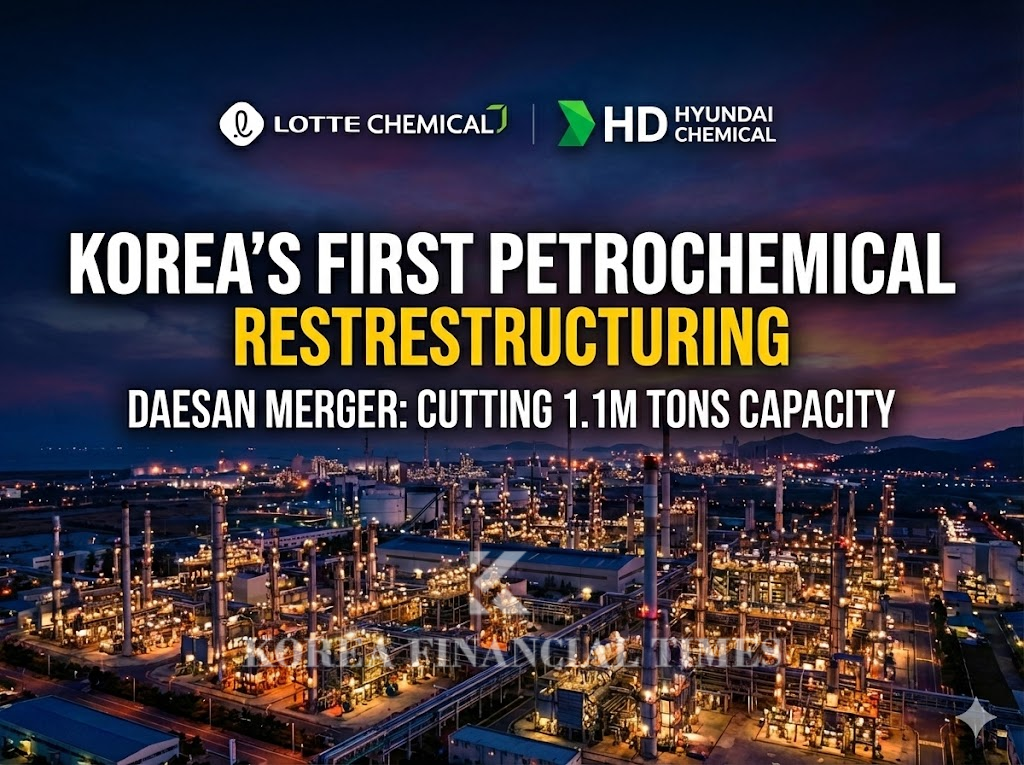
On the 25th, the government convened a joint meeting of the Ministers' Meeting on Economic Affairs and the Ministers' Meeting on Industrial Competitiveness Enhancement, at which it finalized the "Daesan Project No. 1 Business Reorganization Progress and Support Package." Under the plan, HD Hyundai Chemical (a joint venture between HD Hyundai Oilbank and Lotte Chemical) and Lotte Chemical's Daesan operations will be integrated. Lotte Chemical will spin off its Daesan business through a physical division and merge it into HD Hyundai Chemical to create a new integrated entity. The ownership stake in the combined HD Hyundai Chemical will shift from the existing 6 (HD Hyundai Oilbank) to 4 (Lotte Chemical) ratio to a 50-50 split.
HD Hyundai Oilbank and Lotte Chemical have agreed to inject KRW 600 billion each — a combined KRW 1.2 trillion — into the newly integrated entity.
The two companies plan to invest KRW 245 billion in reducing low-value-added facilities and improving operational efficiency, including a three-year suspension of Lotte Chemical's naphtha cracking center (NCC) with a capacity of 1.1 million tons. As a result, the integrated entity's ethylene production capacity will be reduced from 1.95 million tons to 850,000 tons, while facility utilization rates are set to rise from 80% to 100%.
An additional KRW 335 billion will be invested in high-value-added and eco-friendly businesses, including plastics for power cable insulation, organic solvents for secondary battery electrolytes, bio-naphtha-based products, and the introduction of ethane as a feedstock.
Government to Provide KRW 2.1 Trillion in Financial Support
The government is preparing a support package of over KRW 2.14 trillion for the integration project. The plan centers on creditor financial institutions, led by the Korea Development Bank, providing up to KRW 1 trillion in investment and operating funds. To help the entity achieve target debt ratios and enable independent market financing, existing loans of up to KRW 1 trillion will be converted into perpetual bonds. Up to KRW 115 billion has also been allocated to support the supply of low-cost electricity and raw materials for cost reduction purposes.In addition, the government plans to support the project through repayment deferrals on covenant debt totaling KRW 7.9 trillion, various tax incentives including electricity tariff relief, and the rationalization of licensing and permit procedures.
All-Out Effort to Escape Trillion-Won Losses — Shifting From Commodity to High-Value Products
The integration was driven by a convergence of interests between the two companies, both seeking to shed low-value-added facilities in response to oversupply caused by aggressive capacity expansions by Chinese petrochemical firms. Analysts also note that the relatively swift agreement was facilitated by the fact that, unlike other industrial complexes such as Yeosu and Ulsan where restructuring talks are still ongoing, the two parties had already established a joint venture relationship at the Daesan complex.
* Includes projected figures for HD Hyundai Chemical (cumulative operating loss of KRW 391.8 billion for Q1–Q3) / This infographic, originally published by Korea Financial Times, has been reconstructed using generative AI (Gemini).
이미지 확대보기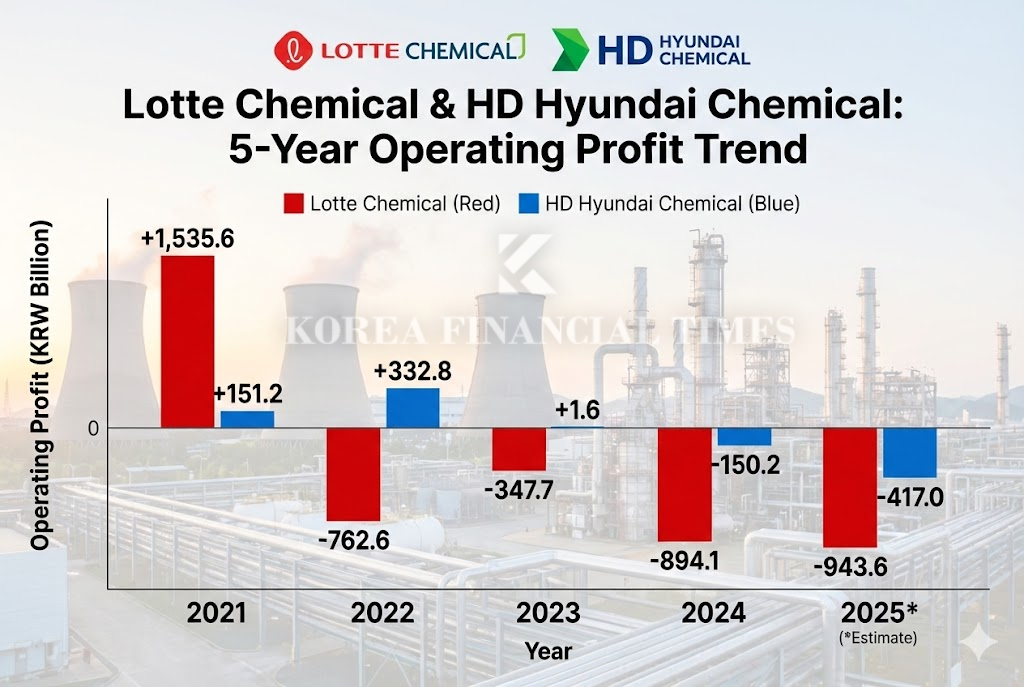
Lotte Chemical has posted cumulative losses of nearly KRW 3 trillion over four years since 2022, recording its largest annual operating loss of KRW 943.6 billion last year. The company has positioned the reduction of commodity products as a core management priority and is widely regarded as the most proactive player in the industry's restructuring efforts. Lotte Chemical has also released internal projections suggesting that petrochemical restructuring could generate hundreds of billions of won in operating profit improvement.
HD Hyundai Chemical has also recorded losses for two consecutive years since 2024. Notably, its cumulative operating loss for the first three quarters of last year alone reached KRW 391.8 billion — significantly larger than its full-year loss of KRW 156.2 billion the previous year. Its debt-to-equity ratio stood at 372.3% as of the end of the third quarter of last year, exceeding the 250% threshold stipulated in financial covenants with lenders.
Restructuring Expected to Spread to Yeosu and Ulsan Industrial Complexes
With the Daesan Industrial Complex business reorganization — Korea's first petrochemical restructuring project pursued by the government and industry — now finalized, expectations are growing that restructuring efforts at other complexes, including Yeosu and Ulsan, will also gain momentum.In Yeosu, LG Chem and GS Caltex are in discussions on an integrated operation of their respective NCCs within the complex. Yeochun NCC (a joint venture between Hanwha Chemical and DL Chemical), another NCC operator in the Yeosu complex, is also in talks with Lotte Chemical regarding restructuring.
The Ulsan complex involves three companies: SK Geo Centric, Korea Petrochemical Ind. Co. (대한유화), and S-Oil. S-Oil, which is looking to aggressively expand ethylene capacity through its new "Shaheen Project" facilities, has differing interests from the other companies that are aligned with a capacity reduction strategy — meaning that reaching a consensus is expected to take more time.
Gwak Horyung (horr@fntimes.com)











![이성훈 LH 사장 다주택·대출 규제 발언 도마…여야 의원 잇단 지적 [2026 국감]](https://cfnimage.commutil.kr/phpwas/restmb_setimgmake.php?pp=006&w=69&h=45&m=5&simg=20261012163012026870048b718333218159227151.jpg&nmt=18)

![12개월 최고 연 6.00%…BNK저축은행 'BNK동행적금'[이주의 저축은행 적금금리-10월 2주]](https://cfnimage.commutil.kr/phpwas/restmb_setimgmake.php?pp=006&w=69&h=45&m=5&simg=202610110103170668607c96e797801121481643.jpg&nmt=18)

![12개월 최고 연 4.10%…OK저축은행 'OK e-안심앱플러스정기예금6'[이주의 저축은행 예금금리-10월 2주]](https://cfnimage.commutil.kr/phpwas/restmb_setimgmake.php?pp=006&w=69&h=45&m=5&simg=202610110051040059207c96e797801121481643.jpg&nmt=18)


![[그래픽 뉴스] ‘순대’가 경제용어라고? 순(純)대외자산, 한국의 진짜 해외자산은 얼마일까?](https://cfnimage.commutil.kr/phpwas/restmb_setimgmake.php?pp=006&w=298&h=298&m=1&simg=202609021356075202de68fcbb3512411124362_0.jpg&nmt=18)
![[그래픽 뉴스] ISA 대개편! 나에게 유리한 계좌는?](https://cfnimage.commutil.kr/phpwas/restmb_setimgmake.php?pp=006&w=298&h=298&m=1&simg=202608041713155615de68fcbb3512411124362_0.jpg&nmt=18)
![[그래픽 뉴스] 미국 증시 새로운 키워드 'MANGOS'](https://cfnimage.commutil.kr/phpwas/restmb_setimgmake.php?pp=006&w=298&h=298&m=1&simg=202607291740382069de68fcbb3512411124362_0.jpg&nmt=18)

![[그래픽 뉴스] 은퇴후 30년 부모님 세대의 생존전략](https://cfnimage.commutil.kr/phpwas/restmb_setimgmake.php?pp=006&w=298&h=298&m=1&simg=202606301704439153de68fcbb3512411124362_0.jpg&nmt=18)
![[신간]은퇴연옥…김경록의 은퇴 후 삶의 나침반](https://cfnimage.commutil.kr/phpwas/restmb_setimgmake.php?pp=006&w=81&h=123&m=5&simg=20260414140833047280f8caa4a5ce12411124362.jpg&nmt=18)
![[신간] 물처럼 흐르고 원칙으로 서다…김용환의 통찰을 담다](https://cfnimage.commutil.kr/phpwas/restmb_setimgmake.php?pp=006&w=81&h=123&m=5&simg=20260409114249027860f8caa4a5ce12411124362.jpg&nmt=18)
![[안현정 서평] 플랫폼의 영지에서 ‘미학적 주권’을 선포하라...'K가 죽어야 K가 산다' 장준환 著](https://cfnimage.commutil.kr/phpwas/restmb_setimgmake.php?pp=006&w=81&h=123&m=5&simg=20260527121426063220c1c16452b012411124362.jpg&nmt=18)
![[서평] 추세 매매의 대가들...추세추종 투자전략의 대가 14인 인터뷰](https://cfnimage.commutil.kr/phpwas/restmb_setimgmake.php?pp=006&w=81&h=123&m=5&simg=2023102410444004986c1c16452b0175114235199.jpg&nmt=18)


![[머니무브 2026] “지금 사도 될까?” 답이 안 보인다면…하반기 투자, 4명의 전문가에게 물어보세요](https://cfnimage.commutil.kr/phpwas/restmb_setimgmake.php?pp=006&w=89&h=45&m=1&simg=202609151044050355302a735e27af12411124362.jpg&nmt=18)
![[AD] ‘PBV 라인업 확장’ 기아, 9월 독일서 ‘PV7’ 첫 공개](https://cfnimage.commutil.kr/phpwas/restmb_setimgmake.php?pp=006&w=89&h=45&m=1&simg=2026083111010602815074925877361231180222.jpg&nmt=18)
![[AD] 제네시스, 럭셔리 경험 더한 ‘2027 GV70’‧‘GV70 그래파이트’ 출시](https://cfnimage.commutil.kr/phpwas/restmb_setimgmake.php?pp=006&w=89&h=45&m=1&simg=20260702143546085600749258773622211122717.jpg&nmt=18)