






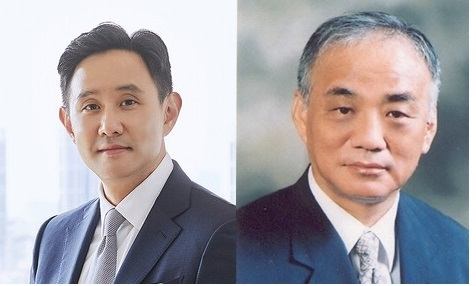
Choi Yoon-bum, Chairman of Korea Zinc (left) and Jang Hyeong-jin, Advisor of Youngpoong
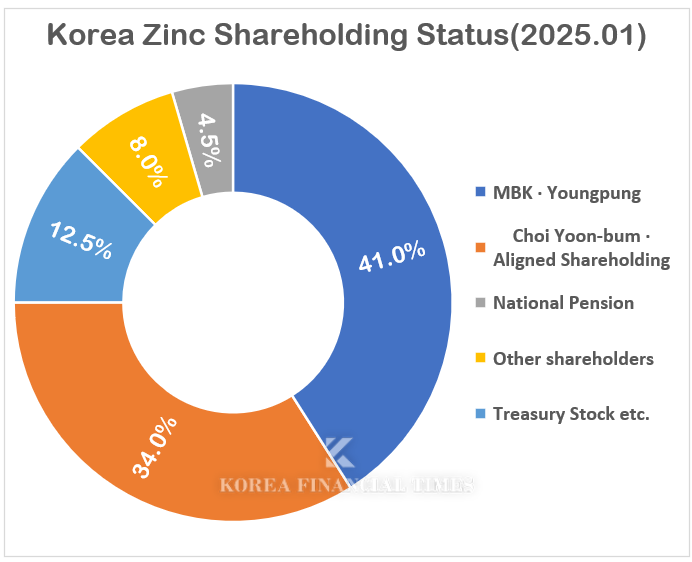
MBK-Youngpung holds a 40.97% stake in Korea Zinc. Chairman Choi Yoon-bum and his friend are estimated to hold 34%. MBK-Youngpung is ahead by 6 to 7 percentage points. However, MBK-Youngpung does not have a majority with 46.7 percent of voting shares. It is far from certain that it will be able to pass its agenda. Choi's Aligned Shareholding consists of Hanwha, Hyundai Motor, LG Chem, Trapigura, Morgan Stanley, and Chosun Refractories, all of which are classified as friends. However, it's hard to be sure what position they will take at the actual shareholders' meeting.
To begin with, there are three main issues on the agenda for the extraordinary general meeting of Koryo Zinc: ▲ concentrated voting system, ▲ limitation of the number of directors (19), and ▲ nomination of director candidates.
The concentrated voting system is a method that grants voting rights to the number of directors elected per share when appointing multiple directors. For example, if 10 directors are elected, a shareholder with 10 shares has 100 votes. They can also vote for a single director candidate. Under the same conditions, under the traditional “one share = one vote” system, they would have 10 votes. The existing system favors large shareholders with large stakes.
In the case of Korea Zinc, voting in favor of a concentrated voting system would mean supporting Chairman Choi Yoon-bum, whose shareholding is lagging behind. Moreover, the proposal to introduce the concentrated voting system limits the voting rights of a single shareholder to a maximum of 3%. The analysis favors Choi's side, whose shares are divided among various companies and institutions.
Limiting the number of directors is also a proposal from Choi's side. Currently, the board of directors of Koryo Zinc consists of 12 members. Excluding non-executive director Jang Hyung-jin and advisor Youngpung, the remaining 11 are Choi's people. The 19-member limit would mean seven new directors. This means that MBK-Youngpung will not be able to control the board of directors at this extraordinary general meeting.
ISS sided with MBK and Youngpung on this issue. It opposed the concentrated voting system and voted against all director nominees recommended by the board. Glass Lewis, on the other hand, voted in favor of Choi. It favored the introduction of the concentrated voting system and opposed MBK-Youngpung's nominees. ISS noted that a concentrated voting system for minority shareholders “could have unintended consequences” in the case of Korea Zinc. “The company's financial and operational performance has been quite good compared to its peers, including the leadership of Chairman Choi Yoon-bum,” Glass Lewis said.
With such conflicting opinions, it is difficult to predict the outcome of the extraordinary general meeting of Korea Zinc. Some observers believe that the management dispute will be prolonged.
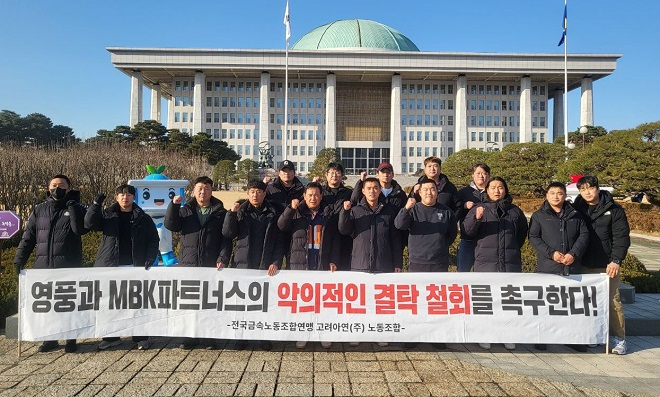
Even if MBK-Youngpung wins control of the board this time, it is doubtful that the uncertainty caused by the dispute will disappear completely. This is because Korea Zinc employees are actively voicing their support for the current management.
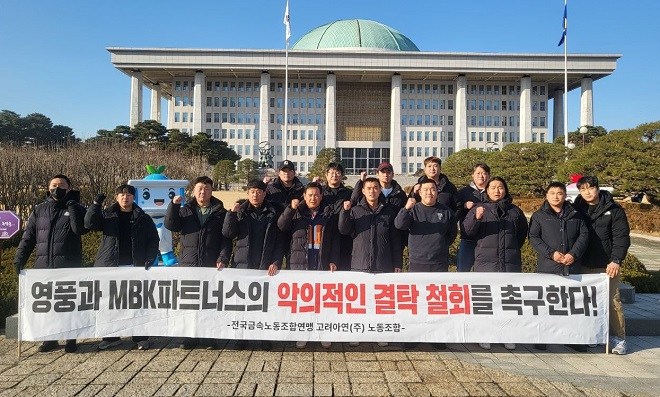
On the 16th, Vice Chairman Lee Jae-joong, Chief Technology Officer of Korea Zinc, and core technical staff issued a statement saying, “We will not stand with MBK-Youngpung if the hostile M&A attempt by MBK-Youngpung is successful.”
The Korea Zinc Workers' Union also announced on the 17th that it recently held a meeting with the Korean Confederation of Trade Unions and the Korean Federation of Metalworkers' Unions to discuss solidarity struggles against the 'hostile M&A'. “If MBK robs Korea Zinc, we will do everything we can to stop it at any cost, including a general strike, to protect our workplace,” said Moon Byung-guk, chairman of the KZIN union.
Gwak Horyung (horr@fntimes.com)











![서초구 '아크로리버파크' 34평, 10억 오른 74억원에 거래 [일일 신고가]](https://cfnimage.commutil.kr/phpwas/restmb_setimgmake.php?pp=006&w=69&h=45&m=5&simg=20260624115142011110dd55077bc212411124362.jpg&nmt=18)
!['첫 연임' 신학기 vs '新리더십' 이형주…차기 수협은행장 선임 D-Day [2027 은행장 선임 레이스]](https://cfnimage.commutil.kr/phpwas/restmb_setimgmake.php?pp=006&w=69&h=45&m=5&simg=202609211608140057701b5a2213792211381469.jpg&nmt=18)


![[그래픽 뉴스] ‘순대’가 경제용어라고? 순(純)대외자산, 한국의 진짜 해외자산은 얼마일까?](https://cfnimage.commutil.kr/phpwas/restmb_setimgmake.php?pp=006&w=298&h=298&m=1&simg=202609021356075202de68fcbb3512411124362_0.jpg&nmt=18)
![[그래픽 뉴스] ISA 대개편! 나에게 유리한 계좌는?](https://cfnimage.commutil.kr/phpwas/restmb_setimgmake.php?pp=006&w=298&h=298&m=1&simg=202608041713155615de68fcbb3512411124362_0.jpg&nmt=18)
![[그래픽 뉴스] 미국 증시 새로운 키워드 'MANGOS'](https://cfnimage.commutil.kr/phpwas/restmb_setimgmake.php?pp=006&w=298&h=298&m=1&simg=202607291740382069de68fcbb3512411124362_0.jpg&nmt=18)

![[그래픽 뉴스] 은퇴후 30년 부모님 세대의 생존전략](https://cfnimage.commutil.kr/phpwas/restmb_setimgmake.php?pp=006&w=298&h=298&m=1&simg=202606301704439153de68fcbb3512411124362_0.jpg&nmt=18)
![[신간]은퇴연옥…김경록의 은퇴 후 삶의 나침반](https://cfnimage.commutil.kr/phpwas/restmb_setimgmake.php?pp=006&w=81&h=123&m=5&simg=20260414140833047280f8caa4a5ce12411124362.jpg&nmt=18)
![[신간] 물처럼 흐르고 원칙으로 서다…김용환의 통찰을 담다](https://cfnimage.commutil.kr/phpwas/restmb_setimgmake.php?pp=006&w=81&h=123&m=5&simg=20260409114249027860f8caa4a5ce12411124362.jpg&nmt=18)
![[안현정 서평] 플랫폼의 영지에서 ‘미학적 주권’을 선포하라...'K가 죽어야 K가 산다' 장준환 著](https://cfnimage.commutil.kr/phpwas/restmb_setimgmake.php?pp=006&w=81&h=123&m=5&simg=20260527121426063220c1c16452b012411124362.jpg&nmt=18)
![[서평] 추세 매매의 대가들...추세추종 투자전략의 대가 14인 인터뷰](https://cfnimage.commutil.kr/phpwas/restmb_setimgmake.php?pp=006&w=81&h=123&m=5&simg=2023102410444004986c1c16452b0175114235199.jpg&nmt=18)


![[머니무브 2026] “지금 사도 될까?” 답이 안 보인다면…하반기 투자, 4명의 전문가에게 물어보세요](https://cfnimage.commutil.kr/phpwas/restmb_setimgmake.php?pp=006&w=89&h=45&m=1&simg=202609151044050355302a735e27af12411124362.jpg&nmt=18)
![[AD] ‘PBV 라인업 확장’ 기아, 9월 독일서 ‘PV7’ 첫 공개](https://cfnimage.commutil.kr/phpwas/restmb_setimgmake.php?pp=006&w=89&h=45&m=1&simg=2026083111010602815074925877361231180222.jpg&nmt=18)
![[AD] 제네시스, 럭셔리 경험 더한 ‘2027 GV70’‧‘GV70 그래파이트’ 출시](https://cfnimage.commutil.kr/phpwas/restmb_setimgmake.php?pp=006&w=89&h=45&m=1&simg=20260702143546085600749258773622211122717.jpg&nmt=18)
![[AD] 개소세 혜택 종료…현대차, ‘썸머 페스타’로 고객 부담 완화](https://cfnimage.commutil.kr/phpwas/restmb_setimgmake.php?pp=006&w=89&h=45&m=1&simg=20260702142355004830749258773622211122717.jpg&nmt=18)
![[AD] 기아 ‘디 올 뉴 셀토스’, 인도 타임스 드라이브 어워즈서 ‘올해의 SUV’ 선정](https://cfnimage.commutil.kr/phpwas/restmb_setimgmake.php?pp=006&w=89&h=45&m=1&simg=202605071156400590007492587736124111243152.jpg&nmt=18)