






Kia is often likened to a younger sibling overshadowed by the eldest brother of the group, Hyundai Motor. But shade is precisely what shields one from the scorching summer heat — being in someone's shadow is not necessarily a bad thing. The reality is that because Hyundai Motor, as the group's flagship affiliate, has led everything from infrastructure development to future investments, Kia has been able to sustain its growth with a comparatively lighter financial burden.
Kia in the Shadow of Its Big Brother
The Korea Financial Times calculated and analyzed Kia's Altman Z-Score over the past seven years using the corporate data platform DeepSearch. The company's financial soundness was assessed based on the following financial statement components: X1 (working capital / total assets) + X2 (retained earnings / total assets) + X3 (operating profit / total assets) + X4 (market capitalization / total liabilities) + X5 (revenue / total assets). For manufacturing companies, a score of 3 or above is considered the safe zone, while a score below 1.8 is classified as a danger zone.The results showed that Kia's Z-Score was 2.33 in 2019, 2.31 in 2020, 2.72 in 2021, 2.75 in 2022, 3.35 in 2023, 3.21 in 2024, and 3.18 in 2025. Despite some fluctuations, the score progressed from the 2-point "gray zone" to the 3-point "safe zone" over the seven-year period.
Kia's Z-Score shows a stark contrast when compared to Hyundai Motor's. Hyundai Motor's Z-Score stood at 1.37 in 2019, 1.32 in 2020, 1.34 in 2021, 1.34 in 2022, 1.46 in 2023, 1.30 in 2024, and 1.27 in 2025 — consistently recording scores in the danger zone of the 1-point range every year.
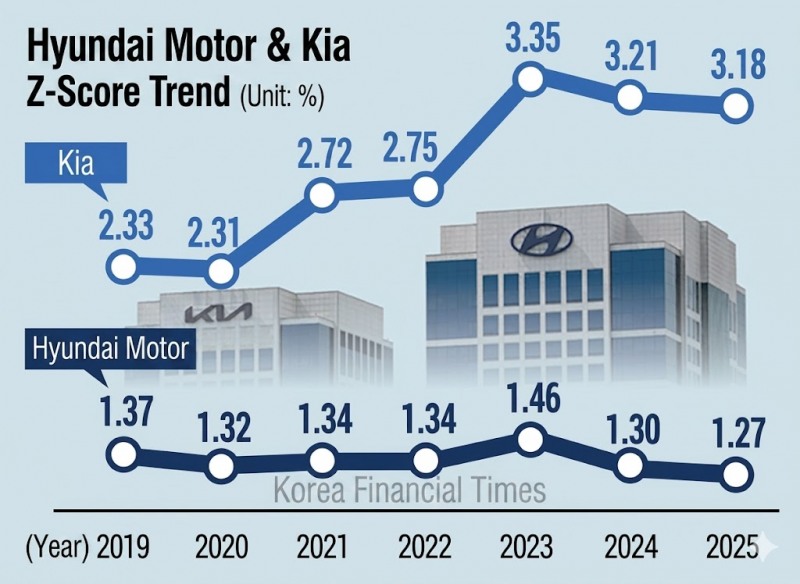
This infographic, originally published by Korea Financial Times, has been reconstructed using generative AI (Gemini).
이미지 확대보기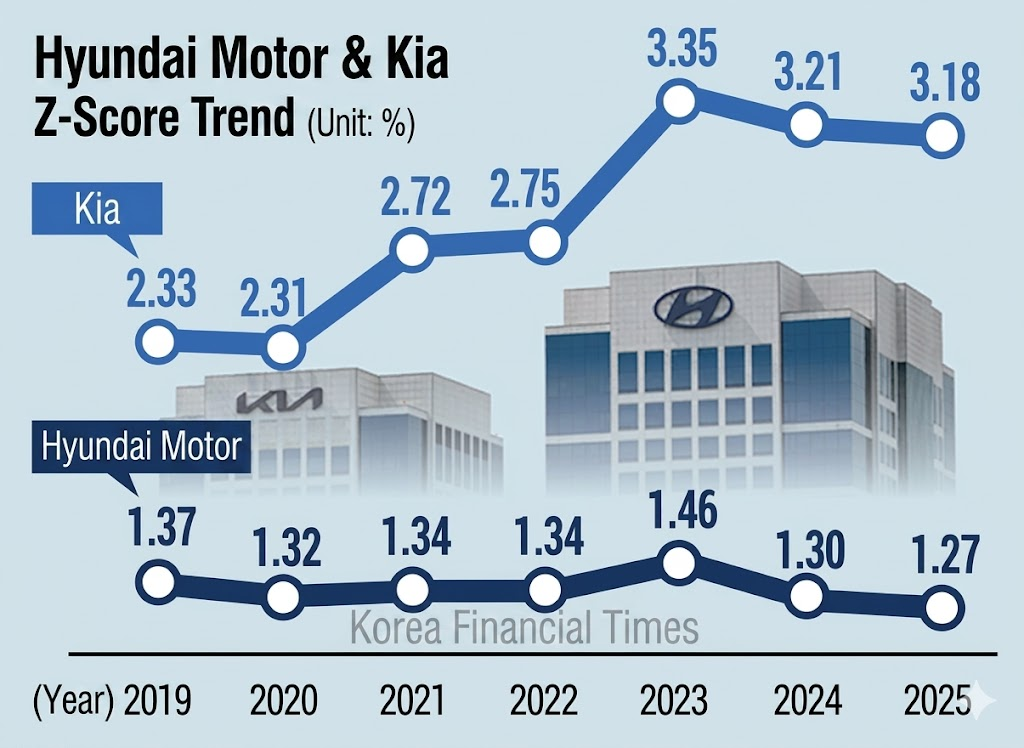
How should the significant gap in Z-Scores between the two automakers within Hyundai Motor Group be interpreted? One of the primary reasons lies in the different roles each company plays within the group.
Shareholder Returns or Succession Strategy? The Dual Purpose Behind Hyundai Motor and Kia's Payout PoliciesSix Years Locked Away: What Will Hyundai Steel Decide on Its Treasury Shares at This AGM?Robot Joints, 80%-a-Year Growth: Hyundai Mobis, Samsung Electro-Mechanics Lead Korea's Actuator Rush [K-Humanoid Wars ④]Hanwha Aerospace Stock Surges 3,500% in Six Years on 'Extraordinary Strength' [KFT Topic]Naver hits KRW 10 trillion revenue but premium valuation in doubt [KFT Topic]
The finished vehicle industry is a quintessential capital-intensive industry. It simultaneously requires large-scale production facilities, capital expenditure, the construction of a global sales network, and research and development (R&D) investment. In recent years, as the industry structure has rapidly shifted toward electric vehicles (EVs) and software-defined vehicles (SDVs), the scale of investment has expanded even further.
As investments aimed at securing future technologies — such as EV platform development, battery technology acquisition, and autonomous driving software development — have surged, automakers are operating in a structure in which both total assets and investment spending increase in tandem.
Within Hyundai Motor Group, it is Hyundai Motor that leads this investment drive. Hyundai Motor plans to invest approximately KRW 17 trillion in future investments alone this year. At its CEO Investor Day held on the 9th of this month, Kia announced that it will channel approximately KRW 10 trillion into future investments.
A prime example is the 2020 establishment of Motional, the autonomous driving joint venture, with a total investment of KRW 2.5 trillion, in which Hyundai Motor, Kia, and Hyundai Mobis participated in a ratio of 2.6 to 1.4 to 1. Similarly, in Boston Dynamics' KRW 1.3 trillion rights offering last August, Hyundai Motor contributed the largest share at KRW 362.6 billion, followed by Kia at KRW 223.4 billion and Hyundai Mobis at KRW 146.5 billion.
Kia has improved its profitability while bearing a relatively lighter investment load. The returns on investments — including robotics — are naturally being reflected in its share price, with the company's corporate value being recognized even from within Hyundai Motor's shadow.
Indeed, the key reason Kia's Z-Score surpassed the 3.0 threshold after 2023 is that the steep rise in operating profit (X3: operating profit / total assets), the steady accumulation of retained earnings (X2: retained earnings / total assets), and the increase in market capitalization (X4) following a corporate valuation re-rating collectively overwhelmed the growth in debt.
In 2023, Kia posted operating profit of KRW 11.6079 trillion — breaking the KRW 10 trillion mark for the first time — driven by an expanded EV lineup and the strong performance of SUV models including the Sportage and Sorento. In 2024, operating profit reached a record high of KRW 12.6671 trillion. In 2025, it came in at KRW 9.0781 trillion amid the impact of U.S. tariffs.
Retained earnings grew from approximately KRW 43 trillion in 2023 to approximately KRW 55 trillion as of the end of last year, an increase of approximately KRW 12 trillion, while market capitalization also expanded from approximately KRW 40 trillion to KRW 47 trillion over the same period. Meanwhile, the debt ratio declined year-on-year, from 73.18% in 2023, to 66.11% in 2024, and further to 61.76% in 2025.
PBR Reversal Against Hyundai Motor — What's the Way Forward?
While Kia maintains its Z-Score in the safe zone, its growth trajectory as a traditional automaker is assessed to have reached its limits. In fact, following Hyundai Motor's unveiling of the humanoid robot Atlas this year, a "value re-rating" centered on the robotics transition has reversed the valuation standings of the two companies.Consider the trend in the Price-to-Book Ratio (PBR), a key valuation metric for the two companies' share prices. PBR indicates the extent to which a company's share price is valued relative to its net assets. A PBR below 1 means the share price is being valued at a discount to book value.
Through the end of last year, Kia maintained a PBR of 0.7x–0.9x, while Hyundai Motor hovered at around 0.5x. The dynamic shifted after Hyundai Motor unveiled Atlas at CES in January this year. As of the 15th of this month, Kia's PBR stands at 1.04x and Hyundai Motor's at 1.16x.
This is precisely why Kia is accelerating its own transition to a future mobility company centered on robotics, just as Hyundai Motor has done.
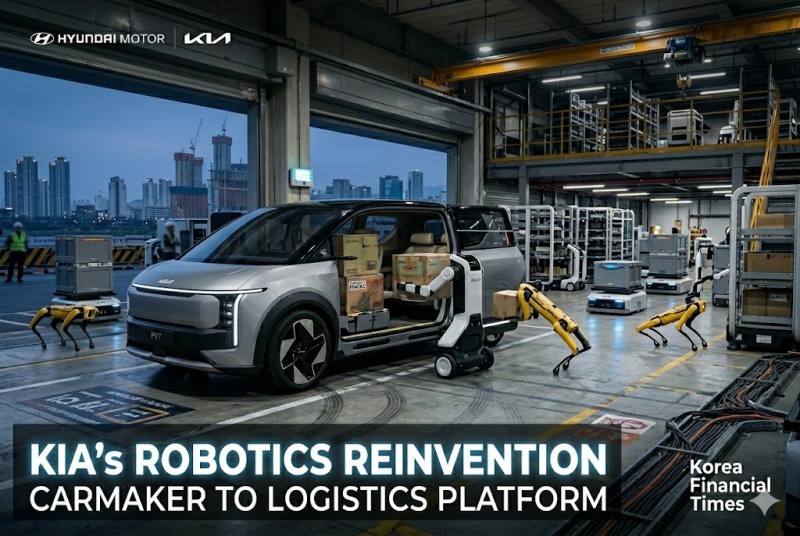
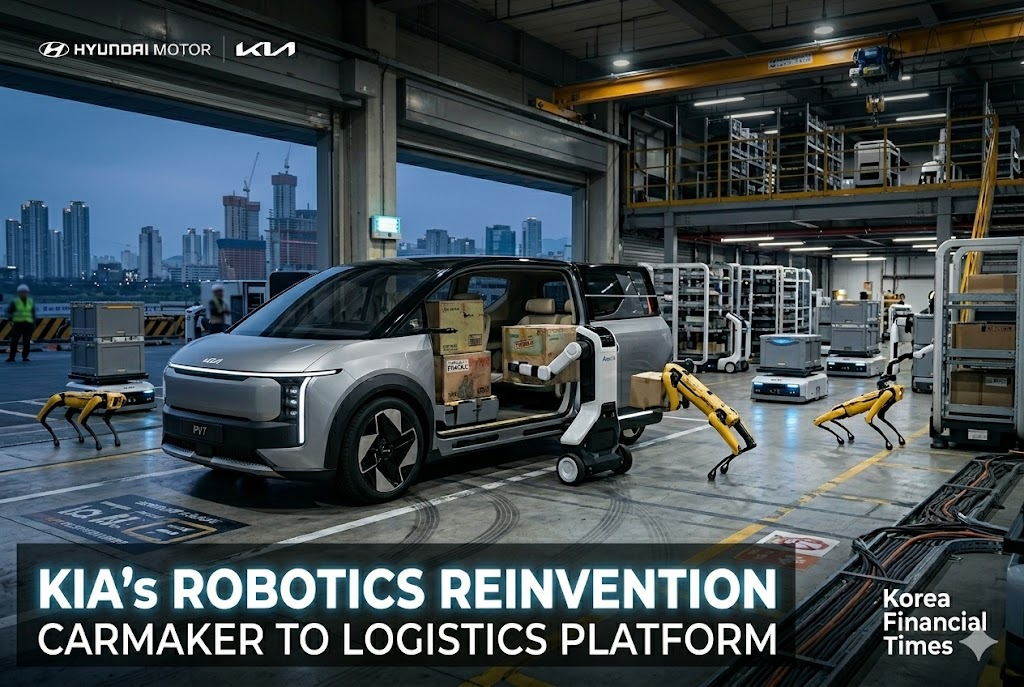
Kia is currently spearheading the PBV business within Hyundai Motor Group. By integrating Hyundai Motor Group's robotics technology with PBV, Kia is evolving from a simple "vehicle manufacturer" into a "logistics solution provider."
A PBV is a vehicle that can be designed and configured for the specific purpose desired by the consumer. Its applications are wide-ranging, encompassing general passenger transportation, freight logistics, last-mile delivery, ride-hailing services, and mobile offices.
Kia launched its first PBV, the PV5, in July last year, marking the official start of its PBV business. This year, the company will introduce the PV5 in the Japanese market to expand its global footprint. In addition, it plans to launch the large-size model PV7 in 2027, and will gradually extend its lineup from 2029 with the extra-large model PV9 and a compact model.
Kia will also pioneer new markets by combining PBV with the Hyundai Motor Group robotics ecosystem.
At its CEO Investor Day held this month, Kia announced its ambition to develop a full-stack solution integrating Boston Dynamics' Stretch and Spot robots with its PBV models (the PV7 and PV9), targeting the last-mile delivery market — estimated at approximately USD 288 billion annually.
Kia is currently experimenting with a system in which Boston Dynamics' robot dog Spot and warehouse robot Stretch are deployed inside the PV5 or the larger PV7, so that when the vehicle reaches its destination, the robots carry out the final delivery to the end recipient.
Furthermore, Kia is incorporating MoVED (Mobile Versatile Entity with Drive), a robotics platform that Hyundai Motor Group began commercializing this year, into its PBV ecosystem — thereby extending its logistics reach to inner-city areas with challenging terrain, such as unpaved roads and staircases, where conventional vehicles cannot access.
Production capacity is also being enhanced through the deployment of humanoid robot Atlas on the factory floor. Following a full-scale deployment at HMGMA (Hyundai Motor Group Metaplant America) in 2028, Atlas is set to be introduced at the Kia Georgia plant (KaGA) in the second half of 2029, with plans for a phased rollout across global manufacturing facilities. The company has identified 16 key processes at its production sites to pursue improvements in safety, productivity, and quality.
An industry official commented: "Kia is accelerating the expansion of its PBV business on the back of solid financial health. As it now moves to integrate with Hyundai Motor Group's robotics capabilities, a re-rating as an AI-and-robotics integrated platform company is expected to begin, depending on the performance outcomes of these businesses."
Kim JaeHun (rlqm93@fntimes.com)












![24개월 최고 연 4.00%…제주은행 'J정기예금(만기지급식)' [이주의 은행 예금금리-10월 4주]](https://cfnimage.commutil.kr/phpwas/restmb_setimgmake.php?pp=006&w=69&h=45&m=5&simg=202610231018530270305e6e69892f222110224119.jpg&nmt=18)
![기관 '한화오션'·외인 '삼성전자'·개인 '삼성전기' 1위 [주간 코스피 순매수- 2026년 10월19일~10월23일]](https://cfnimage.commutil.kr/phpwas/restmb_setimgmake.php?pp=006&w=69&h=45&m=5&simg=20261024171622010220179ad4390711823574140.jpg&nmt=18)
![12개월 최고 연 7.00%…경남은행 '오면우대! 하면우대! 정기적금' [이주의 은행 적금금리-10월 4주]](https://cfnimage.commutil.kr/phpwas/restmb_setimgmake.php?pp=006&w=69&h=45&m=5&simg=202610231103420840305e6e69892f222110224119.jpg&nmt=18)
![24개월 최고 연 4.10%…OK저축은행 'OK e-안심정기예금'[이주의 저축은행 예금금리-10월 4주]](https://cfnimage.commutil.kr/phpwas/restmb_setimgmake.php?pp=006&w=69&h=45&m=5&simg=202610241739030963907c96e7978011215281239.jpg&nmt=18)
![12개월 최고 연 4.10%…경남은행 'The든든예금(시즌2)' [이주의 은행 예금금리-10월 4주]](https://cfnimage.commutil.kr/phpwas/restmb_setimgmake.php?pp=006&w=69&h=45&m=5&simg=202610231017430908005e6e69892f222110224119.jpg&nmt=18)


![[그래픽 뉴스] ‘순대’가 경제용어라고? 순(純)대외자산, 한국의 진짜 해외자산은 얼마일까?](https://cfnimage.commutil.kr/phpwas/restmb_setimgmake.php?pp=006&w=298&h=298&m=1&simg=202609021356075202de68fcbb3512411124362_0.jpg&nmt=18)
![[그래픽 뉴스] ISA 대개편! 나에게 유리한 계좌는?](https://cfnimage.commutil.kr/phpwas/restmb_setimgmake.php?pp=006&w=298&h=298&m=1&simg=202608041713155615de68fcbb3512411124362_0.jpg&nmt=18)
![[그래픽 뉴스] 미국 증시 새로운 키워드 'MANGOS'](https://cfnimage.commutil.kr/phpwas/restmb_setimgmake.php?pp=006&w=298&h=298&m=1&simg=202607291740382069de68fcbb3512411124362_0.jpg&nmt=18)

![[그래픽 뉴스] 은퇴후 30년 부모님 세대의 생존전략](https://cfnimage.commutil.kr/phpwas/restmb_setimgmake.php?pp=006&w=298&h=298&m=1&simg=202606301704439153de68fcbb3512411124362_0.jpg&nmt=18)
![[신간] 장애가 가르쳐준 삶의 의미...목진석 9단 아버지 목이균씨의 자서전](https://cfnimage.commutil.kr/phpwas/restmb_setimgmake.php?pp=006&w=81&h=123&m=5&simg=20261023093852062530f8caa4a5ce12411124362.jpg&nmt=18)
![[신간]은퇴연옥…김경록의 은퇴 후 삶의 나침반](https://cfnimage.commutil.kr/phpwas/restmb_setimgmake.php?pp=006&w=81&h=123&m=5&simg=20260414140833047280f8caa4a5ce12411124362.jpg&nmt=18)
![[안현정 서평] 플랫폼의 영지에서 ‘미학적 주권’을 선포하라...'K가 죽어야 K가 산다' 장준환 著](https://cfnimage.commutil.kr/phpwas/restmb_setimgmake.php?pp=006&w=81&h=123&m=5&simg=20260527121426063220c1c16452b012411124362.jpg&nmt=18)
![[서평] 추세 매매의 대가들...추세추종 투자전략의 대가 14인 인터뷰](https://cfnimage.commutil.kr/phpwas/restmb_setimgmake.php?pp=006&w=81&h=123&m=5&simg=2023102410444004986c1c16452b0175114235199.jpg&nmt=18)


![[머니무브 2026] “지금 사도 될까?” 답이 안 보인다면…하반기 투자, 4명의 전문가에게 물어보세요](https://cfnimage.commutil.kr/phpwas/restmb_setimgmake.php?pp=006&w=89&h=45&m=1&simg=202609151044050355302a735e27af12411124362.jpg&nmt=18)
![[AD] ‘PBV 라인업 확장’ 기아, 9월 독일서 ‘PV7’ 첫 공개](https://cfnimage.commutil.kr/phpwas/restmb_setimgmake.php?pp=006&w=89&h=45&m=1&simg=2026083111010602815074925877361231180222.jpg&nmt=18)
![[AD] 제네시스, 럭셔리 경험 더한 ‘2027 GV70’‧‘GV70 그래파이트’ 출시](https://cfnimage.commutil.kr/phpwas/restmb_setimgmake.php?pp=006&w=89&h=45&m=1&simg=20260702143546085600749258773622211122717.jpg&nmt=18)