







This achievement by Hanwha Aerospace is no coincidence. It is the result of foreseeing that the deepening global security crisis would translate not just into massive orders but into profits.
Following the Russia-Ukraine war and Middle East conflicts, the expansion of global geopolitical risks since 2022 has led to a surge in global defense demand for ammunition and weapon systems. In this process, Hanwha Aerospace has consecutively secured high-profit, quality new orders for K9 and Chunmoo systems in Europe and the Middle East.
Over the past four years, Hanwha Aerospace's revenue has doubled and operating profit has expanded sixfold. However, despite continuous growth, the debt ratio appeared relatively high due to rapid short-term growth and accounting practices that record advances as liabilities. The standalone debt ratio was 132.58% in 2021 but rose to 393.10% in 2024.
Net debt surged from KRW 154.9 billion in 2021 to KRW 7,371.7 billion in 2024. This was influenced by the rapid increase in advances as the company secured orders worth KRW 31.4 trillion in the defense sector alone over a short period. Additionally, the company injected KRW 2 trillion into acquiring Hanwha Ocean shares and conducting a paid-in capital increase in 2023, and invested enormous funds in 2024, including contributing USD 500 million to Hanwha Future Proof and acquiring shares in Singapore-based marine equipment manufacturer Dyna-Mac.
Financial Distress Concerns Resolved in One Year
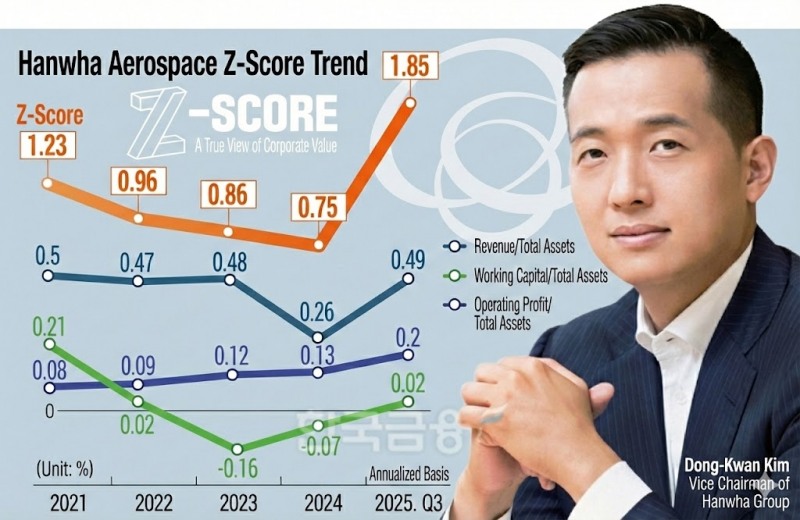
According to the Hanwha Aerospace Altman Z-Score confirmed by Korea Financial Times through artificial intelligence (AI) data platform DeepSearch, the score continuously declined: ▲1.23 in 2021 ▲0.96 in 2022 ▲0.86 in 2023 ▲0.75 in 2024.Then it surged to 1.85 on an annualized basis for the third quarter of 2025. Typically, a Z-Score below 1.8 is considered to indicate significant financial risk, but Hanwha Aerospace rebounded within a year and entered the safe zone.
"Revenue/Total Assets," which indicates a company's asset management capability and revenue generation power, fell from 0.50 in 2021 to 0.26 in 2024, but improved to 0.49 in the third quarter of last year. "Working Capital/Total Assets," which determines liquidity and asset management efficiency, also deteriorated from 0.21 in 2021 to -0.18 in 2023, but recovered to 0.02 in the third quarter of last year.
This improvement was driven by the record-breaking performance achieved last year. Hanwha Aerospace recorded cumulative revenue of KRW 18,281.7 billion and operating profit of KRW 2,281.7 billion through the third quarter of last year, achieving its highest-ever performance.
Additionally, the influx of approximately KRW 4 trillion through two paid-in capital increases conducted last year was decisive in resolving debt burdens.
Due to the nature of the defense market, once a country purchases a weapon system, the transaction is maintained for at least 30 years through long-term maintenance. Therefore, financial stability is considered important when evaluating the sustainability of defense product suppliers. Particularly, when intensive investment is needed, if the debt ratio rises quickly due to borrowing, it can be disadvantageous when competing with overseas defense companies such as those in Europe.
Hanwha Aerospace chose paid-in capital increases to secure financial soundness. It completed paid-in capital increases of KRW 1.3 trillion and KRW 2.9 trillion in April and July of last year, respectively. As a result, not only was the financial burden alleviated, but it became a decisive measure that enabled Hanwha Aerospace to emerge as a global defense company. Although there was significant criticism regarding shareholder value dilution when the paid-in capital increases were announced, the stock price has steadily risen since, with market capitalization once surpassing KRW 54 trillion.
Corporate Bond Demand Forecasting a 'Hit'… Market Confidence Rising
Recent market reactions toward Hanwha Aerospace have been even more enthusiastic. In the corporate bond demand forecasting conducted on the 7th, Hanwha Aerospace succeeded in attracting KRW 3.23 trillion, approximately 13 times more than the initially planned amount of KRW 250 billion. Accordingly, on the 15th, the company issued corporate bonds worth KRW 500 billion, twice the original planned amount.The market showed strengthening confidence as the "Market Capitalization/Total Debt" ratio, which looks at the debt ratio relative to corporate value, also rose. Hanwha Aerospace's corporate bond credit rating maintained 'AA- (stable)' since 2020, then was upgraded to 'AA- (positive)' in June of last year, and to 'AA (stable)' in November of the same year.
The profitability indicator "Operating Profit/Total Assets" also continuously improved: ▲0.08 in 2021 ▲0.09 in 2022 ▲0.12 in 2023 ▲0.13 in 2024 ▲0.20 in the third quarter of 2025.
The order backlog is also steadily increasing. It recorded KRW 19.9 trillion in 2022, KRW 27.9 trillion in 2023, KRW 32.4 trillion in 2024, and KRW 31 trillion in the third quarter of last year. The stock price, which was around KRW 34,000 in early 2020, recorded a closing price of KRW 1,255,000 on the 23rd. This represents a surge of 3,591.18% in six years.
Shin Haeju (hjs0509@fntimes.com)











![기관 '주성엔지니어링'·외인 '알테오젠'·개인 '알테오젠' 1위 [주간 코스닥 순매수- 2026년 9월7일~9월11일]](https://cfnimage.commutil.kr/phpwas/restmb_setimgmake.php?pp=006&w=69&h=45&m=5&simg=20260912015140019820179ad4390711823512161.jpg&nmt=18)
![12개월 최고 연 7.00%…카카오뱅크 '우리아이적금' [이주의 은행 적금금리-9월 3주]](https://cfnimage.commutil.kr/phpwas/restmb_setimgmake.php?pp=006&w=69&h=45&m=5&simg=202609111245270848705e6e69892f222110224112.jpg&nmt=18)
![12개월 최고 연 3.85%…경남은행 'The든든예금(시즌2)' [이주의 은행 예금금리-9월 3주]](https://cfnimage.commutil.kr/phpwas/restmb_setimgmake.php?pp=006&w=69&h=45&m=5&simg=202609111227290077405e6e69892f222110224112.jpg&nmt=18)

![12개월 최고 연 4.02%…참저축은행 e-회전정기예금[이주의 저축은행 예금금리-9월 2주]](https://cfnimage.commutil.kr/phpwas/restmb_setimgmake.php?pp=006&w=69&h=45&m=5&simg=202609130113300929407c96e797801121481643.jpg&nmt=18)


![[그래픽 뉴스] ‘순대’가 경제용어라고? 순(純)대외자산, 한국의 진짜 해외자산은 얼마일까?](https://cfnimage.commutil.kr/phpwas/restmb_setimgmake.php?pp=006&w=298&h=298&m=1&simg=202609021356075202de68fcbb3512411124362_0.jpg&nmt=18)
![[그래픽 뉴스] ISA 대개편! 나에게 유리한 계좌는?](https://cfnimage.commutil.kr/phpwas/restmb_setimgmake.php?pp=006&w=298&h=298&m=1&simg=202608041713155615de68fcbb3512411124362_0.jpg&nmt=18)
![[그래픽 뉴스] 미국 증시 새로운 키워드 'MANGOS'](https://cfnimage.commutil.kr/phpwas/restmb_setimgmake.php?pp=006&w=298&h=298&m=1&simg=202607291740382069de68fcbb3512411124362_0.jpg&nmt=18)

![[그래픽 뉴스] 은퇴후 30년 부모님 세대의 생존전략](https://cfnimage.commutil.kr/phpwas/restmb_setimgmake.php?pp=006&w=298&h=298&m=1&simg=202606301704439153de68fcbb3512411124362_0.jpg&nmt=18)
![[신간]은퇴연옥…김경록의 은퇴 후 삶의 나침반](https://cfnimage.commutil.kr/phpwas/restmb_setimgmake.php?pp=006&w=81&h=123&m=5&simg=20260414140833047280f8caa4a5ce12411124362.jpg&nmt=18)
![[신간] 물처럼 흐르고 원칙으로 서다…김용환의 통찰을 담다](https://cfnimage.commutil.kr/phpwas/restmb_setimgmake.php?pp=006&w=81&h=123&m=5&simg=20260409114249027860f8caa4a5ce12411124362.jpg&nmt=18)
![[안현정 서평] 플랫폼의 영지에서 ‘미학적 주권’을 선포하라...'K가 죽어야 K가 산다' 장준환 著](https://cfnimage.commutil.kr/phpwas/restmb_setimgmake.php?pp=006&w=81&h=123&m=5&simg=20260527121426063220c1c16452b012411124362.jpg&nmt=18)
![[서평] 추세 매매의 대가들...추세추종 투자전략의 대가 14인 인터뷰](https://cfnimage.commutil.kr/phpwas/restmb_setimgmake.php?pp=006&w=81&h=123&m=5&simg=2023102410444004986c1c16452b0175114235199.jpg&nmt=18)


![[AD] ‘PBV 라인업 확장’ 기아, 9월 독일서 ‘PV7’ 첫 공개](https://cfnimage.commutil.kr/phpwas/restmb_setimgmake.php?pp=006&w=89&h=45&m=1&simg=2026083111010602815074925877361231180222.jpg&nmt=18)
![[AD] 제네시스, 럭셔리 경험 더한 ‘2027 GV70’‧‘GV70 그래파이트’ 출시](https://cfnimage.commutil.kr/phpwas/restmb_setimgmake.php?pp=006&w=89&h=45&m=1&simg=20260702143546085600749258773622211122717.jpg&nmt=18)
![[AD] 개소세 혜택 종료…현대차, ‘썸머 페스타’로 고객 부담 완화](https://cfnimage.commutil.kr/phpwas/restmb_setimgmake.php?pp=006&w=89&h=45&m=1&simg=20260702142355004830749258773622211122717.jpg&nmt=18)
![[AD] 기아 ‘디 올 뉴 셀토스’, 인도 타임스 드라이브 어워즈서 ‘올해의 SUV’ 선정](https://cfnimage.commutil.kr/phpwas/restmb_setimgmake.php?pp=006&w=89&h=45&m=1&simg=202605071156400590007492587736124111243152.jpg&nmt=18)
![[AD]‘그랜저 잡자’ 기아, 상품성 더한 ‘The 2027 K8’ 출시](https://cfnimage.commutil.kr/phpwas/restmb_setimgmake.php?pp=006&w=89&h=45&m=1&simg=2026042110193702730074925877361211627527.jpg&nmt=18)