





Laying Groundwork for 'Strategic Retention' Ahead of Commercial Law Reform
Kumho Petrochemical will hold its 49th AGM on March 26 to consider a proposal adding provisions on treasury share retention to its articles of incorporation. Under the existing articles, treasury share-related matters are decided by the board of directors. The proposed amendment adds language allowing the company to retain or dispose of treasury shares once a plan receives shareholder approval at a general meeting.The revision is part of a broader effort to align the company's articles with the third round of amendments to the Commercial Act, which took effect this month. Under the revised law, treasury shares held or newly acquired by a company must in principle be cancelled. However, continued retention is permitted with AGM approval.
Kumho Petrochemical's articles of incorporation specify that treasury shares are held for management purposes including the introduction of new technologies and improvement of financial structure. The company has previously indicated its intention to use treasury shares to fund investments in eco-friendly, high-value-added new businesses and mergers and acquisitions (M&A).
In contrast to companies such as SK and Doosan, which decided to cancel all treasury shares in the lead-up to and following the Commercial Act amendments, Kumho Petrochemical's insistence on retaining at least a portion of its holdings is widely seen as linked to its relatively fragile ownership structure.
The founding family's combined voting stake stands at just over 17%, comprising Chairman Park Chan-koo (7.84%), his eldest son President Park Jun-kyung (8.39%), and his eldest daughter Vice President Park Ju-hyung (1.24%). In addition, Park Cheol-wan, a former executive director and the chairman's nephew who is at the center of the governance dispute, holds approximately 10%. Park has warned the company that he will pursue legal action if it proceeds with the issuance of exchangeable bonds (EB) using treasury shares.
Cancellations Accelerated Since the 'Nephew's Revolt'
Kumho Petrochemical currently holds 3,498,834 treasury shares, equivalent to 13.44% of issued shares — down by approximately 2 million shares from 5,592,528 shares (18.36%) held just before the governance dispute, known internally as the "Nephew's Revolt," erupted in 2020.Specifically, through a shareholder return plan announced in 2021, the company stated its intention to deploy previously held treasury shares over the following decade for future strategic investment and cancellation. That same year, the company cancelled 171,847 treasury shares while simultaneously exchanging an identical 171,847 shares with OCI in a stock swap described as a strategic collaboration to advance a new bio-materials business. Park Cheol-wan filed suit at the time alleging the share exchange was motivated by a desire to entrench management control, but the case was dismissed.
Samsung Eyes Record KRW 90 Trillion Shareholder Payout as Chip Supercycle Ignites Earnings [Treasury Stock Report]Six Years Locked Away: What Will Hyundai Steel Decide on Its Treasury Shares at This AGM?POSCO Holdings Completes 6% Share Cancellation Pledge — But Core Profit Recovery Remains the Missing PieceLG Corp. Taps Asset Sale Proceeds to Defend Dividend Amid Subsidiary SlumpShinsegae Posts KRW 480 Billion Operating Profit on Strong Department Store Performance
In 2024, the company unveiled a more aggressive shareholder return policy, committing to cancel half of the treasury shares it held at the time — 2,624,417 shares — over a three-year period. The move was widely interpreted as a response to pressure from Park Cheol-wan, who had allied with Cha Partners Asset Management to challenge the company.
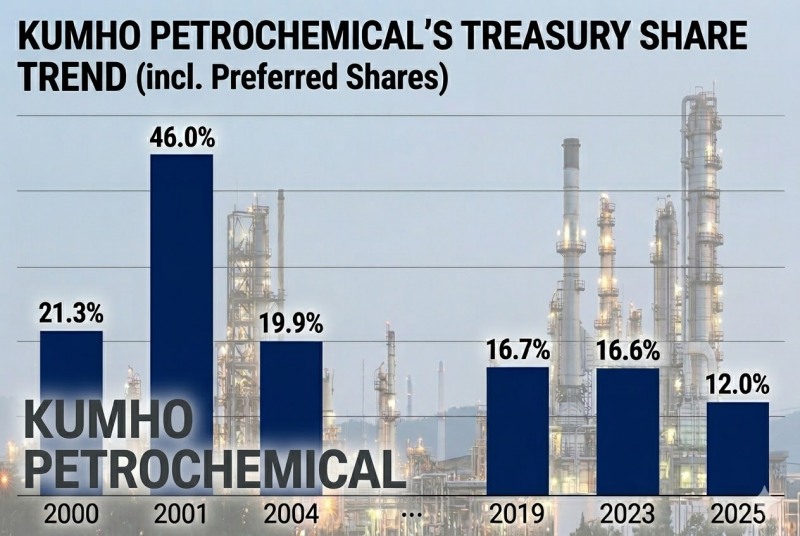
This infographic, originally published by Korea Financial Times, has been reconstructed using generative AI.
이미지 확대보기
Kumho Petrochemical has since cancelled two-thirds of the committed volume in 2024 and 2025, with plans to cancel the remaining one-third within the first half of this year.
Separately, the company is also conducting treasury share buybacks and cancellations in accordance with its 2024–2026 shareholder return plan established last year. Under that plan, 40% of standalone net profit is earmarked for shareholder returns — 20–25% for dividends and 10–15% for treasury share buybacks and cancellations. On March 11, the company repurchased 246,305 treasury shares worth approximately KRW 30 billion for the purpose of cancellation. This exceeds the committed shareholder return ratio against last year's standalone net profit of KRW 175.7 billion, at approximately 17%.
The bulk of Kumho Petrochemical's large treasury share holdings originated from the absorption merger of Kumho Chemical in 2001, which resulted in the acquisition of Kumho Chemical's stake in Kumho Petrochemical plus shares subject to appraisal rights (10.41 million shares), bringing the total — including directly and indirectly held shares — to 15.71 million shares, equivalent to 46% of total issued shares.
In 2004, a large-scale treasury share cancellation was carried out, and a portion of the remaining shares was purchased by members of the Kumho founding family, including Park Sung-yong, Park Sam-koo, Park Chan-koo, and Park Cheol-wan. The residual 5.59 million shares have remained on the company's books as treasury shares for the ensuing two decades.
Gwak Horyung (horr@fntimes.com)











![LG전자 116% 뛸 때 LG디스플레이 -30% 왜? [정답은 TSR]](https://cfnimage.commutil.kr/phpwas/restmb_setimgmake.php?pp=006&w=69&h=45&m=5&simg=20260928103014001610c1c16452b012411124362.jpg&nmt=18)


!['머니무브 2026 부의공식' 포럼 개최…돈의 흐름 읽는 전문가들이 모인다 [머니무브 2026]](https://cfnimage.commutil.kr/phpwas/restmb_setimgmake.php?pp=006&w=69&h=45&m=5&simg=202609281733040003002a735e27af12411124362.jpg&nmt=18)
![“내 돈, 다음엔 어디로”…주식·부동산·토큰증권 3대 변수 읽는다 [머니무브 2026]](https://cfnimage.commutil.kr/phpwas/restmb_setimgmake.php?pp=006&w=69&h=45&m=5&simg=202609281019550812102a735e27af12411124362.jpg&nmt=18)


![[그래픽 뉴스] ‘순대’가 경제용어라고? 순(純)대외자산, 한국의 진짜 해외자산은 얼마일까?](https://cfnimage.commutil.kr/phpwas/restmb_setimgmake.php?pp=006&w=298&h=298&m=1&simg=202609021356075202de68fcbb3512411124362_0.jpg&nmt=18)
![[그래픽 뉴스] ISA 대개편! 나에게 유리한 계좌는?](https://cfnimage.commutil.kr/phpwas/restmb_setimgmake.php?pp=006&w=298&h=298&m=1&simg=202608041713155615de68fcbb3512411124362_0.jpg&nmt=18)
![[그래픽 뉴스] 미국 증시 새로운 키워드 'MANGOS'](https://cfnimage.commutil.kr/phpwas/restmb_setimgmake.php?pp=006&w=298&h=298&m=1&simg=202607291740382069de68fcbb3512411124362_0.jpg&nmt=18)

![[그래픽 뉴스] 은퇴후 30년 부모님 세대의 생존전략](https://cfnimage.commutil.kr/phpwas/restmb_setimgmake.php?pp=006&w=298&h=298&m=1&simg=202606301704439153de68fcbb3512411124362_0.jpg&nmt=18)
![[신간]은퇴연옥…김경록의 은퇴 후 삶의 나침반](https://cfnimage.commutil.kr/phpwas/restmb_setimgmake.php?pp=006&w=81&h=123&m=5&simg=20260414140833047280f8caa4a5ce12411124362.jpg&nmt=18)
![[신간] 물처럼 흐르고 원칙으로 서다…김용환의 통찰을 담다](https://cfnimage.commutil.kr/phpwas/restmb_setimgmake.php?pp=006&w=81&h=123&m=5&simg=20260409114249027860f8caa4a5ce12411124362.jpg&nmt=18)
![[안현정 서평] 플랫폼의 영지에서 ‘미학적 주권’을 선포하라...'K가 죽어야 K가 산다' 장준환 著](https://cfnimage.commutil.kr/phpwas/restmb_setimgmake.php?pp=006&w=81&h=123&m=5&simg=20260527121426063220c1c16452b012411124362.jpg&nmt=18)
![[서평] 추세 매매의 대가들...추세추종 투자전략의 대가 14인 인터뷰](https://cfnimage.commutil.kr/phpwas/restmb_setimgmake.php?pp=006&w=81&h=123&m=5&simg=2023102410444004986c1c16452b0175114235199.jpg&nmt=18)


![[머니무브 2026] “지금 사도 될까?” 답이 안 보인다면…하반기 투자, 4명의 전문가에게 물어보세요](https://cfnimage.commutil.kr/phpwas/restmb_setimgmake.php?pp=006&w=89&h=45&m=1&simg=202609151044050355302a735e27af12411124362.jpg&nmt=18)
![[AD] ‘PBV 라인업 확장’ 기아, 9월 독일서 ‘PV7’ 첫 공개](https://cfnimage.commutil.kr/phpwas/restmb_setimgmake.php?pp=006&w=89&h=45&m=1&simg=2026083111010602815074925877361231180222.jpg&nmt=18)
![[AD] 제네시스, 럭셔리 경험 더한 ‘2027 GV70’‧‘GV70 그래파이트’ 출시](https://cfnimage.commutil.kr/phpwas/restmb_setimgmake.php?pp=006&w=89&h=45&m=1&simg=20260702143546085600749258773622211122717.jpg&nmt=18)
![[AD] 개소세 혜택 종료…현대차, ‘썸머 페스타’로 고객 부담 완화](https://cfnimage.commutil.kr/phpwas/restmb_setimgmake.php?pp=006&w=89&h=45&m=1&simg=20260702142355004830749258773622211122717.jpg&nmt=18)