






LIG Nex1 will put an agenda item to amend its articles of incorporation before shareholders at its annual general meeting on the 31st. The proposed revision would raise the issuance limits for CBs and BWs from KRW 100 billion each to KRW 500 billion each — a fivefold increase.
Under the current articles, CBs and BWs may each be issued up to KRW 100 billion for management purposes including the introduction of new technologies and improvement of financial structure. The company's position is that the limit increase is a natural step in line with its growing scale.
"The existing issuance limits were set a long time ago," a LIG Nex1 spokesperson said. "We are building preemptive safeguards in step with our performance growth."
LIG Nex1's current bond issuance limits lag behind those of other domestic defense companies. Hanwha Systems has a CB issuance limit of KRW 400 billion, while Hyundai Rotem's stands at KRW 800 billion.
Revenue Up 126% in Five Years — Reserve Capital Secured to Match Expansion
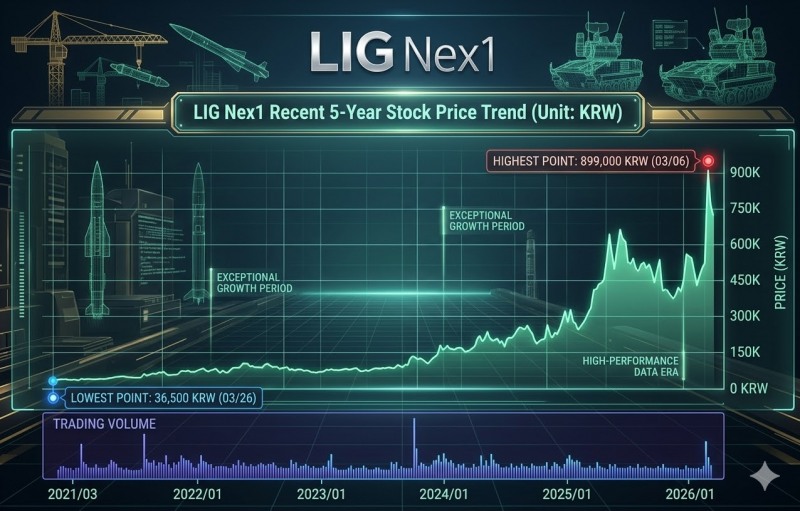
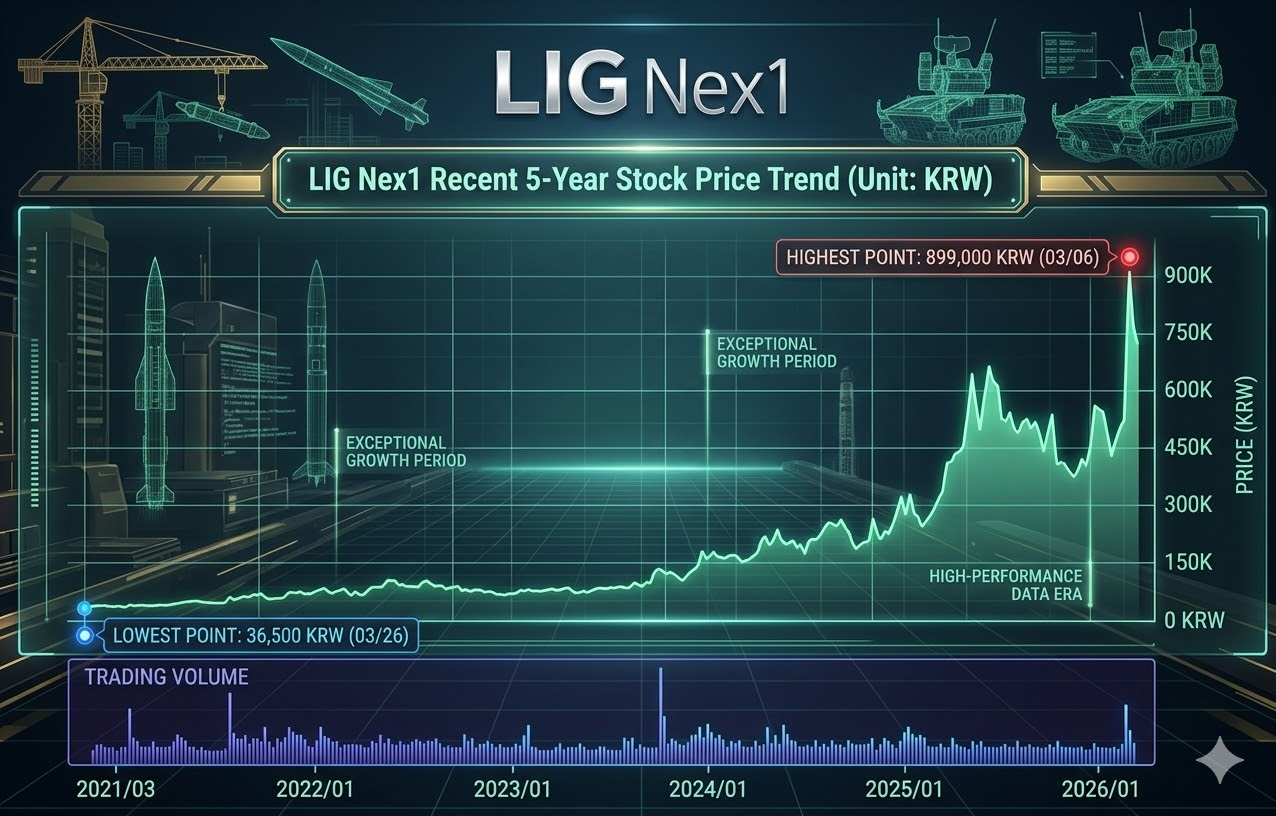
LIG Nex1 has posted revenue growth of 126% and operating profit growth of 260% over the past five years. In particular, last year's full-scale exports of the Cheongung-II (M-SAM 2) air defense system to the Middle East helped the company cross the KRW 4 trillion annual revenue threshold for the first time in its history. Its order backlog at end of last year reached KRW 26 trillion 230 billion, while its share price surged 1,271% from 2021 through last year.Industry observers note that LIG Nex1 has no record of issuing CBs or BWs in the past five years, fueling speculation that the limit increase may signal more than a precautionary measure — possibly anticipating large-scale investment in the near term.
Some market participants, however, have raised concerns that the issuance of CBs and BWs — potentially up to KRW 1 trillion in total — in place of conventional corporate bonds or bank borrowings could create an overhang (latent selling pressure) on the stock. This is because both instruments carry the option to be converted into shares, which would increase the total share count and put downward pressure on LIG Nex1's stock price.
LIG Calls for Global Leap, Faces 'Koo Family Company' Label Challenge [KFT Topic]Hanwha Systems' Operating Profit Down 60% Due to Philly Shipyard Investment: "Nuclear Submarine Plan Undecided"NearthLab: The Drone Startup That Inspected Wind Turbines — Now Targeting the Global Battlefield [Rising Stars of K-Defense]Hanwha Systems Doubles in a Month: Defense Exports and Philly Shipyard Reversal Fuel Stunning Rally
CBs, or convertible bonds, are debt instruments that can be converted into a predetermined number of shares at the holder's discretion, while BWs, or bonds with warrants, grant the holder the right to purchase new shares at a set price. Both carry characteristics of both debt and equity.
The embedded equity conversion option allows companies to raise funds at lower interest rates than conventional corporate bonds, yielding significant savings on interest costs. Should the instruments later be converted into shares, the resulting shift from debt to equity would also be expected to improve the company's financial structure.
Preventing Shareholder Value Dilution Is Key
As of end-September last year, LIG Nex1's standalone debt-to-equity ratio stood at a high 403.1%. Analysts, however, attribute this to accounting structures unique to the defense industry. The figure reflects advance payments received upon contract signing, which are recorded as liabilities, alongside corresponding prepayments made to subcontractors."The effective debt-to-equity ratio — adjusted by netting advance receipts against prepayments — comes in at 250.5%, which is considerably lower than the headline figure," said Kim Hyung-jin, a senior researcher at NICE Credit Rating.
Nonetheless, should CB or BW investors exercise their conversion rights amid rising share prices, a large volume of new shares would be issued, potentially diluting the equity value of existing shareholders.
On this point, a LIG Nex1 spokesperson said: "As there are no specific issuance plans at this time, the impact on the share price is expected to be limited. When actual issuance occurs, we will thoroughly review measures to protect shareholder value."
Separately, LIG Nex1 last month issued KRW 340 billion in corporate bonds and received a credit rating upgrade from 'AA-/Stable' to 'AA/Stable,' reflecting its strong financial standing.
The proceeds are earmarked for use through 2031: KRW 190 billion for raw material procurement for Middle East operations, KRW 10 billion for logistics and transportation costs, and KRW 140 billion for research and development (R&D) of integrated air defense and unmanned systems solutions.
Interest in the Cheongung-II system has been growing following reports that the system achieved a 96% intercept success rate against ballistic missiles fired by Iran in the recent U.S.-Israel–Iran conflict.
"Reports indicate that the United Arab Emirates (UAE), a key customer, has ordered early delivery of Cheongung-II batteries and additional guided missiles," said Lee Han-gyeol, an analyst at Kiwoom Securities. "A single Cheongung battery can fire 32 guided missiles, with each missile estimated to be priced at approximately KRW 1.5 billion."
Shin Haeju (hjs0509@fntimes.com)











![[THE COMPASS] 한미사이언스 경영권 분쟁, 신동국이 주도하는 ‘종식’ 게임](https://cfnimage.commutil.kr/phpwas/restmb_setimgmake.php?pp=006&w=69&h=45&m=5&simg=20261008122108000710a837df649412411124362.jpg&nmt=18)
![영업익 53% 뛴다는데…대웅제약 몸값 누르는 두 가지 변수 [5대 제약사 3Q 실적 ④]](https://cfnimage.commutil.kr/phpwas/restmb_setimgmake.php?pp=006&w=69&h=45&m=5&simg=202610081106100618007fd637f543112168227135.jpg&nmt=18)


![[그래픽 뉴스] ‘순대’가 경제용어라고? 순(純)대외자산, 한국의 진짜 해외자산은 얼마일까?](https://cfnimage.commutil.kr/phpwas/restmb_setimgmake.php?pp=006&w=298&h=298&m=1&simg=202609021356075202de68fcbb3512411124362_0.jpg&nmt=18)
![[그래픽 뉴스] ISA 대개편! 나에게 유리한 계좌는?](https://cfnimage.commutil.kr/phpwas/restmb_setimgmake.php?pp=006&w=298&h=298&m=1&simg=202608041713155615de68fcbb3512411124362_0.jpg&nmt=18)
![[그래픽 뉴스] 미국 증시 새로운 키워드 'MANGOS'](https://cfnimage.commutil.kr/phpwas/restmb_setimgmake.php?pp=006&w=298&h=298&m=1&simg=202607291740382069de68fcbb3512411124362_0.jpg&nmt=18)

![[그래픽 뉴스] 은퇴후 30년 부모님 세대의 생존전략](https://cfnimage.commutil.kr/phpwas/restmb_setimgmake.php?pp=006&w=298&h=298&m=1&simg=202606301704439153de68fcbb3512411124362_0.jpg&nmt=18)
![[신간]은퇴연옥…김경록의 은퇴 후 삶의 나침반](https://cfnimage.commutil.kr/phpwas/restmb_setimgmake.php?pp=006&w=81&h=123&m=5&simg=20260414140833047280f8caa4a5ce12411124362.jpg&nmt=18)
![[신간] 물처럼 흐르고 원칙으로 서다…김용환의 통찰을 담다](https://cfnimage.commutil.kr/phpwas/restmb_setimgmake.php?pp=006&w=81&h=123&m=5&simg=20260409114249027860f8caa4a5ce12411124362.jpg&nmt=18)
![[안현정 서평] 플랫폼의 영지에서 ‘미학적 주권’을 선포하라...'K가 죽어야 K가 산다' 장준환 著](https://cfnimage.commutil.kr/phpwas/restmb_setimgmake.php?pp=006&w=81&h=123&m=5&simg=20260527121426063220c1c16452b012411124362.jpg&nmt=18)
![[서평] 추세 매매의 대가들...추세추종 투자전략의 대가 14인 인터뷰](https://cfnimage.commutil.kr/phpwas/restmb_setimgmake.php?pp=006&w=81&h=123&m=5&simg=2023102410444004986c1c16452b0175114235199.jpg&nmt=18)


![[머니무브 2026] “지금 사도 될까?” 답이 안 보인다면…하반기 투자, 4명의 전문가에게 물어보세요](https://cfnimage.commutil.kr/phpwas/restmb_setimgmake.php?pp=006&w=89&h=45&m=1&simg=202609151044050355302a735e27af12411124362.jpg&nmt=18)
![[AD] ‘PBV 라인업 확장’ 기아, 9월 독일서 ‘PV7’ 첫 공개](https://cfnimage.commutil.kr/phpwas/restmb_setimgmake.php?pp=006&w=89&h=45&m=1&simg=2026083111010602815074925877361231180222.jpg&nmt=18)
![[AD] 제네시스, 럭셔리 경험 더한 ‘2027 GV70’‧‘GV70 그래파이트’ 출시](https://cfnimage.commutil.kr/phpwas/restmb_setimgmake.php?pp=006&w=89&h=45&m=1&simg=20260702143546085600749258773622211122717.jpg&nmt=18)