







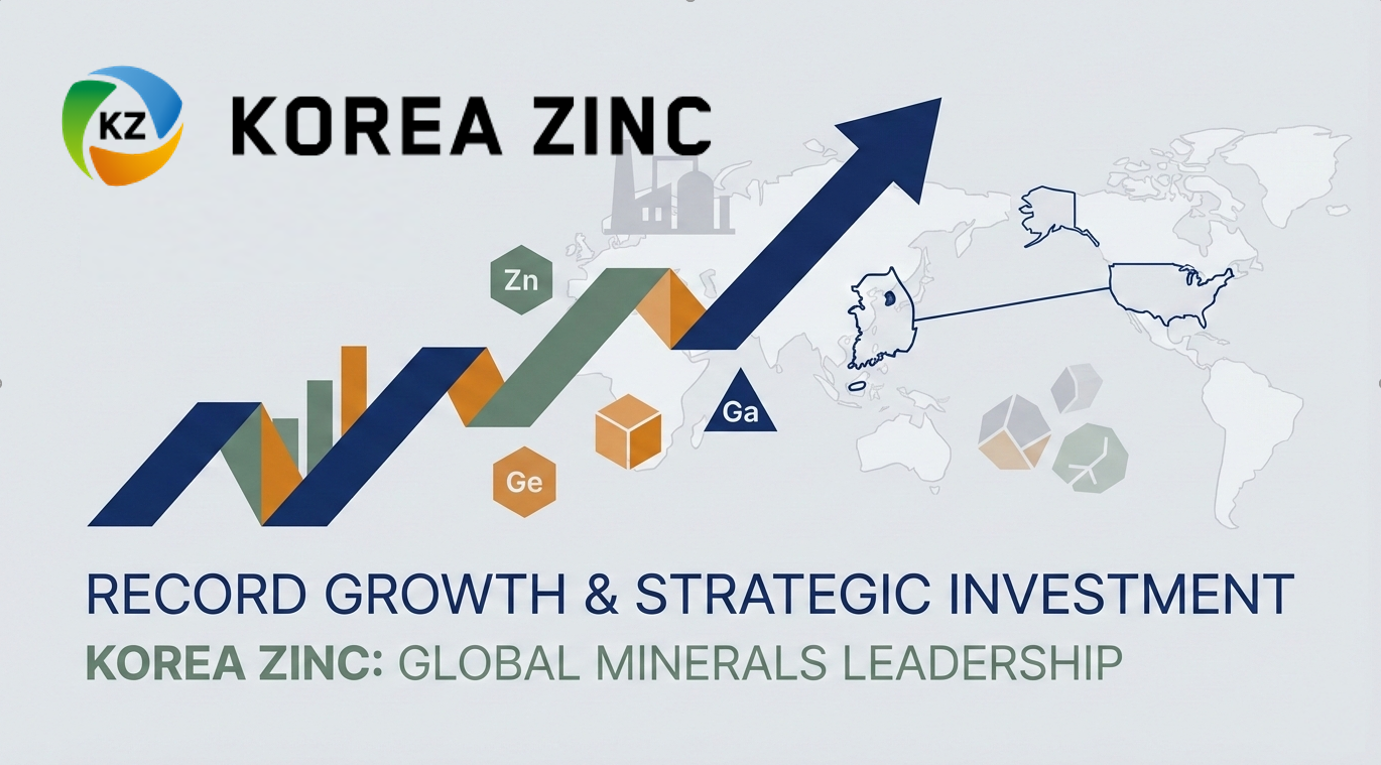
Now in his third year as chairman, Choi announced in 2023 a mid- to long-term financial goal of reaching KRW 25 trillion in revenue and up to 12 percent in operating margin by 2033. At the time, amid sluggish conditions in the company's core zinc and lead businesses, his strategy was to aggressively establish a diversified portfolio and increase the share of new businesses to 50 percent.
The new businesses Choi pledged to develop are referred to as the "Troika Drive," encompassing resource circulation (recycled copper, solar panel waste pre-processing, etc.), secondary battery materials (precursors, copper foil, nickel sulfate), renewable energy (wind power), and green hydrogen. In fact, the Troika Drive is a vision Choi had been designing for Korea Zinc's next 50 years even before becoming chairman.
He also focused on expanding supply chains for strategic minerals such as antimony, indium, bismuth, germanium, and gallium. These minerals are essential materials for cutting-edge industries including AI, electric vehicles, and defense. Choi's foresight has rapidly elevated Korea Zinc as a "de-China strategic minerals" company as U.S.-China protectionist trade conflicts recently intensified export controls on strategic minerals.
In fact, Korea Zinc signed a memorandum of understanding with U.S. defense contractor Lockheed Martin for germanium supply at the Korea-U.S. Business Roundtable held in Washington, D.C., in August. The company also announced plans to build gallium production facilities, formalizing its global de-China strategy.
As a result, Korea Zinc is posting record earnings this year. Cumulative revenue through the third quarter reached KRW 11.818 trillion, up 37 percent from last year. The company is expected to reach KRW 16 trillion by year-end. Despite one-time costs including employee performance bonuses and recent rare metal price adjustments, the operating margin stood at 6.8 percent, down only 0.1 percentage point from the previous year. The share of new business revenue reached 29 percent in the first half of this year, up 21 percentage points from when the 2023 plan was established.
Korea Zinc is expected to maintain robust growth in the fourth quarter as well. Key minerals such as gold and silver are hitting all-time highs, and strategic mineral exports to the U.S. have begun in earnest.
iM Securities recently forecasted Korea Zinc's fourth-quarter consolidated revenue at KRW 4.793 trillion and operating profit at KRW 396 billion. Compared to the fourth quarter of last year, revenue is expected to increase 40.4 percent and operating profit 44.9 percent.
Kim Yun-sang, a researcher at iM Securities, said, "Korea Zinc recovers overwhelmingly more metals than other smelters through its integrated zinc-lead processing system," adding, "Key price indicators are at historically favorable levels, so fourth-quarter earnings will reach record highs."
With record annual earnings within reach this year, Chairman Choi has placed another strategic bet: entering the United States.
On Dec. 15, Korea Zinc announced plans to establish a joint venture with the U.S. government to build a smelter of approximately 200,000 pyeong (approximately 660,000 square meters) in Tennessee. The smelter will produce 13 products, including 11 types designated as "critical minerals" by the U.S. government. The U.S. government will have priority purchasing rights for the minerals produced.
Construction of Korea Zinc's U.S. smelter is scheduled to begin with site preparation in 2026, with completion targeted for 2029. After completion, operations will begin in phases starting with zinc, lead, and copper processes. The facility will be capable of processing approximately 1.1 million tons of raw materials annually to produce 540,000 tons of final products. Annual production targets are 300,000 tons of zinc, 200,000 tons of lead, 3,500 tons of copper, and 5,100 tons of rare metals.
This smelter construction is significant in that Korea Zinc is securing a stable production base in North America while strengthening growth potential.
A Korea Zinc official said, "Establishing a production base in the United States, where policy and regulatory predictability is high, can mitigate global uncertainties such as geopolitical risks, export controls, and logistics disruptions."
Kim JaeHun (rlqm93@fntimes.com)











![이성훈 LH 사장 다주택·대출 규제 발언 도마…여야 의원 잇단 지적 [2026 국감]](https://cfnimage.commutil.kr/phpwas/restmb_setimgmake.php?pp=006&w=69&h=45&m=5&simg=20261012163012026870048b718333218159227151.jpg&nmt=18)

![12개월 최고 연 6.00%…BNK저축은행 'BNK동행적금'[이주의 저축은행 적금금리-10월 2주]](https://cfnimage.commutil.kr/phpwas/restmb_setimgmake.php?pp=006&w=69&h=45&m=5&simg=202610110103170668607c96e797801121481643.jpg&nmt=18)

![12개월 최고 연 4.10%…OK저축은행 'OK e-안심앱플러스정기예금6'[이주의 저축은행 예금금리-10월 2주]](https://cfnimage.commutil.kr/phpwas/restmb_setimgmake.php?pp=006&w=69&h=45&m=5&simg=202610110051040059207c96e797801121481643.jpg&nmt=18)


![[그래픽 뉴스] ‘순대’가 경제용어라고? 순(純)대외자산, 한국의 진짜 해외자산은 얼마일까?](https://cfnimage.commutil.kr/phpwas/restmb_setimgmake.php?pp=006&w=298&h=298&m=1&simg=202609021356075202de68fcbb3512411124362_0.jpg&nmt=18)
![[그래픽 뉴스] ISA 대개편! 나에게 유리한 계좌는?](https://cfnimage.commutil.kr/phpwas/restmb_setimgmake.php?pp=006&w=298&h=298&m=1&simg=202608041713155615de68fcbb3512411124362_0.jpg&nmt=18)
![[그래픽 뉴스] 미국 증시 새로운 키워드 'MANGOS'](https://cfnimage.commutil.kr/phpwas/restmb_setimgmake.php?pp=006&w=298&h=298&m=1&simg=202607291740382069de68fcbb3512411124362_0.jpg&nmt=18)

![[그래픽 뉴스] 은퇴후 30년 부모님 세대의 생존전략](https://cfnimage.commutil.kr/phpwas/restmb_setimgmake.php?pp=006&w=298&h=298&m=1&simg=202606301704439153de68fcbb3512411124362_0.jpg&nmt=18)
![[신간]은퇴연옥…김경록의 은퇴 후 삶의 나침반](https://cfnimage.commutil.kr/phpwas/restmb_setimgmake.php?pp=006&w=81&h=123&m=5&simg=20260414140833047280f8caa4a5ce12411124362.jpg&nmt=18)
![[신간] 물처럼 흐르고 원칙으로 서다…김용환의 통찰을 담다](https://cfnimage.commutil.kr/phpwas/restmb_setimgmake.php?pp=006&w=81&h=123&m=5&simg=20260409114249027860f8caa4a5ce12411124362.jpg&nmt=18)
![[안현정 서평] 플랫폼의 영지에서 ‘미학적 주권’을 선포하라...'K가 죽어야 K가 산다' 장준환 著](https://cfnimage.commutil.kr/phpwas/restmb_setimgmake.php?pp=006&w=81&h=123&m=5&simg=20260527121426063220c1c16452b012411124362.jpg&nmt=18)
![[서평] 추세 매매의 대가들...추세추종 투자전략의 대가 14인 인터뷰](https://cfnimage.commutil.kr/phpwas/restmb_setimgmake.php?pp=006&w=81&h=123&m=5&simg=2023102410444004986c1c16452b0175114235199.jpg&nmt=18)


![[머니무브 2026] “지금 사도 될까?” 답이 안 보인다면…하반기 투자, 4명의 전문가에게 물어보세요](https://cfnimage.commutil.kr/phpwas/restmb_setimgmake.php?pp=006&w=89&h=45&m=1&simg=202609151044050355302a735e27af12411124362.jpg&nmt=18)
![[AD] ‘PBV 라인업 확장’ 기아, 9월 독일서 ‘PV7’ 첫 공개](https://cfnimage.commutil.kr/phpwas/restmb_setimgmake.php?pp=006&w=89&h=45&m=1&simg=2026083111010602815074925877361231180222.jpg&nmt=18)
![[AD] 제네시스, 럭셔리 경험 더한 ‘2027 GV70’‧‘GV70 그래파이트’ 출시](https://cfnimage.commutil.kr/phpwas/restmb_setimgmake.php?pp=006&w=89&h=45&m=1&simg=20260702143546085600749258773622211122717.jpg&nmt=18)