






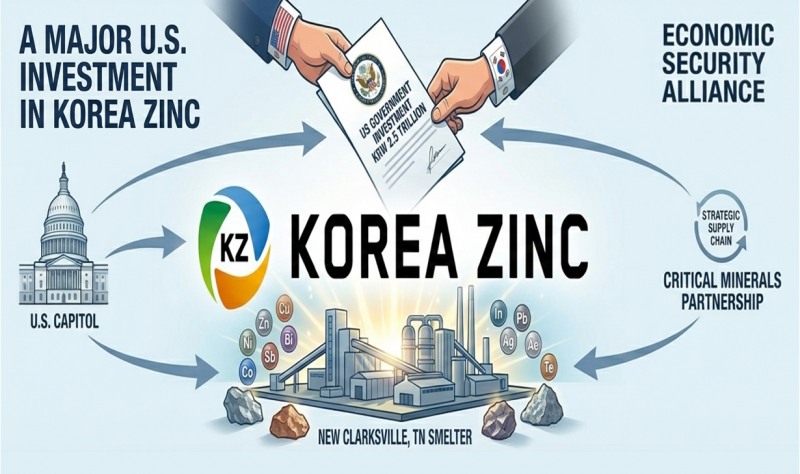
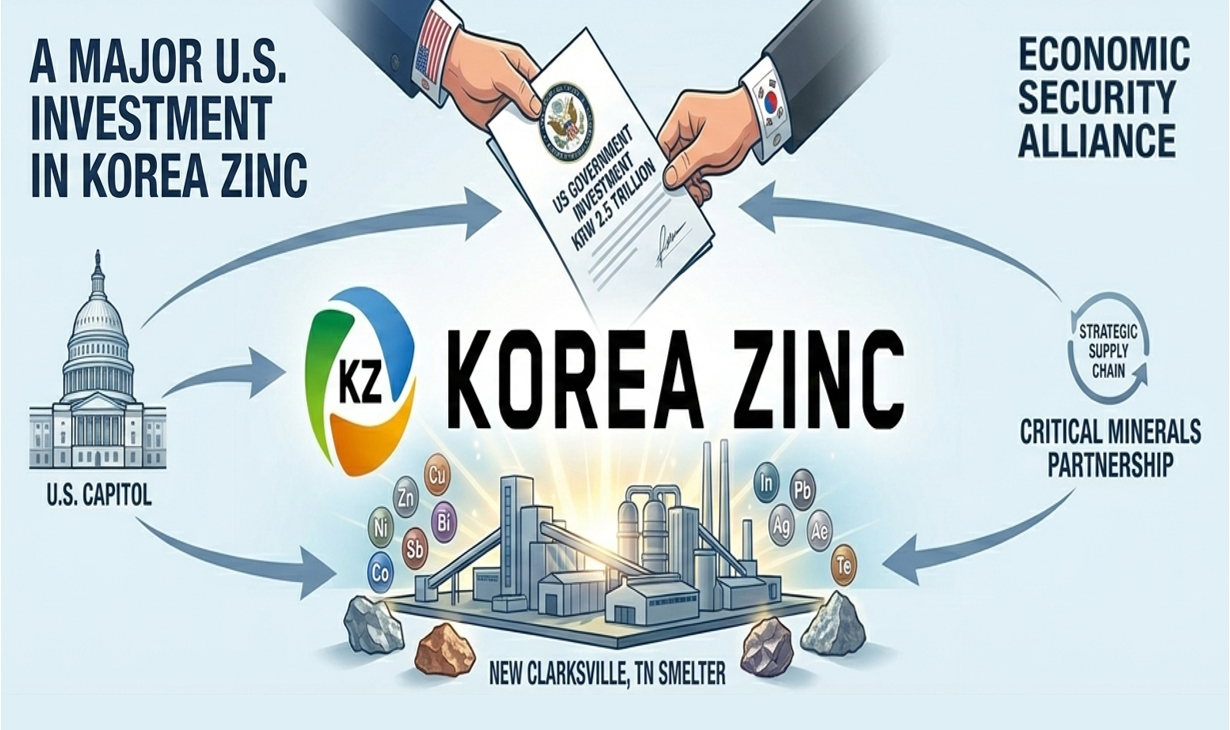
Korea Zinc will invest a total of KRW 11 trillion to build a 'U.S. Smelter' in Clarksville, Tennessee. This is a mega project with approximately KRW 10 trillion (USD 6.6 billion) invested in facility investment (Capex) alone.
The U.S. government will invest a total of USD 2.36 billion (approximately KRW 2.46 trillion) in this project. Specifically, the U.S. Department of War and investors will provide USD 2.15 billion (approximately KRW 3.2 trillion), and the Department of Commerce will provide USD 210 million (approximately KRW 310 billion) under the CHIPS Act. The U.S. government will secure 'Preferred Access' to critical minerals produced by Korea Zinc.
The key to this investment is that it combines equity investment beyond simple subsidies. From the U.S. perspective, which must actively utilize economically allied companies to build comprehensive supply chains, Korea Zinc is analyzed to have been selected as the optimal partner.
U.S. Commerce Secretary Howard Lutnick highly evaluated the strategic value of this investment. He emphasized, "Korea Zinc's U.S. investment is a transformational deal that will change the critical minerals landscape," and "Through this, the U.S. can produce 13 types of critical strategic minerals on a large scale that are essential for national security, including aerospace, defense, semiconductors, and automobiles."
Over the past six months, the U.S. government has invested over USD 10 billion (approximately KRW 14.7 trillion) to secure equity and warrants in companies in critical minerals, IT, and energy sectors, including U.S. Steel, Intel, MP Materials, Trilogy Metals, and Westinghouse.
This is a preemptive response to the increasingly severe 'resource weaponization' risk. Currently, the U.S. import dependency for zinc reaches 73%, and self-sufficiency in major critical minerals such as antimony (85%), bismuth (89%), and gallium (100%) is also vulnerable.
The reason the U.S. chose Korea Zinc is clear. Not only does Korea Zinc possess world-class smelting technology and production capabilities, but it is already producing 12 of the 60 critical minerals selected by the U.S. (antimony, bismuth, cobalt, copper, indium, lead, nickel, silver, tellurium, zinc). When gallium and germanium are added by 2028, a total of 14 types can be supplied.
관련기사
Korea Zinc is also expected to maximize its influence in the U.S. market through this investment. As supply shortages intensify due to local aging smelter closures and environmental regulations, Korea Zinc's complex smelter is expected to become a key base absorbing U.S. demand.
The industry views this investment as an opportunity for Korea-U.S. economic partnership to become even stronger. An industry official evaluated it as "a representative exemplary case symbolizing the economic security alliance between Korea and the U.S. beyond private company investment."
Shin Haeju (hjs0509@fntimes.com)











![이성훈 LH 사장 다주택·대출 규제 발언 도마…여야 의원 잇단 지적 [2026 국감]](https://cfnimage.commutil.kr/phpwas/restmb_setimgmake.php?pp=006&w=69&h=45&m=5&simg=20261012163012026870048b718333218159227151.jpg&nmt=18)

![12개월 최고 연 6.00%…BNK저축은행 'BNK동행적금'[이주의 저축은행 적금금리-10월 2주]](https://cfnimage.commutil.kr/phpwas/restmb_setimgmake.php?pp=006&w=69&h=45&m=5&simg=202610110103170668607c96e797801121481643.jpg&nmt=18)

![12개월 최고 연 4.10%…OK저축은행 'OK e-안심앱플러스정기예금6'[이주의 저축은행 예금금리-10월 2주]](https://cfnimage.commutil.kr/phpwas/restmb_setimgmake.php?pp=006&w=69&h=45&m=5&simg=202610110051040059207c96e797801121481643.jpg&nmt=18)


![[그래픽 뉴스] ‘순대’가 경제용어라고? 순(純)대외자산, 한국의 진짜 해외자산은 얼마일까?](https://cfnimage.commutil.kr/phpwas/restmb_setimgmake.php?pp=006&w=298&h=298&m=1&simg=202609021356075202de68fcbb3512411124362_0.jpg&nmt=18)
![[그래픽 뉴스] ISA 대개편! 나에게 유리한 계좌는?](https://cfnimage.commutil.kr/phpwas/restmb_setimgmake.php?pp=006&w=298&h=298&m=1&simg=202608041713155615de68fcbb3512411124362_0.jpg&nmt=18)
![[그래픽 뉴스] 미국 증시 새로운 키워드 'MANGOS'](https://cfnimage.commutil.kr/phpwas/restmb_setimgmake.php?pp=006&w=298&h=298&m=1&simg=202607291740382069de68fcbb3512411124362_0.jpg&nmt=18)

![[그래픽 뉴스] 은퇴후 30년 부모님 세대의 생존전략](https://cfnimage.commutil.kr/phpwas/restmb_setimgmake.php?pp=006&w=298&h=298&m=1&simg=202606301704439153de68fcbb3512411124362_0.jpg&nmt=18)
![[신간]은퇴연옥…김경록의 은퇴 후 삶의 나침반](https://cfnimage.commutil.kr/phpwas/restmb_setimgmake.php?pp=006&w=81&h=123&m=5&simg=20260414140833047280f8caa4a5ce12411124362.jpg&nmt=18)
![[신간] 물처럼 흐르고 원칙으로 서다…김용환의 통찰을 담다](https://cfnimage.commutil.kr/phpwas/restmb_setimgmake.php?pp=006&w=81&h=123&m=5&simg=20260409114249027860f8caa4a5ce12411124362.jpg&nmt=18)
![[안현정 서평] 플랫폼의 영지에서 ‘미학적 주권’을 선포하라...'K가 죽어야 K가 산다' 장준환 著](https://cfnimage.commutil.kr/phpwas/restmb_setimgmake.php?pp=006&w=81&h=123&m=5&simg=20260527121426063220c1c16452b012411124362.jpg&nmt=18)
![[서평] 추세 매매의 대가들...추세추종 투자전략의 대가 14인 인터뷰](https://cfnimage.commutil.kr/phpwas/restmb_setimgmake.php?pp=006&w=81&h=123&m=5&simg=2023102410444004986c1c16452b0175114235199.jpg&nmt=18)


![[머니무브 2026] “지금 사도 될까?” 답이 안 보인다면…하반기 투자, 4명의 전문가에게 물어보세요](https://cfnimage.commutil.kr/phpwas/restmb_setimgmake.php?pp=006&w=89&h=45&m=1&simg=202609151044050355302a735e27af12411124362.jpg&nmt=18)
![[AD] ‘PBV 라인업 확장’ 기아, 9월 독일서 ‘PV7’ 첫 공개](https://cfnimage.commutil.kr/phpwas/restmb_setimgmake.php?pp=006&w=89&h=45&m=1&simg=2026083111010602815074925877361231180222.jpg&nmt=18)
![[AD] 제네시스, 럭셔리 경험 더한 ‘2027 GV70’‧‘GV70 그래파이트’ 출시](https://cfnimage.commutil.kr/phpwas/restmb_setimgmake.php?pp=006&w=89&h=45&m=1&simg=20260702143546085600749258773622211122717.jpg&nmt=18)