






Strong Performance Reflects AI Leadership
According to LG CNS on the 27th, the company's revenue last year reached KRW 6.1295 trillion, up 2.5% from the previous year. Operating profit rose 8.4% year-over-year to KRW 555.8 billion.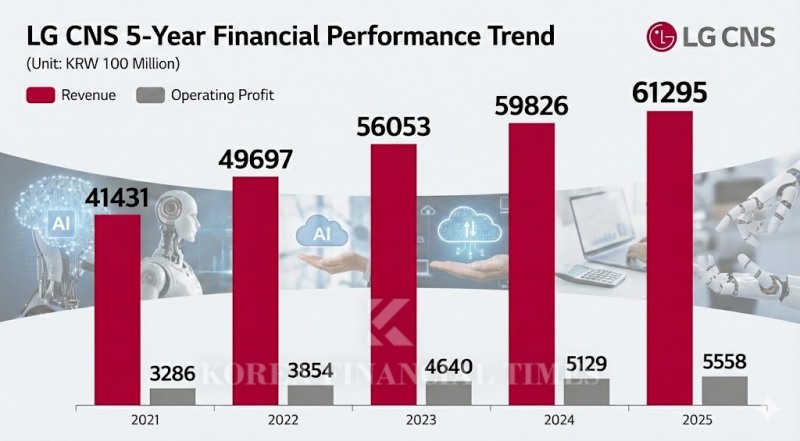

The architect of this performance turnaround is CEO Hyun Shin-kyun. Immediately after taking office, he declared the "first year of AI internalization" and has been applying AI across all system development processes and internal operations.
An IT expert by background, Hyun joined LG CNS in 2017 after stints at Accenture, Deloitte, and A.T. Kearney Consulting, serving as development management team leader at KB Kookmin Bank and head of the business innovation group at LG Display. He held positions as Chief Technology Officer (CTO) and head of the D&A business division.
Last year, he was promoted to president and led organizational transformation leveraging his AX expertise. Since his promotion, he has restructured the organization around three pillars—AI, cloud, and data—and increased the proportion of internal AI utilization projects to over 70%. He has also established a virtuous cycle where internal productivity improvements lead to external business expansion.
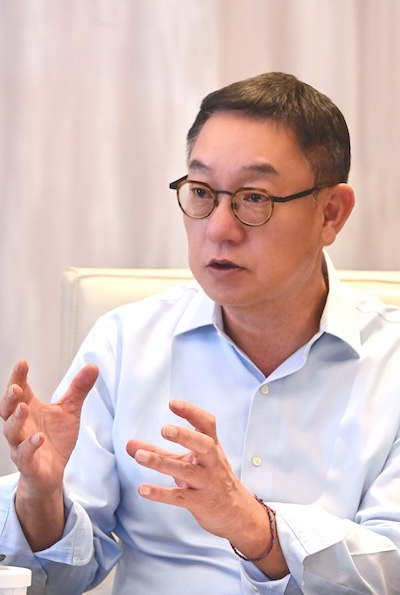
Hyun Shin-kyun, President of LG CNS. / Photo = LG CNS
At a press conference in January last year, Hyun stated, "We are beginning a new leap forward following our initial public offering (IPO)," adding, "As an 'AX innovator' leading the global market, we will actively pioneer new markets and continue to discover core drivers that will propel LG CNS's future growth."
Koo Kwang-mo's Vision for AI and Robotics Drives LG Group's Transformation [KFT Topic]'Beyond Mobile to Robotics': LG Innotek Continues Portfolio Expansion [KFT Topic]LG Electronics' Two Robot Companies Show Polar Opposite Results...Robostar vs ROBOTIS '10-Fold Return Gap'LG Display Set to Reach KRW 1 Trillion Operating Profit Next Year
Under this strategy, LG CNS is pursuing expansion of domestic and international open-source ecosystems and entry into new businesses such as robotics and agentic AI. One year into Hyun's tenure, the effects of structural reform are becoming evident, and the company's transformation into an "AI-cloud-based AX and RX specialist" is becoming a reality.
'AI Engine' Fully Operational...Agentic Ecosystem Expansion
The fastest-growing area under Hyun's leadership has been the AI business. He has elevated competitiveness across the AI ecosystem by pursuing a "multi-large language model (LLM)" strategy that employs both proprietary and global LLMs in parallel.Earlier this month, LG CNS, participating in the LG AI Research consortium, ranked first (90.2 points) in the initial evaluation for the government's "indigenous AI foundation model" project.
In particular, the company is achieving meaningful results in the public and healthcare sectors based on the group's proprietary LLM "EXAONE." In the defense sector, it has won contracts for similar communication networks for the Army, Navy, and Air Force, as well as the next-generation integrated defense facility information system. In healthcare, it is partnering with Cha Bio Group to develop a "connected healthcare" service utilizing hospital and wearable data.
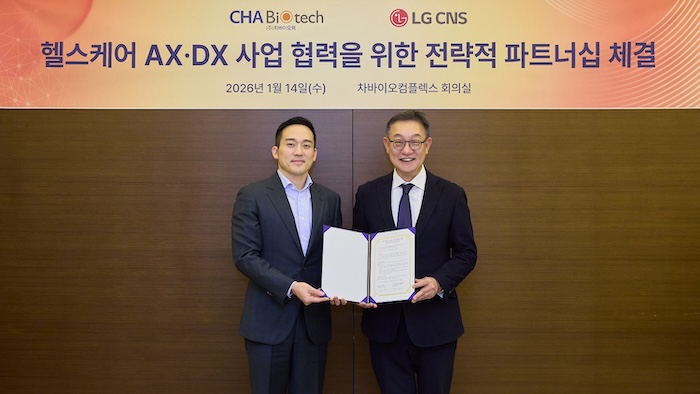
(From left) Cha Won-tae, Vice Chairman of Cha Bio Group, and Hyun Shin-kyun, President of LG CNS. / Photo = LG CNS
이미지 확대보기
AI competitiveness is also expanding through global collaboration. LG CNS is jointly developing a generative AI-based work automation platform with Amazon Web Services (AWS) and providing customized AI services integrating Microsoft's Copilot and Azure OpenAI. With Google Cloud, it has strengthened collaboration in data analysis and modeling.
As AI business establishes itself as the core technology engine, LG CNS is accelerating expansion into the more evolved "Agentic AI" domain. LG CNS has completed autonomous agent demonstration projects with five manufacturing companies and three logistics companies, securing efficiency cases in delivery prediction and new material exploration.
From AI Infrastructure to Robot Transformation: Next-Generation Growth Axis in Full Swing
LG CNS is fully launching its future growth strategy centered on AI infrastructure and physical AI as twin pillars.In the cloud sector, it is leading the market based on a design-build-operate (DBO) model. Leveraging its experience in designing and operating large AI data centers in Pyeongtaek and Cheongna, the company won a contract last year to build an AI data center in Indonesia and is considering expansion into Vietnam and other markets.
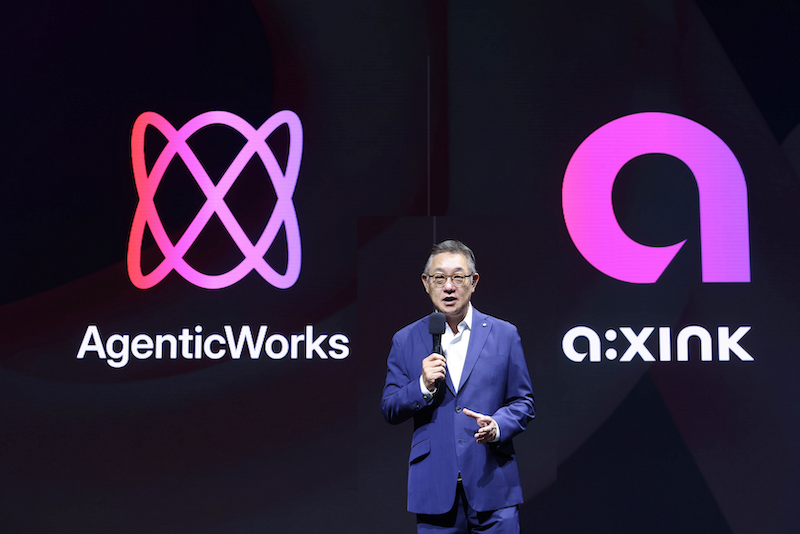
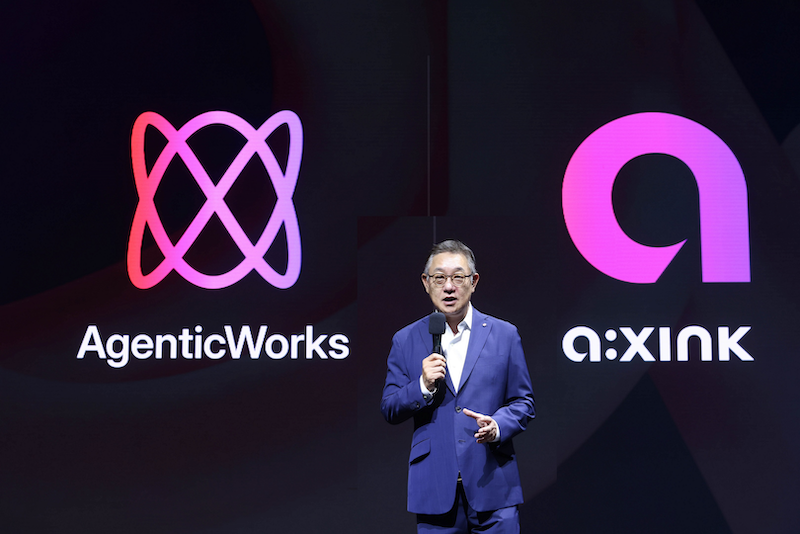
Based on the "One LG" collaboration framework, it is advancing data center solutions optimized for AI workloads by consolidating capabilities in high-efficiency cooling, advanced power systems, and ESG-friendly design.
Simultaneously, LG CNS is strengthening its "physical AI" business based on robot foundation models (RFM). It is enhancing RX capabilities by fine-tuning robot movements using data collected from industrial sites and securing its own integrated robot operation platform.
Currently, proof-of-concept (PoC) trials have been completed at logistics centers and factories of approximately 10 client companies, with preparations underway for commercialization of industrial humanoid robots. Going forward, the company plans to expand its physical AI domain through integrated robot services combining RFM, robot hardware, and its proprietary platform.
2026: First Full Year of 'Dual Engine' Results with Global Expansion
Investment in AI infrastructure and robot transformation is directly linked to global market expansion. LG CNS is focusing on global market penetration this year, designating it as "the first full year of AX and RX transformation."In North America, robot implementation projects for complete automation of affiliate factories are expanding, while in the Asia-Pacific region, K-banking systems are being exported to Indonesia, Singapore, and other countries.
As a platform-based growth structure encompassing AI, cloud, data centers, and RX takes root, global revenue growth is expected to gain full momentum.
Song Kwang-ryun, CFO of LG CNS, emphasized at the 2025 annual earnings conference call, "This year, we anticipate various opportunities alongside intensified competition in the IT business environment," adding, "To secure competitive advantage, we will advance our core AX competitiveness, respond swiftly to customer demands, and secure stable growth momentum through continued expansion of data center AX."
He continued, "We will solidify our position as an AX leading company by expanding AI data centers based on group company solutions and securing numerous AX projects across various industries including manufacturing, retail, and services," adding, "We will also formalize our global leap by securing new growth drivers utilizing RX technology."
Jeong Chaeyun (chaeyun@fntimes.com)










![[Z-스코어 기업가치 바로 보기] 차입이냐 자기자본이냐…LG엔솔 vs 삼성SDI ‘명암ʼ](https://cfnimage.commutil.kr/phpwas/restmb_setimgmake.php?pp=006&w=69&h=45&m=5&simg=20260912004753014480dd55077bc212411124362.jpg&nmt=18)

![[기자수첩] 보험사 품는 사모펀드, 대주주 심사 재고해야](https://cfnimage.commutil.kr/phpwas/restmb_setimgmake.php?pp=006&w=69&h=45&m=5&simg=20260913173909069220ed56b8e1f814379898.jpg&nmt=18)


![[그래픽 뉴스] ‘순대’가 경제용어라고? 순(純)대외자산, 한국의 진짜 해외자산은 얼마일까?](https://cfnimage.commutil.kr/phpwas/restmb_setimgmake.php?pp=006&w=298&h=298&m=1&simg=202609021356075202de68fcbb3512411124362_0.jpg&nmt=18)
![[그래픽 뉴스] ISA 대개편! 나에게 유리한 계좌는?](https://cfnimage.commutil.kr/phpwas/restmb_setimgmake.php?pp=006&w=298&h=298&m=1&simg=202608041713155615de68fcbb3512411124362_0.jpg&nmt=18)
![[그래픽 뉴스] 미국 증시 새로운 키워드 'MANGOS'](https://cfnimage.commutil.kr/phpwas/restmb_setimgmake.php?pp=006&w=298&h=298&m=1&simg=202607291740382069de68fcbb3512411124362_0.jpg&nmt=18)

![[그래픽 뉴스] 은퇴후 30년 부모님 세대의 생존전략](https://cfnimage.commutil.kr/phpwas/restmb_setimgmake.php?pp=006&w=298&h=298&m=1&simg=202606301704439153de68fcbb3512411124362_0.jpg&nmt=18)
![[신간]은퇴연옥…김경록의 은퇴 후 삶의 나침반](https://cfnimage.commutil.kr/phpwas/restmb_setimgmake.php?pp=006&w=81&h=123&m=5&simg=20260414140833047280f8caa4a5ce12411124362.jpg&nmt=18)
![[신간] 물처럼 흐르고 원칙으로 서다…김용환의 통찰을 담다](https://cfnimage.commutil.kr/phpwas/restmb_setimgmake.php?pp=006&w=81&h=123&m=5&simg=20260409114249027860f8caa4a5ce12411124362.jpg&nmt=18)
![[안현정 서평] 플랫폼의 영지에서 ‘미학적 주권’을 선포하라...'K가 죽어야 K가 산다' 장준환 著](https://cfnimage.commutil.kr/phpwas/restmb_setimgmake.php?pp=006&w=81&h=123&m=5&simg=20260527121426063220c1c16452b012411124362.jpg&nmt=18)
![[서평] 추세 매매의 대가들...추세추종 투자전략의 대가 14인 인터뷰](https://cfnimage.commutil.kr/phpwas/restmb_setimgmake.php?pp=006&w=81&h=123&m=5&simg=2023102410444004986c1c16452b0175114235199.jpg&nmt=18)


![[AD] ‘PBV 라인업 확장’ 기아, 9월 독일서 ‘PV7’ 첫 공개](https://cfnimage.commutil.kr/phpwas/restmb_setimgmake.php?pp=006&w=89&h=45&m=1&simg=2026083111010602815074925877361231180222.jpg&nmt=18)
![[AD] 제네시스, 럭셔리 경험 더한 ‘2027 GV70’‧‘GV70 그래파이트’ 출시](https://cfnimage.commutil.kr/phpwas/restmb_setimgmake.php?pp=006&w=89&h=45&m=1&simg=20260702143546085600749258773622211122717.jpg&nmt=18)
![[AD] 개소세 혜택 종료…현대차, ‘썸머 페스타’로 고객 부담 완화](https://cfnimage.commutil.kr/phpwas/restmb_setimgmake.php?pp=006&w=89&h=45&m=1&simg=20260702142355004830749258773622211122717.jpg&nmt=18)
![[AD] 기아 ‘디 올 뉴 셀토스’, 인도 타임스 드라이브 어워즈서 ‘올해의 SUV’ 선정](https://cfnimage.commutil.kr/phpwas/restmb_setimgmake.php?pp=006&w=89&h=45&m=1&simg=202605071156400590007492587736124111243152.jpg&nmt=18)
![[AD]‘그랜저 잡자’ 기아, 상품성 더한 ‘The 2027 K8’ 출시](https://cfnimage.commutil.kr/phpwas/restmb_setimgmake.php?pp=006&w=89&h=45&m=1&simg=2026042110193702730074925877361211627527.jpg&nmt=18)