






The domestic petrochemical industry downturn results from a complex combination of China-driven oversupply and downstream demand slowdown caused by US-China trade disputes. This has left virtually all domestic petrochemical companies experiencing their most challenging period ever.
However, Lotte Chemical's struggles appear particularly pronounced due to its business structure concentrated in commodity products. Commodity products are basic chemicals used to manufacture plastics commonly found in daily life, such as microwave containers, packaging materials, and disposable items. Since 2020, China, the largest consumer market, has expanded self-sufficiency, significantly reducing opportunities for domestic companies.
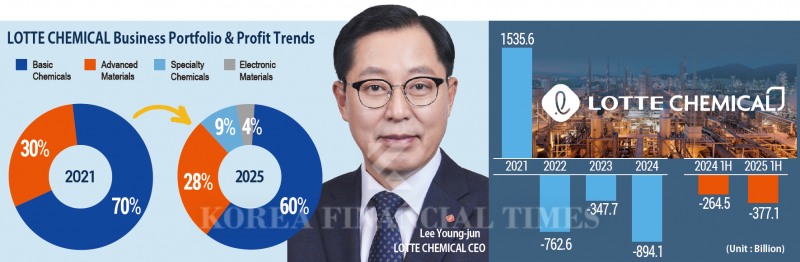
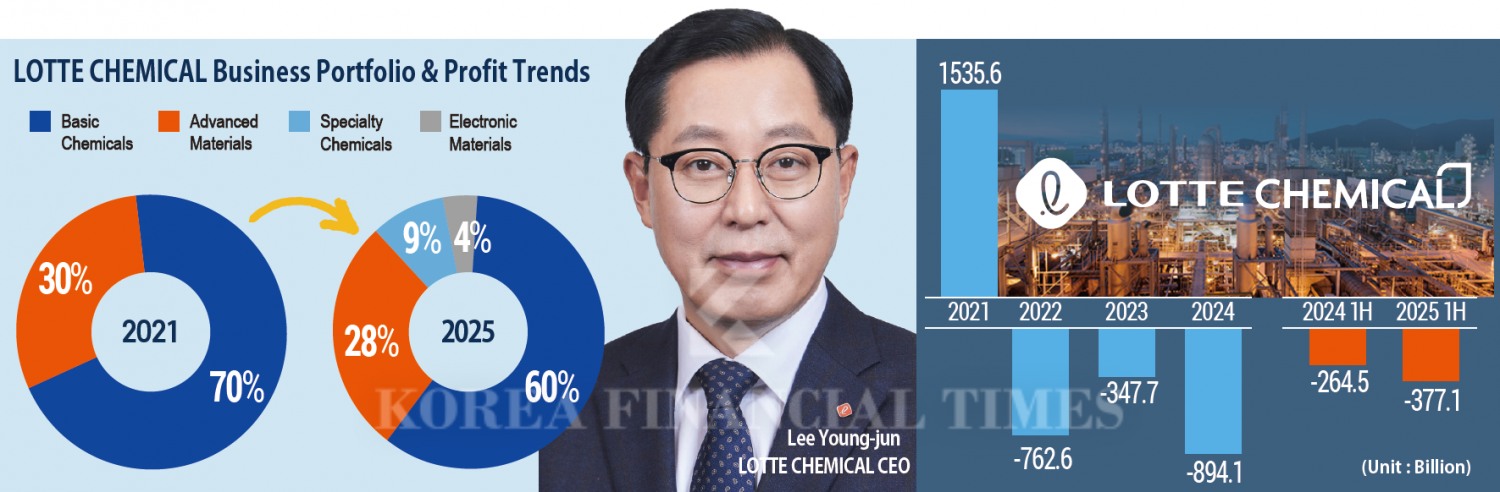
According to Lotte Chemical's semi-annual report, the basic chemicals division handling commodity products accounted for 60 percent of consolidated sales by business segment in the first half of this year. The advanced materials division producing specialty products for home appliances, IT, automotive, and medical devices represented only 28 percent.
Lotte Chemical has set a plan to reduce the commodity proportion to 30 percent by 2030. In contrast, LG Chem, despite having the largest domestic NCC production capacity, diversified early into batteries and other sectors. Petrochemicals account for just 38 percent of total sales, and this includes all petrochemical products including specialty products. The NCC-based commodity proportion is estimated at approximately 14 percent.
The appointment of CEO Lee Young-jun as Lotte Chemical's chief executive in November last year sent a strong message about transforming the commodity-focused business structure. Unlike his predecessor, who was an expert in large-scale M&A, CEO Lee is recognised as a specialty field expert.
He worked at Samsung General Chemicals, Cheil Industries, and Samsung SDI before joining Lotte Group through the 2015 Samsung-Lotte big deal, and has led the advanced materials division at Lotte Chemical. Indeed, the advanced materials division he leads has maintained 5-6 percent operating margins despite demand slowdown from US-China trade disputes and weak selling prices.
However, immediately after taking office, he had to focus on addressing the urgent issue of rapidly deteriorating financial structure rather than expanding advanced materials. Lotte Chemical's net borrowings surged 24-fold from KRW 296 billion at the end of 2021 to KRW 7.154 trillion at the end of 2024.
From LOTTE and SK to LG and EcoPro… Battery and Petrochemical Firms Turn to Price Return Swap (PRS) for FundraisingSK, LG, LOTTE: 'Secure Cash!' — Restructuring, Liquidity Drive 'All-In'Petrochemical Restructuring Underway… Will S-OIL’s ‘Time Bomb’ Go Off?Lotte Corporation Responds to Credit Rating Downgrade : “Uncertainty Resolved… Full Commitment to Improving Financial Soundness”
To reduce this burden, he implemented an 'asset light' strategy through asset sales. From October last year to March this year, he secured approximately KRW 1.3 trillion by selling a 40 percent stake in the US subsidiary (LCLA), 25 percent stake in the Indonesian subsidiary (LCI), the entire 75 percent stake in the Pakistani subsidiary, and the entire 4.9 percent stake in Japan's Resonac.
Another challenge remaining for CEO Lee is domestic NCC restructuring. In August, 10 NCC companies including Lotte Chemical joined a government-led 25 percent voluntary reduction plan. However, specific implementation measures have not yet emerged due to differing interests among companies.
Lotte Chemical favours horizontal integration that reduces costs by consolidating operations with peer companies. The company is reportedly discussing consolidation with HD Hyundai Chemical and Yeochun NCC.
If he survives year-end personnel changes, CEO Lee's real test is expected to come next year.
Securities firms recently mention the possibility of Lotte Chemical returning to annual profits next year, viewing the petrochemical industry as having passed the bottom.
However, opinions differ on the timing and pace of recovery. Meritz Securities diagnosed that "demand remains cautious as US-China tariff negotiations continue, with wait-and-see attitudes likely to persist." Shinhan Investment Securities assessed that "while second-half market uncertainties remain, the downcycle trough has passed" and "recovery gradients may not be steep, but possibilities for further slowdown are limited."
Gwak Horyung (horr@fntimes.com)











![이성훈 LH 사장 다주택·대출 규제 발언 도마…여야 의원 잇단 지적 [2026 국감]](https://cfnimage.commutil.kr/phpwas/restmb_setimgmake.php?pp=006&w=69&h=45&m=5&simg=20261012163012026870048b718333218159227151.jpg&nmt=18)


![[그래픽 뉴스] ‘순대’가 경제용어라고? 순(純)대외자산, 한국의 진짜 해외자산은 얼마일까?](https://cfnimage.commutil.kr/phpwas/restmb_setimgmake.php?pp=006&w=298&h=298&m=1&simg=202609021356075202de68fcbb3512411124362_0.jpg&nmt=18)
![[그래픽 뉴스] ISA 대개편! 나에게 유리한 계좌는?](https://cfnimage.commutil.kr/phpwas/restmb_setimgmake.php?pp=006&w=298&h=298&m=1&simg=202608041713155615de68fcbb3512411124362_0.jpg&nmt=18)
![[그래픽 뉴스] 미국 증시 새로운 키워드 'MANGOS'](https://cfnimage.commutil.kr/phpwas/restmb_setimgmake.php?pp=006&w=298&h=298&m=1&simg=202607291740382069de68fcbb3512411124362_0.jpg&nmt=18)

![[그래픽 뉴스] 은퇴후 30년 부모님 세대의 생존전략](https://cfnimage.commutil.kr/phpwas/restmb_setimgmake.php?pp=006&w=298&h=298&m=1&simg=202606301704439153de68fcbb3512411124362_0.jpg&nmt=18)
![[신간]은퇴연옥…김경록의 은퇴 후 삶의 나침반](https://cfnimage.commutil.kr/phpwas/restmb_setimgmake.php?pp=006&w=81&h=123&m=5&simg=20260414140833047280f8caa4a5ce12411124362.jpg&nmt=18)
![[신간] 물처럼 흐르고 원칙으로 서다…김용환의 통찰을 담다](https://cfnimage.commutil.kr/phpwas/restmb_setimgmake.php?pp=006&w=81&h=123&m=5&simg=20260409114249027860f8caa4a5ce12411124362.jpg&nmt=18)
![[안현정 서평] 플랫폼의 영지에서 ‘미학적 주권’을 선포하라...'K가 죽어야 K가 산다' 장준환 著](https://cfnimage.commutil.kr/phpwas/restmb_setimgmake.php?pp=006&w=81&h=123&m=5&simg=20260527121426063220c1c16452b012411124362.jpg&nmt=18)
![[서평] 추세 매매의 대가들...추세추종 투자전략의 대가 14인 인터뷰](https://cfnimage.commutil.kr/phpwas/restmb_setimgmake.php?pp=006&w=81&h=123&m=5&simg=2023102410444004986c1c16452b0175114235199.jpg&nmt=18)


![[머니무브 2026] “지금 사도 될까?” 답이 안 보인다면…하반기 투자, 4명의 전문가에게 물어보세요](https://cfnimage.commutil.kr/phpwas/restmb_setimgmake.php?pp=006&w=89&h=45&m=1&simg=202609151044050355302a735e27af12411124362.jpg&nmt=18)
![[AD] ‘PBV 라인업 확장’ 기아, 9월 독일서 ‘PV7’ 첫 공개](https://cfnimage.commutil.kr/phpwas/restmb_setimgmake.php?pp=006&w=89&h=45&m=1&simg=2026083111010602815074925877361231180222.jpg&nmt=18)
![[AD] 제네시스, 럭셔리 경험 더한 ‘2027 GV70’‧‘GV70 그래파이트’ 출시](https://cfnimage.commutil.kr/phpwas/restmb_setimgmake.php?pp=006&w=89&h=45&m=1&simg=20260702143546085600749258773622211122717.jpg&nmt=18)