





Given that the robotics business inherently requires heavy upfront investment, the move is being interpreted as a step by Kim to reinforce robotics, a business he has long identified as a future growth driver.
Hanwha M&S Provides Fresh Capital to Hanwha Robotics After 13 Months
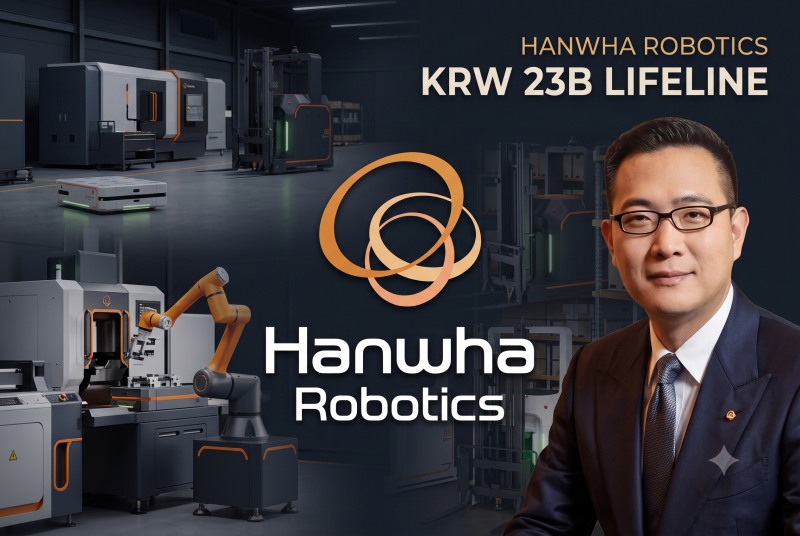
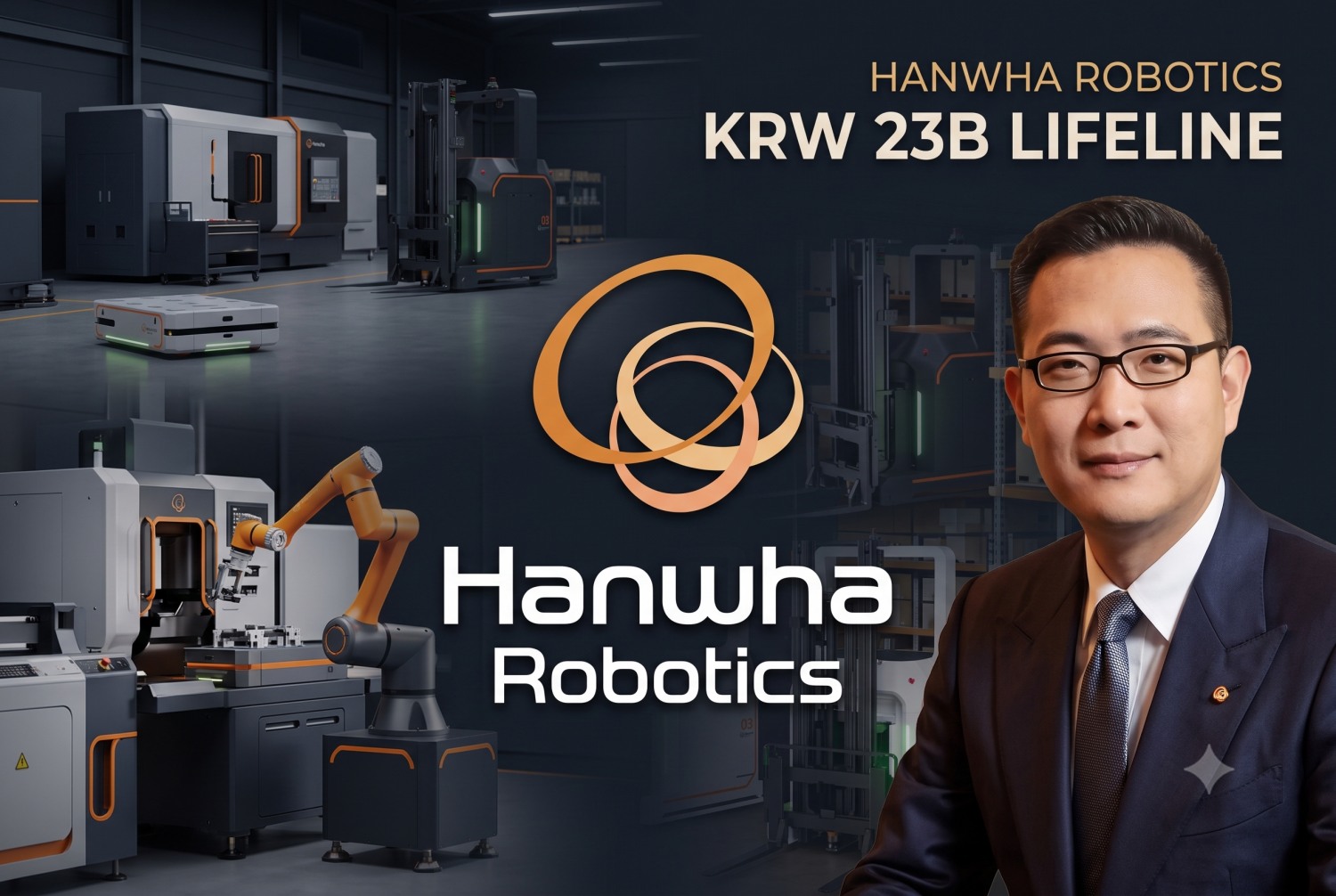
According to industry sources on the 11th, Hanwha Robotics disclosed on the 7th that it had decided on a rights offering worth KRW 23 billion. The offering will issue 46 million common shares at face value (KRW 500 per share) to raise the KRW 23 billion, through a shareholder allocation method, with the entire proceeds to be used as operating capital.The record date for new share allocation is set for the 21st, with subscription and payment to take place on the 23rd. Hanwha M&S, the largest shareholder, will contribute KRW 15.633 billion in proportion to its 67.97% stake, while Hanwha Hotels & Resorts will provide KRW 7.367 billion corresponding to its remaining 32.03% stake, together subscribing to all of the new shares. This marks an additional capital injection 13 months after the KRW 30 billion rights offering in August last year.
Hanwha M&S is an intermediate holding company of Hanwha Group launched on the 3rd of last month. It brings together the department store, hotel and catering (life) businesses previously overseen by Kim Dong-seon — including Hanwha Galleria and Hanwha Hotels & Resorts — along with tech affiliates in video security, robotics and semiconductor equipment. Including its subsidiaries' own subsidiaries, the group comprises 57 companies with consolidated revenue of KRW 6 trillion and total assets of KRW 11.3 trillion as of the end of last year. It relisted on the KOSPI on the 25th of last month, establishing itself as a separate holding company system.
With Kim Dong-seon now overseeing both the existing retail and leisure businesses and the new tech ventures, he has effectively begun striking out on his own. Hanwha Robotics is regarded as the core new-business affiliate within this portfolio.
High Upfront Costs Weigh as Both Revenue and Losses Grow
In launching Hanwha M&S, Kim planned to expand the company's business scope beyond its existing retail, leisure and food and beverage operations into advanced industries.
"Hanwha's Youngest Son Promoted, Puts New Holding Company to the Test"Hanwha Eyes Jeju as Strategic Hub for Space, Defense, and TourismHanwha to Split into Defense-Energy and Tech-Lifestyle Entities [KFT Topic]From Autonomous Vehicles to Defense Tech: GenGenAI's Quest to Solve the Data Problem [Rising Stars of K-Defense]New '3% Rule' on Duplicate Listings Puts HD Hyundai Robotics, LS Essex in the Crosshairs
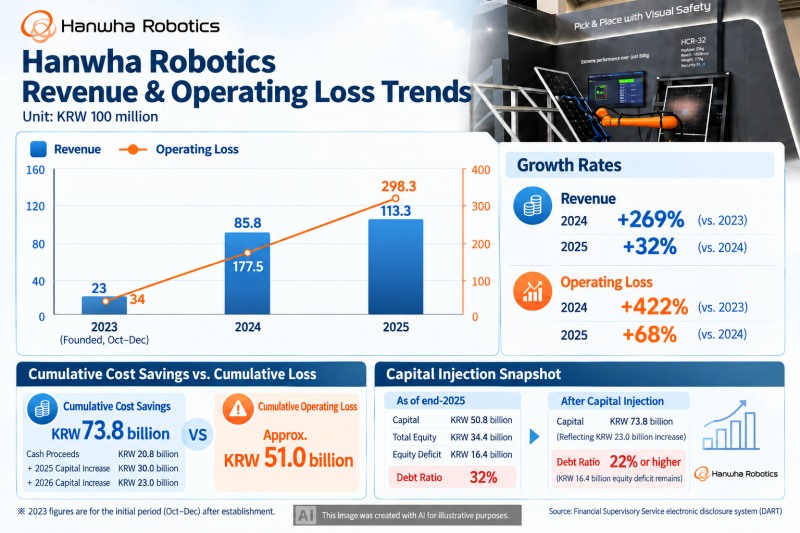
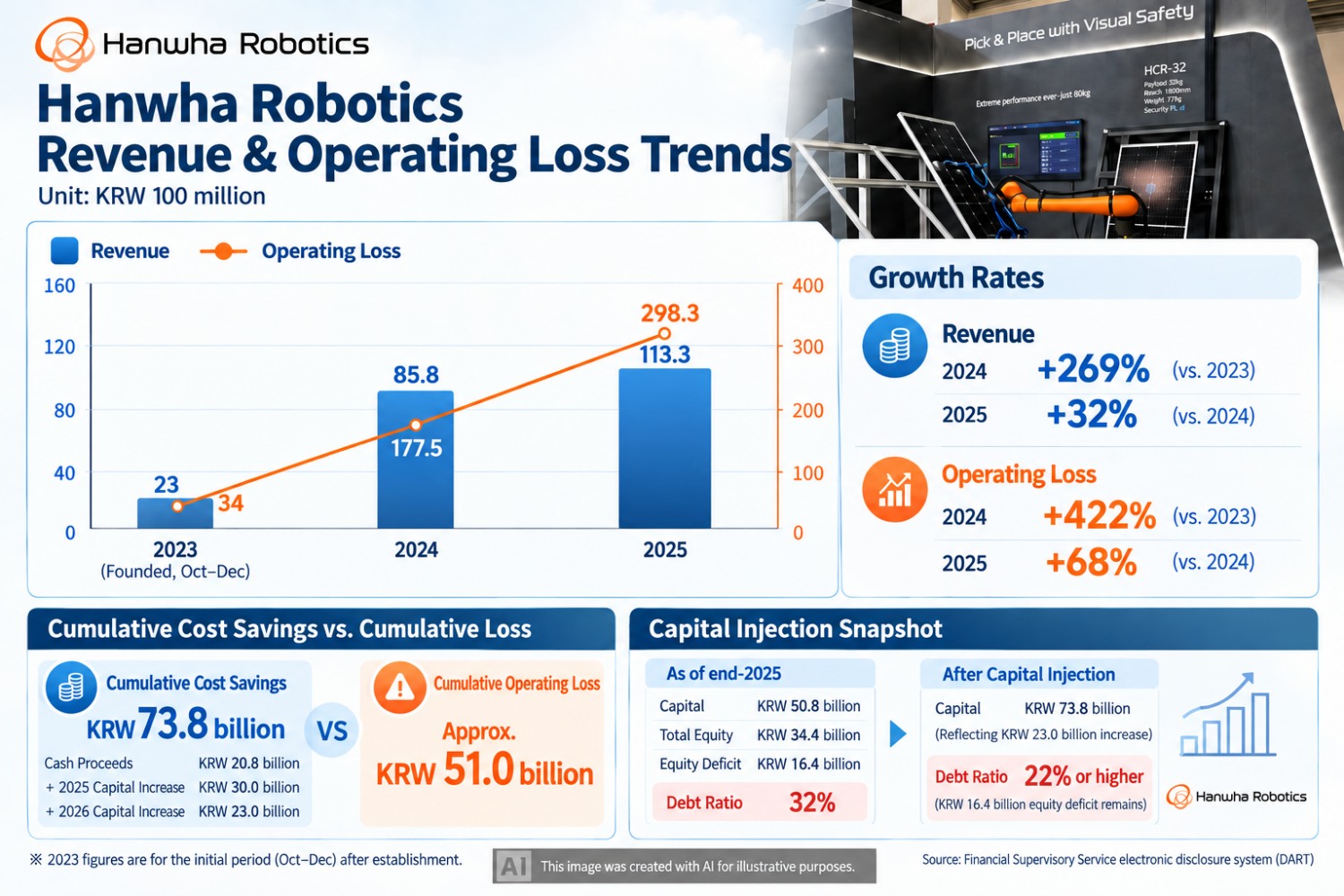
In 2023, its first year of operation, Hanwha Robotics posted revenue of KRW 2.3 billion and an operating loss of KRW 3.4 billion. In 2024, revenue jumped to KRW 8.6 billion, but the operating loss also swelled 422% to KRW 17.75 billion. Last year, revenue rose 32% to KRW 11.33 billion, while the operating loss grew a further 68% to KRW 29.83 billion. Revenue grew every year over the three-year period, but losses widened at an even faster pace.
This reflects the impact of upfront investment costs, among other factors. Given the nature of the collaborative robot industry, establishing a market position requires massive spending on technology development. As a relatively young company, Hanwha Robotics remains in an investment phase focused on strengthening its technology and product competitiveness rather than commercialization.
As a result, the company's cost-to-revenue ratio is also elevated. Last year, its cost of goods sold stood at KRW 29.19 billion, equivalent to 258% of revenue.
Capital Impairment Persists Despite Group Support; Profitability Remains the Challenge
To improve its financial position, which has deteriorated due to heavy investment, group-level capital support was necessary. Hanwha Robotics raised KRW 20.8 billion through an in-kind contribution at the time of its establishment. Through rights offerings, it has raised a total of KRW 53 billion over 13 months — KRW 30 billion in August last year and the latest KRW 23 billion. Total capital raised to date stands at KRW 73.8 billion.However, even with this fresh capital, the issue of capital impairment remains. As of the end of last year, Hanwha Robotics' paid-in capital stood at KRW 50.8 billion, exceeding its total equity of KRW 34.4 billion by KRW 16.4 billion, putting the company in a state of partial capital impairment. The impairment ratio was about 32%.
Because the new shares in this offering are issued at face value (KRW 500), the impairment ratio itself will fall to around 22%, but the actual shortfall of KRW 16.4 billion remains unchanged. While the impairment ratio appears to improve, this is far from a genuine improvement in the company's financial structure.
Ultimately, securing profitability is the key challenge. Since Woo Chang-pyo took office as CEO this year, Hanwha Robotics has announced plans to expand its lineup with new products — including the collaborative robot "HCR-32" and the welding robot "HCR-5W" — and to broaden its application of AI technology.
A Hanwha Robotics official explained, "This rights offering is aimed at strengthening our technological and product capabilities, including R&D, and expanding into new markets. Building on the robotics technology competitiveness we have accumulated, we will continue to expand into new markets."
Jung Jina (urzinnie@fntimes.com)