








Naver is focused on expanding AI infrastructure, while Kakao — taking its spinoff as an opportunity — is concentrating on strengthening agentic AI services.
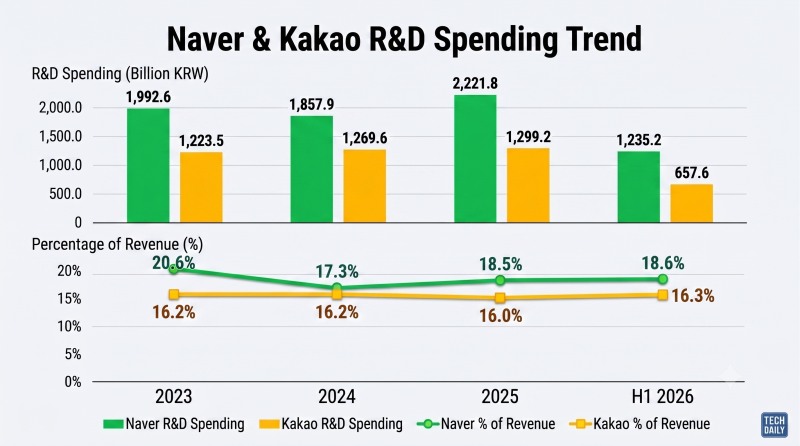
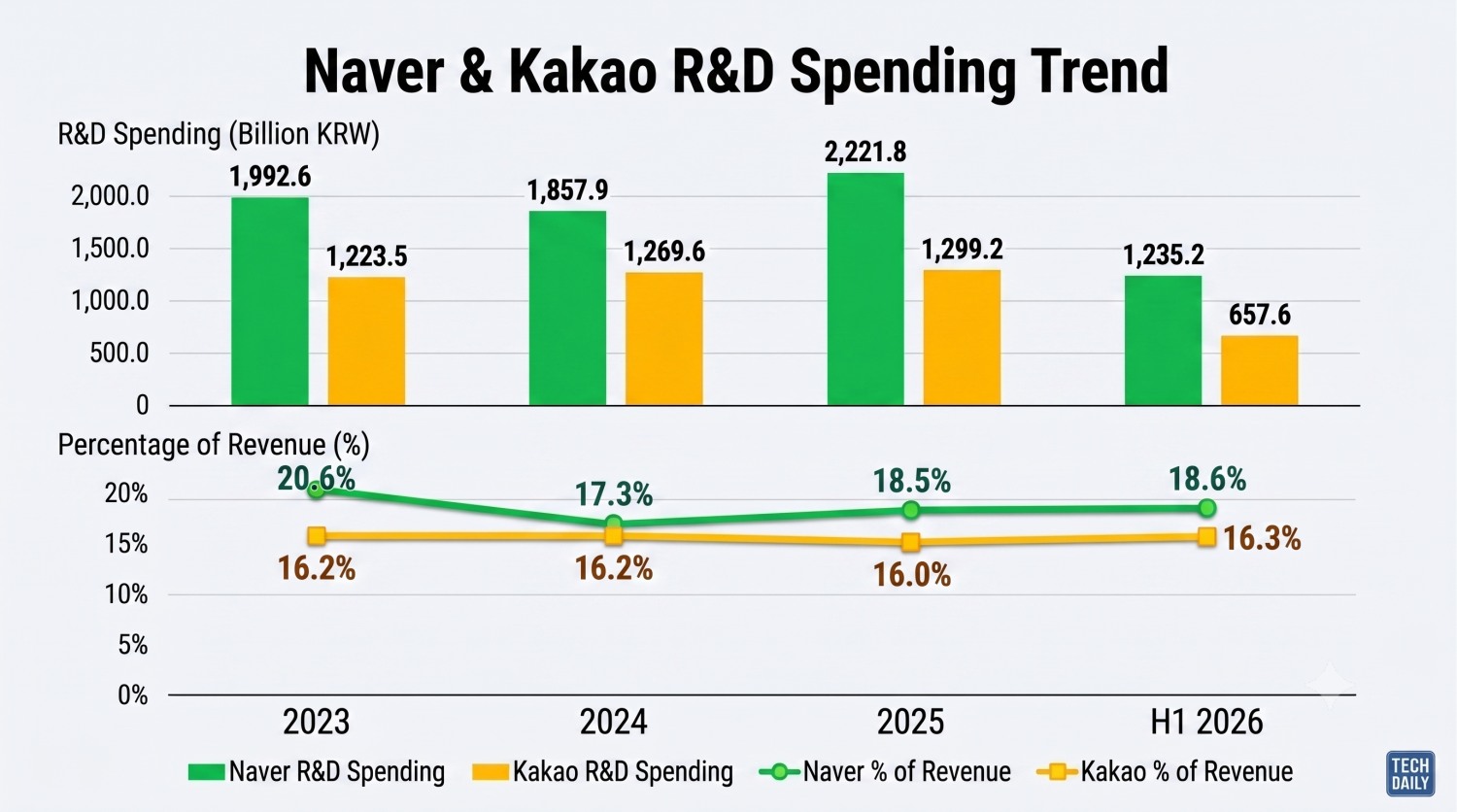
According to the Financial Supervisory Service's electronic disclosure system on the 24th, Naver's and Kakao's R&D spending in the first half of 2026 came to KRW 1.2352 trillion and KRW 657.6 billion, respectively. The two companies' revenues stood at KRW 6.6299 trillion for Naver and KRW 4.0406 trillion for Kakao. While the scale of investment differs, the R&D-to-revenue ratio was similar at 18.6% for Naver and 16.3% for Kakao.
Both companies have poured a substantial portion of their revenue into R&D every year. Naver's R&D spending came to KRW 1.9926 trillion in 2023, KRW 1.8579 trillion in 2024, and KRW 2.2218 trillion in 2025, representing 20.6%, 17.3%, and 18.5% of revenue, respectively.
Over the same period, Kakao spent KRW 1.2235 trillion, KRW 1.2696 trillion, and KRW 1.2992 trillion, representing 16.2%, 16.1%, and 16.0% of revenue, respectively.
Naver focuses on securing leadership in the AI infrastructure ecosystem
However, a clear divergence emerges in AI business strategy. Naver is applying AI to its existing businesses — search, advertising, and commerce — while simultaneously expanding AI infrastructure such as AI factories, cloud, and GPUs.The plan is to combine data and AI technology accumulated across search, shopping, maps, and Naver Place to enhance user experience and advertising/commerce competitiveness, while also expanding into the role of an AI infrastructure provider.
To this end, Naver is building an AI factory in partnership with Brookfield and Nvidia. Brookfield, as the exclusive capital partner, will raise up to USD 9 billion, while Nvidia will invest USD 1 billion. The plan goes beyond simply leasing AI data center (AIDC) space, aiming to supply AI computing resources to corporate, public-sector, and global customers.
Domestically, Naver will use its hyperscale data center "Gak Sejong" as a forward base, starting with 55MW in the first half of 2027 and expanding to 200MW by 2028. In the long run, the company plans to build gigawatt (GW)-scale infrastructure to secure leadership in the AI infrastructure ecosystem beyond the Asia-Pacific region, extending into Europe and the Middle East.
Naver is also pursuing expansion into the Middle East AI data center market in parallel. In April, Naver Cloud signed a strategic business agreement with Hanmi Global for joint participation in overseas data center projects, and the two companies are jointly pursuing large-scale data center markets in the Middle East, including Saudi Arabia. Naver Cloud is responsible for AI/cloud infrastructure strategy and service model design, while Hanmi Global handles design and construction consulting, project management, and local permitting.
Naver stated, "We are flexibly adjusting our R&D spending to preemptively secure the technologies we need in line with our business direction," and that "AI is the most important thing right now."
Kakao advances "agentic AI," targets over KRW 1 trillion in AI revenue by 2030
Kakao, by contrast, is focusing less on large-scale infrastructure expansion and more on advancing agentic AI services centered on KakaoTalk.On the 21st, Kakao held a board meeting and resolved to split the company into a newly established entity, "Kakao AI," and a surviving entity, "Kakao X," through a spin-off. Kakao AI will oversee core businesses including KakaoTalk, AI, advertising, and commerce, while Kakao X will manage major subsidiaries in techfin, content, and mobility, as well as new investments.
Notably, Kakao AI has declared its ambition to become an "AI core company," strengthening its agentic AI service capabilities by organically linking KakaoTalk-centered AI, advertising, and commerce. The aim is to create a differentiated user experience and revenue model.
Kakao AI is developing AI models optimized for agent services, ranging from on-device to server-based, built on its own multimodal foundation model and lightweight technology. Its on-device model has achieved performance comparable to global models.
Its proprietary tokenizer lightweighting technology has improved processing efficiency, minimizing memory and battery consumption, and this has been applied to "Kanana in KakaoTalk." Its server model likewise distills and lightens the knowledge of large models, achieving context-comprehension performance on par with global large models at one-tenth the size.
The foundation for its nationwide AI service is an on-device-first architecture. Roughly half of user requests are processed directly on-device by its proprietary lightweight model, "Kanana Nano," while more complex requests are handled by server-based AI models and specialized agents. The "AI Conductor," currently under development, is an orchestration technology that assesses the complexity and difficulty of a request and selects and connects the optimal model.
Based on this strategy, Kakao has set a target of maintaining roughly 20% average annual growth through 2030, aiming for revenue exceeding KRW 6 trillion and an operating margin above 30%. The company projects that AI-related revenue will surpass KRW 1 trillion.
Kakao CEO Chung Shina said the company would expand its AI model lineup with an eye toward both cost efficiency and stability so that AI services can reach the entire population, adding that it would once again prove through AI the DNA that has driven Kakao's overwhelming success in B2C services.
Park Suyeon (suy1663@fntimes.com)











![이성훈 LH 사장 다주택·대출 규제 발언 도마…여야 의원 잇단 지적 [2026 국감]](https://cfnimage.commutil.kr/phpwas/restmb_setimgmake.php?pp=006&w=69&h=45&m=5&simg=20261012163012026870048b718333218159227151.jpg&nmt=18)

![12개월 최고 연 6.00%…BNK저축은행 'BNK동행적금'[이주의 저축은행 적금금리-10월 2주]](https://cfnimage.commutil.kr/phpwas/restmb_setimgmake.php?pp=006&w=69&h=45&m=5&simg=202610110103170668607c96e797801121481643.jpg&nmt=18)

![12개월 최고 연 4.10%…OK저축은행 'OK e-안심앱플러스정기예금6'[이주의 저축은행 예금금리-10월 2주]](https://cfnimage.commutil.kr/phpwas/restmb_setimgmake.php?pp=006&w=69&h=45&m=5&simg=202610110051040059207c96e797801121481643.jpg&nmt=18)


![[그래픽 뉴스] ‘순대’가 경제용어라고? 순(純)대외자산, 한국의 진짜 해외자산은 얼마일까?](https://cfnimage.commutil.kr/phpwas/restmb_setimgmake.php?pp=006&w=298&h=298&m=1&simg=202609021356075202de68fcbb3512411124362_0.jpg&nmt=18)
![[그래픽 뉴스] ISA 대개편! 나에게 유리한 계좌는?](https://cfnimage.commutil.kr/phpwas/restmb_setimgmake.php?pp=006&w=298&h=298&m=1&simg=202608041713155615de68fcbb3512411124362_0.jpg&nmt=18)
![[그래픽 뉴스] 미국 증시 새로운 키워드 'MANGOS'](https://cfnimage.commutil.kr/phpwas/restmb_setimgmake.php?pp=006&w=298&h=298&m=1&simg=202607291740382069de68fcbb3512411124362_0.jpg&nmt=18)

![[그래픽 뉴스] 은퇴후 30년 부모님 세대의 생존전략](https://cfnimage.commutil.kr/phpwas/restmb_setimgmake.php?pp=006&w=298&h=298&m=1&simg=202606301704439153de68fcbb3512411124362_0.jpg&nmt=18)
![[신간]은퇴연옥…김경록의 은퇴 후 삶의 나침반](https://cfnimage.commutil.kr/phpwas/restmb_setimgmake.php?pp=006&w=81&h=123&m=5&simg=20260414140833047280f8caa4a5ce12411124362.jpg&nmt=18)
![[신간] 물처럼 흐르고 원칙으로 서다…김용환의 통찰을 담다](https://cfnimage.commutil.kr/phpwas/restmb_setimgmake.php?pp=006&w=81&h=123&m=5&simg=20260409114249027860f8caa4a5ce12411124362.jpg&nmt=18)
![[안현정 서평] 플랫폼의 영지에서 ‘미학적 주권’을 선포하라...'K가 죽어야 K가 산다' 장준환 著](https://cfnimage.commutil.kr/phpwas/restmb_setimgmake.php?pp=006&w=81&h=123&m=5&simg=20260527121426063220c1c16452b012411124362.jpg&nmt=18)
![[서평] 추세 매매의 대가들...추세추종 투자전략의 대가 14인 인터뷰](https://cfnimage.commutil.kr/phpwas/restmb_setimgmake.php?pp=006&w=81&h=123&m=5&simg=2023102410444004986c1c16452b0175114235199.jpg&nmt=18)


![[머니무브 2026] “지금 사도 될까?” 답이 안 보인다면…하반기 투자, 4명의 전문가에게 물어보세요](https://cfnimage.commutil.kr/phpwas/restmb_setimgmake.php?pp=006&w=89&h=45&m=1&simg=202609151044050355302a735e27af12411124362.jpg&nmt=18)
![[AD] ‘PBV 라인업 확장’ 기아, 9월 독일서 ‘PV7’ 첫 공개](https://cfnimage.commutil.kr/phpwas/restmb_setimgmake.php?pp=006&w=89&h=45&m=1&simg=2026083111010602815074925877361231180222.jpg&nmt=18)
![[AD] 제네시스, 럭셔리 경험 더한 ‘2027 GV70’‧‘GV70 그래파이트’ 출시](https://cfnimage.commutil.kr/phpwas/restmb_setimgmake.php?pp=006&w=89&h=45&m=1&simg=20260702143546085600749258773622211122717.jpg&nmt=18)