








Kia's sales momentum is attributed to solid performance in its core SUV lineup, combined with the successful rollout of new lineups such as mass-market electric vehicle (EV) models and purpose-built vehicles (PBVs).
According to Kia's disclosure on the 28th, the company's cumulative domestic sales from January to July reached 350,383 units, up about 9% from a year earlier and marking an all-time high. Over the same period, Hyundai Motor's domestic sales fell 11.3% year-on-year to 364,826 units.
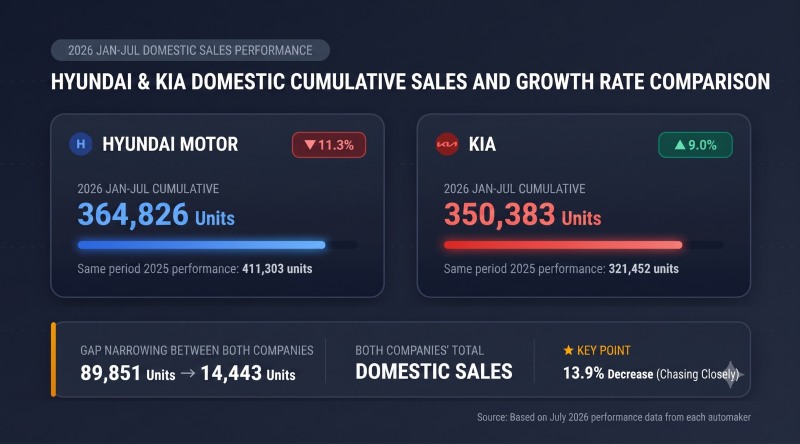
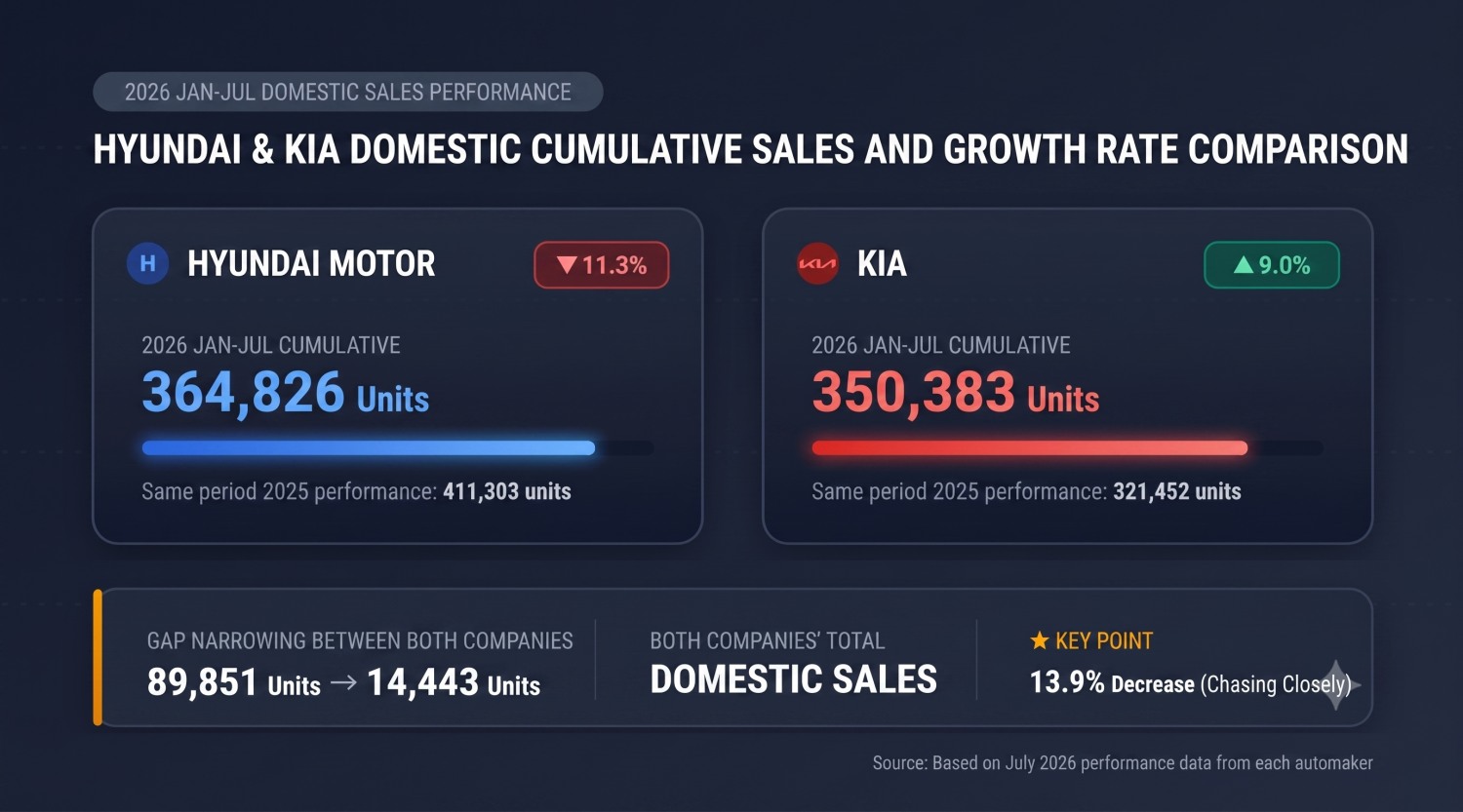
What stands out is the narrowing gap between the two companies. The cumulative sales gap for January–July this year stood at just 14,446 units. In the same period last year, the gap between the two companies' domestic sales was roughly 90,000 units. In about a year, Kia has closed a gap of 80,000 units, pulling right up to Hyundai Motor's heels.
Notably, Kia posted domestic sales of 55,045 units in April, surpassing Hyundai Motor's 54,051 units to claim the top spot in domestic sales for the first time since its founding — the first time Kia has ever outsold Hyundai Motor in monthly sales. Kia repeated the feat in July, selling 54,604 units domestically compared with Hyundai Motor's 48,113 units.
Kia's sales advance is attributed to a lineup overhaul centered on SUVs — in contrast to Hyundai Motor's sedan-heavy approach — the expansion of its mass-market EV lineup, and its early lead in the electric commercial vehicle segment led by the PV5.
An SUV Lineup That Overtook Sedan-Centric Hyundai Motor
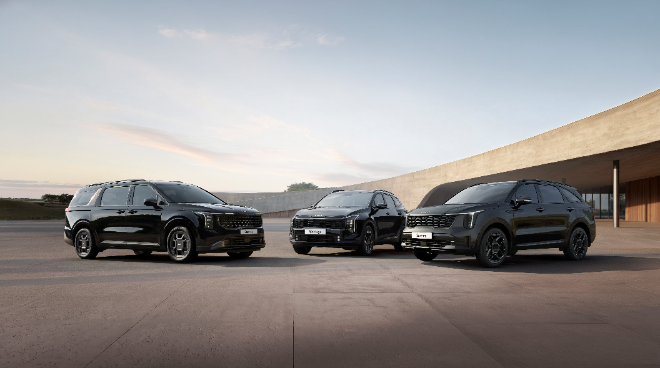
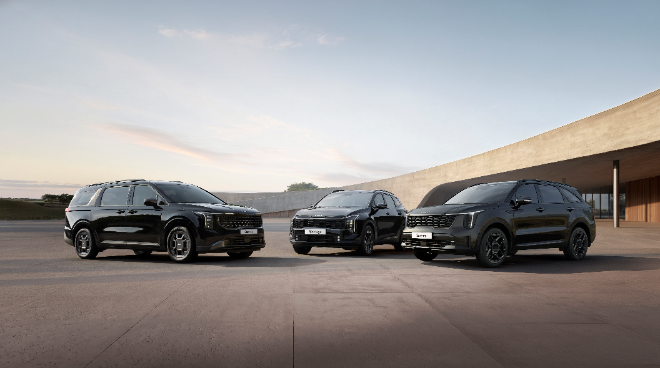
The first driver behind Kia's sales advance is its SUV (sports utility vehicle)-centered portfolio. Unlike Hyundai Motor, which remains heavily dependent on sedan models such as the Avante and Grandeur, Kia moved early and successfully to restructure its lineup around RVs and SUVs in line with shifting market trends.
From Carmaker to Logistics Platform: Kia's Robotics-Fueled ReinventionShareholder Returns or Succession Strategy? The Dual Purpose Behind Hyundai Motor and Kia's Payout PoliciesKia's U.S. EV Sales Plunge 39%... What's Happening? [KFT Topic]Why Is Kia's Stock Lagging Despite Beating Hyundai on Earnings?
According to data from Carisyou and other sources, sedan sales in Korea's domestic auto market fell 2.5% from January to July this year, while SUV sales rose 2.1%, continuing a trend of SUV strength. Amid a lifestyle shift toward car camping and leisure activities that has deepened the preference for SUVs, Kia's SUV-focused strategy is seen as having paid off.
Kia previously moved decisively to streamline unpopular sedan models such as the K3, instead reinforcing a tightly packed SUV lineup spanning the Sorento, Sportage, and Seltos. In particular, the Sorento and Sportage have dominated the top ranks of best-selling domestic models, aggressively absorbing demand that would otherwise have gone to Hyundai Motor's sedans.
This is starkly evident when comparing the two companies' top-selling models. From January to July this year, Hyundai Motor's top-selling models were the Grandeur (46,922 units), Sonata (34,923 units), and Avante (31,292 units) — all sedans. Kia's top sellers, by contrast, were SUVs: the Sorento (61,579 units), Carnival (37,119 units), and Sportage (36,644 units), with sales volumes that outpaced Hyundai Motor's sedan lineup.
Leading EV Mass-Adoption Despite Pressure from Chinese Rivals
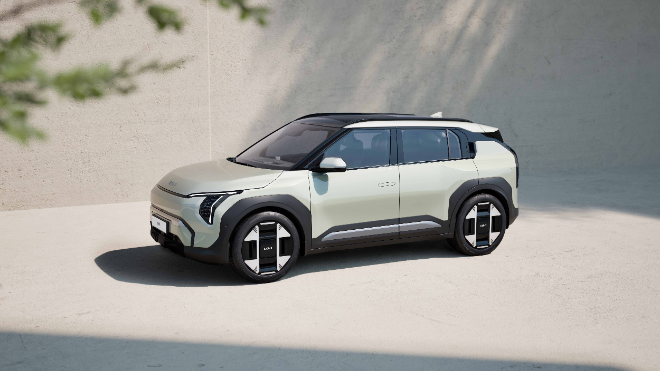
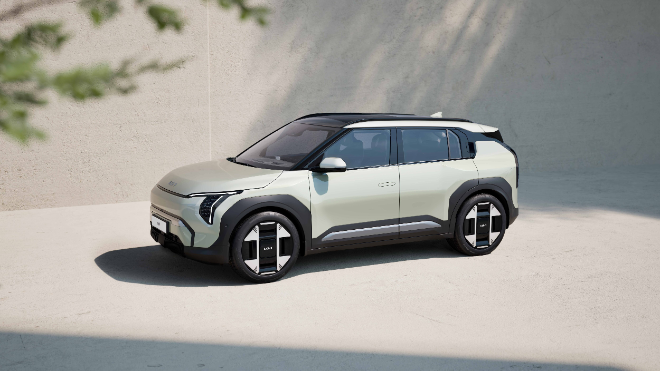
The second pillar is Kia's fully established "mass-market EV lineup." Even amid a chasm — a temporary slowdown in demand — and fierce competition from low-cost Chinese electric vehicles, Kia has broken through by leading with reasonably priced, mass-market models.While Kia moved early to introduce mass-market EVs, Hyundai Motor has yet to launch new EV models to support its existing lineup of the Ioniq 5 and Ioniq 6.
At the center of Kia's EV mass-adoption strategy is the EV3, a compact electric SUV. Backed by price competitiveness — with an effective purchase price in the KRW 20 million–30 million range — and strong product appeal, the EV3 has overtaken Tesla to firmly hold the top spot in domestic EV sales.
Kia sold 72,078 EVs domestically in the first half of this year, the highest first-half sales volume on record. The compact EV3 (18,431 units) and midsize EV5 (15,965 units) led the sales. The achievement carries added significance given that Chinese EV makers such as Tesla and BYD have been leveraging cost competitiveness to increase their penetration of Korea's EV market.
The PV5 Reshapes the Commercial Vehicle Paradigm
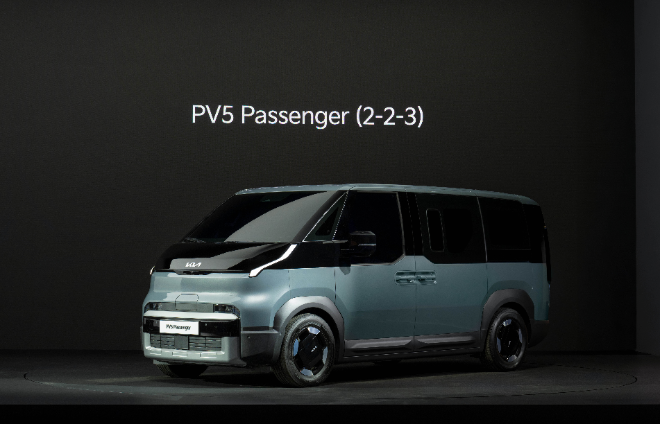
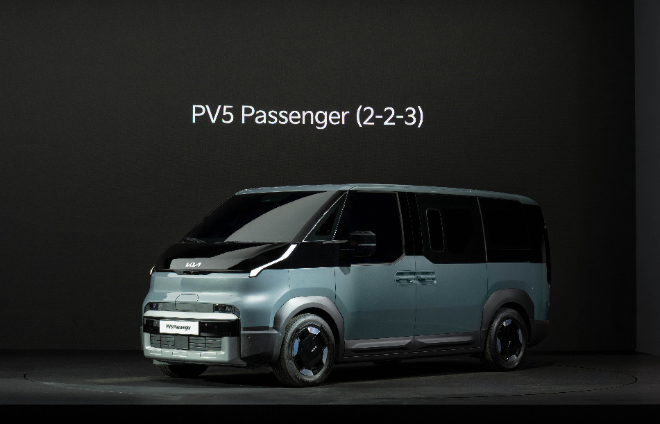
The final pillar is the remarkable performance of Kia's PBV lineup — which the company has positioned as a core future growth driver — particularly the PV5. Sales of the PV5, which stood at roughly 2,400 units shortly after launch, reached a total of 15,000 units in the first half of this year alone, putting the model on track to surpass 30,000 cumulative units sold.Kia's first dedicated PBV model, the PV5, is seen as reshaping the paradigm of the commercial vehicle market by offering business-tailored solutions — including taxi service, ride-hailing via call apps, and logistics delivery — that go beyond simple transportation.
Notable examples include a taxi model integrated with a dedicated driver display for Kakao T, a Wheelchair Accessible Vehicle (WAV) model for passengers with mobility needs, and a "Donor" model optimized for specialty conversions — absorbing new demand in the B2B and customized commercial vehicle markets.
A Kia official said, "What proved decisive for the PV5 was breaking away from the rigid one-ton commercial vehicle market long dominated by models like the Porter and Bongo, and pioneering a new category of customized mobility solutions." The official added, "Because the vehicle's structure can be freely modified to suit individual users' needs, demand is growing not only among commercial operators but also among general consumers who enjoy activities such as leisure and camping."
Kim JaeHun (rlqm93@fntimes.com)











![이성훈 LH 사장 다주택·대출 규제 발언 도마…여야 의원 잇단 지적 [2026 국감]](https://cfnimage.commutil.kr/phpwas/restmb_setimgmake.php?pp=006&w=69&h=45&m=5&simg=20261012163012026870048b718333218159227151.jpg&nmt=18)

![12개월 최고 연 6.00%…BNK저축은행 'BNK동행적금'[이주의 저축은행 적금금리-10월 2주]](https://cfnimage.commutil.kr/phpwas/restmb_setimgmake.php?pp=006&w=69&h=45&m=5&simg=202610110103170668607c96e797801121481643.jpg&nmt=18)

![12개월 최고 연 4.10%…OK저축은행 'OK e-안심앱플러스정기예금6'[이주의 저축은행 예금금리-10월 2주]](https://cfnimage.commutil.kr/phpwas/restmb_setimgmake.php?pp=006&w=69&h=45&m=5&simg=202610110051040059207c96e797801121481643.jpg&nmt=18)


![[그래픽 뉴스] ‘순대’가 경제용어라고? 순(純)대외자산, 한국의 진짜 해외자산은 얼마일까?](https://cfnimage.commutil.kr/phpwas/restmb_setimgmake.php?pp=006&w=298&h=298&m=1&simg=202609021356075202de68fcbb3512411124362_0.jpg&nmt=18)
![[그래픽 뉴스] ISA 대개편! 나에게 유리한 계좌는?](https://cfnimage.commutil.kr/phpwas/restmb_setimgmake.php?pp=006&w=298&h=298&m=1&simg=202608041713155615de68fcbb3512411124362_0.jpg&nmt=18)
![[그래픽 뉴스] 미국 증시 새로운 키워드 'MANGOS'](https://cfnimage.commutil.kr/phpwas/restmb_setimgmake.php?pp=006&w=298&h=298&m=1&simg=202607291740382069de68fcbb3512411124362_0.jpg&nmt=18)

![[그래픽 뉴스] 은퇴후 30년 부모님 세대의 생존전략](https://cfnimage.commutil.kr/phpwas/restmb_setimgmake.php?pp=006&w=298&h=298&m=1&simg=202606301704439153de68fcbb3512411124362_0.jpg&nmt=18)
![[신간]은퇴연옥…김경록의 은퇴 후 삶의 나침반](https://cfnimage.commutil.kr/phpwas/restmb_setimgmake.php?pp=006&w=81&h=123&m=5&simg=20260414140833047280f8caa4a5ce12411124362.jpg&nmt=18)
![[신간] 물처럼 흐르고 원칙으로 서다…김용환의 통찰을 담다](https://cfnimage.commutil.kr/phpwas/restmb_setimgmake.php?pp=006&w=81&h=123&m=5&simg=20260409114249027860f8caa4a5ce12411124362.jpg&nmt=18)
![[안현정 서평] 플랫폼의 영지에서 ‘미학적 주권’을 선포하라...'K가 죽어야 K가 산다' 장준환 著](https://cfnimage.commutil.kr/phpwas/restmb_setimgmake.php?pp=006&w=81&h=123&m=5&simg=20260527121426063220c1c16452b012411124362.jpg&nmt=18)
![[서평] 추세 매매의 대가들...추세추종 투자전략의 대가 14인 인터뷰](https://cfnimage.commutil.kr/phpwas/restmb_setimgmake.php?pp=006&w=81&h=123&m=5&simg=2023102410444004986c1c16452b0175114235199.jpg&nmt=18)


![[머니무브 2026] “지금 사도 될까?” 답이 안 보인다면…하반기 투자, 4명의 전문가에게 물어보세요](https://cfnimage.commutil.kr/phpwas/restmb_setimgmake.php?pp=006&w=89&h=45&m=1&simg=202609151044050355302a735e27af12411124362.jpg&nmt=18)
![[AD] ‘PBV 라인업 확장’ 기아, 9월 독일서 ‘PV7’ 첫 공개](https://cfnimage.commutil.kr/phpwas/restmb_setimgmake.php?pp=006&w=89&h=45&m=1&simg=2026083111010602815074925877361231180222.jpg&nmt=18)
![[AD] 제네시스, 럭셔리 경험 더한 ‘2027 GV70’‧‘GV70 그래파이트’ 출시](https://cfnimage.commutil.kr/phpwas/restmb_setimgmake.php?pp=006&w=89&h=45&m=1&simg=20260702143546085600749258773622211122717.jpg&nmt=18)