






Growth in High-Margin "New Products" Drives Earnings Boost
According to industry sources on May 21, Celltrion recorded consolidated revenue of KRW 1.145 trillion and an operating profit of KRW 321.9 billion for the first quarter of this year. This marks a year-on-year increase of 36% in revenue and 116% in operating profit, setting a new record high for any first quarter in the company's history.A company official noted, “Excluding the temporary impact of routine maintenance carried out at our U.S. production facilities during the first quarter, our operating profit margin would hover around the 30% range.” Factoring in the maintenance, the operating profit margin stood at 28%.
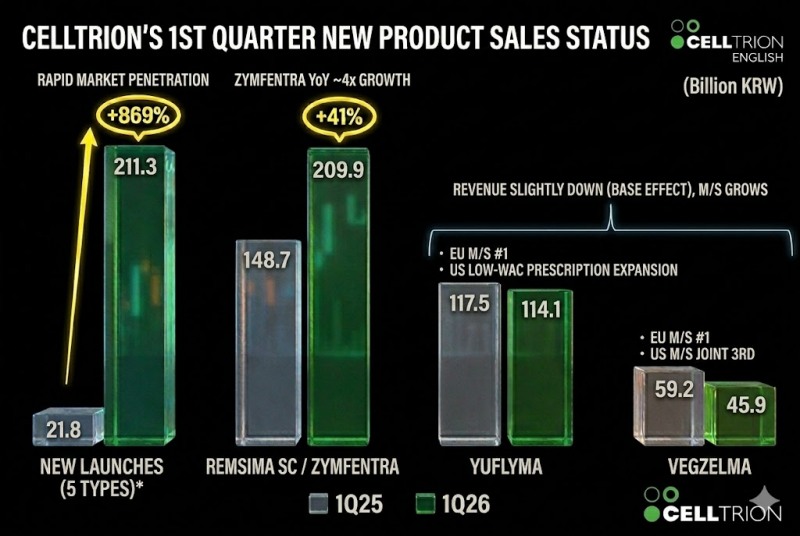
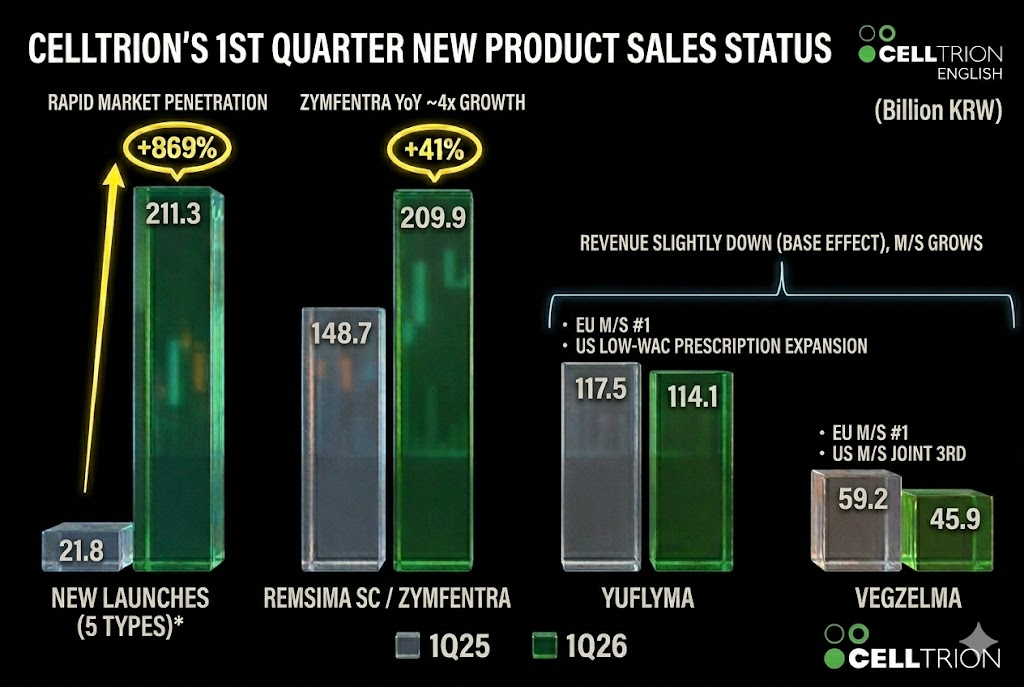
The stellar performance was largely driven by the growth of its "new product lines" among the 11 biosimilars currently on the market. Celltrion defines its new product lines as those launched since the 2020s. The combined first-quarter revenue of these new products surged 67% year-on-year to KRW 581.2 billion, accounting for more than 60% of total biosimilar sales.
In particular, Omlyclo, a Xolair biosimilar launched in Europe last September, has rapidly expanded its market footprint, securing a 98% market share in Denmark, 80% in Spain, and 70% in Netherlands within just four months of its release, thereby boosting its contribution to overall revenue.
In the United States, Zymfentra, a subcutaneous (SC) formulation of infliximab, generated KRW 52.8 billion in revenue in the first quarter, with monthly prescriptions increasing more than threefold compared to last year. Steqeyma, a Stelara biosimilar, captured over 10% of the U.S. market share as of the first quarter, bringing in KRW 39.7 billion in revenue.
Eydenzelt, an Eylea biosimilar, added KRW 6.5 billion in revenue, showing steady growth in the European market. Meanwhile, existing lineups within the new product category—Remsima SC, Yuflyma, and Vegzelma—maintained robust sales in the U.S. and Europe, generating KRW 157.1 billion, KRW 114.1 billion, and KRW 45.9 billion in the first quarter, respectively.
Quantum Leap Powered by KRW 1 Trillion Order Backlog and Factory Expansions
Alongside surging revenue and operating profit, rising contract orders and manufacturing facility investments have strengthened the company’s underlying fundamentals. In January, Celltrion signed a massive contract manufacturing organization (CMO) agreement worth KRW 678.7 billion with Eli Lilly and Company, a global pharmaceutical giant. In March, it secured an additional CMO contract worth KRW 294.9 billion with another unnamed global pharmaceutical firm, bringing its cumulative contract backlog to nearly KRW 1 trillion.To meet growing global demand and internalize the production of drug substances (DS), the company is currently investing in the construction of its 4th and 5th manufacturing plants with a total capacity of 180,000 liters at its Songdo Campus in Incheon. The total estimated investment for this project stands at KRW 1.2265 trillion.
Furthermore, to expand its direct sales network, Celltrion recently acquired a 100% stake in Giphar, a French healthcare company boasting a sales network of over 9,000 pharmacies across France. This acquisition lays the groundwork for generating more than KRW 250 billion in additional revenue over the next five years.
The pharmaceutical giant also put its shareholder return strategy at the forefront. Following a board resolution in March, Celltrion completely cancelled all 9.11 million shares of its treasury stock, valued at KRW 1.8 trillion, on April 1.
Deploying All Measures, Including Bonus Issues and Stock Buybacks, to Combat Weak Stock Price
Despite these aggressive initiatives, the company's stock price continues to underperform. On May 20, Celltrion's stock closed at KRW 179,400, representing a sharp drop of more than 25% compared to three months ago. While the stock staged a mild rebound to KRW 189,700 around 2:00 p.m. on May 21, it remains significantly below its 52-week high of KRW 248,500 recorded on February 24.
Addressing the undervalued stock price, Celltrion published a "Letter to Shareholders" on its official website on May 19. The company diagnosed that its corporate value sits in an excessively undervalued zone due to external environmental factors and stated that it is strictly reviewing measures to enhance shareholder value.
“Due to external factors such as recent geopolitical uncertainties in the Middle East, increased volatility in international oil prices, and the concentration of liquidity into specific industrial sectors, the corporate value across the entire bio and pharmaceutical sector is not being fully appreciated,” the company mentioned. “Celltrion’s corporate value remains in an excessively undervalued territory.”
Just two days after publishing the shareholder letter, Celltrion made a surprise announcement today (May 21) regarding a "Comprehensive Market Response Package," which includes a bonus issue (stock dividend), treasury stock buybacks, and share acquisitions by its largest shareholder. First, the company will implement a bonus issue of approximately 10.92 million shares, surpassing last year's distribution of around 8.49 million shares. Under this plan, 0.05 new shares will be allocated for every 1 common share held. The new shares are scheduled to be listed on June 30.
Celltrion will also buy back its own shares. The company decided to purchase an additional KRW 100 billion (approx. 550,000 shares) worth of treasury stock. This move comes immediately after the completion of its KRW 1.8 trillion (approx. 9.11 million shares) treasury stock cancellation last month. Since the company aims to retire these newly acquired treasury shares within this year, the total scale of treasury stock cancellation for this year alone is projected to reach approximately KRW 2 trillion (approx. 10 million shares).
Adding to this momentum, Celltrion Holdings, the company's largest shareholder, decided to acquire an additional KRW 100 billion worth of shares in its subsidiary, reinforcing its commitment to responsible management.
A Celltrion official stated, "Backed by our solid fundamentals, we expect our second-quarter performance to maintain a stable growth trajectory. We will continue to roll out bold and continuous shareholder-friendly policies while simultaneously working to enhance our corporate value."
Yang Hyunwoo (yhw@fntimes.com)












![기술력 1위 ‘현대건설ʼ…계룡건설 ‘톱10ʼ 진입 [2026 시평-기술능력평가]](https://cfnimage.commutil.kr/phpwas/restmb_setimgmake.php?pp=006&w=69&h=45&m=5&simg=20260822010947010760dd55077bc212411124362.jpg&nmt=18)

![삼성·현대 3조대 ‘양강ʼ…3위는 대우건설 [2026 시평-신인도평가]](https://cfnimage.commutil.kr/phpwas/restmb_setimgmake.php?pp=006&w=69&h=45&m=5&simg=20260822011230051350dd55077bc212411124362.jpg&nmt=18)

![[데스크 칼럼] 돈 모이는 홍콩, 돈 불리는 싱가포르…한국은?](https://cfnimage.commutil.kr/phpwas/restmb_setimgmake.php?pp=006&w=69&h=45&m=5&simg=20260822011609014670dd55077bc212411124362.jpg&nmt=18)


![[그래픽 뉴스] ISA 대개편! 나에게 유리한 계좌는?](https://cfnimage.commutil.kr/phpwas/restmb_setimgmake.php?pp=006&w=298&h=298&m=1&simg=202608041713155615de68fcbb3512411124362_0.jpg&nmt=18)
![[그래픽 뉴스] 미국 증시 새로운 키워드 'MANGOS'](https://cfnimage.commutil.kr/phpwas/restmb_setimgmake.php?pp=006&w=298&h=298&m=1&simg=202607291740382069de68fcbb3512411124362_0.jpg&nmt=18)

![[그래픽 뉴스] 은퇴후 30년 부모님 세대의 생존전략](https://cfnimage.commutil.kr/phpwas/restmb_setimgmake.php?pp=006&w=298&h=298&m=1&simg=202606301704439153de68fcbb3512411124362_0.jpg&nmt=18)
![[그래픽 뉴스] 퇴근 후 주차했는데 수익 발생? V2G의 정체](https://cfnimage.commutil.kr/phpwas/restmb_setimgmake.php?pp=006&w=298&h=298&m=1&simg=202605131656357745de68fcbb3512411124362_0.jpg&nmt=18)
![[신간]은퇴연옥…김경록의 은퇴 후 삶의 나침반](https://cfnimage.commutil.kr/phpwas/restmb_setimgmake.php?pp=006&w=81&h=123&m=5&simg=20260414140833047280f8caa4a5ce12411124362.jpg&nmt=18)
![[신간] 물처럼 흐르고 원칙으로 서다…김용환의 통찰을 담다](https://cfnimage.commutil.kr/phpwas/restmb_setimgmake.php?pp=006&w=81&h=123&m=5&simg=20260409114249027860f8caa4a5ce12411124362.jpg&nmt=18)
![[안현정 서평] 플랫폼의 영지에서 ‘미학적 주권’을 선포하라...'K가 죽어야 K가 산다' 장준환 著](https://cfnimage.commutil.kr/phpwas/restmb_setimgmake.php?pp=006&w=81&h=123&m=5&simg=20260527121426063220c1c16452b012411124362.jpg&nmt=18)
![[서평] 추세 매매의 대가들...추세추종 투자전략의 대가 14인 인터뷰](https://cfnimage.commutil.kr/phpwas/restmb_setimgmake.php?pp=006&w=81&h=123&m=5&simg=2023102410444004986c1c16452b0175114235199.jpg&nmt=18)


![[AD] 제네시스, 럭셔리 경험 더한 ‘2027 GV70’‧‘GV70 그래파이트’ 출시](https://cfnimage.commutil.kr/phpwas/restmb_setimgmake.php?pp=006&w=89&h=45&m=1&simg=20260702143546085600749258773622211122717.jpg&nmt=18)
![[AD] 개소세 혜택 종료…현대차, ‘썸머 페스타’로 고객 부담 완화](https://cfnimage.commutil.kr/phpwas/restmb_setimgmake.php?pp=006&w=89&h=45&m=1&simg=20260702142355004830749258773622211122717.jpg&nmt=18)
![[AD] 기아 ‘디 올 뉴 셀토스’, 인도 타임스 드라이브 어워즈서 ‘올해의 SUV’ 선정](https://cfnimage.commutil.kr/phpwas/restmb_setimgmake.php?pp=006&w=89&h=45&m=1&simg=202605071156400590007492587736124111243152.jpg&nmt=18)
![[AD]‘그랜저 잡자’ 기아, 상품성 더한 ‘The 2027 K8’ 출시](https://cfnimage.commutil.kr/phpwas/restmb_setimgmake.php?pp=006&w=89&h=45&m=1&simg=2026042110193702730074925877361211627527.jpg&nmt=18)
![[카드뉴스] KT&G, ‘CDP’ 기후변화·수자원 관리 부문 우수기업 선정](https://cfnimage.commutil.kr/phpwas/restmb_setimgmake.php?pp=006&w=89&h=45&m=1&simg=202603241415423015de68fcbb3512411124362_0.png&nmt=18)