






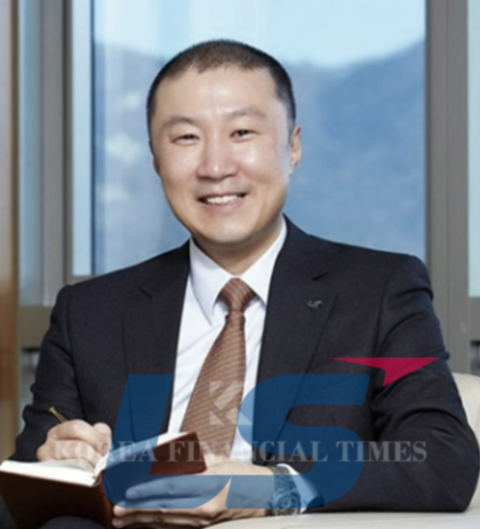
Koo Ja-eun, Chairman of LS Group. / Photo courtesy of LS
On August 12, LS declared it would retire 1 million treasury shares, representing 3.1% of its total outstanding stock. The shares will be retired in two phases : 500,000 shares on August 21, with the remaining 500,000 to be retired by the first quarter of 2026. LS currently holds 5,852,462 treasury shares, representing 15.1% of its issued stock.
An LS spokesperson stated, “While pending amendments to the Commercial Act may influence future plans, there is currently no intention to retire additional treasury shares beyond the announced one million.”
Some industry observers speculate that LS’s decision to retire treasury shares is ultimately aimed at defending its management rights against Hoban Group. The two conglomerates are engaged in a shareholding battle, with Hoban acquiring over a 2% stake in LS this March. Although Hoban has yet to surpass the critical 3% threshold—which would grant it rights such as inspecting LS’s accounting books and challenging director misconduct—LS remains on alert.
In particular, Taihan Cable, an affiliate of Hoban Group, and LS Cable are long-standing rivals. In April, LS Cable won a final court ruling against Taihan Cable in a lawsuit over the alleged misappropriation of bus duct technology. More recently, the two companies have been vying for contracts in the “West Coast Energy Highway” national power grid project promoted by the Lee Jae-myung administration.
This forms the basis for analysis that LS’s share retirement move is aimed at boosting its stock price to make it more difficult for Hoban Group to increase its stake. A reduction in the number of shares in circulation typically lifts earnings per share and dividends per share, increasing the likelihood of a higher stock price. This, in turn, can raise the cost for outside players to acquire additional stakes.
Despite this, LS’s share price moved in the opposite direction, closing down 0.58% at KRW 170,200 on August 12. On August 13, the price dipped further to around KRW 167,200 within two hours of market open.
An industry insider commented, “Discussions around amendments to the Commercial Act have been ongoing since the Lee Jae-myung administration took office, so expectations around treasury share retirement for holding companies might have been priced into the shares already.”
Meritz Securities analyst Jang Jae-hyeok described the move as “very positive from a shareholder value perspective,” but noted that, “Since the existing sum-of-the-parts (SOTP) valuation already factors in net asset value and treasury stock in the share count, there is theoretically no change in the fair value per share.”
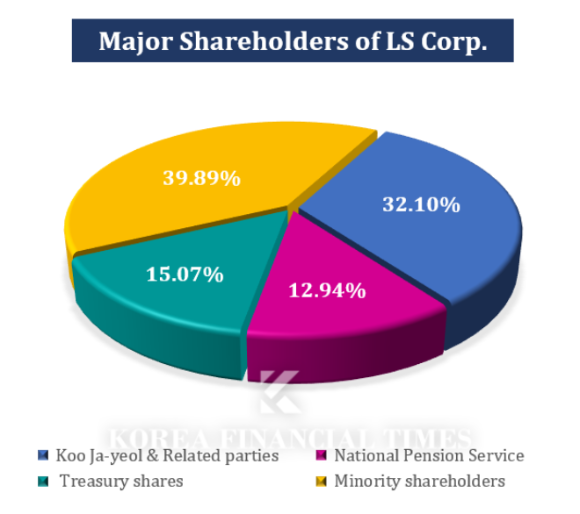
Chart prepared by Korea Financial Times / Data from the Financial Supervisory Service’s DART disclosure system
Earlier in May, LS issued KRW 65 billion worth of exchangeable bonds (EBs) backed by 387,365 treasury shares—equivalent to 1.2% of total shares—subscribed by Korean Air.
This move was widely interpreted as a defensive tactic against Hoban Group’s managerial challenge. Because treasury shares lack voting rights and cannot be used in shareholder meetings, issuing EBs linked to these shares enables LS to establish a friendly controlling interest.
Once Korean Air converts these bonds into shares, it will acquire voting rights, potentially tipping future votes in favor of LS management during proxy battles.
Shin Haeju (hjs0509@fntimes.com)












![“더현대 성공 공식 넓혔다”…정지영이 그린 현대백화점 3년 [CEO 임기보고서]](https://cfnimage.commutil.kr/phpwas/restmb_setimgmake.php?pp=006&w=69&h=45&m=5&simg=2024050622411806767dd55077bc221924813982.jpg&nmt=18)
![[DCM] 롯데렌탈 공모채 1500억…최대주주 교체에 조기상환 변수](https://cfnimage.commutil.kr/phpwas/restmb_setimgmake.php?pp=006&w=69&h=45&m=5&simg=20261020115913077240141825007d12411124362.jpg&nmt=18)
![[THE COMPASS] 한화시스템, 한화오션 인수 ‘브릿지’ 역할 청산…본업 강화 집중](https://cfnimage.commutil.kr/phpwas/restmb_setimgmake.php?pp=006&w=69&h=45&m=5&simg=20261020125755010330a837df649412411124362.jpg&nmt=18)


![[그래픽 뉴스] ‘순대’가 경제용어라고? 순(純)대외자산, 한국의 진짜 해외자산은 얼마일까?](https://cfnimage.commutil.kr/phpwas/restmb_setimgmake.php?pp=006&w=298&h=298&m=1&simg=202609021356075202de68fcbb3512411124362_0.jpg&nmt=18)
![[그래픽 뉴스] ISA 대개편! 나에게 유리한 계좌는?](https://cfnimage.commutil.kr/phpwas/restmb_setimgmake.php?pp=006&w=298&h=298&m=1&simg=202608041713155615de68fcbb3512411124362_0.jpg&nmt=18)
![[그래픽 뉴스] 미국 증시 새로운 키워드 'MANGOS'](https://cfnimage.commutil.kr/phpwas/restmb_setimgmake.php?pp=006&w=298&h=298&m=1&simg=202607291740382069de68fcbb3512411124362_0.jpg&nmt=18)

![[그래픽 뉴스] 은퇴후 30년 부모님 세대의 생존전략](https://cfnimage.commutil.kr/phpwas/restmb_setimgmake.php?pp=006&w=298&h=298&m=1&simg=202606301704439153de68fcbb3512411124362_0.jpg&nmt=18)
![[신간]은퇴연옥…김경록의 은퇴 후 삶의 나침반](https://cfnimage.commutil.kr/phpwas/restmb_setimgmake.php?pp=006&w=81&h=123&m=5&simg=20260414140833047280f8caa4a5ce12411124362.jpg&nmt=18)
![[신간] 물처럼 흐르고 원칙으로 서다…김용환의 통찰을 담다](https://cfnimage.commutil.kr/phpwas/restmb_setimgmake.php?pp=006&w=81&h=123&m=5&simg=20260409114249027860f8caa4a5ce12411124362.jpg&nmt=18)
![[안현정 서평] 플랫폼의 영지에서 ‘미학적 주권’을 선포하라...'K가 죽어야 K가 산다' 장준환 著](https://cfnimage.commutil.kr/phpwas/restmb_setimgmake.php?pp=006&w=81&h=123&m=5&simg=20260527121426063220c1c16452b012411124362.jpg&nmt=18)
![[서평] 추세 매매의 대가들...추세추종 투자전략의 대가 14인 인터뷰](https://cfnimage.commutil.kr/phpwas/restmb_setimgmake.php?pp=006&w=81&h=123&m=5&simg=2023102410444004986c1c16452b0175114235199.jpg&nmt=18)


![[머니무브 2026] “지금 사도 될까?” 답이 안 보인다면…하반기 투자, 4명의 전문가에게 물어보세요](https://cfnimage.commutil.kr/phpwas/restmb_setimgmake.php?pp=006&w=89&h=45&m=1&simg=202609151044050355302a735e27af12411124362.jpg&nmt=18)
![[AD] ‘PBV 라인업 확장’ 기아, 9월 독일서 ‘PV7’ 첫 공개](https://cfnimage.commutil.kr/phpwas/restmb_setimgmake.php?pp=006&w=89&h=45&m=1&simg=2026083111010602815074925877361231180222.jpg&nmt=18)
![[AD] 제네시스, 럭셔리 경험 더한 ‘2027 GV70’‧‘GV70 그래파이트’ 출시](https://cfnimage.commutil.kr/phpwas/restmb_setimgmake.php?pp=006&w=89&h=45&m=1&simg=20260702143546085600749258773622211122717.jpg&nmt=18)