






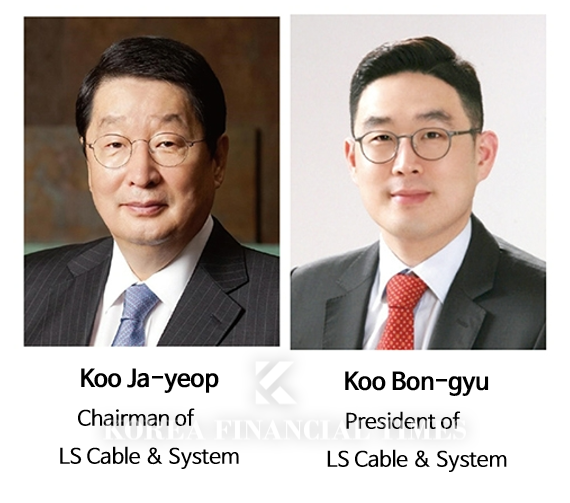
According to LS Cable & System's 2024 business report released on April 1, Koo Ja-yeop earned KRW 4.796 billion, while Koo Bon-gyu received KRW 1.508 billion last year. Chairman Koo Ja-yeop is the father of President Koo Bon-gyu. Compared to the previous year, Koo Ja-yeop's salary increased by 8.7%, and Koo Bon-gyu’s surged by 31.07%.
The combined salaries of the father-son duo amounted to KRW 6.3 billion, which accounted for 79.41% of the total director compensation of KRW 7.939 billion at LS Cable & System in 2024.
Last year, LS Cable & System reported sales of KRW 6.7653 trillion and an operating profit of KRW 274.5 billion, marking increases of 8.82% and 18.06%, respectively, compared to the previous year. The operating profit margin rose by 0.32 percentage points to reach 4.06%, outperforming competitor Taihan Cable & Solution’s margin of 3.50%.
However, net profit for the year plummeted by 57.59%, settling at KRW 44.7 billion. While the company generated more revenue from its core business than the previous year, the actual cash retained was cut in half. Nevertheless, Koo Ja-yeop and Koo Bon-gyu received compensation equivalent to 14% of the net profit.
LS Cable & System explained the drop in net profit, stating that it was due to a significant increase in nuclear power plant safety contributions for 2024 and foreign exchange losses from the sharp rise in exchange rates in December last year.
Koo Ja-yeop received KRW 2.684 billion in base salary, KRW 2.112 billion in bonuses, and KRW 1 million in other income (such as welfare benefits).
Chairman Koo Ja-yeop received a salary of KRW 2.684 billion, a bonus of KRW 2.112 billion, and other employment income (welfare support) of KRW 1 million.
His salary consisted of a base salary of KRW 1.522 billion, allowances of KRW 262 million, and a role-based salary of KRW 900 million. Compared to the previous year, his salary increased by 2.62%, while his bonus rose by 17.79%.
Koo Bon-gyu earned a salary of KRW 890 million, KRW 610 million in bonuses, and KRW 8 million in other income. His salary included KRW 544 million in basic pay, KRW 99 million in position allowances, and KRW 246 million for role-based pay. Bonuses consisted of KRW 389 million for short-term performance incentives and KRW 221 million for long-term performance incentives.
LS Cable & System determines executive performance bonuses by considering both quantitative and non-quantitative indicators. The non-quantitative indicators assess improvements in competitive capabilities, while the quantitative indicators evaluate pre-tax profit for short-term incentives and sales and operating profit target achievement rates for long-term incentives. Last year, LS Cable & System achieved its highest sales ever.
The total compensation for the five registered directors, excluding outside directors and audit committee members, amounted to KRW 7.939 billion. Of this, the father-son duo, Koo Ja-yeop and Koo Bon-gyu, accounted for 79.41%, marking a 1.68 percentage point decrease from the previous year.
Employee compensation also showed an upward trend. Executive salaries increased by 17.96% compared to the previous year, while employee salaries rose by 5.68%.
Executive salaries rose by an average of 17.96%, while employee salaries increased by just 5.68%. Among non-registered executives (excluding overseas employees), the average annual salary was KRW 388 million per person.
For employees—including regular staff (1,985) and temporary workers (145)—the total payroll amounted to KRW 176.63 billion last year, with an average individual salary of KRW 83 million.
Shin Haeju (hjs0509@fntimes.com)











![LG전자 116% 뛸 때 LG디스플레이 -30% 왜? [정답은 TSR]](https://cfnimage.commutil.kr/phpwas/restmb_setimgmake.php?pp=006&w=69&h=45&m=5&simg=20260928103014001610c1c16452b012411124362.jpg&nmt=18)


!['머니무브 2026 부의공식' 포럼 개최…돈의 흐름 읽는 전문가들이 모인다 [머니무브 2026]](https://cfnimage.commutil.kr/phpwas/restmb_setimgmake.php?pp=006&w=69&h=45&m=5&simg=202609281733040003002a735e27af12411124362.jpg&nmt=18)
!['연장전' 가는 차기 수협은행장 선임···표 대결 '승리' 신학기 행장, 연임 가능성↑ [2027 은행장 레이스]](https://cfnimage.commutil.kr/phpwas/restmb_setimgmake.php?pp=006&w=69&h=45&m=5&simg=202609211608140057701b5a2213792211381469.jpg&nmt=18)


![[그래픽 뉴스] ‘순대’가 경제용어라고? 순(純)대외자산, 한국의 진짜 해외자산은 얼마일까?](https://cfnimage.commutil.kr/phpwas/restmb_setimgmake.php?pp=006&w=298&h=298&m=1&simg=202609021356075202de68fcbb3512411124362_0.jpg&nmt=18)
![[그래픽 뉴스] ISA 대개편! 나에게 유리한 계좌는?](https://cfnimage.commutil.kr/phpwas/restmb_setimgmake.php?pp=006&w=298&h=298&m=1&simg=202608041713155615de68fcbb3512411124362_0.jpg&nmt=18)
![[그래픽 뉴스] 미국 증시 새로운 키워드 'MANGOS'](https://cfnimage.commutil.kr/phpwas/restmb_setimgmake.php?pp=006&w=298&h=298&m=1&simg=202607291740382069de68fcbb3512411124362_0.jpg&nmt=18)

![[그래픽 뉴스] 은퇴후 30년 부모님 세대의 생존전략](https://cfnimage.commutil.kr/phpwas/restmb_setimgmake.php?pp=006&w=298&h=298&m=1&simg=202606301704439153de68fcbb3512411124362_0.jpg&nmt=18)
![[신간]은퇴연옥…김경록의 은퇴 후 삶의 나침반](https://cfnimage.commutil.kr/phpwas/restmb_setimgmake.php?pp=006&w=81&h=123&m=5&simg=20260414140833047280f8caa4a5ce12411124362.jpg&nmt=18)
![[신간] 물처럼 흐르고 원칙으로 서다…김용환의 통찰을 담다](https://cfnimage.commutil.kr/phpwas/restmb_setimgmake.php?pp=006&w=81&h=123&m=5&simg=20260409114249027860f8caa4a5ce12411124362.jpg&nmt=18)
![[안현정 서평] 플랫폼의 영지에서 ‘미학적 주권’을 선포하라...'K가 죽어야 K가 산다' 장준환 著](https://cfnimage.commutil.kr/phpwas/restmb_setimgmake.php?pp=006&w=81&h=123&m=5&simg=20260527121426063220c1c16452b012411124362.jpg&nmt=18)
![[서평] 추세 매매의 대가들...추세추종 투자전략의 대가 14인 인터뷰](https://cfnimage.commutil.kr/phpwas/restmb_setimgmake.php?pp=006&w=81&h=123&m=5&simg=2023102410444004986c1c16452b0175114235199.jpg&nmt=18)


![[머니무브 2026] “지금 사도 될까?” 답이 안 보인다면…하반기 투자, 4명의 전문가에게 물어보세요](https://cfnimage.commutil.kr/phpwas/restmb_setimgmake.php?pp=006&w=89&h=45&m=1&simg=202609151044050355302a735e27af12411124362.jpg&nmt=18)
![[AD] ‘PBV 라인업 확장’ 기아, 9월 독일서 ‘PV7’ 첫 공개](https://cfnimage.commutil.kr/phpwas/restmb_setimgmake.php?pp=006&w=89&h=45&m=1&simg=2026083111010602815074925877361231180222.jpg&nmt=18)
![[AD] 제네시스, 럭셔리 경험 더한 ‘2027 GV70’‧‘GV70 그래파이트’ 출시](https://cfnimage.commutil.kr/phpwas/restmb_setimgmake.php?pp=006&w=89&h=45&m=1&simg=20260702143546085600749258773622211122717.jpg&nmt=18)
![[AD] 개소세 혜택 종료…현대차, ‘썸머 페스타’로 고객 부담 완화](https://cfnimage.commutil.kr/phpwas/restmb_setimgmake.php?pp=006&w=89&h=45&m=1&simg=20260702142355004830749258773622211122717.jpg&nmt=18)