






Korea Zinc is set for another clash between the Young Poong-MBK alliance and Chairman Choi Yun-beom at the March regular shareholders' meeting over control of the company./ AI generated
이미지 확대보기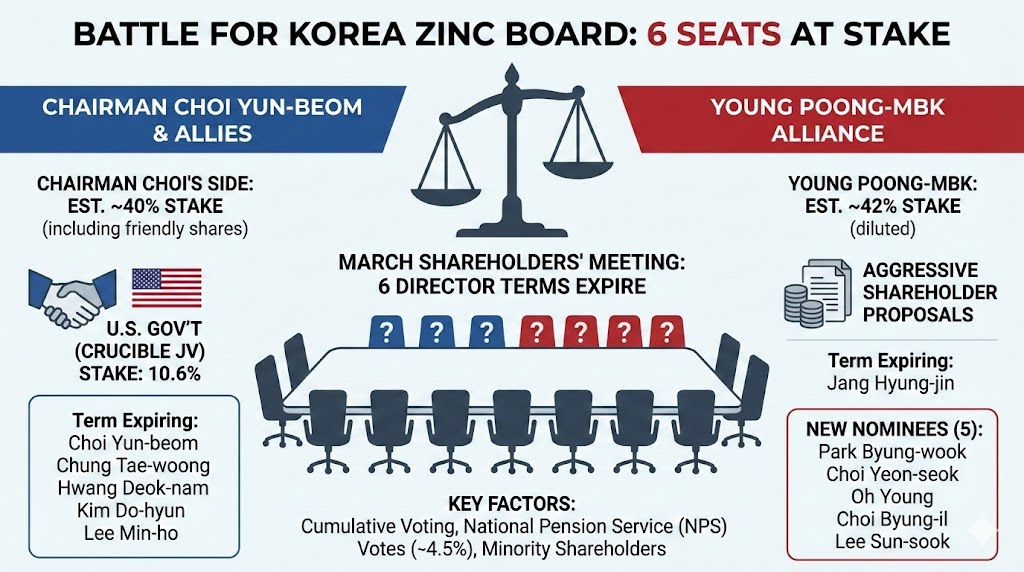
Battle for Board Restructuring Control Continues This Year
Korea Zinc's board consists of 19 members. Of these, four directors were nominated by the largest shareholder, the Young Poong-MBK alliance. Fifteen are personnel aligned with management under Chairman Choi Yun-beom. However, four of the 15 were appointed at last year's extraordinary shareholders' meeting with restricted voting rights for the opposing side, and their duties have been suspended after a court ruled this unlawful. In reality, the structure can be viewed as 11 (Chairman Choi) versus 4 (Young Poong-MBK).Six directors' terms expire in March: five from Chairman Choi's side and one from Young Poong-MBK. These include Chairman Choi Yun-beom and CEO Chung Tae-woong, as well as outside directors Hwang Deok-nam, Kim Do-hyun, and Lee Min-ho. From Young Poong-MBK, the term of Jang Hyung-jin, Young Poong advisor serving as a non-executive director, is set to expire.
A proxy battle between both sides is expected at next month's regular shareholders' meeting as each attempts to place as many members as possible on the board.
Young Poong-MBK announced on the 12th that they recently nominated five new director candidates through a shareholder proposal. They proposed Park Byung-wook, Young Poong outside director, and Choi Yeon-seok, MBK Partner, as non-executive director candidates, and Oh Young, Choi Byung-il, and Lee Sun-sook as outside director candidates. Young Poong-MBK stated, "These individuals possess balanced expertise in industry, finance and management experience, and independence," adding, "This is not about one shareholder group monopolizing the board, but to enable diverse shareholders to participate in board governance."
Chairman Choi's side is also expected to convene a board meeting soon to propose agenda items for this year's shareholders' meeting, including director appointments.
U.S. Government as 'White Knight' Narrows the Gap
Initially, it appeared only a matter of time before Young Poong-MBK would gain control of Korea Zinc. The plan was to secure at least four additional directors at this year's meeting based on their shareholding advantage, then achieve a majority at next year's meeting.However, a variable emerged in December of last year. Korea Zinc decided on a KRW 2.85 trillion third-party paid-in capital increase for Crucible JV, a joint venture involving the U.S. government, to construct a smelter in Tennessee, bringing both sides' shareholdings to near parity.
Crucible JV, effectively controlled by the U.S. government, disclosed that it secured a 10.6% stake in Korea Zinc. As a cooperative partner in the management dispute, it is highly likely to vote in favor of Chairman Choi's side. In this case, Chairman Choi's side, including existing friendly shares, is estimated to have secured approximately 40% of shares. Meanwhile, Young Poong-MBK's stake is estimated at approximately 42% following dilution from the capital increase.
Under the cumulative voting system that will be used at Korea Zinc's shareholders' meeting, it is extremely difficult for Young Poong-MBK to independently secure a majority of the six seats. Additionally, votes from the National Pension Service and other minority shareholders are likely to be divided. The National Pension Service, which currently holds approximately 4.5% of Korea Zinc shares, appeared to maintain "neutrality" by voting evenly on both sides' proposals last year, but in reality is assessed to have exercised voting rights favorably for maintaining Chairman Choi's management control. The corporate rehabilitation proceedings of Homeplus, where MBK is the largest shareholder, likely had an influence.
Young Poong-MBK: "Start with Structural Governance Improvements"
Young Poong-MBK has now adopted a strategy of strengthening its presence as a shareholder at this meeting. Through the shareholder proposal, Young Poong-MBK stated, "This is not about short-term management disputes or personnel changes, but about normalizing corporate value through structural governance improvements."First, Young Poong-MBK proposed to formalize 'directors' fiduciary duty to shareholders' in Korea Zinc's articles of incorporation. This would directly reflect in the articles the shareholder protection principle that the government codified through the first Commercial Act revision last year.
They also proposed specifying in the articles the principle that the board must protect shareholder interests and treat all shareholders fairly when issuing new shares.
They revived the executive officer system that was rejected last year. This system separates executive officers who lead business operations from the board that oversees them. It is a governance structure mainly applied to companies acquired by private equity funds, with strengthening board control as its core.
They also proposed amending the articles so that the board chairman, not the CEO, chairs shareholders' meetings to ensure fairness. This appears to consider how Korea Zinc President Park Ki-duk, who served as temporary chairman at last year's meeting, led the voting rights restrictions.
Additionally, Young Poong-MBK included proposals to enhance shareholder value, such as ▲a 1-to-10 stock split ▲transfer to voluntary reserves to secure dividend resources.
Gwak Horyung (horr@fntimes.com)











![이성훈 LH 사장 다주택·대출 규제 발언 도마…여야 의원 잇단 지적 [2026 국감]](https://cfnimage.commutil.kr/phpwas/restmb_setimgmake.php?pp=006&w=69&h=45&m=5&simg=20261012163012026870048b718333218159227151.jpg&nmt=18)

![12개월 최고 연 6.00%…BNK저축은행 'BNK동행적금'[이주의 저축은행 적금금리-10월 2주]](https://cfnimage.commutil.kr/phpwas/restmb_setimgmake.php?pp=006&w=69&h=45&m=5&simg=202610110103170668607c96e797801121481643.jpg&nmt=18)

![12개월 최고 연 4.10%…OK저축은행 'OK e-안심앱플러스정기예금6'[이주의 저축은행 예금금리-10월 2주]](https://cfnimage.commutil.kr/phpwas/restmb_setimgmake.php?pp=006&w=69&h=45&m=5&simg=202610110051040059207c96e797801121481643.jpg&nmt=18)


![[그래픽 뉴스] ‘순대’가 경제용어라고? 순(純)대외자산, 한국의 진짜 해외자산은 얼마일까?](https://cfnimage.commutil.kr/phpwas/restmb_setimgmake.php?pp=006&w=298&h=298&m=1&simg=202609021356075202de68fcbb3512411124362_0.jpg&nmt=18)
![[그래픽 뉴스] ISA 대개편! 나에게 유리한 계좌는?](https://cfnimage.commutil.kr/phpwas/restmb_setimgmake.php?pp=006&w=298&h=298&m=1&simg=202608041713155615de68fcbb3512411124362_0.jpg&nmt=18)
![[그래픽 뉴스] 미국 증시 새로운 키워드 'MANGOS'](https://cfnimage.commutil.kr/phpwas/restmb_setimgmake.php?pp=006&w=298&h=298&m=1&simg=202607291740382069de68fcbb3512411124362_0.jpg&nmt=18)

![[그래픽 뉴스] 은퇴후 30년 부모님 세대의 생존전략](https://cfnimage.commutil.kr/phpwas/restmb_setimgmake.php?pp=006&w=298&h=298&m=1&simg=202606301704439153de68fcbb3512411124362_0.jpg&nmt=18)
![[신간]은퇴연옥…김경록의 은퇴 후 삶의 나침반](https://cfnimage.commutil.kr/phpwas/restmb_setimgmake.php?pp=006&w=81&h=123&m=5&simg=20260414140833047280f8caa4a5ce12411124362.jpg&nmt=18)
![[신간] 물처럼 흐르고 원칙으로 서다…김용환의 통찰을 담다](https://cfnimage.commutil.kr/phpwas/restmb_setimgmake.php?pp=006&w=81&h=123&m=5&simg=20260409114249027860f8caa4a5ce12411124362.jpg&nmt=18)
![[안현정 서평] 플랫폼의 영지에서 ‘미학적 주권’을 선포하라...'K가 죽어야 K가 산다' 장준환 著](https://cfnimage.commutil.kr/phpwas/restmb_setimgmake.php?pp=006&w=81&h=123&m=5&simg=20260527121426063220c1c16452b012411124362.jpg&nmt=18)
![[서평] 추세 매매의 대가들...추세추종 투자전략의 대가 14인 인터뷰](https://cfnimage.commutil.kr/phpwas/restmb_setimgmake.php?pp=006&w=81&h=123&m=5&simg=2023102410444004986c1c16452b0175114235199.jpg&nmt=18)


![[머니무브 2026] “지금 사도 될까?” 답이 안 보인다면…하반기 투자, 4명의 전문가에게 물어보세요](https://cfnimage.commutil.kr/phpwas/restmb_setimgmake.php?pp=006&w=89&h=45&m=1&simg=202609151044050355302a735e27af12411124362.jpg&nmt=18)
![[AD] ‘PBV 라인업 확장’ 기아, 9월 독일서 ‘PV7’ 첫 공개](https://cfnimage.commutil.kr/phpwas/restmb_setimgmake.php?pp=006&w=89&h=45&m=1&simg=2026083111010602815074925877361231180222.jpg&nmt=18)
![[AD] 제네시스, 럭셔리 경험 더한 ‘2027 GV70’‧‘GV70 그래파이트’ 출시](https://cfnimage.commutil.kr/phpwas/restmb_setimgmake.php?pp=006&w=89&h=45&m=1&simg=20260702143546085600749258773622211122717.jpg&nmt=18)