






On July 1, the Korean won was recently trading near the 1,400 won mark, according to the financial investment industry. While further gains are seen as limited, it's hardly reassuring.
Currently, the Korean won is trading at levels similar to those seen in April, when the U.S. Consumer Price Index (CPI) rose more than expected (3.5%). At the time, the dollar appreciated and the won depreciated as expectations of a rate cut by the US Federal Reserve (Fed) faded.
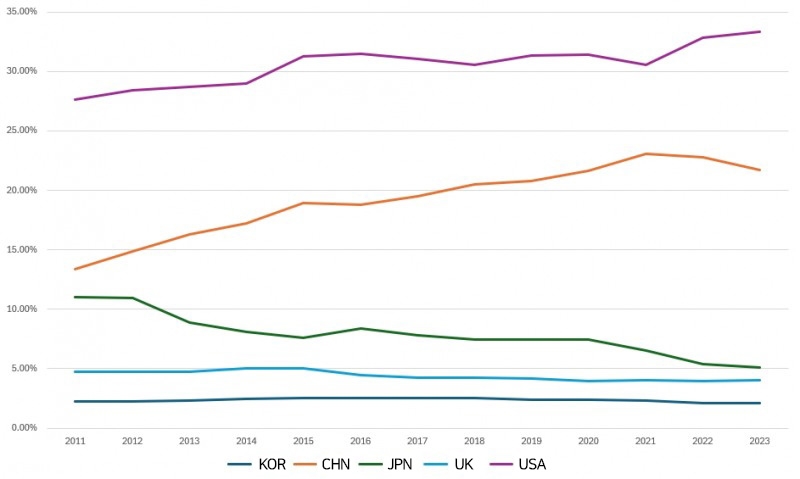
Trends in the share of GDP of each country relative to the global economy./Source=Bank of Korea
이미지 확대보기
However, the current rally in the won-dollar exchange rate is of a different nature than in April. While the U.S. interest rate decision and Japanese monetary policy are still under debate, growth, employment, and inflation are either in line with market expectations or slowing down.
The Korean won's appreciation has been driven by changing economic fundamentals. According to the Bank of Korea, the share of the U.S. gross domestic product (GDP) in the global economy (37 countries, including the U.S. and China, but excluding data gaps such as Russia) expanded from 27.60% in 2011 to 33.32% in 2023, while Korea's GDP shrank from 2.22% to 2.09% during the same period.
On the other hand, the exchange rate of the won to the dollar was only above 1,200 won during the 2008 financial crisis before the COVID-19 pandemic. Since then, the exchange rate has been above KRW 1,200, but it was only a "temporary" phenomenon due to short-term market instability.
In March 2022, the KRW exchange rate broke through the 1200 won level and started trading at a different level than before. Since then, the exchange rate hasn't fallen below 1200 won.
However, even after the trade balance returned to a surplus, the Korean won hasn't been able to depreciate. This is partly due to the fact that the US interest rate is higher than the Korean interest rate. However, Korea is an export-oriented country, so strong exports partially offset the U.S.-Korea interest rate differential. This means that other factors besides interest rates and the trade balance are affecting the KRW exchange rate.
Therefore, the aforementioned changes in the GDP shares of major global economies could be the answer. Behind this is the US-China trade war and global supply chain reorganization.
Especially since the COVID-19 pandemic, supply chain issues have emerged and trade trends have begun to change. The U.S. has been a manufacturing powerhouse through "reshoring", which is still ongoing.
On the other hand, China, which was expected to "reopening" in the wake of the pandemic, saw its economy begin to deteriorate. Funds flowing out of China headed to the U.S., and Korea, which is highly dependent on Chinese exports, was bound to weaken.
Conversely, the conditions for Korea's economic fundamentals to return to the previous level are either the rise of China or an increase in exports to the United States. However, given that the Korean economy grew in an environment of global trade openness, the current protectionist trend is a weakening factor.
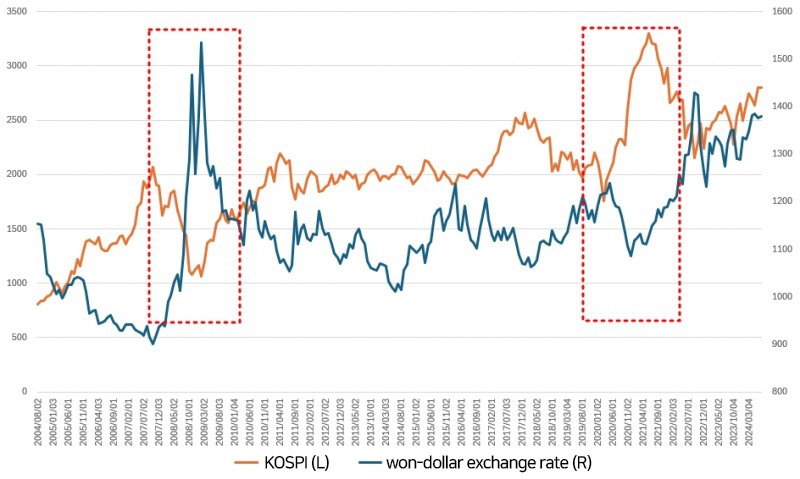
The dollar exchange rate and KOSPI index tends to move into the opposite direction.Recently, it is moving between KRW 1300 to 1400 and 1400 won./ Source=Bank of Korea, Korea Exchange
이미지 확대보기
The direction of the won-dollar exchange rate also affects the domestic stock market. Basically, the more attractive the won becomes, the higher the stock market will rise.
Semiconductors and automobiles account for a high proportion of Korea's exports. Of these, semiconductors are important in terms of the stock market. The first and second largest companies by market capitalization are Samsung Electronics and SK Hynix, which together account for 26% of the KOSPI.
However, it is doubtful that growth focused on semiconductors will be able to raise the level of the Korean stock market from its current level. While a weaker won makes exports more competitive, it also weighs heavily on raw material prices. In fact, domestic companies' operating margins have been low in the past during high exchange rates.
"Countries are gradually reducing their trade openness and expectations for China's economic recovery are falling," said Choi Kwang-hyuk, a researcher at LS Securities. "Korea has reduced its dependence on the Chinese economy, but it still accounts for a large share of exports." "Considering the Korean economy's position in the global economy, we don't think the won is too weak at the moment," he said.
Lee Sungkyu (lsk0603@fntimes.com)











![[머니무브 2026] 이승우 “美 장기금리 5% 넘어서면 한국 증시, ‘AI 투자비용’까지 봐야”](https://cfnimage.commutil.kr/phpwas/restmb_setimgmake.php?pp=006&w=69&h=45&m=5&simg=20260917185156027250c1c16452b012411124362.jpg&nmt=18)
![정상혁號 신한은행, 영업·RM·심사역 '원팀' 결합…산업·회계 전문가 키운다 [은행원의 진화]](https://cfnimage.commutil.kr/phpwas/restmb_setimgmake.php?pp=006&w=69&h=45&m=5&simg=20260822020013047950b4a7c6999c121131189150.jpg&nmt=18)


![최창원, SK디스커버리 성과급 2배 늘었지만…올해는 가스 사업 부진 [가성비 C-레벨]](https://cfnimage.commutil.kr/phpwas/restmb_setimgmake.php?pp=006&w=69&h=45&m=5&simg=202609171558030943707de3572ddd12517950139.jpg&nmt=18)


![[그래픽 뉴스] ‘순대’가 경제용어라고? 순(純)대외자산, 한국의 진짜 해외자산은 얼마일까?](https://cfnimage.commutil.kr/phpwas/restmb_setimgmake.php?pp=006&w=298&h=298&m=1&simg=202609021356075202de68fcbb3512411124362_0.jpg&nmt=18)
![[그래픽 뉴스] ISA 대개편! 나에게 유리한 계좌는?](https://cfnimage.commutil.kr/phpwas/restmb_setimgmake.php?pp=006&w=298&h=298&m=1&simg=202608041713155615de68fcbb3512411124362_0.jpg&nmt=18)
![[그래픽 뉴스] 미국 증시 새로운 키워드 'MANGOS'](https://cfnimage.commutil.kr/phpwas/restmb_setimgmake.php?pp=006&w=298&h=298&m=1&simg=202607291740382069de68fcbb3512411124362_0.jpg&nmt=18)

![[그래픽 뉴스] 은퇴후 30년 부모님 세대의 생존전략](https://cfnimage.commutil.kr/phpwas/restmb_setimgmake.php?pp=006&w=298&h=298&m=1&simg=202606301704439153de68fcbb3512411124362_0.jpg&nmt=18)
![[신간]은퇴연옥…김경록의 은퇴 후 삶의 나침반](https://cfnimage.commutil.kr/phpwas/restmb_setimgmake.php?pp=006&w=81&h=123&m=5&simg=20260414140833047280f8caa4a5ce12411124362.jpg&nmt=18)
![[신간] 물처럼 흐르고 원칙으로 서다…김용환의 통찰을 담다](https://cfnimage.commutil.kr/phpwas/restmb_setimgmake.php?pp=006&w=81&h=123&m=5&simg=20260409114249027860f8caa4a5ce12411124362.jpg&nmt=18)
![[안현정 서평] 플랫폼의 영지에서 ‘미학적 주권’을 선포하라...'K가 죽어야 K가 산다' 장준환 著](https://cfnimage.commutil.kr/phpwas/restmb_setimgmake.php?pp=006&w=81&h=123&m=5&simg=20260527121426063220c1c16452b012411124362.jpg&nmt=18)
![[서평] 추세 매매의 대가들...추세추종 투자전략의 대가 14인 인터뷰](https://cfnimage.commutil.kr/phpwas/restmb_setimgmake.php?pp=006&w=81&h=123&m=5&simg=2023102410444004986c1c16452b0175114235199.jpg&nmt=18)


![[머니무브 2026] “지금 사도 될까?” 답이 안 보인다면…하반기 투자, 4명의 전문가에게 물어보세요](https://cfnimage.commutil.kr/phpwas/restmb_setimgmake.php?pp=006&w=89&h=45&m=1&simg=202609151044050355302a735e27af12411124362.jpg&nmt=18)
![[AD] ‘PBV 라인업 확장’ 기아, 9월 독일서 ‘PV7’ 첫 공개](https://cfnimage.commutil.kr/phpwas/restmb_setimgmake.php?pp=006&w=89&h=45&m=1&simg=2026083111010602815074925877361231180222.jpg&nmt=18)
![[AD] 제네시스, 럭셔리 경험 더한 ‘2027 GV70’‧‘GV70 그래파이트’ 출시](https://cfnimage.commutil.kr/phpwas/restmb_setimgmake.php?pp=006&w=89&h=45&m=1&simg=20260702143546085600749258773622211122717.jpg&nmt=18)
![[AD] 개소세 혜택 종료…현대차, ‘썸머 페스타’로 고객 부담 완화](https://cfnimage.commutil.kr/phpwas/restmb_setimgmake.php?pp=006&w=89&h=45&m=1&simg=20260702142355004830749258773622211122717.jpg&nmt=18)
![[AD] 기아 ‘디 올 뉴 셀토스’, 인도 타임스 드라이브 어워즈서 ‘올해의 SUV’ 선정](https://cfnimage.commutil.kr/phpwas/restmb_setimgmake.php?pp=006&w=89&h=45&m=1&simg=202605071156400590007492587736124111243152.jpg&nmt=18)