







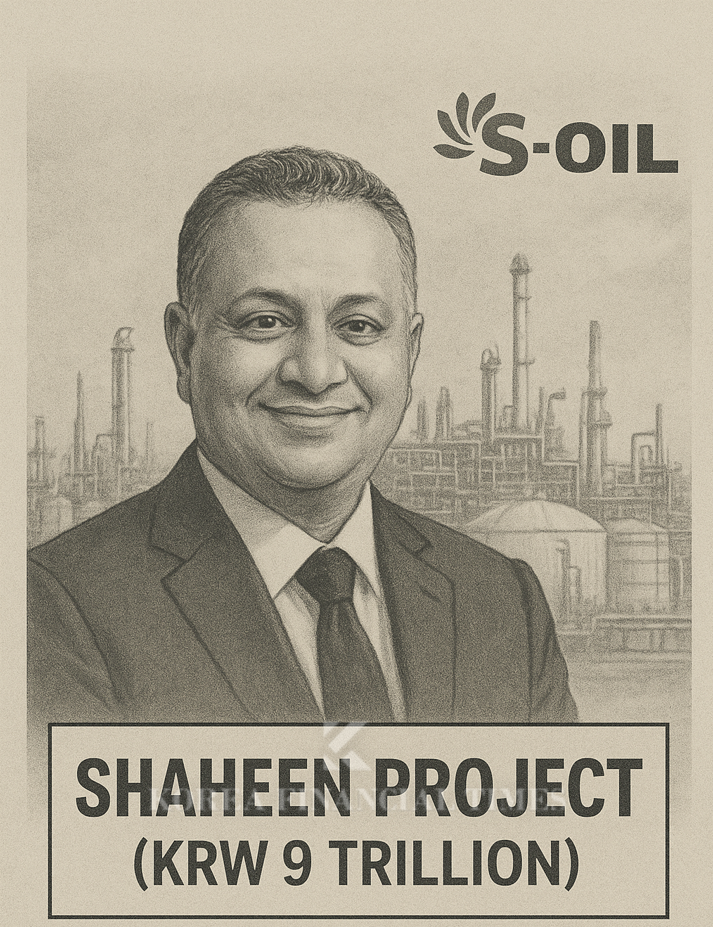
Even the profitability S-OIL has highlighted post-completion is in doubt. Aggressive capacity buildouts in China and continued slack in global demand are already pushing both product prices and margins lower. There is also criticism that the project could further exacerbate the chronic oversupply plaguing Korea’s petrochemical sector.
According to S-OIL on the 28th, Shaheen was 77% complete as of the first half of this year, with mechanical completion targeted for the first half of next year.
Shaheen Project is an integrated refining–petrochemical complex S-OIL is building on an 880,000-square-meter site—about the size of 120 soccer fields—within the Onsan National Industrial Complex in Ulsan. The total investment amounts to approximately KRW 9.258 trillion, making it a mega-project.
Once fully onstream in the second half of next year, the complex will produce basic feedstocks annually, including 1.8 million tons of ethylene, 770,000 tons of propylene, 200,000 tons of butadiene, and 280,000 tons of benzene. It will also allow the company to manufacture polyethylene in-house—LLDPE at 880,000 tons and HDPE at 440,000 tons—using the ethylene produced as feedstock for plastics and other synthetic materials.
Notably, Shaheen Project will be the first commercial deployment of TC2C, a technology developed by S-OIL’s largest shareholder, Saudi Aramco. The process produces petrochemicals directly from crude oil and is said to offer comparatively stronger economics and quality than conventional petrochemical routes.
S-OIL plans to leverage Shaheen Project to diversify its product slate and strengthen profitability. Both CEO Anwar Al-Hejazi and Saudi Aramco President Mohammed Y. Al Qahtani have visited the construction site, signaling strong interest.
Nevertheless, skepticism outweighs optimism. On top of the hefty KRW 9 trillion price tag, the company’s earnings have deteriorated since Al-Hejazi’s appointment, deepening financial burdens.
Petrochemical Restructuring Underway… Will S-OIL’s ‘Time Bomb’ Go Off?S-OIL, "Direct Exports to U.S. Only 0.1% of Total Sales, No Tariff Impact"... But Concerns RemainS-OIL’s Cautious Approach to Fundraising: Focus on Controlling Borrowing Expansion'Solid Performance Amidst Recession' - S-Oil · GS Caltex, What’s Their Secret?
S-OIL’s consolidated operating profit came in at KRW 3.4052 trillion in 2022, prior to Al-Hejazi’s tenure, but halved to KRW 1.3546 trillion in 2023, and fell further to KRW 422.2 billion last year. A downturn in global economic conditions dragged down crude prices and refining margins, weakening the core refining–petrochemical business. The slump has persisted, with a cumulative operating loss of KRW 365.5 billion in the first half of this year.
As performance worsens, operating cash inflows have also shrunk. Net cash from operating activities fell 41.9% from KRW 2.5257 trillion at end-2023 to KRW 1.4675 trillion in 2024. The estimate for this year is KRW 1.3879 trillion, down about 5.4% from 2024.
While cash inflows have declined, financial leverage has risen due to borrowings for Shaheen Project. Total debt, which hovered around KRW 5 trillion in 2022 and 2023, increased to about KRW 8 trillion last year. The debt-to-equity ratio also rose from 161% to 181% over the same period. Net debt climbed from KRW 3.758 trillion (2022) to KRW 3.8617 trillion (2023) and KRW 6.0459 trillion (2024), reflecting heavier financial strain as net debt—total borrowings minus cash and cash equivalents—increases.
S-OIL plans to invest KRW 3.487 trillion in Shaheen Project this year and KRW 1.6594 trillion next year. However, as of the second quarter, cash and cash equivalents stood at roughly KRW 1.5 trillion.
Industry analysts broadly judge that profitability will be difficult to guarantee even after Shaheen Project starts up next year. The core issue is that product prices and margins are already declining amid China-driven capacity buildouts and sluggish global demand.
Since 2018, China has pursued petrochemical self-sufficiency, massively expanding its facilities; roughly 50% of global ethylene output is now produced in China. With the United States imposing reciprocal tariffs on China, there is concern that cargoes previously bound for the U.S. could be redirected into Asia, further aggravating oversupply.
Korea’s petrochemical industry has responded in recent years by lowering utilization rates and undertaking large-scale restructuring to mitigate oversupply. The government has also rolled out its “Policy Direction for Revitalizing the Petrochemical Industry,” signaling tailored support for companies that actively cut production to help ease the glut.
Given this backdrop, many warn that Shaheen could further worsen the sector’s domestically concentrated oversupply. Consequently, it may take time for Shaheen project to secure sustainable profitability.
In a recent report, Dongjin Kang, an analyst at Hyundai Motor Securities, noted, “Refining margins have remained weak, led by gasoline, naphtha, and high-sulfur fuel oil. While a larger-than-expected scale of capacity closures could stabilize supply–demand to some extent, there are few clear catalysts for robust demand.”
He added, “China’s petrochemical exports are rising rapidly, weighing on prices for Shaheen Project’s key products. Given the project’s substantial unit construction cost, it is uncertain whether it will serve as a positive driver for S-OIL’s profitability.”
Kim JaeHun (rlqm93@fntimes.com)











![[르포] 1100평 한 층서 '협업', 보안데이터 하루 '10억 건'…하나금융의 진화](https://cfnimage.commutil.kr/phpwas/restmb_setimgmake.php?pp=006&w=69&h=45&m=5&simg=202609301743410358601b5a2213792211381469.jpg&nmt=18)


![[그래픽 뉴스] ‘순대’가 경제용어라고? 순(純)대외자산, 한국의 진짜 해외자산은 얼마일까?](https://cfnimage.commutil.kr/phpwas/restmb_setimgmake.php?pp=006&w=298&h=298&m=1&simg=202609021356075202de68fcbb3512411124362_0.jpg&nmt=18)
![[그래픽 뉴스] ISA 대개편! 나에게 유리한 계좌는?](https://cfnimage.commutil.kr/phpwas/restmb_setimgmake.php?pp=006&w=298&h=298&m=1&simg=202608041713155615de68fcbb3512411124362_0.jpg&nmt=18)
![[그래픽 뉴스] 미국 증시 새로운 키워드 'MANGOS'](https://cfnimage.commutil.kr/phpwas/restmb_setimgmake.php?pp=006&w=298&h=298&m=1&simg=202607291740382069de68fcbb3512411124362_0.jpg&nmt=18)

![[그래픽 뉴스] 은퇴후 30년 부모님 세대의 생존전략](https://cfnimage.commutil.kr/phpwas/restmb_setimgmake.php?pp=006&w=298&h=298&m=1&simg=202606301704439153de68fcbb3512411124362_0.jpg&nmt=18)
![[신간]은퇴연옥…김경록의 은퇴 후 삶의 나침반](https://cfnimage.commutil.kr/phpwas/restmb_setimgmake.php?pp=006&w=81&h=123&m=5&simg=20260414140833047280f8caa4a5ce12411124362.jpg&nmt=18)
![[신간] 물처럼 흐르고 원칙으로 서다…김용환의 통찰을 담다](https://cfnimage.commutil.kr/phpwas/restmb_setimgmake.php?pp=006&w=81&h=123&m=5&simg=20260409114249027860f8caa4a5ce12411124362.jpg&nmt=18)
![[안현정 서평] 플랫폼의 영지에서 ‘미학적 주권’을 선포하라...'K가 죽어야 K가 산다' 장준환 著](https://cfnimage.commutil.kr/phpwas/restmb_setimgmake.php?pp=006&w=81&h=123&m=5&simg=20260527121426063220c1c16452b012411124362.jpg&nmt=18)
![[서평] 추세 매매의 대가들...추세추종 투자전략의 대가 14인 인터뷰](https://cfnimage.commutil.kr/phpwas/restmb_setimgmake.php?pp=006&w=81&h=123&m=5&simg=2023102410444004986c1c16452b0175114235199.jpg&nmt=18)


![[머니무브 2026] “지금 사도 될까?” 답이 안 보인다면…하반기 투자, 4명의 전문가에게 물어보세요](https://cfnimage.commutil.kr/phpwas/restmb_setimgmake.php?pp=006&w=89&h=45&m=1&simg=202609151044050355302a735e27af12411124362.jpg&nmt=18)
![[AD] ‘PBV 라인업 확장’ 기아, 9월 독일서 ‘PV7’ 첫 공개](https://cfnimage.commutil.kr/phpwas/restmb_setimgmake.php?pp=006&w=89&h=45&m=1&simg=2026083111010602815074925877361231180222.jpg&nmt=18)
![[AD] 제네시스, 럭셔리 경험 더한 ‘2027 GV70’‧‘GV70 그래파이트’ 출시](https://cfnimage.commutil.kr/phpwas/restmb_setimgmake.php?pp=006&w=89&h=45&m=1&simg=20260702143546085600749258773622211122717.jpg&nmt=18)
![[AD] 개소세 혜택 종료…현대차, ‘썸머 페스타’로 고객 부담 완화](https://cfnimage.commutil.kr/phpwas/restmb_setimgmake.php?pp=006&w=89&h=45&m=1&simg=20260702142355004830749258773622211122717.jpg&nmt=18)