




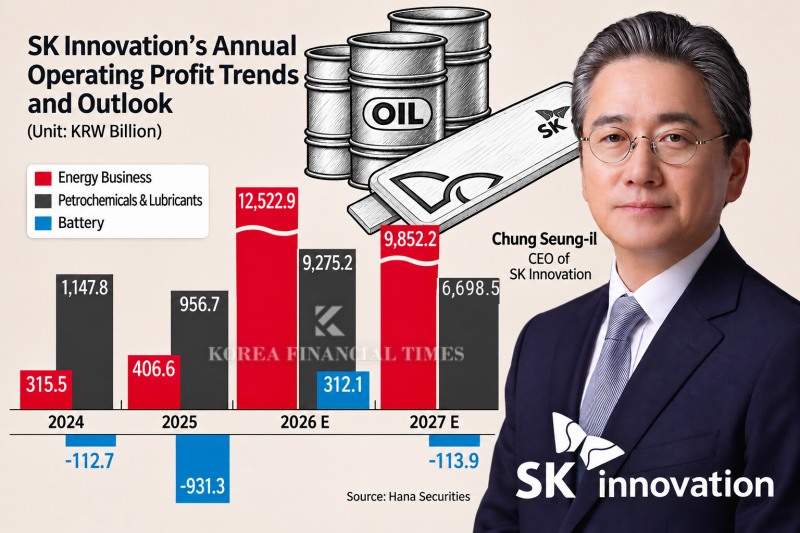
This infographic, originally published by Korea Financial Times, has been reconstructed using generative AI.
이미지 확대보기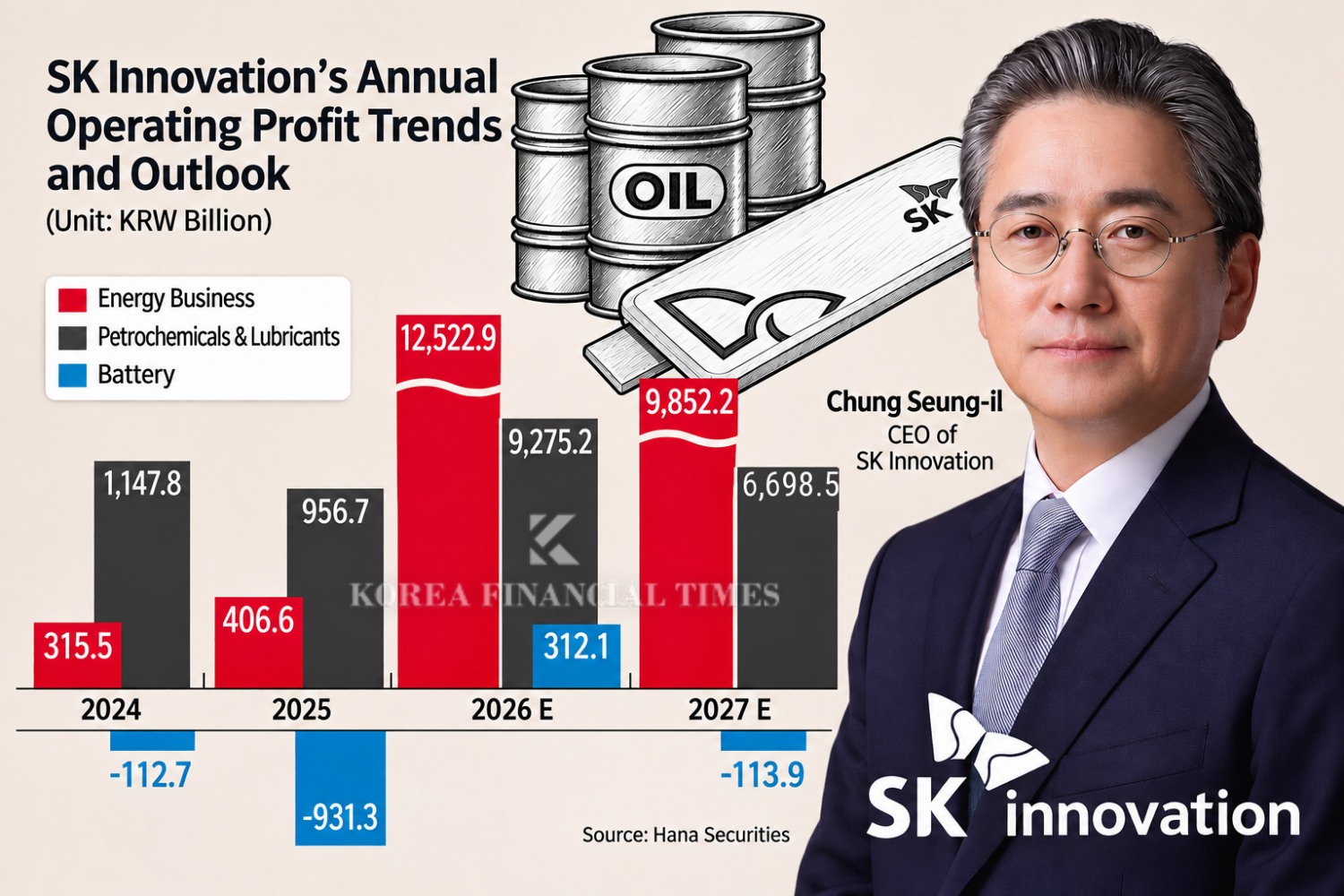
Strong refining margins push this year’s operating profit forecast to KRW 12.5 trillion
SK Innovation’s third-quarter consolidated revenue was KRW 28.7738 trillion, and operating profit was KRW 3.7043 trillion. Operating profit rose 545.9% from a year earlier and 6.2% from the previous quarter, a record high for any quarter. It also beat the brokerage consensus of KRW 2.8606 trillion by about 30%.The refining, lubricants and liquefied natural gas (LNG) power businesses drove the results. The petroleum business posted operating profit of KRW 1.5283 trillion, up 402.4% from a year earlier. Global supply of petroleum products shrank because of operational disruptions at refineries in the Middle East and Russia’s restrictions on diesel exports, which strengthened export margins.
“Prolonged war and geopolitical tensions have heightened supply concerns, sustaining an environment that supports refining margins,” an industry official said.
It is hard to say, however, that the current strength in refining margins will continue. If international oil prices surge, crude procurement costs rise first while petroleum product prices adjust with a time lag, which can produce a “reverse lag” effect.
Inventory gains and losses also vary with the movements of crude and product prices. Supply shortages caused by geopolitical variables are lifting refiners’ earnings, but a sharp swing in oil prices could again shake profitability.
The lubricants business also supported earnings. Third-quarter operating profit in the lubricants division was KRW 1.0906 trillion, up 57.6% from the previous quarter, also a record for any quarter.
Supply of lubricant base oil fell as Middle Eastern competitors suffered production disruptions, which improved selling prices and margins. The lubricants division’s operating margin reached 46.1%.
SK Shifts Focus From Batteries to AI and Chips as Top Executives Gather at SK hynixSK Innovation's Shareholders Sidelined From SKIET's Spin-off to Merger"Turned to a Millstone by the Chasm": SK's EV Trio — When Will Normalization Come?SK's Holding Subsidiaries Diverge: SK Discovery Falls Behind the PackBeyond Hynix: SK's Three-Company AI Alliance Eyes Full-Stack Jackpot
Operating profit in the E&S division was KRW 774.4 billion, up 631.3% from the previous quarter. The division raised power plant utilization rates by using relatively cheap directly imported LNG as fuel amid rising system marginal prices (SMP).
Brokerages expect the earnings improvement to continue into the fourth quarter and beyond. Hana Securities estimates SK Innovation’s full-year operating profit this year at KRW 12.5229 trillion. Considering that operating profit last year was only KRW 406.6 billion, the scale of the recovery is substantial.
Cumulative operating profit through the third quarter has surpassed the KRW 9 trillion level. If full-year results match brokerage forecasts, operating profit could come close to KRW 13 trillion.
Battery losses behind the boom
In contrast to the improvement in its existing energy businesses, the battery business remains unstable.The battery division posted operating profit of KRW 821.8 billion in the second quarter of this year but swung to an operating loss of KRW 80.5 billion in the third quarter. Revenue also fell from KRW 2.946 trillion in the second quarter to KRW 1.5263 trillion in the third. The company cited lower sales volume as the main reason.
This is why the second-quarter profit alone cannot be taken as proof that the battery business has entered a stable profitability track. Since 2025, quarters in which the battery business has turned a profit have been limited.
In particular, because the battery division’s operating profit reflects the effects of support measures such as tax credits, the business’s underlying profitability excluding these effects needs to be examined. The battery division recorded a loss again in the third quarter, leaving the company with the task of securing a stable earnings base.
It is also difficult to conclude that the current results in refining and lubricants will serve as a long-term source of earnings. Supply shortages are pushing up refining margins, but if international oil prices swing sharply, a reverse lag could occur in which cost burdens are reflected in selling prices first. The battery business must prove it can recover profitability, while the existing energy businesses must convert the profits earned during the boom into a sustainable business foundation.
SK Innovation plans to use the earnings from its existing businesses to improve the battery unit’s financial structure and invest in future growth businesses, thereby speeding up its business transformation.
The rebalancing strategy unveiled earlier this year was focused on the same direction.
It set as key tasks raising profitability across the petrochemical and energy value chain, strengthening the battery unit’s financial structure, monetizing non-core assets, and building the foundation for an “electrification” business.
Putting Chung Seung-il in charge of electrification strategy
The core of the electrification strategy is to expand from an oil company into a power provider. Electricity demand is growing rapidly, centered on artificial intelligence (AI) data centers and semiconductor clusters.In response, the company plans to secure LNG and generate and supply electricity, while also offering solutions that combine power management, cooling and energy storage systems (ESS). The aim is to build a value chain spanning power generation, supply and management and evolve into a comprehensive energy company.
The latest personnel changes are in line with this vision. SK Group appointed President Chung Seung-il, whom it had recruited earlier this year to lead future growth businesses, as SK Innovation’s chief president (CEO).
Chung is a former vice minister of the Ministry of Trade, Industry and Energy who also served as president of Korea Gas Corporation and president of Korea Electric Power Corporation. With experience across the energy industry, including gas procurement, power generation and electricity supply, he is regarded as well suited to lead SK Innovation’s LNG-based power business and electrification strategy.
After joining SK Inc. earlier this year as president in charge of future growth businesses, Chung became SK Innovation’s chief president effective November 1. An outside recruit who had overseen group-level future growth businesses has thus been placed as the top executive of a core energy affiliate.
The appointment can be seen as reflecting SK Group’s strategic judgment to manage the profitability of its existing refining and petrochemical businesses while expanding its business scope with a focus on power.
The operating structure of the existing energy businesses also deserves attention. President Kang Dong-soo will concurrently serve as president of SK Innovation and president of SK Energy. Rather than naming a separate management team dedicated to refining, the group has entrusted the refining division, a core profit source for the group, to a figure with experience in strategy, finance and business portfolio management.
While Chung oversees the future growth strategy centered on the power business, Kang will be responsible for the profitability and operational efficiency of the existing energy businesses.
“SK Innovation’s challenge is to channel the profits earned from refining and lubricants into improving the battery business’s financial structure and investing in the power business,” a business-community official said. “This reshuffle appears to reflect the group’s resolve to manage the profitability of existing energy businesses while shifting its business portfolio toward electrification.”
Gwak Horyung (horr@fntimes.com)