




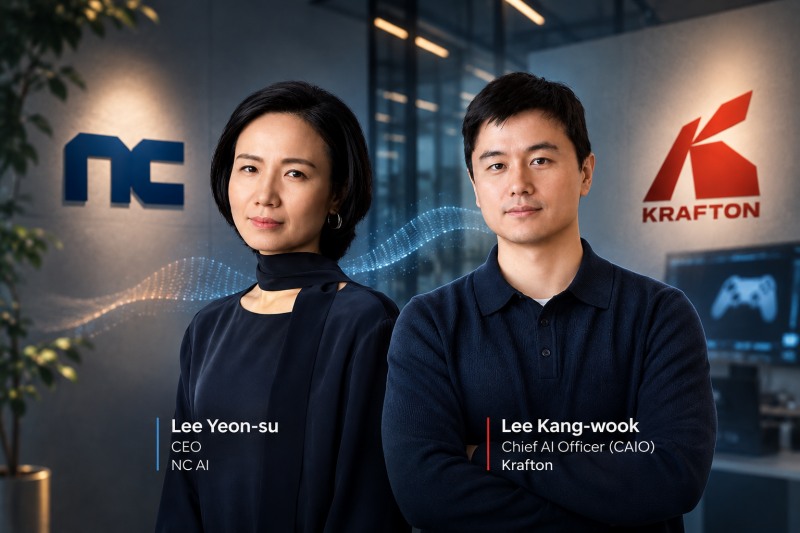
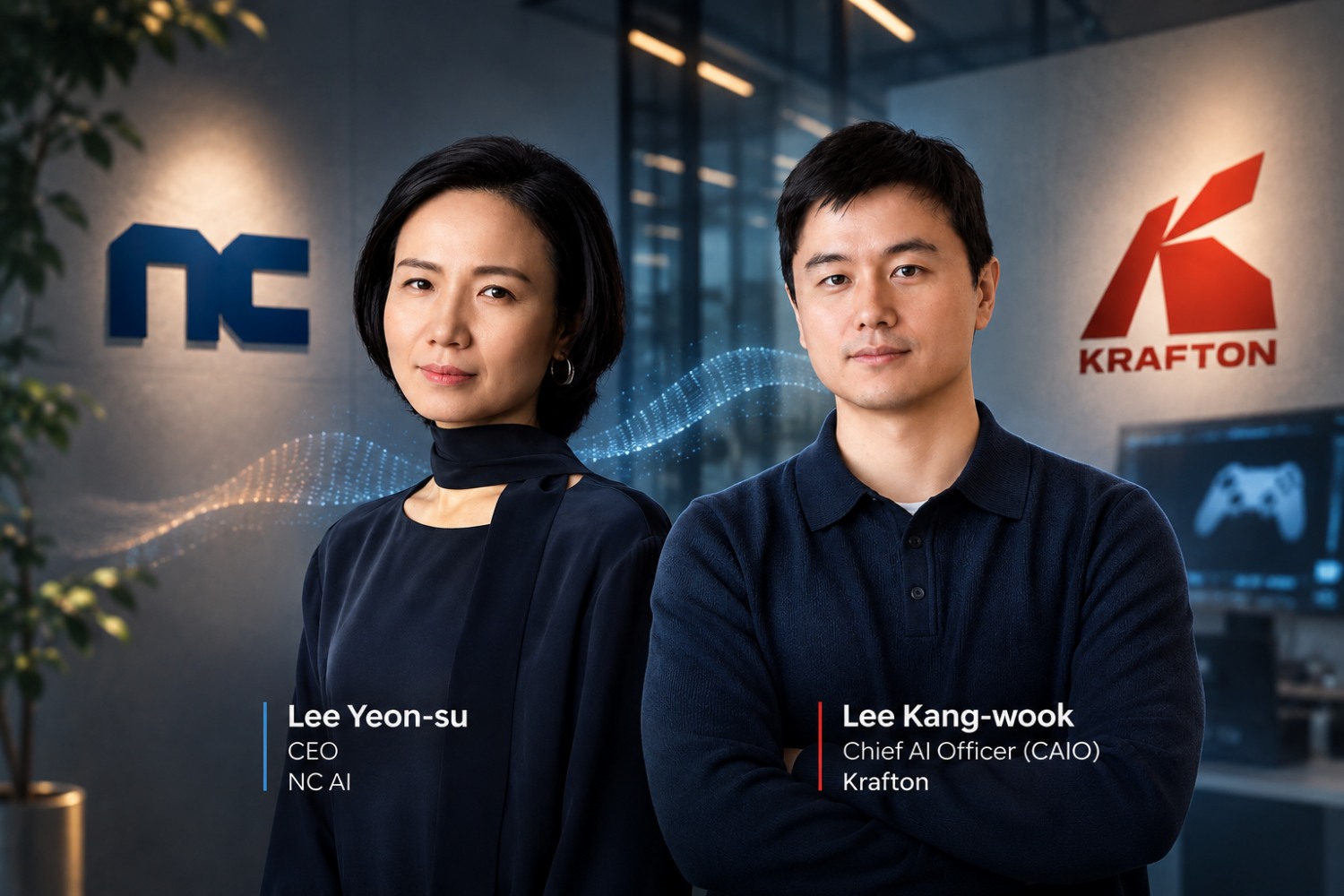
The difference in strategy is also reflected in the people who oversee their AI businesses: Lee Yeon-su, CEO of NC AI, and Lee Kang-wook, Krafton’s Chief AI Officer (CAIO). While Lee Yeon-su has been tasked with growing the AI technology accumulated inside the game company into an independent business, Lee Kang-wook places weight on applying AI to games to change the user experience while also widening the range in which the technology can be used.
Samsung SDS Alumnus Lee Yeon-su Expands AI Business Externally
NC’s AI business starts from extending technologies accumulated during game development to external industries. Since beginning AI research in 2011, NC has built up related technologies such as natural language processing and speech and image recognition. In 2024, it spun off its AI research organization into a separate company, NC AI, and is pursuing business expansion through it.After joining NC in 2014, Lee Yeon-su led the growth of its research organization, serving as head of the Natural Language Processing Lab, head of the AI Center and head of the Research Division.
Lee, who earned his bachelor’s, master’s and doctoral degrees in computer science at Korea University, majored in natural language processing. He gained hands-on experience at Samsung SDS, including commercializing IT solutions. After joining NC in 2014, he led the growth of its research organization, serving as head of the Natural Language Processing Lab, head of the AI Center and head of the Research Division.
He is now the inaugural CEO of NC AI, steering the business direction of the independent company. His vision is to grow it beyond a technology organization that supports game development into a provider that supplies AI technology to diverse industries such as manufacturing, distribution and content.
Its core technology is its own AI brand, “VARCO.” The company is developing technologies needed for content production, including language models as well as image, speech and translation technologies. NC AI’s business direction is to apply these to the needs of each industry. Rather than stopping at developing general-purpose models, it focuses on providing specialized solutions tailored to each industry’s work environment and data.
Lee is directly targeting external markets based on the language, speech and image technologies accumulated during game development. This aligns with a strategy of growing AI into a separate business, going beyond using the technology in game development. It means that, while the game industry serves as the foundation for validating and advancing AI technology, the ultimate scope of its application will not be limited to games.
Koo Kwang-mo's Vision for AI and Robotics Drives LG Group's Transformation [KFT Topic]Netmarble: Undervalued on Assets, Overvalued on Earnings — or Is It?'Tariff-Heavy US,' 'Uncertain China': Samsung, Hyundai Motor, LG, POSCO, Lotte Seek Breakthrough in IndiaWhy Did Kakao and KT Fall Short Against Naver and SKT in Korea’s ‘National AI’ Selection?NC Soft Reports 'First Annual Loss', Aims for Turnaround with Global Releases
Physical AI is also one pillar of business expansion. In February 2026, NC AI joined the K-Physical AI Alliance, which has 53 participating institutions, and is pursuing the development of world foundation models and robotics foundation models as well as demonstrations at industrial sites. It is an attempt to extend AI technology built in digital environments to real industrial settings.
The remaining task for Lee is to connect technological competitiveness with demand at industrial sites. Because the data and work environments required differ by industry, general-purpose technology alone makes it difficult to solve clients’ problems. NC AI needs to flesh out models and services specialized for fields such as manufacturing and distribution and accumulate actual adoption cases.
In particular, since AI businesses involve large technology development costs, establishing a sustainable earnings base is important. For NC AI to expand as an independent company, it must prove not only its technological capability but also a utility for which clients are willing to pay.
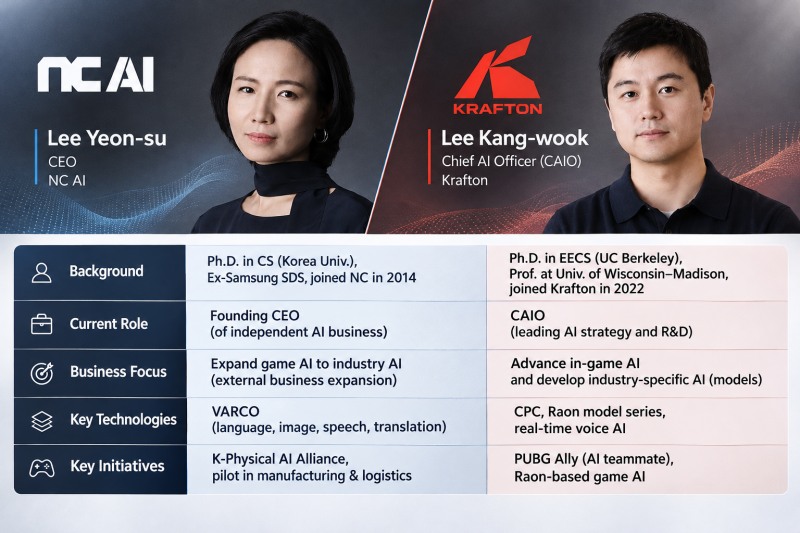
Comparison of the business status of NC AI CEO Lee Yeon-su and Krafton Chief AI Officer (CAIO) Lee Kang-wook, who oversee the AI businesses of NC and Krafton. / This infographic, originally published by Korea Financial Times, has been reconstructed using generative AI.
이미지 확대보기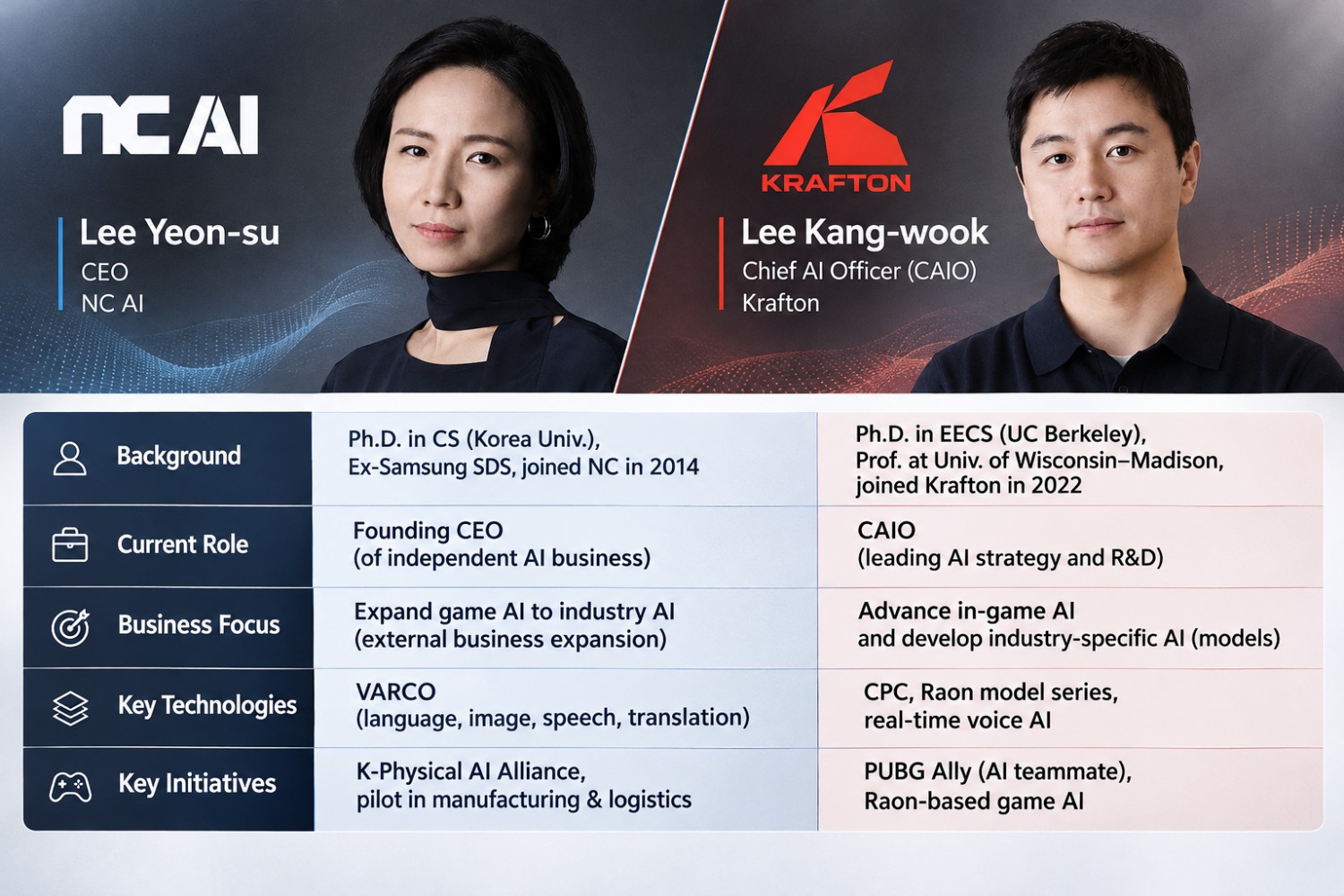
AI Researcher Lee Kang-wook Strengthens Game AI Competitiveness
Krafton’s AI strategy starts from changing the user experience inside games. Lee Kang-wook, the CAIO leading it, completed his undergraduate studies at KAIST and earned a Ph.D. in electrical engineering and computer sciences at the University of California, Berkeley in the U.S. He has since been serving as a professor at the University of Wisconsin-Madison and has headed Krafton’s AI division since 2022. Appointed CAIO in February this year, he now oversees the company’s overall AI strategy.The area Lee Kang-wook is focusing on is the Co-Playable Character (CPC), which applies AI to in-game characters. While conventional non-player characters (NPCs) merely repeat set actions and lines, CPCs aim to be AI companions that respond to a user’s situation and conversation and play the game alongside them.
Krafton is pursuing the application of related technology to games through inZOI’s Smart Zoi, PUBG Ally and others. PUBG Ally in particular focuses on implementing an AI teammate that moves with the user, collects items and joins in combat. Through voice commands and cooperative functions that respond to in-game situations, it seeks to offer interactions that set it apart from existing game characters.
Such technology improves the fun of the game and the user experience, and it is also a means of validating the AI capabilities Krafton has accumulated. This is because it is a process of checking whether AI characters can understand users’ intentions and respond appropriately in an actual game environment.
However, Krafton’s AI strategy does not stay confined to games. Krafton is pursuing the official release of a small model and the development of a larger-scale “Raon-1.” It also plans to develop a voice model capable of two-way, real-time conversation. The idea is to apply these to game AI such as PUBG Ally to improve technological maturity, while expanding its business domain into industry-specific models.
This is an approach that uses games to advance AI technology and treats that as a foundation that can be applied to other industries. Whereas NC has separated its AI organization into an independent company to directly target external industries, Krafton has chosen a path of first strengthening the competitiveness of game AI and then widening the scope of the technology’s use.
Management has also directly mentioned the potential for monetization. At the third-quarter earnings announcement on Nov. 10, Krafton CEO Kim Chang-han said regarding AI investment, “There are cases where we invest in certain businesses with a long-term view, but where possible, we are looking for businesses that can quickly generate real revenue, even if small.”
Concrete business strategies for industry-specific models will be announced separately at a later date. Since the company is currently at the stage of presenting its technology development and application direction, the key question is how it will secure actual customers and a revenue model. It must concretize technologies and services that can work in external industries while raising the maturity of its game AI.
A gaming industry source said, “Both companies share the same direction in that they are expanding the use of AI beyond games to industries across the board,” but added, “However, the process of converting technology into business is different.”
The source continued, “The next task for Lee Yeon-su is to secure external customers and recurring business opportunities as an independent AI company, while for Lee Kang-wook it is to prove the real competitiveness of game AI and confirm the revenue potential of industry-specific models.”
Kim JaeHun (rlqm93@fntimes.com)