






Home and Malaysia Take Flight — Coway Eyes KRW 5 Trillion in Revenue
According to industry sources on the 30th, Coway is expected to extend its growth momentum into the second quarter as well.Park Jong-dae, an analyst at Hana Securities, projected that Coway's consolidated revenue for the second quarter of this year would rise 14% year-on-year to KRW 1.4292 trillion, with operating profit estimated to increase 13% to KRW 273.3 billion over the same period.
Coway had already posted record-high results in the first quarter of this year, with revenue of KRW 1.3297 trillion and operating profit of KRW 250.9 billion — up 13.2% and 18.8% year-on-year, respectively, and the strongest quarterly figures in the company's history.
The strong results are attributed to continued momentum in its domestic and Malaysian operations. Hana Securities projected that Coway's domestic revenue would rise 11% year-on-year in the second quarter, with Malaysian revenue up 22%, together driving overall performance.
In the domestic business, an increase in new rental sales is expected to push net additions (new contracts minus cancellations) in rental accounts to roughly 230,000 in the second quarter, surpassing the 190,000 net additions recorded in the first quarter — a projected 43% increase compared to the second quarter of last year.
Malaysia, which accounts for about 75% of Coway's overseas revenue and more than 30% of its total revenue, remains a core market for the company. In the first quarter of this year, revenue at Coway's Malaysian subsidiary rose 23.5% year-on-year, while operating profit grew more than 40%. The company is seen as improving profitability by expanding beyond its traditional water purifier business into categories such as mattresses and air conditioners.
Hanwha Investment & Securities similarly projected that Coway would meet market expectations in the second quarter, with revenue of KRW 1.4221 trillion and operating profit of KRW 262.3 billion.
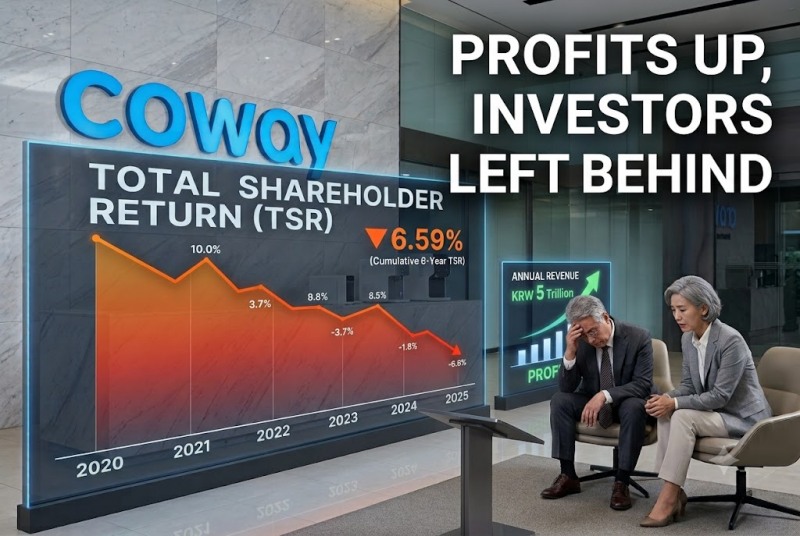
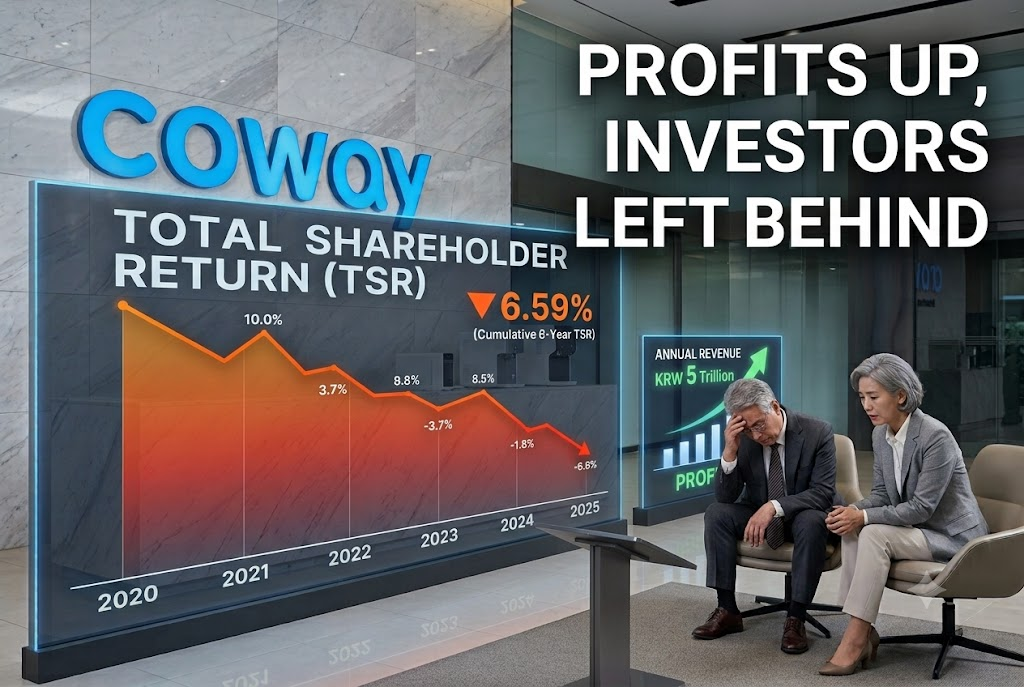
If this trend continues into the second half, Coway is likely to comfortably surpass KRW 5 trillion in annual revenue this year. Last year, the company's consolidated revenue stood at KRW 4.9635 trillion.
TSR Stuck in Single Digits — Rebound Holds the Key
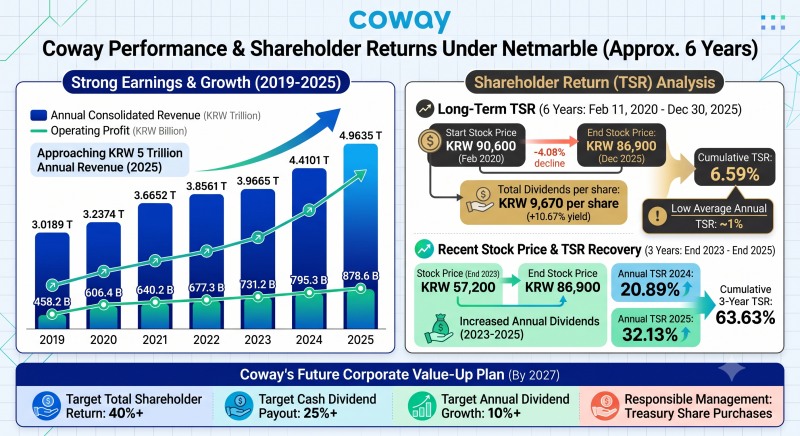
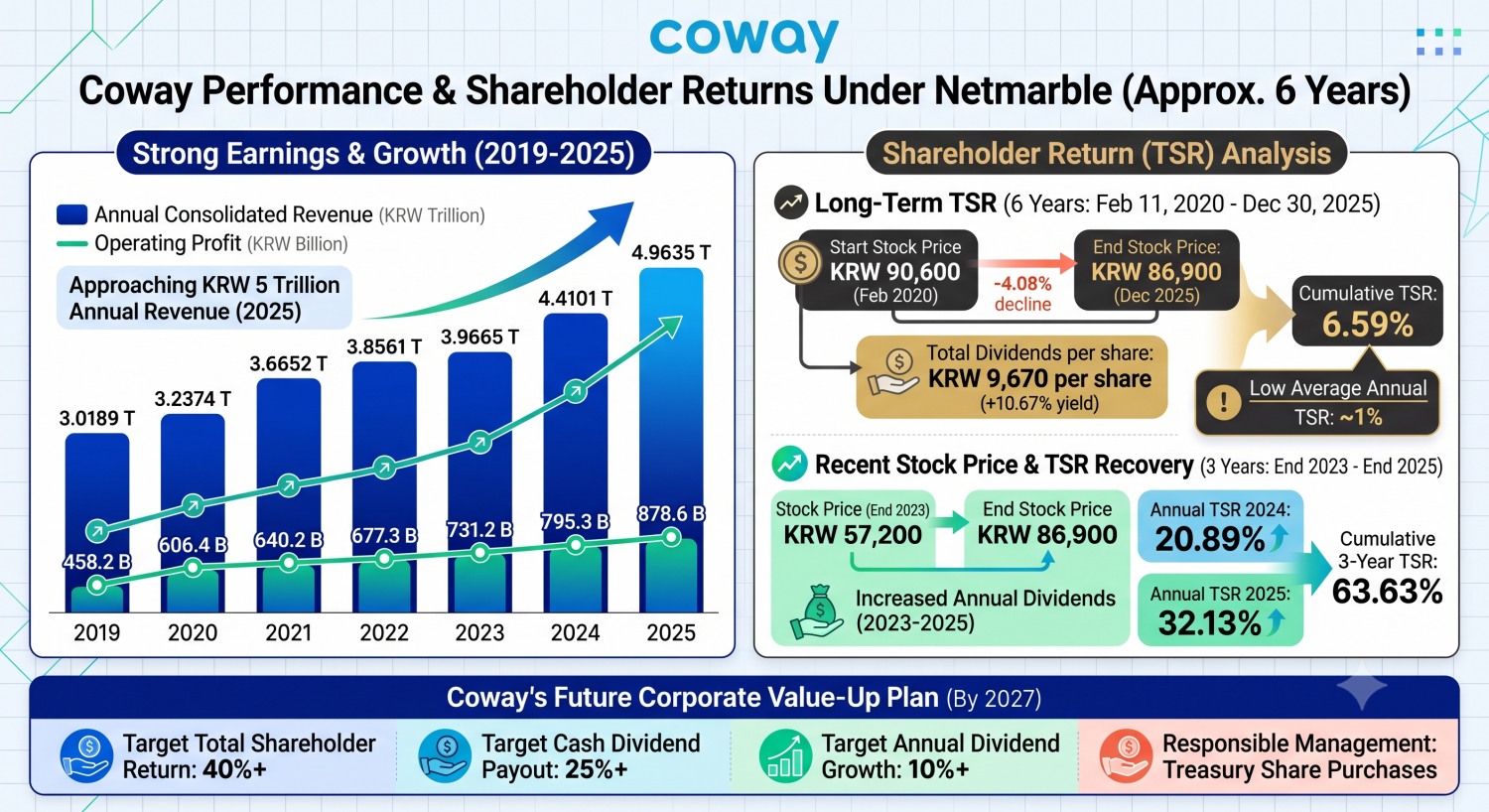
While the company has grown in scale, the returns shareholders are actually experiencing fall well short of expectations.The Korea Financial Times calculated Coway's cumulative TSR over the roughly six-year period from February 11, 2020 — when Netmarble finalized payment for its acquisition of Coway — through December 30, 2025. The result came to 6.59%. TSR is a measure that combines share price movement and dividend yield over a given period, representing the actual total return a shareholder would realize from investing in a company's stock.
Behind this average annual TSR of just over 1% lies a prolonged slump in the share price. Coway's stock traded at KRW 90,600 on February 11, 2020. Six years later, its closing price on the last trading day of 2025 (December 30) was KRW 86,900 — a cumulative decline of 4.08% over the period. Its closing price on the 29th of this month was KRW 90,600, effectively back to the level at which it entered Netmarble's fold. Given that earnings have trended steadily upward over the same span, this is a particularly disappointing outcome.
Coway's performance has grown consistently: revenue and operating profit came to KRW 3.0189 trillion and KRW 458.2 billion in 2019; KRW 3.2374 trillion and KRW 606.4 billion in 2020; KRW 3.6643 trillion and KRW 640.2 billion in 2021; KRW 3.8561 trillion and KRW 677.3 billion in 2022; KRW 3.9665 trillion and KRW 731.3 billion in 2023; KRW 4.3101 trillion and KRW 795.3 billion in 2024; and KRW 4.9635 trillion and KRW 878.6 billion in 2025.
Still, a cumulative dividend yield of 10.67%, from a total of six year-end dividend payouts amounting to KRW 9,670 over the six years, offset the share price decline and pushed the final TSR into positive territory at 6.59%. But given the six-year investment horizon, that translates to an average annual return of just 1.09%.
Narrowing the focus to the past two to three years, however, the share price and TSR figures show signs of recovery. Based on closing prices on the last trading day of each year, Coway's stock rose from KRW 57,200 in 2023 to KRW 66,900 in 2024 and KRW 86,900 in 2025. This was helped by the company raising its per-share dividend from KRW 1,350 in 2023 to KRW 2,630 in 2024, and paying out KRW 1,957 in 2025, boosting shareholder returns.
As a result, Coway's annual TSR came to 20.89% in 2024 and 32.13% in 2025, and its cumulative TSR over the most recent three years, calculated from the start of 2023, has climbed to 63.63%.
Ultimately, this shows that in order to resolve the prolonged undervaluation that has persisted since joining Netmarble, Coway will need sustained growth backed by an aggressive shareholder return policy.
In particular, whether the company can maintain stable cash generation on the back of overseas market expansion while strengthening shareholder returns is seen as the key variable for further TSR improvement going forward.
Coway maintains that, having moved past its earlier experience of excessive dividend payouts undermining competitiveness, it intends to pursue full-fledged shareholder returns built on the fundamentals it has strengthened under Netmarble's ownership.
A company official said that between 2015 and 2019, an excessive dividend payout ratio of nearly 90% had constrained future investment and eroded the company's core competitiveness, but that since Netmarble's acquisition in 2020, Coway has rebalanced shareholder returns against growth investment and focused on strengthening its fundamentals — achieving stable average annual revenue growth of 8.6% through 2025 as a result.
Building on this performance, Coway plans to steadily carry out its "corporate value-up plan," which calls for expanding its total shareholder return ratio to 40% by 2027. The company intends to maintain a cash dividend payout ratio of at least 25% so shareholders can benefit from separate taxation, while raising dividends by more than 10% year-on-year to boost real shareholder returns.
A company official added that the largest shareholder and management have also been directly purchasing treasury shares as part of responsible management, actively demonstrating their commitment to the company's mid- to long-term growth and value-up efforts.
Yang Hyunwoo (yhw@fntimes.com)











![[Z-스코어 기업가치 바로 보기] 차입이냐 자기자본이냐…LG엔솔 vs 삼성SDI ‘명암ʼ](https://cfnimage.commutil.kr/phpwas/restmb_setimgmake.php?pp=006&w=69&h=45&m=5&simg=20260912004753014480dd55077bc212411124362.jpg&nmt=18)

![[기자수첩] 보험사 품는 사모펀드, 대주주 심사 재고해야](https://cfnimage.commutil.kr/phpwas/restmb_setimgmake.php?pp=006&w=69&h=45&m=5&simg=20260913173909069220ed56b8e1f814379898.jpg&nmt=18)


![[그래픽 뉴스] ‘순대’가 경제용어라고? 순(純)대외자산, 한국의 진짜 해외자산은 얼마일까?](https://cfnimage.commutil.kr/phpwas/restmb_setimgmake.php?pp=006&w=298&h=298&m=1&simg=202609021356075202de68fcbb3512411124362_0.jpg&nmt=18)
![[그래픽 뉴스] ISA 대개편! 나에게 유리한 계좌는?](https://cfnimage.commutil.kr/phpwas/restmb_setimgmake.php?pp=006&w=298&h=298&m=1&simg=202608041713155615de68fcbb3512411124362_0.jpg&nmt=18)
![[그래픽 뉴스] 미국 증시 새로운 키워드 'MANGOS'](https://cfnimage.commutil.kr/phpwas/restmb_setimgmake.php?pp=006&w=298&h=298&m=1&simg=202607291740382069de68fcbb3512411124362_0.jpg&nmt=18)

![[그래픽 뉴스] 은퇴후 30년 부모님 세대의 생존전략](https://cfnimage.commutil.kr/phpwas/restmb_setimgmake.php?pp=006&w=298&h=298&m=1&simg=202606301704439153de68fcbb3512411124362_0.jpg&nmt=18)
![[신간]은퇴연옥…김경록의 은퇴 후 삶의 나침반](https://cfnimage.commutil.kr/phpwas/restmb_setimgmake.php?pp=006&w=81&h=123&m=5&simg=20260414140833047280f8caa4a5ce12411124362.jpg&nmt=18)
![[신간] 물처럼 흐르고 원칙으로 서다…김용환의 통찰을 담다](https://cfnimage.commutil.kr/phpwas/restmb_setimgmake.php?pp=006&w=81&h=123&m=5&simg=20260409114249027860f8caa4a5ce12411124362.jpg&nmt=18)
![[안현정 서평] 플랫폼의 영지에서 ‘미학적 주권’을 선포하라...'K가 죽어야 K가 산다' 장준환 著](https://cfnimage.commutil.kr/phpwas/restmb_setimgmake.php?pp=006&w=81&h=123&m=5&simg=20260527121426063220c1c16452b012411124362.jpg&nmt=18)
![[서평] 추세 매매의 대가들...추세추종 투자전략의 대가 14인 인터뷰](https://cfnimage.commutil.kr/phpwas/restmb_setimgmake.php?pp=006&w=81&h=123&m=5&simg=2023102410444004986c1c16452b0175114235199.jpg&nmt=18)


![[AD] ‘PBV 라인업 확장’ 기아, 9월 독일서 ‘PV7’ 첫 공개](https://cfnimage.commutil.kr/phpwas/restmb_setimgmake.php?pp=006&w=89&h=45&m=1&simg=2026083111010602815074925877361231180222.jpg&nmt=18)
![[AD] 제네시스, 럭셔리 경험 더한 ‘2027 GV70’‧‘GV70 그래파이트’ 출시](https://cfnimage.commutil.kr/phpwas/restmb_setimgmake.php?pp=006&w=89&h=45&m=1&simg=20260702143546085600749258773622211122717.jpg&nmt=18)
![[AD] 개소세 혜택 종료…현대차, ‘썸머 페스타’로 고객 부담 완화](https://cfnimage.commutil.kr/phpwas/restmb_setimgmake.php?pp=006&w=89&h=45&m=1&simg=20260702142355004830749258773622211122717.jpg&nmt=18)
![[AD] 기아 ‘디 올 뉴 셀토스’, 인도 타임스 드라이브 어워즈서 ‘올해의 SUV’ 선정](https://cfnimage.commutil.kr/phpwas/restmb_setimgmake.php?pp=006&w=89&h=45&m=1&simg=202605071156400590007492587736124111243152.jpg&nmt=18)
![[AD]‘그랜저 잡자’ 기아, 상품성 더한 ‘The 2027 K8’ 출시](https://cfnimage.commutil.kr/phpwas/restmb_setimgmake.php?pp=006&w=89&h=45&m=1&simg=2026042110193702730074925877361211627527.jpg&nmt=18)