






SI: Shifting from Build to Operate
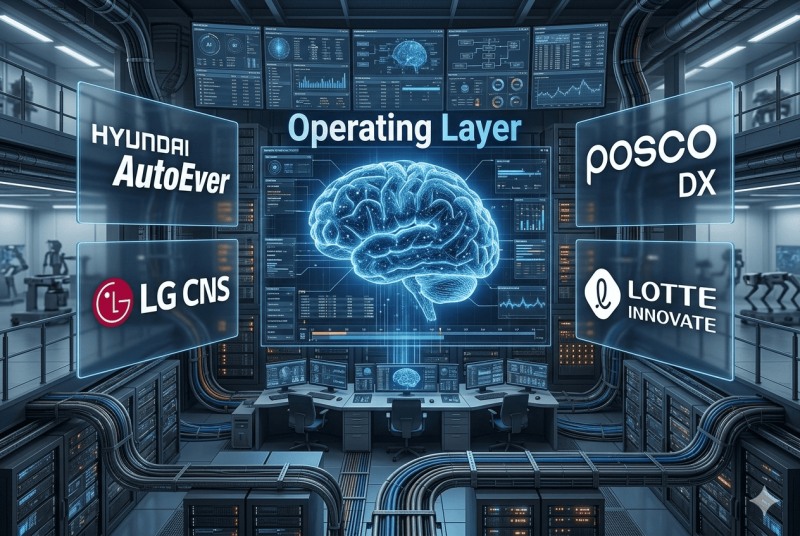
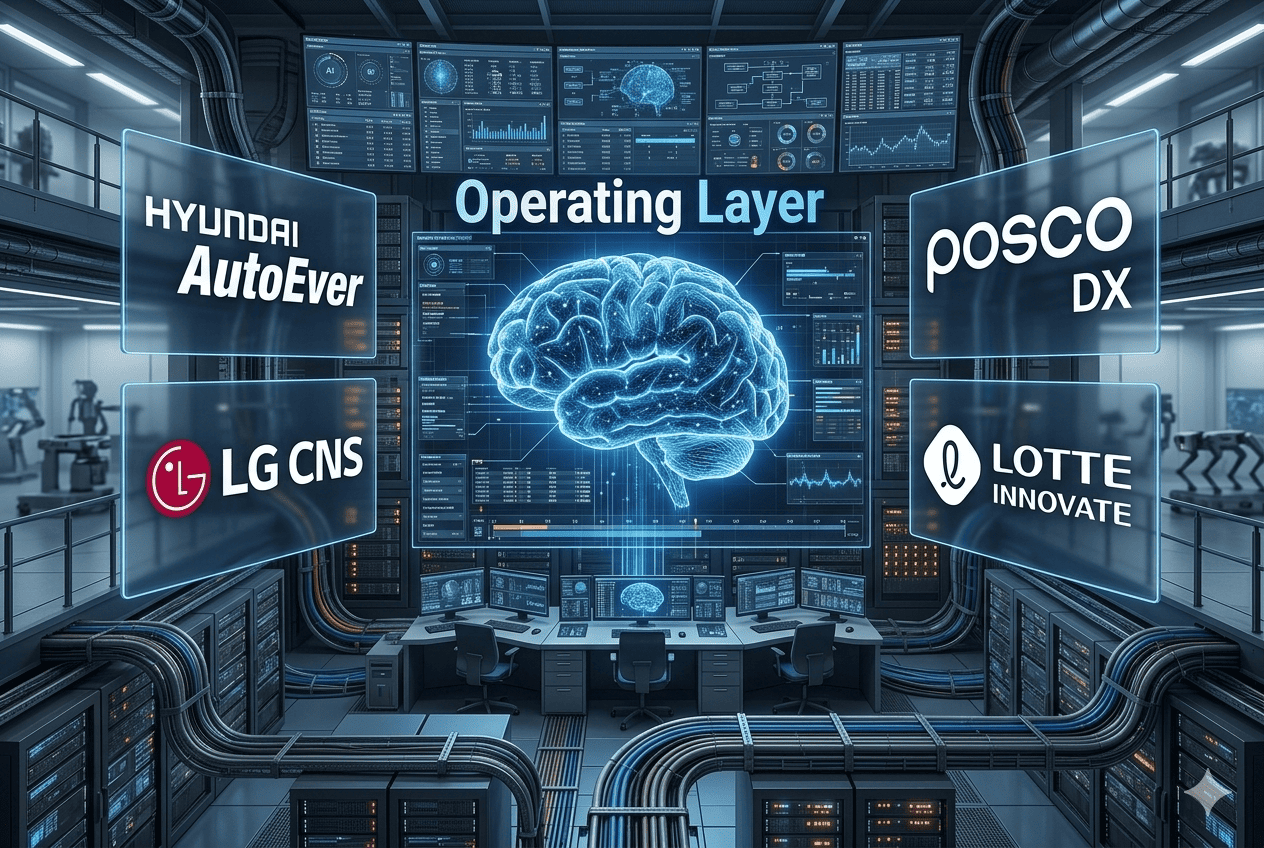
The humanoid industry cannot be completed by robot manufacturers alone. Deploying robots on actual production lines or in logistics centers requires defining the robots' scope of work, collecting and analyzing sensor and camera data, and establishing remote monitoring and fault response systems. Only when digital twins, process optimization, and AI training systems are integrated does commercial deployment become feasible.For this reason, the competitive center of gravity in the humanoid space is shifting away from hardware manufacturers toward SI firms with hands-on field deployment capabilities. In particular, Hyundai AutoEver, LG CNS, POSCO DX, and Lotte Innovate are concretizing their humanoid and physical AI businesses, leveraging their respective group affiliates' manufacturing, logistics, and service infrastructure.
None of these companies manufactures robots themselves. What they share in common is a focus on making robots work in real-world settings. The humanoid industry may appear hardware-centric at first glance, but the crux of commercialization lies in field operations. A humanoid robot without a control system tailored to the manufacturing process, a platform to accumulate operational data, and a fault-resilient monitoring framework is nothing more than a laboratory exhibit.
Within this structure, Hyundai AutoEver, LG CNS, POSCO DX, and Lotte Innovate are each regarded as holding the key to humanoid commercialization in their respective industries — automotive, IT platforms, steel, and retail/logistics. The market they are targeting is not simply robot supply, but the operational systems that enable robots to carry out repetitive tasks.
"Competitiveness in the humanoid era is shifting toward the 'robot brain' and the 'operating platform,'" said one industry insider. "Companies that integrate robot and AI infrastructure within their group affiliates, and those that offer humanoids under a service model, are emerging as the core players."
Hyundai AutoEver: The Backbone of Robot Infrastructure
Hyundai AutoEver, the SI affiliate of Hyundai Motor Group, is emerging as the key infrastructure provider underpinning humanoid robots and autonomous vehicles.As the group advances its smart factory and manufacturing innovation agenda, Hyundai AutoEver has been responsible for factory operating systems, data platforms, robot monitoring, and digital twins. It is regarded not merely as a builder of IT systems, but as the execution arm driving the group's physical AI transformation.
Robot Joints, 80%-a-Year Growth: Hyundai Mobis, Samsung Electro-Mechanics Lead Korea's Actuator Rush [K-Humanoid Wars ④]'From Heavy Industry to Humanoids' — Doosan Robotics Charts a New Future in Physical AI [K-Humanoid Wars, Part 3]Beyond Atlas: Hyundai Bets on Collaborative Robots to Pave Way for Humanoid Future'Samsung's Bet on the Future' — Rainbow Robotics, Korea's Humanoid Pioneer [K-Humanoid Wars, Part 2]Tesla's Humanoid Rival Has Arrived — Boston Dynamics Eyes $70 Billion Valuation [K-Humanoid Wars, Part 1]
Hyundai Motor Group has been rolling out its next-generation humanoid robot, Atlas, as a strategic brand, deploying it in stages at its Georgia plant in the United States, among other locations. The group is also working to establish a dedicated production and demonstration infrastructure through its North American Metaplant.
In this process, Hyundai AutoEver is expected to assume the central SI role covering robot training, monitoring, and data platforms.
At Hyundai Motor Group's Singapore Global Innovation Center (HMGICS), the group already operates an integrated monitoring system based on digital twins for approximately 250 heterogeneous robots — including AGVs, AMRs, collaborative robots, and Boston Dynamics' Spot. This demonstrates that the group has already built infrastructure combining robot monitoring with process digital twins. Analysts suggest this framework can be expanded into a physical AI platform when humanoids are introduced going forward.
Hyundai AutoEver plans to extend the software and data platform shared by the group's autonomous vehicles and robots, building on this infrastructure. Having already validated and operated solutions for integrated monitoring of diverse robot fleets, the company intends to expand the platform to encompass humanoids and autonomous vehicles.
LG CNS: Physical AI Validation Through a Dedicated Lab
LG CNS is accelerating its physical AI business by expanding the introduction of humanoid and autonomous mobile robots.The company operates a dedicated robotics organization called the "Future Robotics Lab," strengthening its R&D infrastructure and repeatedly conducting validation work on remote robot control, data collection, simulation, and operational verification.
This strategy goes beyond simply procuring external robots — it focuses on verifying performance and enabling learning in actual manufacturing and logistics environments.
LG CNS has set a goal of building a "full-stack Robot Transformation (RX) service" that integrates robot hardware, AI, and an operating platform. To this end, the company invested last year in June in Skild AI, a U.S.-based robot AI startup, to develop solutions based on a Robot Foundation Model (RFM).
On March 10 of this year, LG CNS made a strategic investment in Dexmate, a Silicon Valley humanoid company. LG CNS plans to combine Skild AI's RFM with Dexmate's wheeled humanoid hardware and its own operating and training platform to advance a physical AI robot solution tailored for manufacturing and logistics environments.
This trajectory reflects LG CNS's intent to position itself as a platform operator that encompasses not just robot manufacturing, but field deployment and operations as well.
The company plans to integrate RFM, operating, training, and monitoring capabilities across a diverse lineup of humanoid form factors — bipedal, quadrupedal, and wheeled — to realize large-scale robot operations.
POSCO DX: Automating High-Risk Processes
POSCO DX is accelerating the use of humanoid robots to automate high-risk processes in steelmaking and heavy industry. In December last year, the company invested USD 2 million in Persona AI, a U.S.-based humanoid firm, to outline a concrete direction for deploying robots suitable for steel and manufacturing environments.This investment leads into a joint development project aimed at replacing with humanoids the processes involving high temperatures and heavy loads that are difficult for humans to handle directly. POSCO DX is building a physical AI solution tailored to steelworks environments by combining its proprietary industrial AI and manufacturing data with Persona AI's robot technology.
POSCO DX draws attention because it directly operates the industrial sites with the highest dependence on humanoid deployment. Steel mills are high-risk industrial environments characterized by recurring high temperatures, high pressures, and heavy load handling, generating significant demand for automation as well as pressure to improve working conditions. Humanoids, with their human-like range of motion, can be deployed without major changes to existing equipment and layouts, making them well-suited for repetitive, physically demanding tasks such as unloading, coil transport, and logistics management.
In practice, POSCO Group launched a project in February of this year deploying Persona AI humanoid robots in steel coil unloading and logistics processes to verify safety and the feasibility of human-robot collaboration. Based on the results of this pilot, the company plans to extend deployment across the full range of logistics and manufacturing operations.
POSCO DX has also built and is operating a physical AI development framework based on virtual simulation. The company is enhancing its robot control algorithms using data from diverse field environments — including steelmaking and secondary battery production — and has established a structure for parallel AI training and validation by digitally replicating actual operating conditions, thereby reducing safety risks.
Lotte Innovate: Targeting the RaaS Model
Lotte Innovate is putting the Robot as a Service (RaaS) model front and center — supplying humanoids not as a product, but as a service.Rather than selling humanoid hardware outright, the company is pursuing a strategy of bundling robots, infrastructure, operations, and AI models into a service offering. This approach aligns well with the business structure of Lotte Group, which operates extensive retail, logistics, and service sites.
The RaaS model is viewed favorably as an approach that generates recurring revenue as humanoid adoption expands. From the customer's perspective, it lowers the burden of upfront investment; from the supplier's perspective, it enables long-term contracts and the accumulation of data — including operations, updates, and training — alongside ongoing model improvement. Logistics centers and retail stores, in particular, are considered ideal environments for combining humanoids with the RaaS model, given that tasks are repetitive and easily standardized.
Lotte Innovate is developing and validating a physical AI model integrated with robots through its proprietary AI platform, "aiMember." The company is building a general-purpose physical AI solution — applicable across retail, logistics, manufacturing, and service environments — by equipping Unitree's humanoid robot G1 with the aiMember AI engine.
Recently, Lotte Group has been running experiments in next-generation convenience store formats where humanoids and AI take on tasks previously handled by store owners, marking continued efforts to bring the RaaS model into real-world settings. This is consistent with the company's strategy of expanding aiMember across multiple devices and sites beyond specific robot hardware and supplying it in RaaS form.
Industry observers assess that as humanoid adoption gains full momentum, the role of SI firms is likely to grow even larger, as the industry is settling into a structure where long-term operations and data-driven improvement — rather than one-time system buildouts — are becoming central.
"Competitiveness in the humanoid era will be determined not by the robot itself, but by the integrated capability to actually make robots move," said one industry insider. "What platforms and operating models SI firms build will determine the direction of the humanoid industry."
Jeong Chaeyun (chaeyun@fntimes.com)











![이성훈 LH 사장 다주택·대출 규제 발언 도마…여야 의원 잇단 지적 [2026 국감]](https://cfnimage.commutil.kr/phpwas/restmb_setimgmake.php?pp=006&w=69&h=45&m=5&simg=20261012163012026870048b718333218159227151.jpg&nmt=18)

![12개월 최고 연 6.00%…BNK저축은행 'BNK동행적금'[이주의 저축은행 적금금리-10월 2주]](https://cfnimage.commutil.kr/phpwas/restmb_setimgmake.php?pp=006&w=69&h=45&m=5&simg=202610110103170668607c96e797801121481643.jpg&nmt=18)

![12개월 최고 연 4.10%…OK저축은행 'OK e-안심앱플러스정기예금6'[이주의 저축은행 예금금리-10월 2주]](https://cfnimage.commutil.kr/phpwas/restmb_setimgmake.php?pp=006&w=69&h=45&m=5&simg=202610110051040059207c96e797801121481643.jpg&nmt=18)


![[그래픽 뉴스] ‘순대’가 경제용어라고? 순(純)대외자산, 한국의 진짜 해외자산은 얼마일까?](https://cfnimage.commutil.kr/phpwas/restmb_setimgmake.php?pp=006&w=298&h=298&m=1&simg=202609021356075202de68fcbb3512411124362_0.jpg&nmt=18)
![[그래픽 뉴스] ISA 대개편! 나에게 유리한 계좌는?](https://cfnimage.commutil.kr/phpwas/restmb_setimgmake.php?pp=006&w=298&h=298&m=1&simg=202608041713155615de68fcbb3512411124362_0.jpg&nmt=18)
![[그래픽 뉴스] 미국 증시 새로운 키워드 'MANGOS'](https://cfnimage.commutil.kr/phpwas/restmb_setimgmake.php?pp=006&w=298&h=298&m=1&simg=202607291740382069de68fcbb3512411124362_0.jpg&nmt=18)

![[그래픽 뉴스] 은퇴후 30년 부모님 세대의 생존전략](https://cfnimage.commutil.kr/phpwas/restmb_setimgmake.php?pp=006&w=298&h=298&m=1&simg=202606301704439153de68fcbb3512411124362_0.jpg&nmt=18)
![[신간]은퇴연옥…김경록의 은퇴 후 삶의 나침반](https://cfnimage.commutil.kr/phpwas/restmb_setimgmake.php?pp=006&w=81&h=123&m=5&simg=20260414140833047280f8caa4a5ce12411124362.jpg&nmt=18)
![[신간] 물처럼 흐르고 원칙으로 서다…김용환의 통찰을 담다](https://cfnimage.commutil.kr/phpwas/restmb_setimgmake.php?pp=006&w=81&h=123&m=5&simg=20260409114249027860f8caa4a5ce12411124362.jpg&nmt=18)
![[안현정 서평] 플랫폼의 영지에서 ‘미학적 주권’을 선포하라...'K가 죽어야 K가 산다' 장준환 著](https://cfnimage.commutil.kr/phpwas/restmb_setimgmake.php?pp=006&w=81&h=123&m=5&simg=20260527121426063220c1c16452b012411124362.jpg&nmt=18)
![[서평] 추세 매매의 대가들...추세추종 투자전략의 대가 14인 인터뷰](https://cfnimage.commutil.kr/phpwas/restmb_setimgmake.php?pp=006&w=81&h=123&m=5&simg=2023102410444004986c1c16452b0175114235199.jpg&nmt=18)


![[머니무브 2026] “지금 사도 될까?” 답이 안 보인다면…하반기 투자, 4명의 전문가에게 물어보세요](https://cfnimage.commutil.kr/phpwas/restmb_setimgmake.php?pp=006&w=89&h=45&m=1&simg=202609151044050355302a735e27af12411124362.jpg&nmt=18)
![[AD] ‘PBV 라인업 확장’ 기아, 9월 독일서 ‘PV7’ 첫 공개](https://cfnimage.commutil.kr/phpwas/restmb_setimgmake.php?pp=006&w=89&h=45&m=1&simg=2026083111010602815074925877361231180222.jpg&nmt=18)
![[AD] 제네시스, 럭셔리 경험 더한 ‘2027 GV70’‧‘GV70 그래파이트’ 출시](https://cfnimage.commutil.kr/phpwas/restmb_setimgmake.php?pp=006&w=89&h=45&m=1&simg=20260702143546085600749258773622211122717.jpg&nmt=18)