






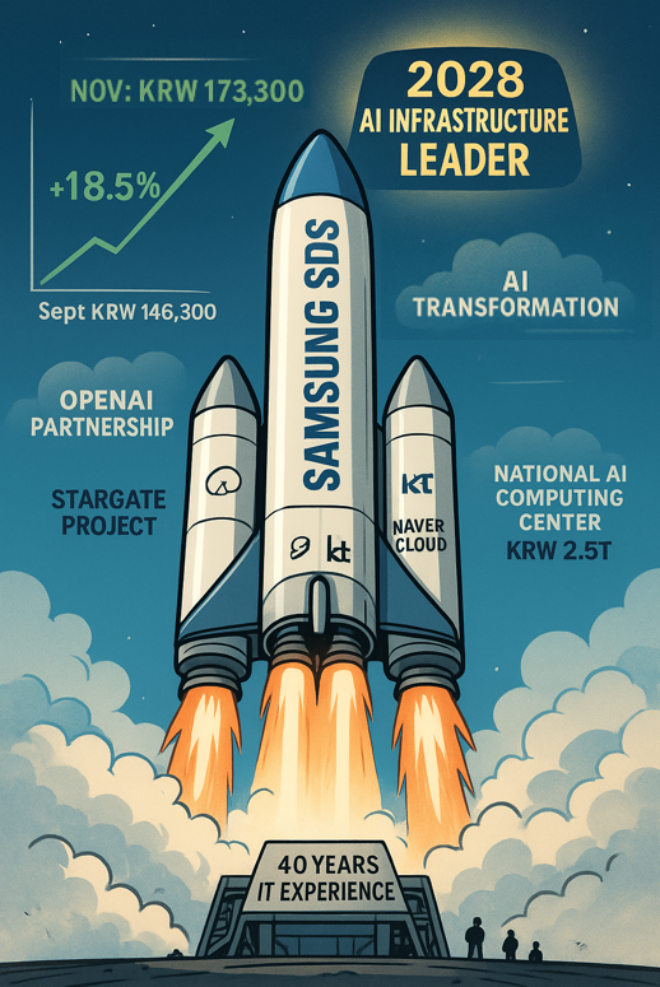

According to Korea Exchange on the 12th, Samsung SDS closed at KRW 173,300 the previous day. Compared simply with the stock price of KRW 146,300 in early September, this represents an increase of approximately 18.5%.
Industry analysts attribute this to heightened expectations as Samsung SDS has successively participated in AI-related projects both domestically and internationally.
On the 1st of last month, Samsung SDS signed a comprehensive partnership Letter of Intent (LOI) with OpenAI. An LOI is a document where companies formalize mutual cooperation intentions before formal contracts. Samsung Electronics, Samsung C&T, and Samsung Heavy Industries also participated in this LOI.

Bird's-eye view of the OpenAI-Samsung data center. / Photo=Pohang City
Through this, Samsung SDS will cooperate with OpenAI in two main areas: ▲Stargate project ▲provision of enterprise ChatGPT services.
The Stargate project is a massive AI data center (DC) construction project led by OpenAI, Oracle, and Japan's SoftBank. Samsung SDS will collaborate in the design, construction, and operation of OpenAI's AIDC in Pohang, North Gyeongsang Province.
Additionally, Samsung SDS is expected to service enterprise ChatGPT to corporate customers based on its experience building and operating business systems for manufacturing, finance, and public institutions. The company plans to optimize and supply the advanced enterprise ChatGPT developed through the Stargate project to various industrial environments in Korean society.

Bird's-eye view of the Solaseado AI Data Center / Photo=Haenam-gun
The National AI Computing Center project is a large-scale public infrastructure project where the government and private sector jointly establish a special purpose company (SPC) to secure large-scale graphics processing unit (GPU) infrastructure and provide computing resources to industry, academia, and startups. The location has been confirmed as Solaseado in Haenam-gun, South Jeolla Province.
Through this project, the government plans to secure 15,000 GPUs by 2028 and expand to more than 50,000 by 2030. The center aims to support research institutions and startups in conducting large-scale AI training and service development at low cost.
As the sole bidder selected, Samsung SDS will take a leading role in the total KRW 2.5 trillion project. As consortium representative, it will oversee infrastructure construction and operation, and overall project management, expected to gain experience in executing large-scale public cloud and AI projects. It is also evaluated as having enhanced government policy execution capability and strategic business positioning.
Samsung SDS is already solidifying its position in the AI ecosystem by building AIDCs. The AIDC that Samsung SDS is constructing in Gumi, North Gyeongsang Province, is a large-scale standalone AIDC that the company will operate independently. Revenue is expected to be generated by leasing the AIDC to Samsung affiliates or external customers or supporting services. The AIDC is expected to begin operations between late 2027 and early 2028.
Lee Ho-joon, Samsung SDS Cloud Service Business Division Head (Vice President), emphasized at the Q3 earnings conference call, "We plan to jointly plan and operate advanced AIDCs of the future with OpenAI and are currently in discussions," adding, "In terms of AI services, we will pursue consulting and operation businesses to introduce OpenAI models into enterprise business systems, diversifying our AI business portfolio and contributing to cloud sales growth."
He continued, "We expect to lead domestic AI transformation business by combining our (Samsung SDS's) 40 years of domestic IT experience with OpenAI's global technology."
Meanwhile, Samsung SDS recorded consolidated sales of KRW 3.3913 trillion and operating profit of KRW 232.3 billion in Q3 this year. These decreased 5% and 8.1% respectively year-over-year. Net profit during the same period increased 8.2% to KRW 201.1 billion.
Jeong Chaeyun (chaeyun@fntimes.com)











![[THE COMPASS] 한미사이언스 경영권 분쟁, 신동국이 주도하는 ‘종식’ 게임](https://cfnimage.commutil.kr/phpwas/restmb_setimgmake.php?pp=006&w=69&h=45&m=5&simg=20261008122108000710a837df649412411124362.jpg&nmt=18)
![영업익 53% 뛴다는데…대웅제약 몸값 누르는 두 가지 변수 [5대 제약사 3Q 실적 ④]](https://cfnimage.commutil.kr/phpwas/restmb_setimgmake.php?pp=006&w=69&h=45&m=5&simg=202610081106100618007fd637f543112168227135.jpg&nmt=18)


![[그래픽 뉴스] ‘순대’가 경제용어라고? 순(純)대외자산, 한국의 진짜 해외자산은 얼마일까?](https://cfnimage.commutil.kr/phpwas/restmb_setimgmake.php?pp=006&w=298&h=298&m=1&simg=202609021356075202de68fcbb3512411124362_0.jpg&nmt=18)
![[그래픽 뉴스] ISA 대개편! 나에게 유리한 계좌는?](https://cfnimage.commutil.kr/phpwas/restmb_setimgmake.php?pp=006&w=298&h=298&m=1&simg=202608041713155615de68fcbb3512411124362_0.jpg&nmt=18)
![[그래픽 뉴스] 미국 증시 새로운 키워드 'MANGOS'](https://cfnimage.commutil.kr/phpwas/restmb_setimgmake.php?pp=006&w=298&h=298&m=1&simg=202607291740382069de68fcbb3512411124362_0.jpg&nmt=18)

![[그래픽 뉴스] 은퇴후 30년 부모님 세대의 생존전략](https://cfnimage.commutil.kr/phpwas/restmb_setimgmake.php?pp=006&w=298&h=298&m=1&simg=202606301704439153de68fcbb3512411124362_0.jpg&nmt=18)
![[신간]은퇴연옥…김경록의 은퇴 후 삶의 나침반](https://cfnimage.commutil.kr/phpwas/restmb_setimgmake.php?pp=006&w=81&h=123&m=5&simg=20260414140833047280f8caa4a5ce12411124362.jpg&nmt=18)
![[신간] 물처럼 흐르고 원칙으로 서다…김용환의 통찰을 담다](https://cfnimage.commutil.kr/phpwas/restmb_setimgmake.php?pp=006&w=81&h=123&m=5&simg=20260409114249027860f8caa4a5ce12411124362.jpg&nmt=18)
![[안현정 서평] 플랫폼의 영지에서 ‘미학적 주권’을 선포하라...'K가 죽어야 K가 산다' 장준환 著](https://cfnimage.commutil.kr/phpwas/restmb_setimgmake.php?pp=006&w=81&h=123&m=5&simg=20260527121426063220c1c16452b012411124362.jpg&nmt=18)
![[서평] 추세 매매의 대가들...추세추종 투자전략의 대가 14인 인터뷰](https://cfnimage.commutil.kr/phpwas/restmb_setimgmake.php?pp=006&w=81&h=123&m=5&simg=2023102410444004986c1c16452b0175114235199.jpg&nmt=18)


![[머니무브 2026] “지금 사도 될까?” 답이 안 보인다면…하반기 투자, 4명의 전문가에게 물어보세요](https://cfnimage.commutil.kr/phpwas/restmb_setimgmake.php?pp=006&w=89&h=45&m=1&simg=202609151044050355302a735e27af12411124362.jpg&nmt=18)
![[AD] ‘PBV 라인업 확장’ 기아, 9월 독일서 ‘PV7’ 첫 공개](https://cfnimage.commutil.kr/phpwas/restmb_setimgmake.php?pp=006&w=89&h=45&m=1&simg=2026083111010602815074925877361231180222.jpg&nmt=18)
![[AD] 제네시스, 럭셔리 경험 더한 ‘2027 GV70’‧‘GV70 그래파이트’ 출시](https://cfnimage.commutil.kr/phpwas/restmb_setimgmake.php?pp=006&w=89&h=45&m=1&simg=20260702143546085600749258773622211122717.jpg&nmt=18)