






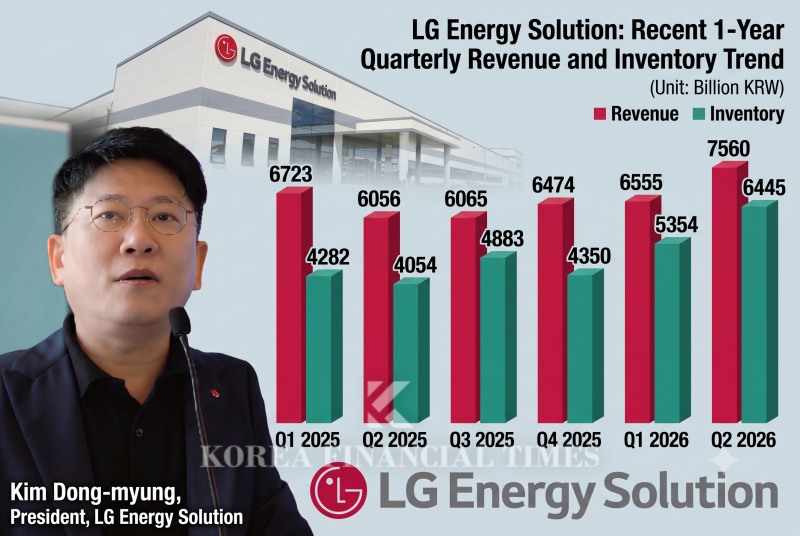
This infographic, originally published by Korea Financial Times, has been reconstructed using generative AI.
이미지 확대보기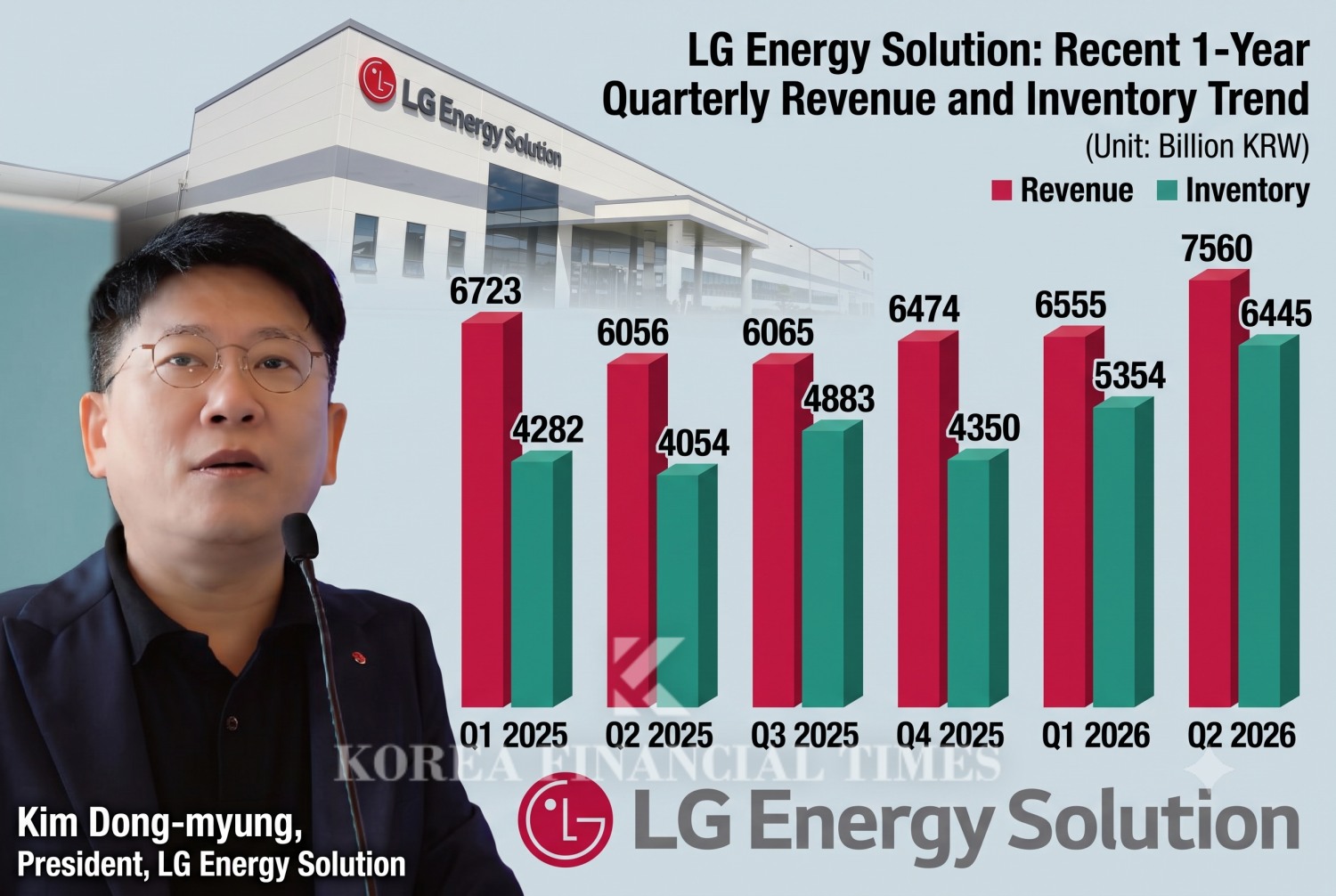
Through preemptive investment in North America, the company appeared to have built an overwhelming "economy of scale" advantage over its rivals and to be reaping the benefits of U.S. subsidies. But as the EV chasm — typically defined as a temporary slowdown in demand — continues to drag on longer than expected, the inventory piling up in warehouses is instead becoming a boomerang that is eating into profitability.
Industry observers say that once the subsidy illusion is stripped away, LG Energy Solution's core business shows an operating loss in the hundreds of billions of won, alongside a burden of inventory assets and valuation losses that has surpassed KRW 6 trillion. As a result, Kim's crisis-management skills and his ability to secure new orders are now facing a full-scale test.
Poverty Amid Plenty
LG Energy Solution posted consolidated revenue of KRW 7.5602 trillion and operating profit of KRW 113.3 billion in the second quarter of this year, swinging back into the black after an operating loss of KRW 207.8 billion the previous quarter. A closer look at the earnings breakdown, however, shows that the underlying core business remains sluggish.The main driver behind the return to profitability was the Advanced Manufacturing Production Credit (AMPC) subsidy under the U.S. Inflation Reduction Act (IRA). The AMPC amount recognized in the second quarter totaled KRW 241 billion. Excluding this subsidy effect, LG Energy Solution actually posted an operating loss of KRW 127.7 billion in the second quarter — an improvement from the KRW 397.5 billion loss in the first quarter, but a loss nonetheless.
This earnings structure stands in contrast to rival Samsung SDI. Samsung SDI likewise could not avoid the effects of the downstream industry slowdown, but it posted an operating profit of KRW 96.1 billion purely on core business competitiveness, without relying on U.S. subsidies (which totaled KRW 107.7 billion for Samsung SDI).
The size of U.S. AMPC subsidies grows in proportion to the scale of local production and sales. LG Energy Solution pursued a strategy of preemptively securing large-scale capacity early on, in order to widen the base for subsidy benefits.
LG Energy Solution posted operating profit of KRW 575.4 billion in 2024, a year in which its U.S. subsidy benefit reached KRW 1.48 trillion — the largest among Korea's three major battery makers.
As Ambitions Grow, LG Chem's Financial Health Quietly Erodes'U.S. Subsidy Effect Fades'… LG Energy Solution Scrapes Together Every PennySamsung SDI's Returns Run Six Times That of LG Energy Solution… But Why?LG Energy Solution vs. Samsung SDI: The Robot Battery Market Battle"Turned to a Millstone by the Chasm": SK's EV Trio — When Will Normalization Come?
Excluding the subsidy, however, the company posted a loss of roughly KRW 900 billion that year. Last year as well, LG Energy Solution rode subsidies (KRW 1.65 trillion) to a continued operating profit (KRW 1.35 trillion).
Strip away the subsidies, and the erosion of LG Energy Solution's business competitiveness becomes evident. As automakers (OEMs) delay EV shipments and rein in orders, factory utilization rates have fallen, driving up fixed costs and unsold-inventory management expenses — a vicious cycle that offsets the subsidy gains. Despite expanded facilities and production capacity, products simply are not selling, resulting in losses that outweigh the subsidy benefits.
Soaring Inventory
Analysts point out that the inventory piling up in warehouses is qualitatively undermining LG Energy Solution's financial soundness.LG Energy Solution's inventory assets surged from KRW 4.2821 trillion in the first quarter of last year to KRW 5.354 trillion in the first quarter of this year, then climbed further to KRW 6.445 trillion in the second quarter of this year. In just over a year, inventory assets have jumped by KRW 2.1629 trillion, or 50.5%.
This means that even as factories continue mass-producing batteries, finished products are not being delivered to customers on schedule, causing inventory to keep accumulating in warehouses. The buildup of inventory assets triggers a chain reaction, amplifying both the "inventory valuation reserve" and "inventory valuation losses" that directly weigh on accounting profitability.
The inventory valuation reserve is a provision set aside when a company expects the market value of its inventory to fall below its acquisition cost. Generally, the larger the reserve, the greater the burden on future profitability.
LG Energy Solution purchased key minerals such as lithium and nickel at high prices before the chasm began. But as mineral prices have continued to fall, the market value (net realizable value) of finished and semi-finished battery products made from those higher-cost raw materials has dropped below their book value.
According to LG Energy Solution's disclosures, the inventory valuation reserve grew from KRW 262.8 billion in the first quarter of last year to KRW 296.9 billion in the first quarter of this year. With inventory surging further in the second quarter of this year, the company faces pressure to set aside additional reserves.
The valuation loss stemming from the actual decline in inventory value has likewise grown substantially over the same period, from roughly KRW 30 billion to roughly KRW 40 billion. With the inventory itself now exceeding KRW 6.4 trillion, any valuation loss triggered by falling sale prices flows directly into higher cost of goods sold — acting as a "time bomb" that directly erodes operating profit.
The inventory buildup is driving down not only sale prices but also factory utilization rates. In the battery business, which requires massive capital investment, falling utilization rates increase the burden of fixed costs such as per-unit depreciation.
Indeed, as utilization rates have been adjusted at some lines of major North American joint-venture (JV) plants, LG Energy Solution's pace of profitability recovery is said to be slower than expected.
In its second-quarter earnings call, LG Energy Solution explained that a major North American strategic customer had adjusted the pace of its EV business and prioritized drawing down existing inventory, leading to the suspension of one joint-venture plant in the first half of this year. The company added that it is currently preparing to resume production and plans to restart operations from mid-third quarter as scheduled.
Kim Dong-myung Focuses on an "Inventory Diet"
CEO Kim Dong-myung has made an all-or-nothing commitment to diversifying the company's business structure in order to draw down inventory and restore factory utilization rates. He is accelerating an "inventory diet" — converting some EV battery lines at North American production sites into lines for ESS-use LFP (lithium iron phosphate) batteries, and adjusting the pace of investment in joint ventures underway with global automakers.LG Energy Solution announced it secured a total of about KRW 3 trillion in orders in the first half of this year. But observers say this remains insufficient to absorb inventory that has swollen to over KRW 6 trillion, along with the company's massive production facilities.
At the second-quarter earnings call, CEO Kim pledged to reverse the mood, saying the company would make an all-out effort to expand new orders in the second half and secure new customers for next-generation cylindrical batteries.
Still, the securities industry and the market remain cautious. While LG Energy Solution said during the earnings call that it is pursuing cylindrical battery supply deals and new projects with a number of global automakers, it did not present specific contract targets or confirmed order volumes that could quickly dispel market skepticism.
One securities industry official assessed that a surface-level return to profitability that relies on U.S. government subsidies has a short shelf life unless there is a genuine recovery in downstream demand. The official added that to keep the massive production capacity built through preemptive investment from becoming a boomerang that widens losses, CEO Kim Dong-myung must deliver tangible operational results in the second half — securing substantial new large-scale orders and visibly reducing inventory that now exceeds KRW 6 trillion.
Kim JaeHun (rlqm93@fntimes.com)











![기관 '리노공업'·외인 '주성엔지니어링'·개인 'HLB' 1위 [주간 코스닥 순매수- 2026년 9월28일~10월2일]](https://cfnimage.commutil.kr/phpwas/restmb_setimgmake.php?pp=006&w=69&h=45&m=5&simg=20261003161606004230179ad43907118235716.jpg&nmt=18)
![기관 '삼성전기'·외인 '우리금융지주'·개인 '삼성전자' 1위 [주간 코스피 순매수- 2026년 9월28일~10월2일]](https://cfnimage.commutil.kr/phpwas/restmb_setimgmake.php?pp=006&w=69&h=45&m=5&simg=20261003160403064450179ad43907118235716.jpg&nmt=18)
![[김의석의 단상] KB 이재근이 당긴 ‘70년대생 은행장’ 시계](https://cfnimage.commutil.kr/phpwas/restmb_setimgmake.php?pp=006&w=69&h=45&m=5&simg=20261002171352092510fa40c3505512411124362.jpg&nmt=18)
![12개월 최고 연 4.05%…SC제일은행 'e-그린세이브예금' [이주의 은행 예금금리-10월 1주]](https://cfnimage.commutil.kr/phpwas/restmb_setimgmake.php?pp=006&w=69&h=45&m=5&simg=202610021737330454301b5a221379211234202153.jpg&nmt=18)


![[그래픽 뉴스] ‘순대’가 경제용어라고? 순(純)대외자산, 한국의 진짜 해외자산은 얼마일까?](https://cfnimage.commutil.kr/phpwas/restmb_setimgmake.php?pp=006&w=298&h=298&m=1&simg=202609021356075202de68fcbb3512411124362_0.jpg&nmt=18)
![[그래픽 뉴스] ISA 대개편! 나에게 유리한 계좌는?](https://cfnimage.commutil.kr/phpwas/restmb_setimgmake.php?pp=006&w=298&h=298&m=1&simg=202608041713155615de68fcbb3512411124362_0.jpg&nmt=18)
![[그래픽 뉴스] 미국 증시 새로운 키워드 'MANGOS'](https://cfnimage.commutil.kr/phpwas/restmb_setimgmake.php?pp=006&w=298&h=298&m=1&simg=202607291740382069de68fcbb3512411124362_0.jpg&nmt=18)
![[그래픽 뉴스] 은퇴후 30년 부모님 세대의 생존전략](https://cfnimage.commutil.kr/phpwas/restmb_setimgmake.php?pp=006&w=298&h=298&m=1&simg=202606301704439153de68fcbb3512411124362_0.jpg&nmt=18)
![[신간]은퇴연옥…김경록의 은퇴 후 삶의 나침반](https://cfnimage.commutil.kr/phpwas/restmb_setimgmake.php?pp=006&w=81&h=123&m=5&simg=20260414140833047280f8caa4a5ce12411124362.jpg&nmt=18)
![[신간] 물처럼 흐르고 원칙으로 서다…김용환의 통찰을 담다](https://cfnimage.commutil.kr/phpwas/restmb_setimgmake.php?pp=006&w=81&h=123&m=5&simg=20260409114249027860f8caa4a5ce12411124362.jpg&nmt=18)
![[안현정 서평] 플랫폼의 영지에서 ‘미학적 주권’을 선포하라...'K가 죽어야 K가 산다' 장준환 著](https://cfnimage.commutil.kr/phpwas/restmb_setimgmake.php?pp=006&w=81&h=123&m=5&simg=20260527121426063220c1c16452b012411124362.jpg&nmt=18)
![[서평] 추세 매매의 대가들...추세추종 투자전략의 대가 14인 인터뷰](https://cfnimage.commutil.kr/phpwas/restmb_setimgmake.php?pp=006&w=81&h=123&m=5&simg=2023102410444004986c1c16452b0175114235199.jpg&nmt=18)


![[머니무브 2026] “지금 사도 될까?” 답이 안 보인다면…하반기 투자, 4명의 전문가에게 물어보세요](https://cfnimage.commutil.kr/phpwas/restmb_setimgmake.php?pp=006&w=89&h=45&m=1&simg=202609151044050355302a735e27af12411124362.jpg&nmt=18)
![[AD] ‘PBV 라인업 확장’ 기아, 9월 독일서 ‘PV7’ 첫 공개](https://cfnimage.commutil.kr/phpwas/restmb_setimgmake.php?pp=006&w=89&h=45&m=1&simg=2026083111010602815074925877361231180222.jpg&nmt=18)
![[AD] 제네시스, 럭셔리 경험 더한 ‘2027 GV70’‧‘GV70 그래파이트’ 출시](https://cfnimage.commutil.kr/phpwas/restmb_setimgmake.php?pp=006&w=89&h=45&m=1&simg=20260702143546085600749258773622211122717.jpg&nmt=18)