






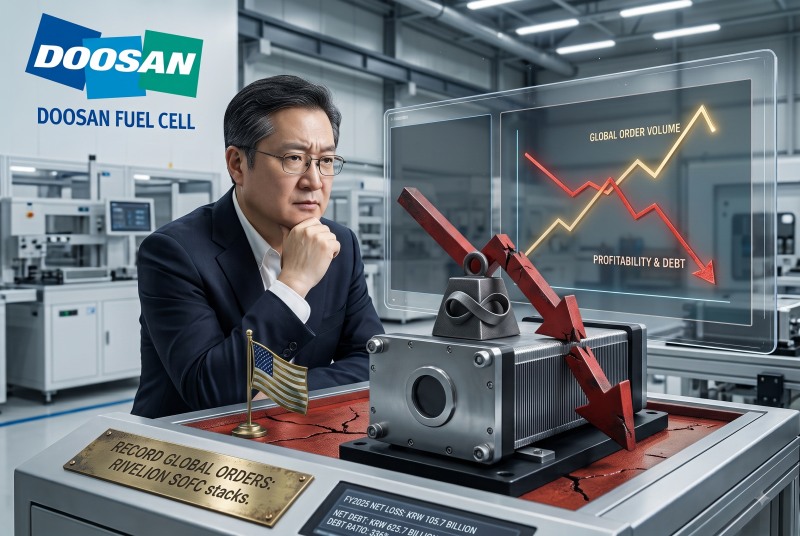
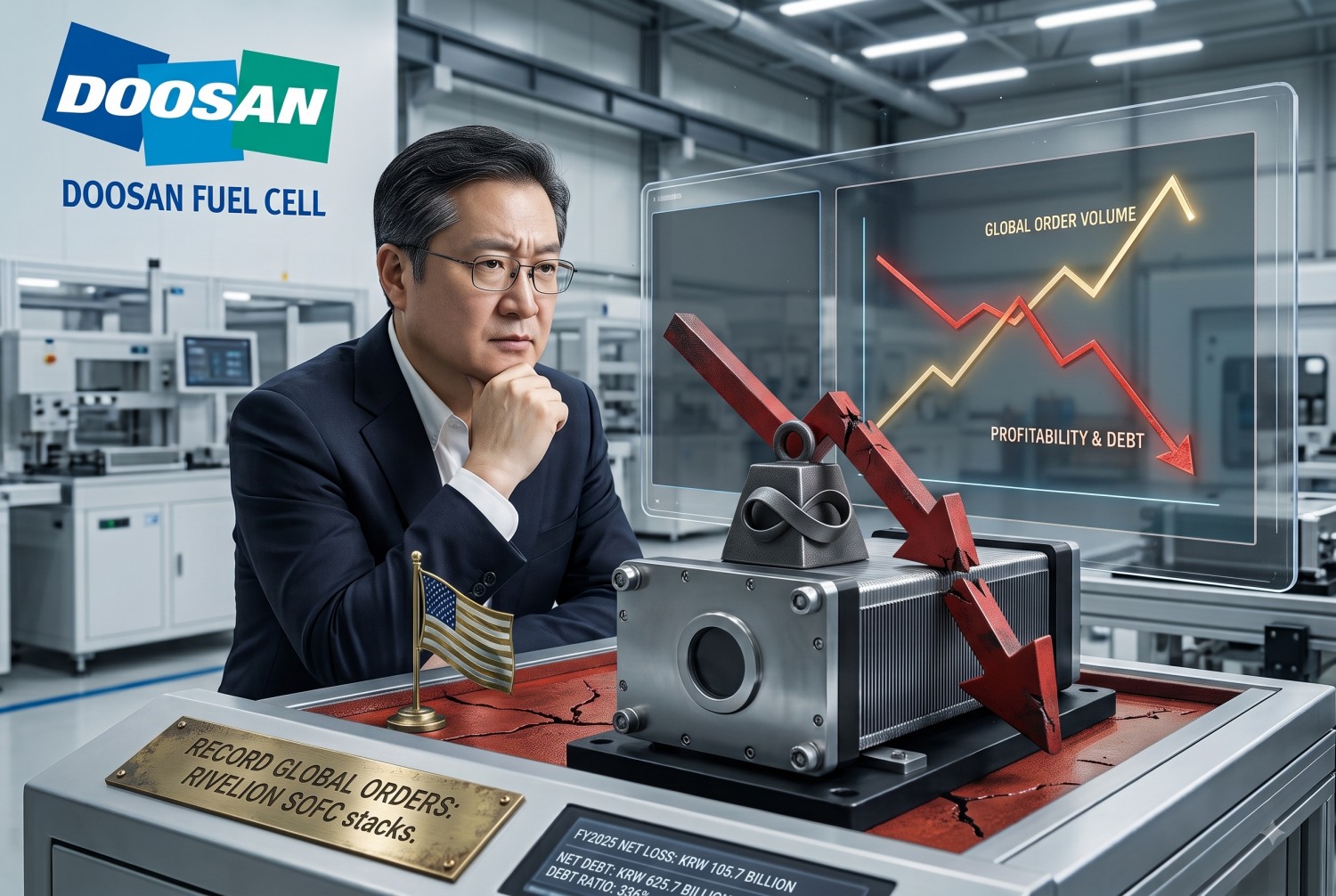
Doosan Fuel Cell recently signed a contract worth KRW 108.7 billion to supply SOFC stacks to German energy company Rivelion. The deal amounts to 23.9% of the company's consolidated revenue last year, making it the largest overseas order in the company's history.
This marks the first tangible achievement of the company's global stack foundry business, and carries significant meaning beyond the deal itself: Doosan Fuel Cell is expanding beyond its existing business model — selling complete fuel cell systems of its own — into supplying stacks, the core component, to external customers.
Largest Order in Company History
Behind the contract lies five years of building production capacity. In 2020, Doosan Fuel Cell decided to invest KRW 72.4 billion in establishing an SOFC cell and stack manufacturing line; following its move into the Saemangeum Industrial Complex and subsequent facility expansions, total investment grew to KRW 155.8 billion.The Iksan and Gunsan plants, originally targeted for completion by the end of 2023, were completed in the first half of 2025 after trial operations, and full-scale 50MW SOFC mass production began in the second half of that year.
The products to be supplied to Rivelion are mid-to-low-temperature SOFC stacks commercialized through technical cooperation with Britain's Ceres Power.
Unlike conventional SOFCs, which operate at temperatures above 800°C, these stacks run at roughly 620°C, achieving power efficiency, durability, and operational stability simultaneously.
Rivelion plans to install the stacks in its reversible power generation equipment and supply them to eco-friendly power facilities across Germany and Europe. Performance verification is reported to have been completed ahead of the final contract signing.
Doosan Fuel Cell Posts KRW 100 Billion Operating Loss, Yet Delivers 11x Returns to InvestorsSmall Reactors, Big Bets: Doosan Enerbility's SMR Revenue to Soar Nearly 10-FoldLotte Chemical Returns to Profit, But Analysts Warn of Fifth Straight Annual LossPOSCO Group Expands Rare Gas Business From Semiconductors to Aerospace and DefenseRiding the U.S. Transformer Boom, ILJIN Electric Keeps Production in Korea, Not America
Doosan Fuel Cell, which had previously centered its business on phosphoric acid fuel cells (PAFC), chose SOFC as a new business line to diversify its operations. While PAFC produces both electricity and heat simultaneously, SOFC offers relatively higher power efficiency.
"Our existing PAFC technology has high combined efficiency, making it suitable for customers who need both electricity and heat, while SOFC offers higher power efficiency and targets customers who need electricity only," a Doosan Fuel Cell official said, adding, "This is part of our effort to diversify the business according to customer needs."
Notably, Doosan Fuel Cell supplies not only complete systems but also stacks separately. Supplying only the stack — rather than an entire system — allows the company to broaden its customer base among power generators, data centers, and other buyers.
Improving Utilization vs. Record Losses
Even so, the company could not avoid posting its largest-ever operating loss in the process. Doosan Fuel Cell logged an operating profit of KRW 1.6 billion in 2023, but swung to an operating loss of KRW 1.7 billion in 2024, with the loss ballooning to KRW 105.7 billion in 2025. The losses have continued into 2026, with an operating loss of KRW 50.9 billion recorded in the second quarter alone.Over the same period, production utilization rates actually improved — rising steadily from 39% in 2023 to 77% in 2024 and 79% in 2025. This means the conventional explanation for widening losses — fixed-cost burden from low utilization — does not apply in Doosan Fuel Cell's case.
Two factors explain the widening losses. First, the company incurred costs from proactively replacing early-generation products of somewhat lower quality supplied in the initial phase of the business. Second, the SOFC business remains in its very early stages, meaning utilization and scale have not yet reached sufficient levels.
Rising raw material costs, including platinum, combined with the expense of replacing cell stacks in existing PAFC products, further widened the losses. Meanwhile, capital expenditure (CAPEX) has steadily declined — from KRW 95.7 billion in 2023 to KRW 28.9 billion in 2025 — with planned spending of just KRW 1.5 billion in 2026 and KRW 3.6 billion in 2027, suggesting the company's large-scale investment phase is effectively winding down.
Credit Rating Downgrade
The deteriorating profitability has also weighed on the company's financial health. On a standalone basis, Doosan Fuel Cell's net debt rose by KRW 98.6 billion in the second quarter of 2026 alone, reaching KRW 625.7 billion, while its debt ratio climbed to 336%. With large operating losses persisting and cash generation from operations unable to keep pace, the resulting working-capital strain has driven up borrowing.This trend has been reflected in credit rating agency assessments. NICE Investors Service and Korea Investors Service recently downgraded the outlook on Doosan Fuel Cell's unsecured bonds from "stable" to "negative," citing weakened operating profitability due to intense competition, low-margin orders, and initial SOFC entry costs, alongside a rising debt burden from capital investment to diversify the business.
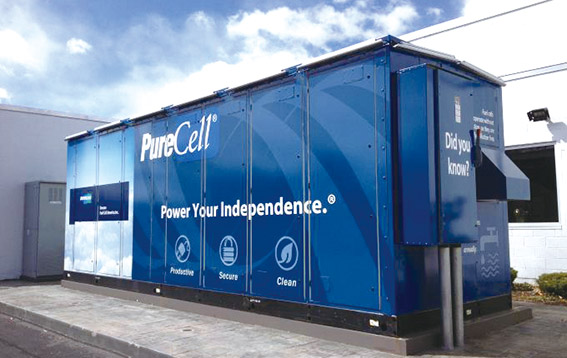
▲ Doosan Fuel Cell's fuel cell. Photo: Doosan Fuel Cell
Adding to the pressure, the company's entire Iksan and Gunsan production facilities have been pledged as collateral worth KRW 114 billion to the Korea Development Bank.
Should the company need additional capacity expansion or borrowing to grow its foundry business going forward, questions may arise over whether it has sufficient collateral capacity remaining.
What's Next
Doosan Fuel Cell stands at a crossroads — whether it becomes a new growth engine for the Doosan Group or slips into the role of a loss-making affiliate. Deliveries to Rivelion will be phased in gradually through the second half of 2027, meaning this contract alone is unlikely to deliver an immediate earnings turnaround.The key to a rebound scenario lies in following the Rivelion deal with additional large-scale orders.
Doosan Fuel Cell is in discussions with prospective customers at home and abroad regarding further SOFC stack sales, with plans to expand stack exports over the medium to long term.
The pace of profitability recovery in its core PAFC business is also a critical factor. Korea's planned volume for the general hydrogen fuel cell bidding market stands at just 125MW, down from the recent three-year average of 175MW, signaling a challenging demand environment.
"The SOFC business was prepared to diversify our customer base, and the standalone stack supply business is likewise a strategy to broaden our customer pool," a Doosan Fuel Cell official said. "The widening operating loss last year reflects quality-improvement work on early supply models and the low utilization rate typical of the SOFC business's early stage."
Jung Jina (urzinnie@fntimes.com)











![기관 '리노공업'·외인 '주성엔지니어링'·개인 'HLB' 1위 [주간 코스닥 순매수- 2026년 9월28일~10월2일]](https://cfnimage.commutil.kr/phpwas/restmb_setimgmake.php?pp=006&w=69&h=45&m=5&simg=20261003161606004230179ad43907118235716.jpg&nmt=18)
![기관 '삼성전기'·외인 '우리금융지주'·개인 '삼성전자' 1위 [주간 코스피 순매수- 2026년 9월28일~10월2일]](https://cfnimage.commutil.kr/phpwas/restmb_setimgmake.php?pp=006&w=69&h=45&m=5&simg=20261003160403064450179ad43907118235716.jpg&nmt=18)
![[김의석의 단상] KB 이재근이 당긴 ‘70년대생 은행장’ 시계](https://cfnimage.commutil.kr/phpwas/restmb_setimgmake.php?pp=006&w=69&h=45&m=5&simg=20261002171352092510fa40c3505512411124362.jpg&nmt=18)
![12개월 최고 연 4.05%…SC제일은행 'e-그린세이브예금' [이주의 은행 예금금리-10월 1주]](https://cfnimage.commutil.kr/phpwas/restmb_setimgmake.php?pp=006&w=69&h=45&m=5&simg=202610021737330454301b5a221379211234202153.jpg&nmt=18)


![[그래픽 뉴스] ‘순대’가 경제용어라고? 순(純)대외자산, 한국의 진짜 해외자산은 얼마일까?](https://cfnimage.commutil.kr/phpwas/restmb_setimgmake.php?pp=006&w=298&h=298&m=1&simg=202609021356075202de68fcbb3512411124362_0.jpg&nmt=18)
![[그래픽 뉴스] ISA 대개편! 나에게 유리한 계좌는?](https://cfnimage.commutil.kr/phpwas/restmb_setimgmake.php?pp=006&w=298&h=298&m=1&simg=202608041713155615de68fcbb3512411124362_0.jpg&nmt=18)
![[그래픽 뉴스] 미국 증시 새로운 키워드 'MANGOS'](https://cfnimage.commutil.kr/phpwas/restmb_setimgmake.php?pp=006&w=298&h=298&m=1&simg=202607291740382069de68fcbb3512411124362_0.jpg&nmt=18)

![[그래픽 뉴스] 은퇴후 30년 부모님 세대의 생존전략](https://cfnimage.commutil.kr/phpwas/restmb_setimgmake.php?pp=006&w=298&h=298&m=1&simg=202606301704439153de68fcbb3512411124362_0.jpg&nmt=18)
![[신간]은퇴연옥…김경록의 은퇴 후 삶의 나침반](https://cfnimage.commutil.kr/phpwas/restmb_setimgmake.php?pp=006&w=81&h=123&m=5&simg=20260414140833047280f8caa4a5ce12411124362.jpg&nmt=18)
![[신간] 물처럼 흐르고 원칙으로 서다…김용환의 통찰을 담다](https://cfnimage.commutil.kr/phpwas/restmb_setimgmake.php?pp=006&w=81&h=123&m=5&simg=20260409114249027860f8caa4a5ce12411124362.jpg&nmt=18)
![[안현정 서평] 플랫폼의 영지에서 ‘미학적 주권’을 선포하라...'K가 죽어야 K가 산다' 장준환 著](https://cfnimage.commutil.kr/phpwas/restmb_setimgmake.php?pp=006&w=81&h=123&m=5&simg=20260527121426063220c1c16452b012411124362.jpg&nmt=18)
![[서평] 추세 매매의 대가들...추세추종 투자전략의 대가 14인 인터뷰](https://cfnimage.commutil.kr/phpwas/restmb_setimgmake.php?pp=006&w=81&h=123&m=5&simg=2023102410444004986c1c16452b0175114235199.jpg&nmt=18)


![[머니무브 2026] “지금 사도 될까?” 답이 안 보인다면…하반기 투자, 4명의 전문가에게 물어보세요](https://cfnimage.commutil.kr/phpwas/restmb_setimgmake.php?pp=006&w=89&h=45&m=1&simg=202609151044050355302a735e27af12411124362.jpg&nmt=18)
![[AD] ‘PBV 라인업 확장’ 기아, 9월 독일서 ‘PV7’ 첫 공개](https://cfnimage.commutil.kr/phpwas/restmb_setimgmake.php?pp=006&w=89&h=45&m=1&simg=2026083111010602815074925877361231180222.jpg&nmt=18)
![[AD] 제네시스, 럭셔리 경험 더한 ‘2027 GV70’‧‘GV70 그래파이트’ 출시](https://cfnimage.commutil.kr/phpwas/restmb_setimgmake.php?pp=006&w=89&h=45&m=1&simg=20260702143546085600749258773622211122717.jpg&nmt=18)