








According to POSCO Group on August 6, POSCO Air Solutions, an industrial gas specialist under the group, obtained the "Aerospace and Defense Quality Management System (AS9100D)" certification from Lloyd's Register Quality Assurance (LRQA), a global certification body. The company is reportedly the first in Asia to receive the certification.
'AS9100D': A Certification That Requires Advanced Quality Assurance
AS9100D is a global standard that adds aerospace- and defense-specific requirements on top of ISO 9001, the international quality management system standard. Obtaining the certification requires an advanced quality assurance system covering product safety, process consistency and complete traceability.Rare gases — such as neon, xenon and krypton, which exist in only trace amounts in the atmosphere — are used across a wide range of advanced industries, including semiconductor and display processes as well as propellant for satellites and launch vehicles. South Korea has long relied on imports due to insufficient domestic production capacity. Supply chain instability flared notably after the outbreak of the Russia-Ukraine war in 2022, when production facilities in the two countries — major global suppliers — were disrupted, driving prices sharply higher.
As a result, securing a domestic production base for rare gases has long been considered an unresolved challenge for Korea's semiconductor and aerospace industries. The new certification is seen as a potential step toward addressing that challenge.
Localization Begins at Gwangyang Steelworks Plant
POSCO Air Solutions was incorporated in August 2024, and broke ground on a high-purity rare gas plant that November. About one year and seven months later, in June this year, the company completed a production plant with an annual capacity of 130,000 Nm³ at the Donghoan site of Gwangyang Steelworks.With the plant now operational, POSCO Air Solutions has built Korea's first end-to-end value chain — from raw material procurement to final production — for four types of rare gases, including neon, xenon and krypton, enabling mass production. The company has also established a production base capable of supplying roughly 52% of the entire domestic semiconductor industry's demand.
POSCO Group said the new certification brings it a step closer to localizing production of rare gases for aerospace applications. Given that rare gases used in semiconductors and displays have also long relied heavily on imports, the completion of the Gwangyang plant combined with the certification is expected to accelerate the localization trend.
The company has also, for the first time, expanded its business scope beyond semiconductors and displays into aerospace and defense. Building on the new certification, POSCO Air Solutions plans to expand its supply of high-purity xenon and krypton, which are used as propellant in electric thrusters for launch vehicles and satellites.
Zhongtai Partnership Stays Intact, Continues to Provide Equipment and Technology
POSCO Air Solutions changed its name from "POSCO Zhongtai Air Solutions" in April. A POSCO Group official explained the change was made "to enhance brand credibility."Despite the name change, the company's partnership with Zhongtai Cryogenic Technology, a Chinese air separation equipment specialist, remains unchanged. When POSCO Zhongtai Air Solutions was first established, POSCO Holdings held a 75.10% stake, with the remaining 24.90% held by Zhongtai.
POSCO Air Solutions reportedly receives raw materials from Zhongtai. POSCO produces crude rare gases at the oxygen plant of its steelworks, while Zhongtai provides the equipment and technology needed to refine the crude gases into high-purity rare gases.
Early-Stage Business Now Tied to Group's 'Triple Core' Strategy
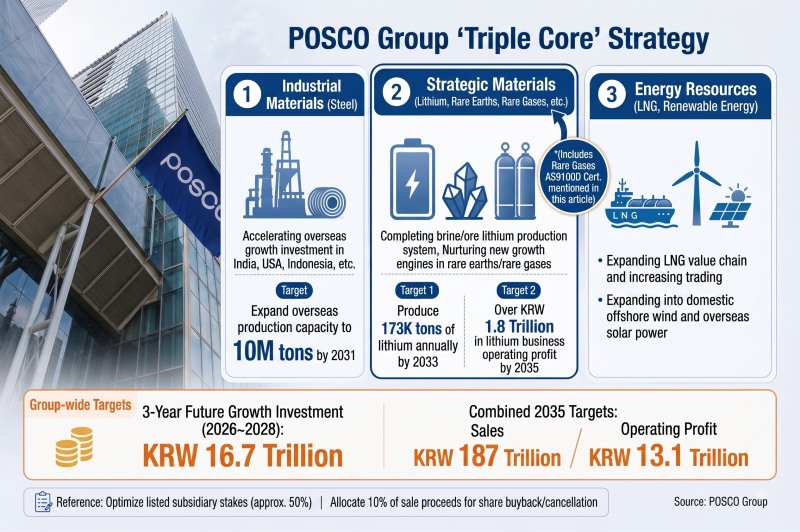
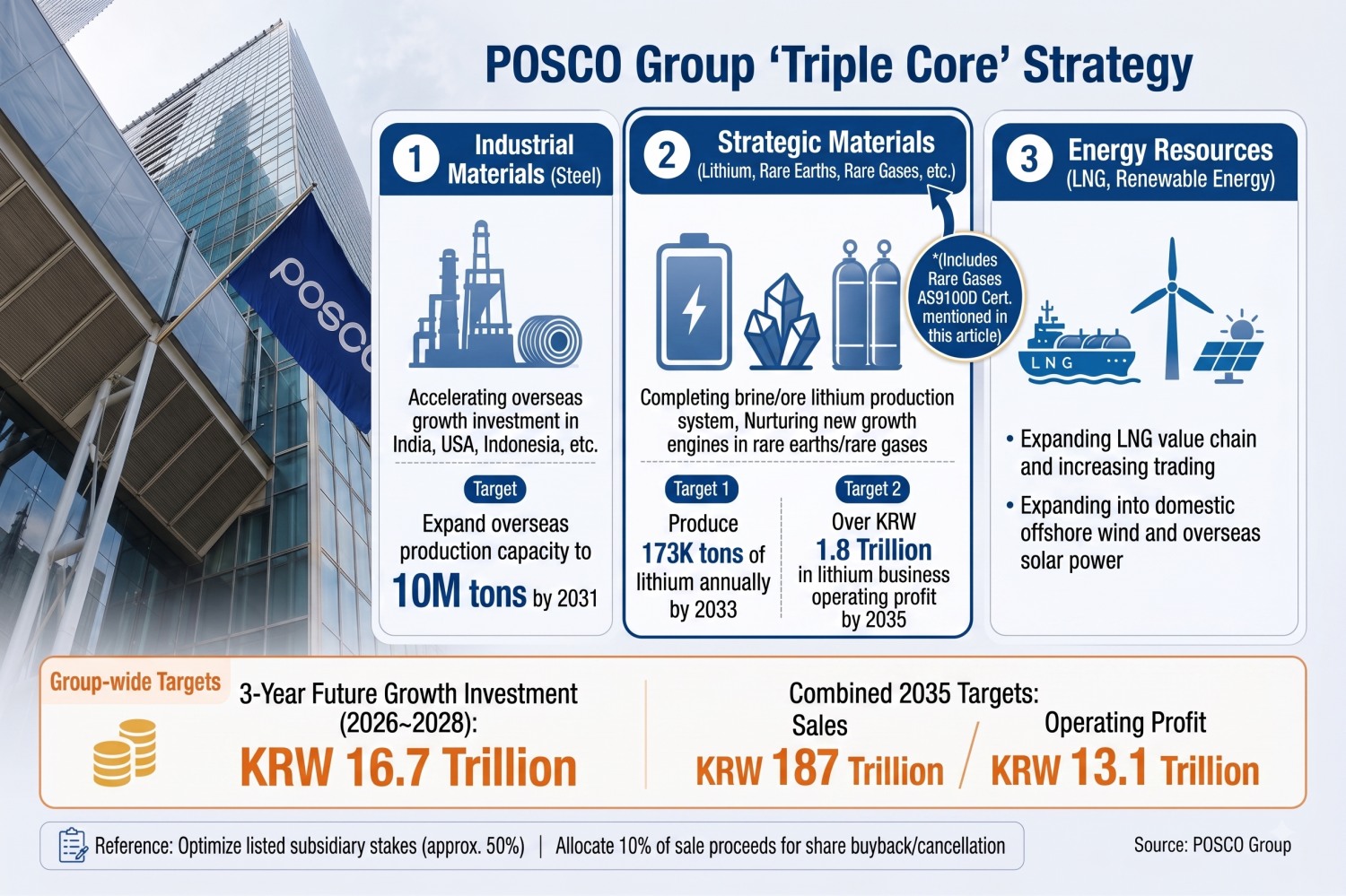
The new certification aligns with the "Triple Core" strategy that POSCO Group unveiled at its CEO Investor Day on July 2. At the time, the group laid out a blueprint to become a "national supplier of core resources" by building a three-pillar structure spanning industrial resources (steel), strategic resources (lithium, rare earths, rare gases, etc.) and energy resources (LNG, renewable energy). While the rare gas business had been in development before the strategy was announced, the new international certification marks its first external achievement since the strategy's unveiling.At the Investor Day, POSCO Group Chairman Jang In-hwa emphasized that now — amid deepening external uncertainty from supply chain instability and accelerating decarbonization — is the time for bold innovation in the company's business portfolio to create new growth opportunities. He also outlined a goal of expanding beyond steel and materials into resources, positioning the group to lead in strengthening national industrial security and supply chains.
That said, the business remains at an early stage. POSCO Air Solutions posted net assets of KRW 100.412 billion and a net loss of KRW 2.634 billion for last year. Given that roughly one year and seven months — from the November 2024 groundbreaking to the plant's completion this past June — were spent on investment and construction, meaningful earnings contributions are expected only from the second half of this year, once the plant reaches full operation.
POSCO Group aims to move away from its rare gas business's traditional dependence on semiconductor industry cycles by securing new demand from the aerospace and defense sectors, thereby improving business stability. Having already accelerated efforts to secure strategic resources such as lithium and rare earths, the group is now diversifying its rare gas business in the same direction — reducing reliance on any single industry.
Rare Gas Is Just the Beginning: KRW 16.7 Trillion 'Bet' Over Three Yea
POSCO Group also plans to invest KRW 16.7 trillion in future growth over the three years from 2026 to 2028 to strengthen execution of its Triple Core strategy.For lithium, the group aims to complete a production system capable of producing 173,000 tons annually by 2033, positioning itself among the world's top five lithium producers. Rare earths and rare/specialty gases are also set to be nurtured as core materials for advanced industries such as electric vehicles, robotics, semiconductors and aerospace, serving as new growth engines.
The ultimate goal of this resource-centered restructuring is combined group revenue of KRW 187 trillion and operating profit of KRW 13.1 trillion by 2035. Rare gases represent just one of several businesses under the group's strategic resources pillar.
Separately, holding company POSCO Holdings has stated it plans to reduce its stakes in listed subsidiaries to around 50% in order to address the "holding company discount," and to redirect the resulting capital toward investment in strategic resources. This suggests that the group's strategic resource businesses, including rare gases, could be subject to further group-wide capital reallocation going forward.
Jung Jina (urzinnie@fntimes.com)











![기관 '리노공업'·외인 '주성엔지니어링'·개인 'HLB' 1위 [주간 코스닥 순매수- 2026년 9월28일~10월2일]](https://cfnimage.commutil.kr/phpwas/restmb_setimgmake.php?pp=006&w=69&h=45&m=5&simg=20261003161606004230179ad43907118235716.jpg&nmt=18)
![기관 '삼성전기'·외인 '우리금융지주'·개인 '삼성전자' 1위 [주간 코스피 순매수- 2026년 9월28일~10월2일]](https://cfnimage.commutil.kr/phpwas/restmb_setimgmake.php?pp=006&w=69&h=45&m=5&simg=20261003160403064450179ad43907118235716.jpg&nmt=18)
![[김의석의 단상] KB 이재근이 당긴 ‘70년대생 은행장’ 시계](https://cfnimage.commutil.kr/phpwas/restmb_setimgmake.php?pp=006&w=69&h=45&m=5&simg=20261002171352092510fa40c3505512411124362.jpg&nmt=18)
![12개월 최고 연 4.05%…SC제일은행 'e-그린세이브예금' [이주의 은행 예금금리-10월 1주]](https://cfnimage.commutil.kr/phpwas/restmb_setimgmake.php?pp=006&w=69&h=45&m=5&simg=202610021737330454301b5a221379211234202153.jpg&nmt=18)


![[그래픽 뉴스] ‘순대’가 경제용어라고? 순(純)대외자산, 한국의 진짜 해외자산은 얼마일까?](https://cfnimage.commutil.kr/phpwas/restmb_setimgmake.php?pp=006&w=298&h=298&m=1&simg=202609021356075202de68fcbb3512411124362_0.jpg&nmt=18)
![[그래픽 뉴스] ISA 대개편! 나에게 유리한 계좌는?](https://cfnimage.commutil.kr/phpwas/restmb_setimgmake.php?pp=006&w=298&h=298&m=1&simg=202608041713155615de68fcbb3512411124362_0.jpg&nmt=18)
![[그래픽 뉴스] 미국 증시 새로운 키워드 'MANGOS'](https://cfnimage.commutil.kr/phpwas/restmb_setimgmake.php?pp=006&w=298&h=298&m=1&simg=202607291740382069de68fcbb3512411124362_0.jpg&nmt=18)

![[그래픽 뉴스] 은퇴후 30년 부모님 세대의 생존전략](https://cfnimage.commutil.kr/phpwas/restmb_setimgmake.php?pp=006&w=298&h=298&m=1&simg=202606301704439153de68fcbb3512411124362_0.jpg&nmt=18)
![[신간]은퇴연옥…김경록의 은퇴 후 삶의 나침반](https://cfnimage.commutil.kr/phpwas/restmb_setimgmake.php?pp=006&w=81&h=123&m=5&simg=20260414140833047280f8caa4a5ce12411124362.jpg&nmt=18)
![[신간] 물처럼 흐르고 원칙으로 서다…김용환의 통찰을 담다](https://cfnimage.commutil.kr/phpwas/restmb_setimgmake.php?pp=006&w=81&h=123&m=5&simg=20260409114249027860f8caa4a5ce12411124362.jpg&nmt=18)
![[안현정 서평] 플랫폼의 영지에서 ‘미학적 주권’을 선포하라...'K가 죽어야 K가 산다' 장준환 著](https://cfnimage.commutil.kr/phpwas/restmb_setimgmake.php?pp=006&w=81&h=123&m=5&simg=20260527121426063220c1c16452b012411124362.jpg&nmt=18)
![[서평] 추세 매매의 대가들...추세추종 투자전략의 대가 14인 인터뷰](https://cfnimage.commutil.kr/phpwas/restmb_setimgmake.php?pp=006&w=81&h=123&m=5&simg=2023102410444004986c1c16452b0175114235199.jpg&nmt=18)


![[머니무브 2026] “지금 사도 될까?” 답이 안 보인다면…하반기 투자, 4명의 전문가에게 물어보세요](https://cfnimage.commutil.kr/phpwas/restmb_setimgmake.php?pp=006&w=89&h=45&m=1&simg=202609151044050355302a735e27af12411124362.jpg&nmt=18)
![[AD] ‘PBV 라인업 확장’ 기아, 9월 독일서 ‘PV7’ 첫 공개](https://cfnimage.commutil.kr/phpwas/restmb_setimgmake.php?pp=006&w=89&h=45&m=1&simg=2026083111010602815074925877361231180222.jpg&nmt=18)
![[AD] 제네시스, 럭셔리 경험 더한 ‘2027 GV70’‧‘GV70 그래파이트’ 출시](https://cfnimage.commutil.kr/phpwas/restmb_setimgmake.php?pp=006&w=89&h=45&m=1&simg=20260702143546085600749258773622211122717.jpg&nmt=18)