






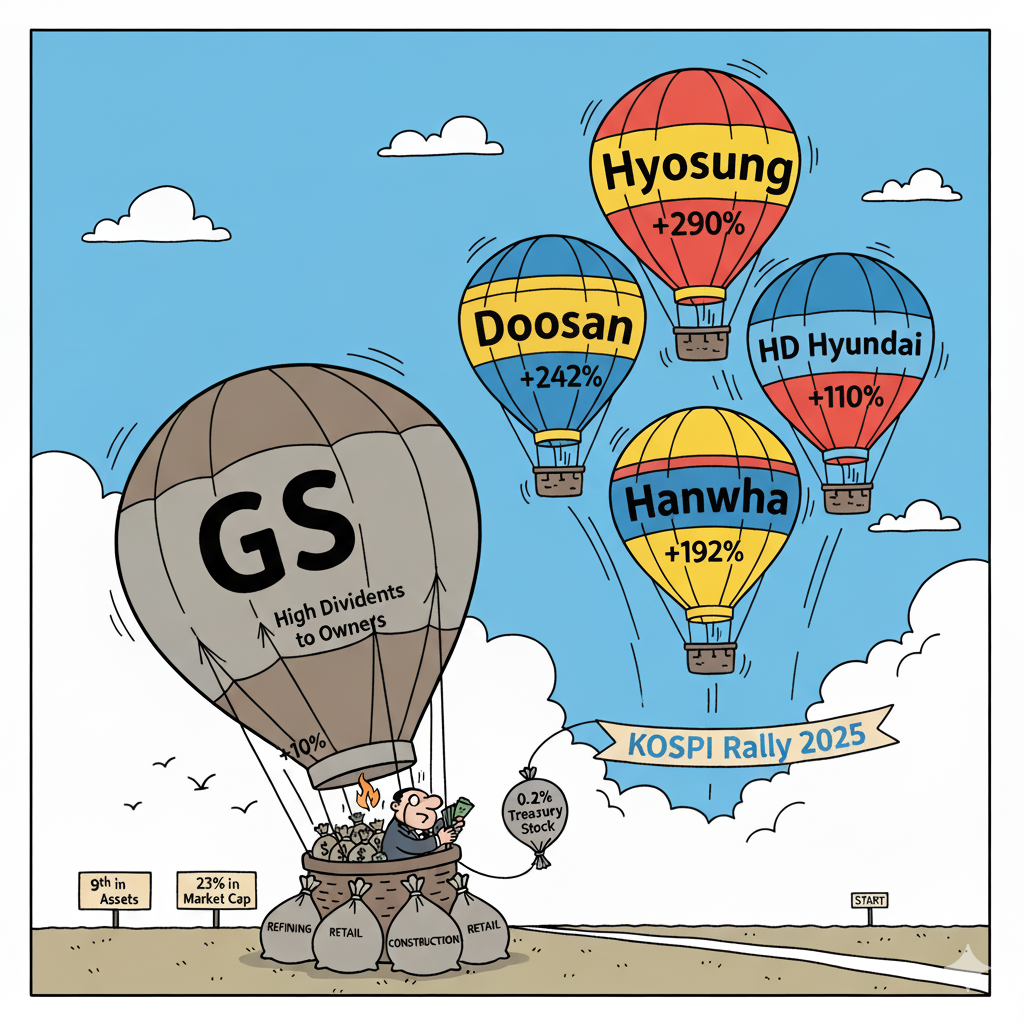
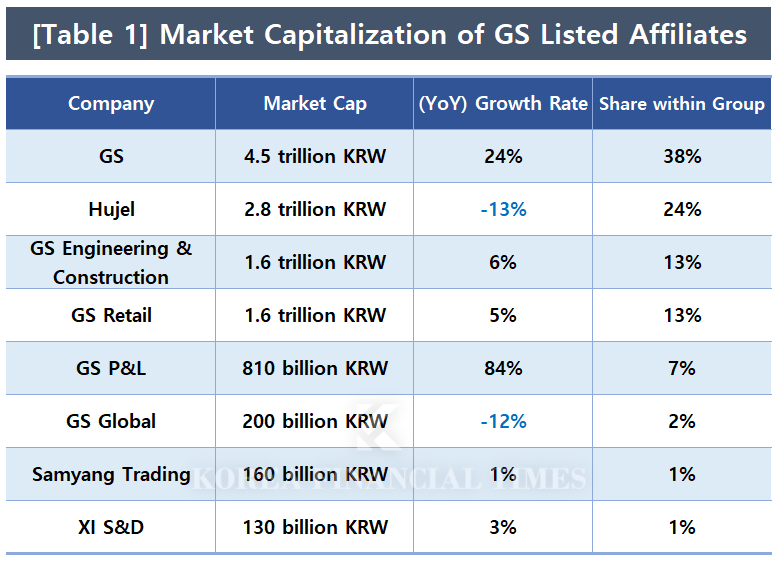
Specifically, during this period, the combined market capitalization of eight listed GS affiliates rose 10%. This is a lackluster performance compared to HD Hyundai (110%) and Hanwha (192%) among the top 10 groups, and even Lotte (22%), which is struggling to find future growth drivers. It also lagged behind Hyosung (290%) and DB (32%), which rank in the 30s in conglomerate rankings, in terms of market capitalization.
GS Group's poor stock performance appears to be due to lowered profit expectations from recessions in core business sectors (refining, retail, construction). The bio sector, which it strategically entered, has also underperformed.
HD Hyundai, Hanwha, Doosan, and Hyosung, which have more than doubled their market capitalization this year, share the common trait of having at least one business sector among those leading the domestic stock market, such as shipbuilding, defense, and power equipment.
However, even considering this, it is difficult to understand why GS is failing to achieve even one-fifth of the KOSPI's growth rate.

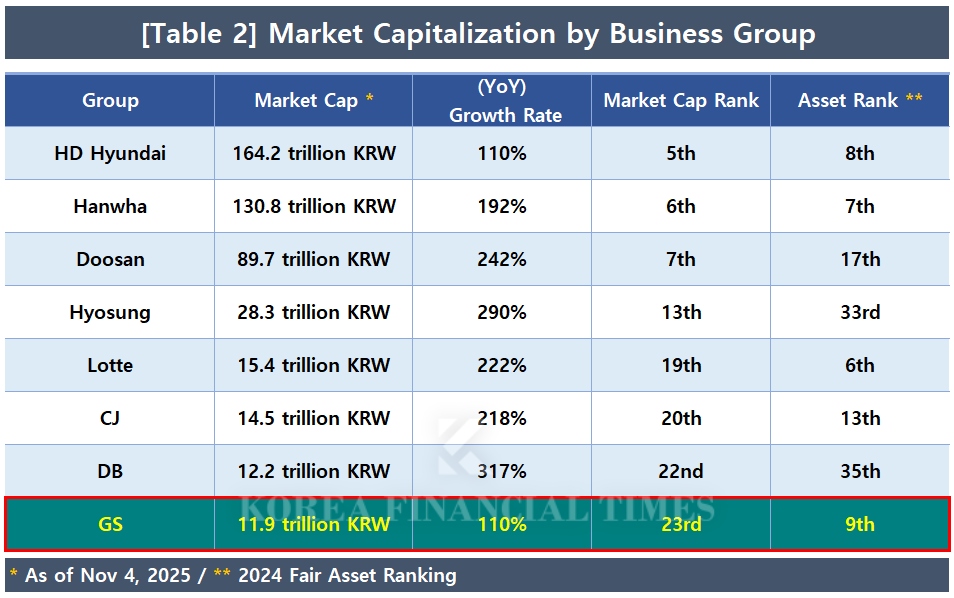
The largest holding in GS Group is GS Corp. (38%). GS Corp. is both a holding company and a company with a significant refining business. It directly controls 100% of unlisted GS Energy, which serves as an intermediate holding company for energy affiliates.
GS Corp. has risen approximately 24% this year. According to FnGuide, this falls far short of the average growth rate (73%) of domestic holding companies since the beginning of the year. It is also lower than the growth rate (38%) of S-Oil, which has a similar business structure to GS Caltex.
GS Corp.'s average dividend yield (based on common stock) over the three years through 2024 reached 6.1%. While there are disclosed dividend standards, they essentially only present minimum dividend amounts, and the company consistently pays a cash dividend of KRW 2,500 per share annually, largely regardless of performance fluctuations.

The background to GS Corp.'s high dividend policy can be linked to its unique governance structure. GS was established when the grandsons of Huh Man-jung, co-founder of (former) LG, separated and became independent from LG. The number of specially related parties holding GS Corp. shares (totaling 53.61% of the equity) reaches 55, including fourth-generation managers who are in the process of sequential management succession.
Because so many people share ownership, it is analyzed to be a structure where it is difficult for any one person's judgment to change the high dividend policy needed to obtain satisfactory dividend income for each individual. If dividend separate taxation is implemented here, the tax burden on the Huh family is expected to decrease significantly.
Nevertheless, investors are paying more attention to owner management's passive shareholder return intentions. This means low expectations for additional shareholder return measures to boost stock prices beyond maintaining the current dividend policy.
In fact, GS Corp. was the last among the top 10 groups to participate in the "value-up" disclosure promoted by Korea Exchange recommendation. The value-up policy content is also not significantly different from before. It contains the statement, "Return at least 40% of average net income (excluding one-time and non-recurring profits) on a separate basis for 2025-2027," and "Minimum dividend is KRW 2,000." The dividend standard is completely identical to the previous 2022-2024 period.
While treasury stock purchases and cancellations to boost stock prices were conducted at some affiliates such as Hugel, GS Corp. has never officially implemented them. With a low treasury stock holding ratio (0.2%), even if the "mandatory cancellation of existing treasury stocks" provision passes in the third commercial law amendment, the effect is not expected to be significant.
Gwak Horyung (horr@fntimes.com)











![[THE COMPASS] 한미사이언스 경영권 분쟁, 신동국이 주도하는 ‘종식’ 게임](https://cfnimage.commutil.kr/phpwas/restmb_setimgmake.php?pp=006&w=69&h=45&m=5&simg=20261008122108000710a837df649412411124362.jpg&nmt=18)
![영업익 53% 뛴다는데…대웅제약 몸값 누르는 두 가지 변수 [5대 제약사 3Q 실적 ④]](https://cfnimage.commutil.kr/phpwas/restmb_setimgmake.php?pp=006&w=69&h=45&m=5&simg=202610081106100618007fd637f543112168227135.jpg&nmt=18)


![[그래픽 뉴스] ‘순대’가 경제용어라고? 순(純)대외자산, 한국의 진짜 해외자산은 얼마일까?](https://cfnimage.commutil.kr/phpwas/restmb_setimgmake.php?pp=006&w=298&h=298&m=1&simg=202609021356075202de68fcbb3512411124362_0.jpg&nmt=18)
![[그래픽 뉴스] ISA 대개편! 나에게 유리한 계좌는?](https://cfnimage.commutil.kr/phpwas/restmb_setimgmake.php?pp=006&w=298&h=298&m=1&simg=202608041713155615de68fcbb3512411124362_0.jpg&nmt=18)
![[그래픽 뉴스] 미국 증시 새로운 키워드 'MANGOS'](https://cfnimage.commutil.kr/phpwas/restmb_setimgmake.php?pp=006&w=298&h=298&m=1&simg=202607291740382069de68fcbb3512411124362_0.jpg&nmt=18)
![[그래픽 뉴스] 은퇴후 30년 부모님 세대의 생존전략](https://cfnimage.commutil.kr/phpwas/restmb_setimgmake.php?pp=006&w=298&h=298&m=1&simg=202606301704439153de68fcbb3512411124362_0.jpg&nmt=18)
![[신간]은퇴연옥…김경록의 은퇴 후 삶의 나침반](https://cfnimage.commutil.kr/phpwas/restmb_setimgmake.php?pp=006&w=81&h=123&m=5&simg=20260414140833047280f8caa4a5ce12411124362.jpg&nmt=18)
![[신간] 물처럼 흐르고 원칙으로 서다…김용환의 통찰을 담다](https://cfnimage.commutil.kr/phpwas/restmb_setimgmake.php?pp=006&w=81&h=123&m=5&simg=20260409114249027860f8caa4a5ce12411124362.jpg&nmt=18)
![[안현정 서평] 플랫폼의 영지에서 ‘미학적 주권’을 선포하라...'K가 죽어야 K가 산다' 장준환 著](https://cfnimage.commutil.kr/phpwas/restmb_setimgmake.php?pp=006&w=81&h=123&m=5&simg=20260527121426063220c1c16452b012411124362.jpg&nmt=18)
![[서평] 추세 매매의 대가들...추세추종 투자전략의 대가 14인 인터뷰](https://cfnimage.commutil.kr/phpwas/restmb_setimgmake.php?pp=006&w=81&h=123&m=5&simg=2023102410444004986c1c16452b0175114235199.jpg&nmt=18)


![[머니무브 2026] “지금 사도 될까?” 답이 안 보인다면…하반기 투자, 4명의 전문가에게 물어보세요](https://cfnimage.commutil.kr/phpwas/restmb_setimgmake.php?pp=006&w=89&h=45&m=1&simg=202609151044050355302a735e27af12411124362.jpg&nmt=18)
![[AD] ‘PBV 라인업 확장’ 기아, 9월 독일서 ‘PV7’ 첫 공개](https://cfnimage.commutil.kr/phpwas/restmb_setimgmake.php?pp=006&w=89&h=45&m=1&simg=2026083111010602815074925877361231180222.jpg&nmt=18)
![[AD] 제네시스, 럭셔리 경험 더한 ‘2027 GV70’‧‘GV70 그래파이트’ 출시](https://cfnimage.commutil.kr/phpwas/restmb_setimgmake.php?pp=006&w=89&h=45&m=1&simg=20260702143546085600749258773622211122717.jpg&nmt=18)