






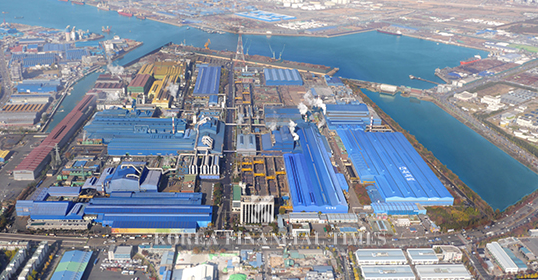
Hyundai Steel Headquarters and Incheon Plant / Photo courtesy of Hyundai Steel
On the 7th, it was reported that Hyundai Steel is considering building a steel plant in the United States to produce steel plates for automobiles. The company is in contact with U.S. government officials in anticipation of strengthening protectionist trade policies following the election of U.S. President Donald Trump. The total investment would reportedly amount to KRW 10 trillion.
In response, Hyundai Steel issued a clarification announcement on the 8th, stating, “We are reviewing various measures to secure sustainable growth and global competitiveness, but no decisions have been made to date.” This does not mean that the company has completely denied the fact that it has reviewed investments.
However, the company's stock price dropped immediately after the market opened and was down over 4.2% as of 2:15 pm. When new investments are announced, it is common for the stock price to rise due to expectations of future profits. At first glance, the strategy of focusing on automotive steel for Hyundai and Kia instead of other steel businesses that are struggling also seems fine. But what is the market worried about?
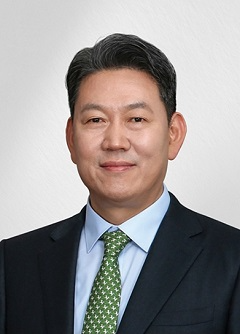
Seo Kang-hyun, CEO of Hyundai Steel
The biggest question is, “What kind of money does Hyundai Steel have to make such a big investment? As of last year, the amount of borrowings and bonds owed by the company amounted to KRW 10 trillion. The interest expense alone was more than KRW 410 billion. In such a situation, the amount of money earned from the offensive of low-cost steel from China continues to decrease. In the third quarter of last year, Hyundai Steel posted a net loss of KRW 16.2 billion. In the same quarter, the company's cash and cash equivalents were KRW 2.1017 trillion, a declining trend.
Since Hyundai Steel is in a situation where it is difficult to afford the cost estimated to exceed KRW 10 trillion, the observation that this investment is being promoted at the Hyundai Motor Group level is gaining ground. If Hyundai Steel owns a local steel mill in the U.S., Hyundai and Kia products will likely be able to reduce their tariff burden and secure price competitiveness.
Gwak Horyung (horr@fntimes.com)











![[기자수첩] 보험사 품는 사모펀드, 대주주 심사 재고해야](https://cfnimage.commutil.kr/phpwas/restmb_setimgmake.php?pp=006&w=69&h=45&m=5&simg=20260913173909069220ed56b8e1f814379898.jpg&nmt=18)


![[그래픽 뉴스] ‘순대’가 경제용어라고? 순(純)대외자산, 한국의 진짜 해외자산은 얼마일까?](https://cfnimage.commutil.kr/phpwas/restmb_setimgmake.php?pp=006&w=298&h=298&m=1&simg=202609021356075202de68fcbb3512411124362_0.jpg&nmt=18)
![[그래픽 뉴스] ISA 대개편! 나에게 유리한 계좌는?](https://cfnimage.commutil.kr/phpwas/restmb_setimgmake.php?pp=006&w=298&h=298&m=1&simg=202608041713155615de68fcbb3512411124362_0.jpg&nmt=18)
![[그래픽 뉴스] 미국 증시 새로운 키워드 'MANGOS'](https://cfnimage.commutil.kr/phpwas/restmb_setimgmake.php?pp=006&w=298&h=298&m=1&simg=202607291740382069de68fcbb3512411124362_0.jpg&nmt=18)

![[그래픽 뉴스] 은퇴후 30년 부모님 세대의 생존전략](https://cfnimage.commutil.kr/phpwas/restmb_setimgmake.php?pp=006&w=298&h=298&m=1&simg=202606301704439153de68fcbb3512411124362_0.jpg&nmt=18)
![[신간]은퇴연옥…김경록의 은퇴 후 삶의 나침반](https://cfnimage.commutil.kr/phpwas/restmb_setimgmake.php?pp=006&w=81&h=123&m=5&simg=20260414140833047280f8caa4a5ce12411124362.jpg&nmt=18)
![[신간] 물처럼 흐르고 원칙으로 서다…김용환의 통찰을 담다](https://cfnimage.commutil.kr/phpwas/restmb_setimgmake.php?pp=006&w=81&h=123&m=5&simg=20260409114249027860f8caa4a5ce12411124362.jpg&nmt=18)
![[안현정 서평] 플랫폼의 영지에서 ‘미학적 주권’을 선포하라...'K가 죽어야 K가 산다' 장준환 著](https://cfnimage.commutil.kr/phpwas/restmb_setimgmake.php?pp=006&w=81&h=123&m=5&simg=20260527121426063220c1c16452b012411124362.jpg&nmt=18)
![[서평] 추세 매매의 대가들...추세추종 투자전략의 대가 14인 인터뷰](https://cfnimage.commutil.kr/phpwas/restmb_setimgmake.php?pp=006&w=81&h=123&m=5&simg=2023102410444004986c1c16452b0175114235199.jpg&nmt=18)


![[머니무브 2026] “지금 사도 될까?” 답이 안 보인다면…하반기 투자, 4명의 전문가에게 물어보세요](https://cfnimage.commutil.kr/phpwas/restmb_setimgmake.php?pp=006&w=89&h=45&m=1&simg=202609151044050355302a735e27af12411124362.jpg&nmt=18)
![[AD] ‘PBV 라인업 확장’ 기아, 9월 독일서 ‘PV7’ 첫 공개](https://cfnimage.commutil.kr/phpwas/restmb_setimgmake.php?pp=006&w=89&h=45&m=1&simg=2026083111010602815074925877361231180222.jpg&nmt=18)
![[AD] 제네시스, 럭셔리 경험 더한 ‘2027 GV70’‧‘GV70 그래파이트’ 출시](https://cfnimage.commutil.kr/phpwas/restmb_setimgmake.php?pp=006&w=89&h=45&m=1&simg=20260702143546085600749258773622211122717.jpg&nmt=18)
![[AD] 개소세 혜택 종료…현대차, ‘썸머 페스타’로 고객 부담 완화](https://cfnimage.commutil.kr/phpwas/restmb_setimgmake.php?pp=006&w=89&h=45&m=1&simg=20260702142355004830749258773622211122717.jpg&nmt=18)
![[AD] 기아 ‘디 올 뉴 셀토스’, 인도 타임스 드라이브 어워즈서 ‘올해의 SUV’ 선정](https://cfnimage.commutil.kr/phpwas/restmb_setimgmake.php?pp=006&w=89&h=45&m=1&simg=202605071156400590007492587736124111243152.jpg&nmt=18)