






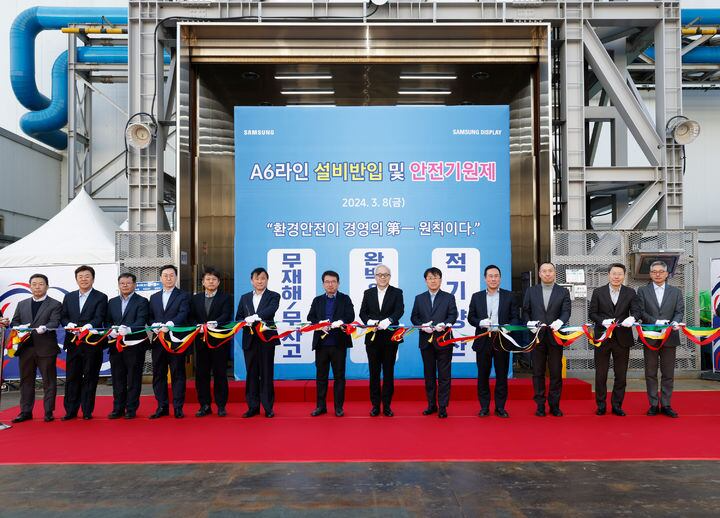
Samsung Display's 8.6 generation IT OLED equipment delivery ceremony at Asan Campus in March. / Photo by Samsung Display
이미지 확대보기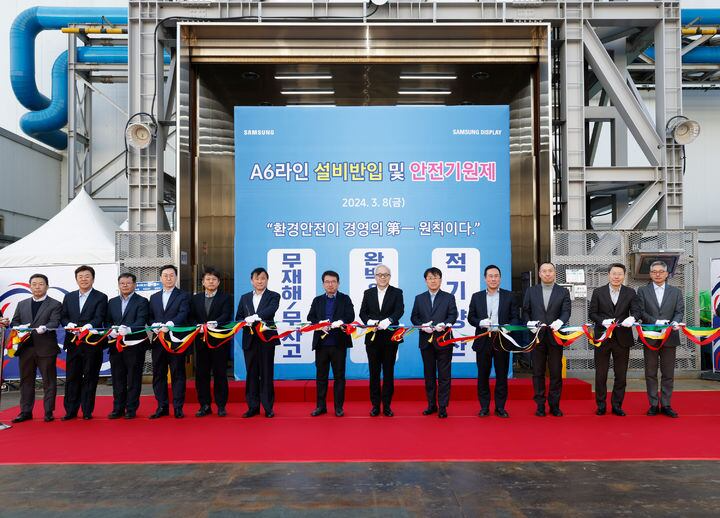
However, LG Display, South Korea's leading display company, has yet to come up with a concrete plan to produce 8.6-generation OLEDs. This is due to its unstable financial situation, including pressure to repay borrowings. LG Display is raising funds for investment through asset securitization and the sale of surplus assets.
According to industry reports on the 24th, Samsung Display will invest about $1.8 billion (KRW 2.4 trillion) to build a new 8.6-generation OLED factory in Vietnam's Bac Ninh province. The plant will be responsible for the post-process of attaching and assembling modules for 8.6-generation OLED panels produced by the Asan plant in South Korea. In particular, the establishment of the Vietnam plant is expected to reduce the cost of 8.6th generation OLED panels.
Earlier, Samsung Display announced in April last year that it would invest about KRW 4.1 trillion to build the world's first new 8.6-generation OLED factory in Asan. The full-fledged aspect is 2026, with an annual production capacity of 10 million 8.6 generation OLED panels.
Samsung Display's large-scale investment in 8.6-generation OLED is aimed at gaining a first-mover advantage. Currently, the electronics market is beginning to transition to OLED for TVs (large) and smartphones (small), followed by mid-sized products such as laptops and tablet PCs. As a result, global display companies are competing for investment and focusing on customer acquisition. In particular, not only Samsung Display but also Chinese companies such as BOE (with an investment plan of about KRW 12 trillion) are chasing Korean companies by launching a low-cost offensive.
Despite this fierce competition for 8.6th generation OLEDs is intensifying in the global OLED market, LG Display has yet to announce specific production plans as well as investment in 8.6th generation OLEDs. This is due to the company's unstable financial situation, including persistent losses and upcoming borrowing pressure.

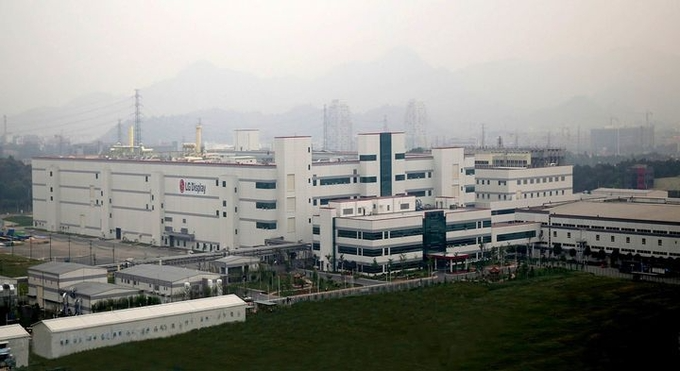
LG Display posted annual losses for two consecutive years until last year. The cumulative deficit over the two years amounted to KRW 4.6 trillion. It succeeded in reducing the deficit in the 1st half of this year, but still posted an operating loss of about KRW 56.31 billion. The company is expected to return to profitability in the second half of the year due to new products such as Apple's i-Phone 16 series, a major customer, but its investment capacity remains a question mark.
In particular, the looming borrowing pressure is a concern. According to LG Display's 1st-half semi-annual report, the company's cash and cash equivalents totaled about KRW 2.34 trillion, down about KRW 1 trillion from KRW 3.23 trillion in the 1st half of last year. This was due to the repayment of foreign currency long-term borrowings that matured in May with cash on hand. However, LG Display's dependence on borrowings in the 1st half of this year was 46.3%, down only about 0.5%p from last year.
LG Display raised about KRW 1.29 trillion through a capital increase in March this year, but much of the proceeds were used for financial stabilization, including repayment of borrowings. According to LG Display, about KRW 415.9 billion of the capital increase was utilized for facility investments related to strengthening the competitiveness of its order-type businesses such as small and medium-sized OLEDs, and about KRW 393.6 billion was used to repay debt. The remaining amount was utilized for operating funds.
LG Display has approximately KRW 2.29 trillion in borrowings scheduled to mature in the second half of the year. LG Display has said it will not borrow more this year, and plans to repay the debt with cash on hand and proceeds from asset sales. In fact, the company redeemed KRW 290 billion in corporate bonds with cash on hand on the 14th.
LG Display says it is focusing on raising funds for the transition to next-generation products such as 8.6-generation OLED, and is also focusing on converting OLED production facilities for small and medium-sized IT. For example, LG Display is currently accelerating the sale of its LCD plant in Guangzhou, China. It recently purchased a 10% stake in an LCD factory owned by China's Skyworth. This is a move to simplify the ownership ratio and make it easier to sell the plant.
According to industry sources, the Guangzhou LCD plant has a net asset value of 9.784 billion yuan (KRW 1.852 trillion), and LG Display will use the cash from the sale to develop and produce next-generation OLED products, including 8.6-generation OLEDs.
Kim JaeHun (rlqm93@fntimes.com)











![정상혁號 신한은행, 영업·RM·심사역 '원팀' 결합…산업·회계 전문가 키운다 [은행원의 진화]](https://cfnimage.commutil.kr/phpwas/restmb_setimgmake.php?pp=006&w=69&h=45&m=5&simg=20260822020013047950b4a7c6999c121131189150.jpg&nmt=18)

![[머니무브 2026] 이승우 “美 장기금리 5% 넘어서면 한국 증시, ‘AI 투자비용’까지 봐야”](https://cfnimage.commutil.kr/phpwas/restmb_setimgmake.php?pp=006&w=69&h=45&m=5&simg=20260917185156027250c1c16452b012411124362.jpg&nmt=18)
![최창원, SK디스커버리 성과급 2배 늘었지만…올해는 가스 사업 부진 [가성비 C-레벨]](https://cfnimage.commutil.kr/phpwas/restmb_setimgmake.php?pp=006&w=69&h=45&m=5&simg=202609171558030943707de3572ddd12517950139.jpg&nmt=18)


![[그래픽 뉴스] ‘순대’가 경제용어라고? 순(純)대외자산, 한국의 진짜 해외자산은 얼마일까?](https://cfnimage.commutil.kr/phpwas/restmb_setimgmake.php?pp=006&w=298&h=298&m=1&simg=202609021356075202de68fcbb3512411124362_0.jpg&nmt=18)
![[그래픽 뉴스] ISA 대개편! 나에게 유리한 계좌는?](https://cfnimage.commutil.kr/phpwas/restmb_setimgmake.php?pp=006&w=298&h=298&m=1&simg=202608041713155615de68fcbb3512411124362_0.jpg&nmt=18)
![[그래픽 뉴스] 미국 증시 새로운 키워드 'MANGOS'](https://cfnimage.commutil.kr/phpwas/restmb_setimgmake.php?pp=006&w=298&h=298&m=1&simg=202607291740382069de68fcbb3512411124362_0.jpg&nmt=18)

![[그래픽 뉴스] 은퇴후 30년 부모님 세대의 생존전략](https://cfnimage.commutil.kr/phpwas/restmb_setimgmake.php?pp=006&w=298&h=298&m=1&simg=202606301704439153de68fcbb3512411124362_0.jpg&nmt=18)
![[신간]은퇴연옥…김경록의 은퇴 후 삶의 나침반](https://cfnimage.commutil.kr/phpwas/restmb_setimgmake.php?pp=006&w=81&h=123&m=5&simg=20260414140833047280f8caa4a5ce12411124362.jpg&nmt=18)
![[신간] 물처럼 흐르고 원칙으로 서다…김용환의 통찰을 담다](https://cfnimage.commutil.kr/phpwas/restmb_setimgmake.php?pp=006&w=81&h=123&m=5&simg=20260409114249027860f8caa4a5ce12411124362.jpg&nmt=18)
![[안현정 서평] 플랫폼의 영지에서 ‘미학적 주권’을 선포하라...'K가 죽어야 K가 산다' 장준환 著](https://cfnimage.commutil.kr/phpwas/restmb_setimgmake.php?pp=006&w=81&h=123&m=5&simg=20260527121426063220c1c16452b012411124362.jpg&nmt=18)
![[서평] 추세 매매의 대가들...추세추종 투자전략의 대가 14인 인터뷰](https://cfnimage.commutil.kr/phpwas/restmb_setimgmake.php?pp=006&w=81&h=123&m=5&simg=2023102410444004986c1c16452b0175114235199.jpg&nmt=18)


![[머니무브 2026] “지금 사도 될까?” 답이 안 보인다면…하반기 투자, 4명의 전문가에게 물어보세요](https://cfnimage.commutil.kr/phpwas/restmb_setimgmake.php?pp=006&w=89&h=45&m=1&simg=202609151044050355302a735e27af12411124362.jpg&nmt=18)
![[AD] ‘PBV 라인업 확장’ 기아, 9월 독일서 ‘PV7’ 첫 공개](https://cfnimage.commutil.kr/phpwas/restmb_setimgmake.php?pp=006&w=89&h=45&m=1&simg=2026083111010602815074925877361231180222.jpg&nmt=18)
![[AD] 제네시스, 럭셔리 경험 더한 ‘2027 GV70’‧‘GV70 그래파이트’ 출시](https://cfnimage.commutil.kr/phpwas/restmb_setimgmake.php?pp=006&w=89&h=45&m=1&simg=20260702143546085600749258773622211122717.jpg&nmt=18)
![[AD] 개소세 혜택 종료…현대차, ‘썸머 페스타’로 고객 부담 완화](https://cfnimage.commutil.kr/phpwas/restmb_setimgmake.php?pp=006&w=89&h=45&m=1&simg=20260702142355004830749258773622211122717.jpg&nmt=18)
![[AD] 기아 ‘디 올 뉴 셀토스’, 인도 타임스 드라이브 어워즈서 ‘올해의 SUV’ 선정](https://cfnimage.commutil.kr/phpwas/restmb_setimgmake.php?pp=006&w=89&h=45&m=1&simg=202605071156400590007492587736124111243152.jpg&nmt=18)