






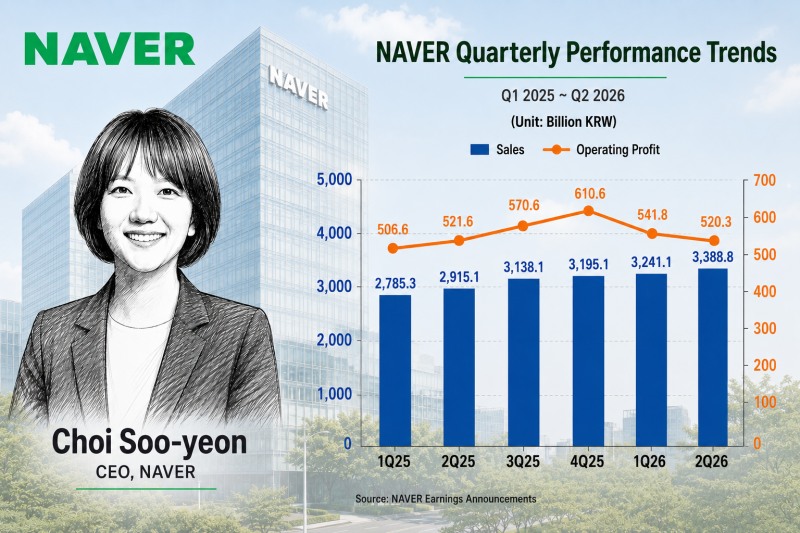
This infographic, originally published by Korea Financial Times, has been reconstructed using generative AI.
이미지 확대보기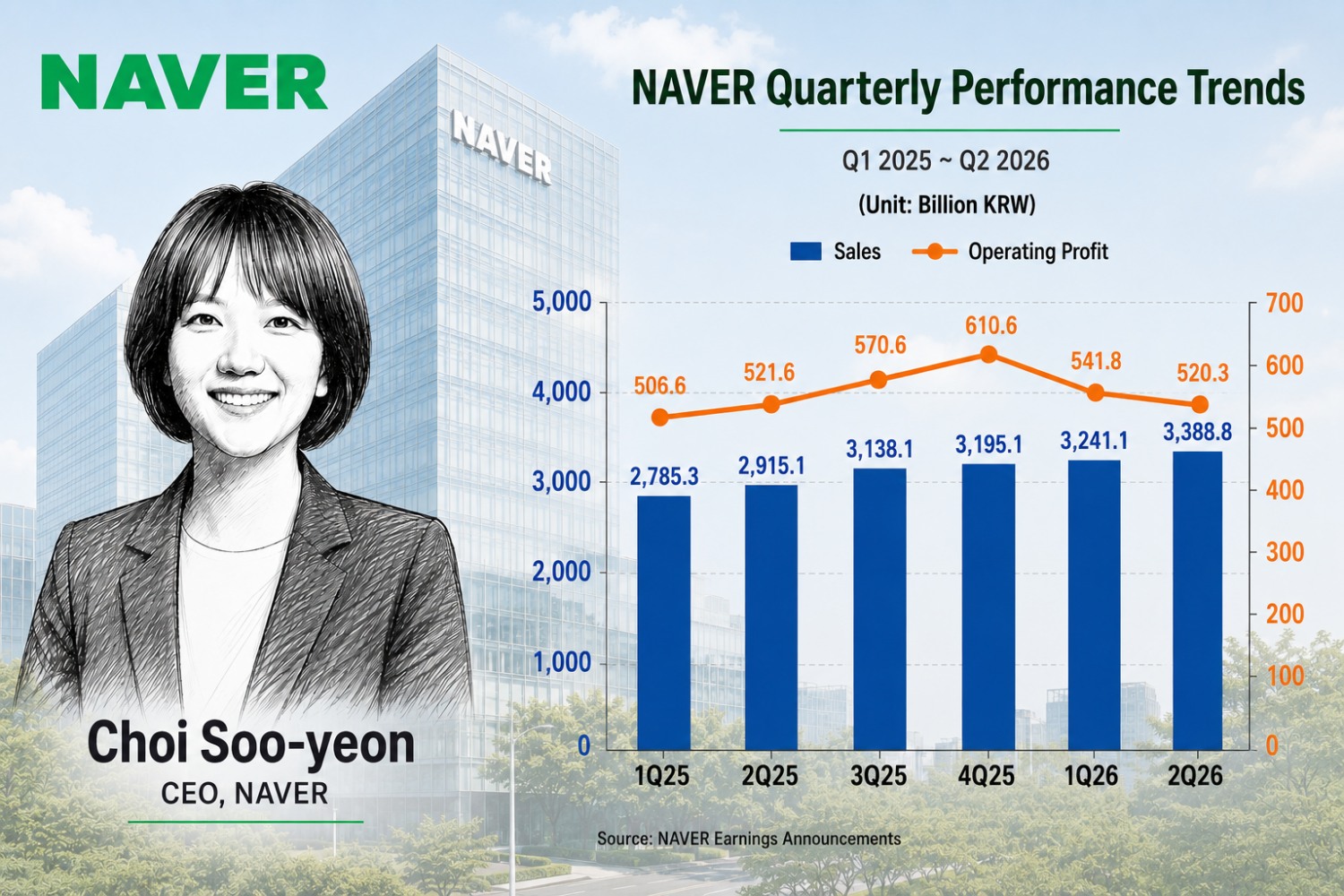
According to industry sources on August 20, the business value of Naver's AI Factory operations is estimated at KRW 14.4 trillion — up KRW 3.3 trillion in about two months from the KRW 11.1 trillion valuation calculated in June, when Naver first entered the AI Factory business.
Naver's AI Factory goes beyond simply leasing data center space, integrating GPU and computing resources into a unified offering. Attention is focused on whether Naver can convert years of technology investment in AI and its data center operating experience into a reliable cash cow.
Kim Jin-gu, an analyst at Kiwoom Securities, said AI Factory operations account for roughly 30% of Naver's total estimated corporate value of KRW 48.7 trillion. He added that if Naver makes strategic decisions for the mid-to-long-term growth of its core businesses through robust cooperation with global frontier companies, there is room for the company's valuation to rise further from current levels.
The estimated business value of the AI Factory unit already far exceeds the KRW 7.3 trillion combined valuation of Naver's existing core businesses, including its search platform and cloud operations.
Naver continues to post steady results in both the B2C and B2B segments of its AI business. On the B2C side, the company unveiled Korea's first hyperscale AI model, HyperCLOVA, in 2021 and has since applied it across its services to strengthen its platform competitiveness.
Naver's platform division posted revenue of KRW 1.9022 trillion in the second quarter of this year, up 12.3% from a year earlier and 3.4% from the previous quarter. Advertising revenue grew 7.5% year-on-year, with AI contributing more than 60% of that growth on the back of AI-driven ad placement optimization and enhanced targeting. In particular, the AI Briefing ad product, which officially launched in late July, has recorded a click-through conversion rate more than 30% higher and a purchase conversion rate more than three times higher than existing search ads, demonstrating the monetization potential of generative AI services.
On the B2B side, Naver opened its "Gak Sejong" data center in 2023 and has expanded its GPU-as-a-Service (GPUaaS) offerings and enterprise AI services through Naver Cloud. The company currently supplies AI models and GPUaaS to Hyundai Motor Group, Korea Hydro & Nuclear Power, and the Bank of Korea, and is also participating in the national AI computing center project.
SK Square's Razor-Thin Math to Keep Control of SK hynixKakao Stumbles on AI and Historic Strike — Can a KRW 2 Trillion Windfall Turn the Tide?NVIDIA's Huang Visits Hyundai HQ, Hails "Hyundai's Time" in the Age of Physical AIEven Jensen Huang Couldn't Save It: Why NAVER's Stock Reversed in Just One Day
This track record is one reason Nvidia chose to form its "KRW 14 trillion alliance" with Naver on the AI Factory project. Nvidia is seeking to use the partnership to strengthen its own B2B service know-how and capabilities.
Kim Yu-won, CEO of Naver Cloud, said the center of the AI industry is shifting from model training toward "inference-centric AI factories" that stably operate large-scale infrastructure. He added that the partnership with Nvidia goes beyond a simple supplier relationship and represents a strategic collaboration to jointly expand the AI ecosystem.
Nvidia, Brookfield Share the Load, Easing Naver's Investment Burden
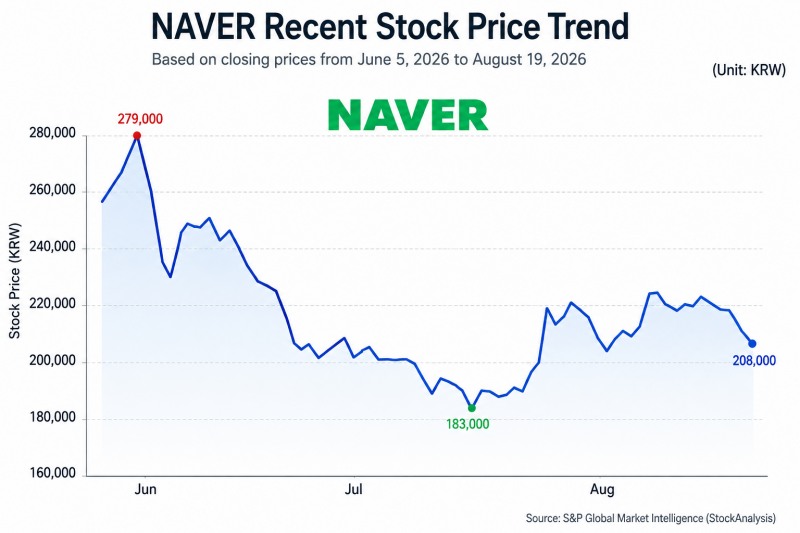
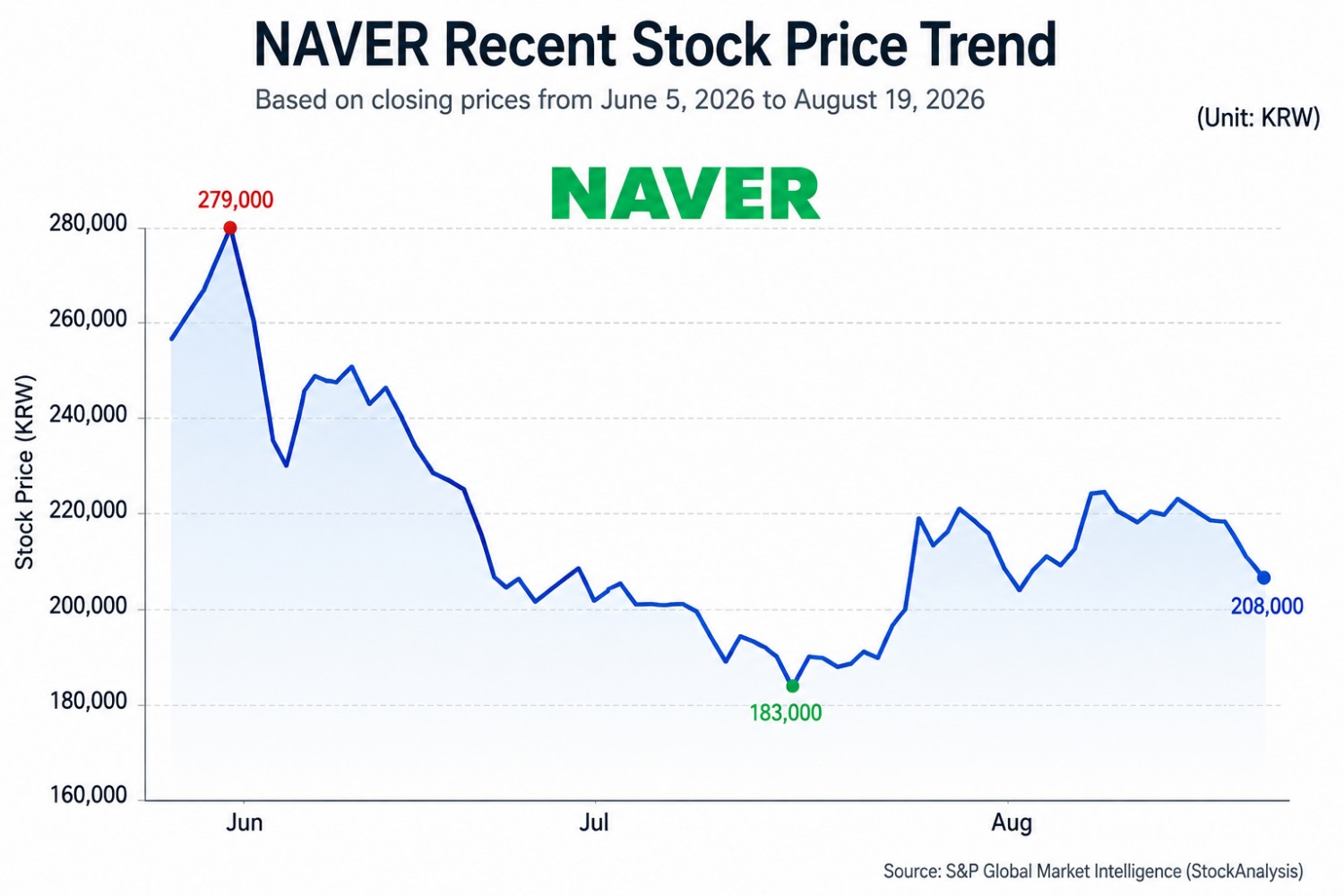
The market had initially raised concerns that the massive capital required to build 1GW of AI infrastructure could strain Naver's finances. Naver shares indeed surged when the AI Factory project was first announced in June, but then fell more than 30% from their peak over the following month amid investor jitters over the project's cost burden and profitability.However, after the structure of the AI Factory's first phase — involving both Nvidia and Brookfield — was disclosed, Naver shares closed at KRW 226,500 on August 4, up 9.16% from the previous trading day. The rally reflected growing expectations that the financial burden of the large-scale infrastructure investment could be eased.
Naver secured a USD 1 billion investment from Nvidia through a third-party allotment of new shares, making Nvidia the company's third-largest shareholder with a 4.5% stake. Naver also signed an exclusive preliminary agreement with Brookfield for USD 9 billion in preferred financing, securing all the capital needed to build out its latest-generation GPU AI infrastructure.
Naver shares closed at KRW 208,000 on August 19, down 4.15% from the previous session.
Naver CEO Choi Soo-yeon said the company has built a foundation to rapidly expand its AI Factory business while minimizing the initial capital burden, thanks to its recent strategic partnership with Nvidia. She added that by proactively securing customers for its initial operating capacity — drawing on both Nvidia's ecosystem, including major global clients, and Naver's own base of corporate and public-sector customers — the company aims to generate meaningful revenue and profit early on and build new growth engines in the global AI computing market.
Blueprint for Expansion Built on 'Full-Stack' Strengths
Naver has positioned not only domestic companies, industries and public institutions but also U.S. AI firms and global AI cloud customers as potential demand sources for its AI Factory. The company says it possesses "full-stack AI capabilities," having accumulated large-scale GPU operating experience since introducing Nvidia's DGX SuperPOD in 2020. Naver has since built its own AI value chain — spanning infrastructure, cloud, models and services — through Gak Sejong, Naver Cloud and HyperCLOVA X.To accelerate its market entry, Naver plans to quickly build out infrastructure using external data center space for up to 200MW of capacity, before expanding to the full 1GW through its own data centers and overseas partners.
Naver expects AI Factory revenue to begin materializing in the first half of 2027. Naver CFO Kim Hee-cheol said that while operator profit margins are likely to start low in the early stages, they could reach more than 20% over the long term as the business matures.
Park Suyeon (suy1663@fntimes.com)












![SK바이오사이언스 안재용, ‘적자 터널’ 닫고 3연임 열까 [CEO 임기보고서]](https://cfnimage.commutil.kr/phpwas/restmb_setimgmake.php?pp=006&w=69&h=45&m=5&simg=202610231027190082807fd637f543112168227135.jpg&nmt=18)


![[그래픽 뉴스] ‘순대’가 경제용어라고? 순(純)대외자산, 한국의 진짜 해외자산은 얼마일까?](https://cfnimage.commutil.kr/phpwas/restmb_setimgmake.php?pp=006&w=298&h=298&m=1&simg=202609021356075202de68fcbb3512411124362_0.jpg&nmt=18)
![[그래픽 뉴스] ISA 대개편! 나에게 유리한 계좌는?](https://cfnimage.commutil.kr/phpwas/restmb_setimgmake.php?pp=006&w=298&h=298&m=1&simg=202608041713155615de68fcbb3512411124362_0.jpg&nmt=18)
![[그래픽 뉴스] 미국 증시 새로운 키워드 'MANGOS'](https://cfnimage.commutil.kr/phpwas/restmb_setimgmake.php?pp=006&w=298&h=298&m=1&simg=202607291740382069de68fcbb3512411124362_0.jpg&nmt=18)

![[그래픽 뉴스] 은퇴후 30년 부모님 세대의 생존전략](https://cfnimage.commutil.kr/phpwas/restmb_setimgmake.php?pp=006&w=298&h=298&m=1&simg=202606301704439153de68fcbb3512411124362_0.jpg&nmt=18)
![[신간] 장애가 가르쳐준 삶의 의미...목진석 9단 아버지 목이균씨의 자서전](https://cfnimage.commutil.kr/phpwas/restmb_setimgmake.php?pp=006&w=81&h=123&m=5&simg=20261023093852062530f8caa4a5ce12411124362.jpg&nmt=18)
![[신간]은퇴연옥…김경록의 은퇴 후 삶의 나침반](https://cfnimage.commutil.kr/phpwas/restmb_setimgmake.php?pp=006&w=81&h=123&m=5&simg=20260414140833047280f8caa4a5ce12411124362.jpg&nmt=18)
![[안현정 서평] 플랫폼의 영지에서 ‘미학적 주권’을 선포하라...'K가 죽어야 K가 산다' 장준환 著](https://cfnimage.commutil.kr/phpwas/restmb_setimgmake.php?pp=006&w=81&h=123&m=5&simg=20260527121426063220c1c16452b012411124362.jpg&nmt=18)
![[서평] 추세 매매의 대가들...추세추종 투자전략의 대가 14인 인터뷰](https://cfnimage.commutil.kr/phpwas/restmb_setimgmake.php?pp=006&w=81&h=123&m=5&simg=2023102410444004986c1c16452b0175114235199.jpg&nmt=18)


![[머니무브 2026] “지금 사도 될까?” 답이 안 보인다면…하반기 투자, 4명의 전문가에게 물어보세요](https://cfnimage.commutil.kr/phpwas/restmb_setimgmake.php?pp=006&w=89&h=45&m=1&simg=202609151044050355302a735e27af12411124362.jpg&nmt=18)
![[AD] ‘PBV 라인업 확장’ 기아, 9월 독일서 ‘PV7’ 첫 공개](https://cfnimage.commutil.kr/phpwas/restmb_setimgmake.php?pp=006&w=89&h=45&m=1&simg=2026083111010602815074925877361231180222.jpg&nmt=18)
![[AD] 제네시스, 럭셔리 경험 더한 ‘2027 GV70’‧‘GV70 그래파이트’ 출시](https://cfnimage.commutil.kr/phpwas/restmb_setimgmake.php?pp=006&w=89&h=45&m=1&simg=20260702143546085600749258773622211122717.jpg&nmt=18)