






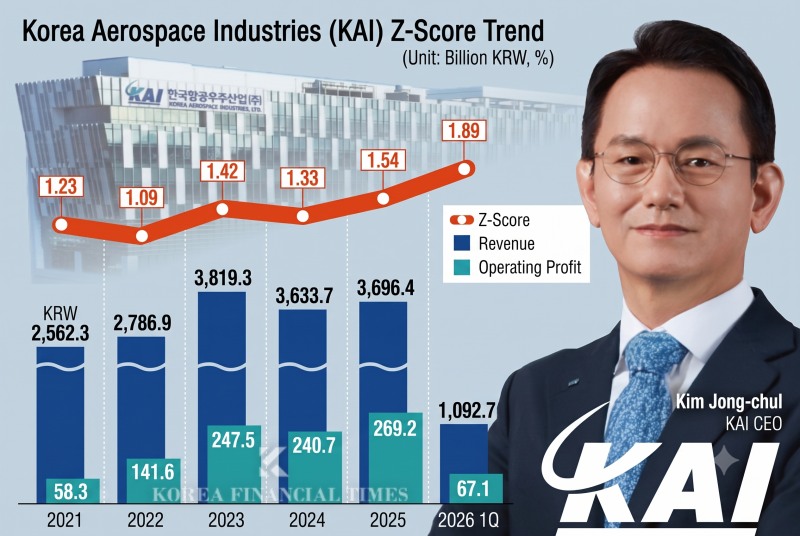
This infographic, originally published by Korea Financial Times, has been reconstructed using generative AI.
이미지 확대보기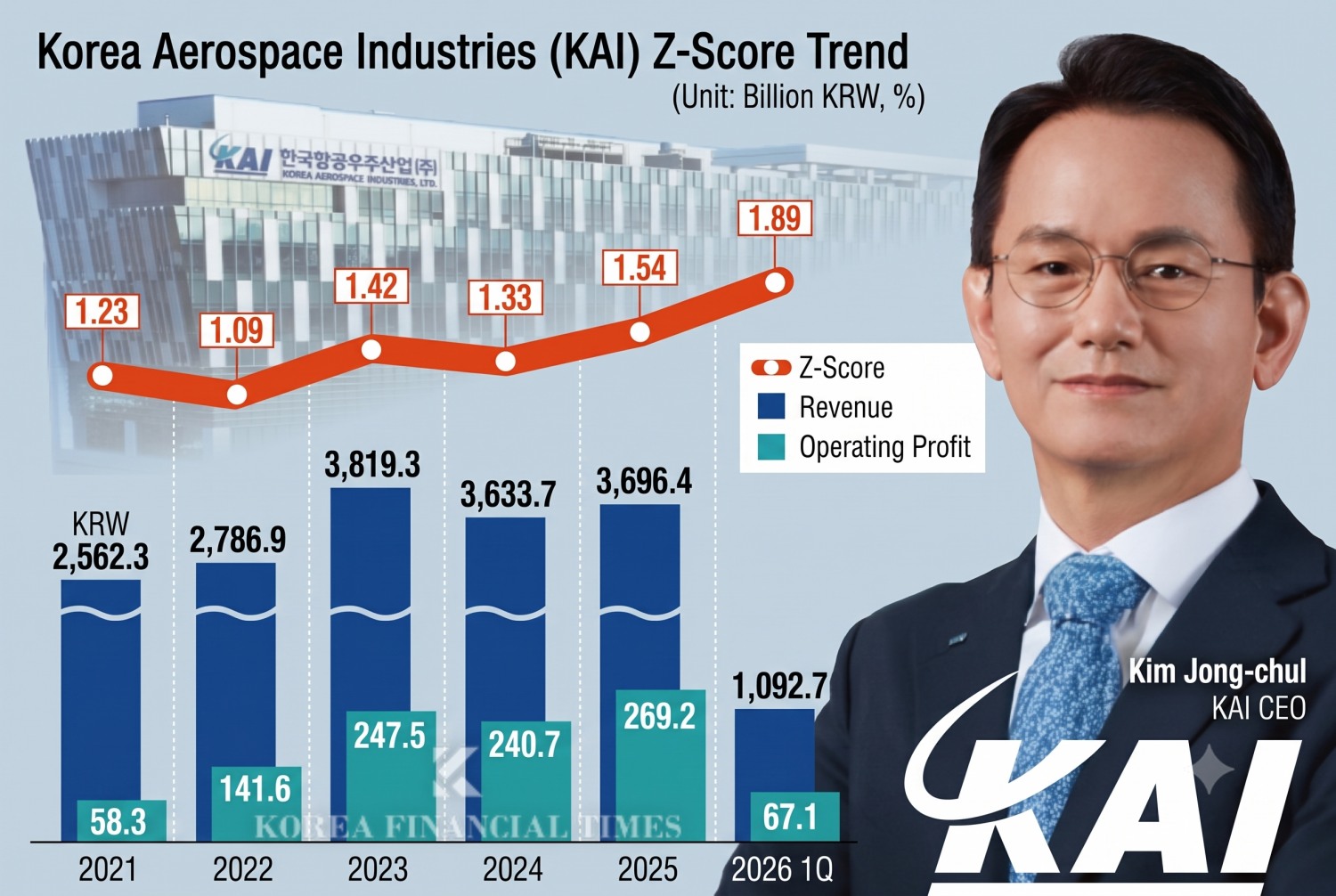
Korea Aerospace Industries (KAI) is passing through its strongest financial position in the past five years. The company's order backlog has swollen to roughly KRW 26 trillion, and the market has responded favorably as production of the Korean-developed next-generation fighter jet KF-21 and the Light Armed Helicopter (LAH) moves into full swing.
Out of the Danger Zone, But…
According to THE COMPASS, the AI-based data analytics platform built in-house by the Korea Financial Times, KAI's Z-Score stood at 1.23 in 2021, 1.09 in 2022, 1.42 in 2023, 1.33 in 2024, and 1.54 in 2025. Despite fluctuations, the score remained largely within the danger zone (below 1.8). It was only in the first quarter of this year that the figure climbed to 1.89, moving out of the danger zone for the first time.The Z-Score is an indicator used to predict a company's likelihood of default. It is calculated by applying weights to five financial ratios — liquidity, retained earnings, recent profitability, market value of equity relative to liabilities, and asset efficiency — and summing the results. A score above 3.0 is considered a safe zone, while a score below 1.8 is considered a danger zone.
The indicator is derived from financial statement items. X1 (liquidity) is working capital divided by total assets. X2 (accumulation) is retained earnings divided by total assets, and X3 (profitability) is operating profit divided by total assets. X4 (stability) is market capitalization divided by total liabilities, and X5 (efficiency) is revenue divided by total assets.
Based on THE COMPASS data, KAI ranks 19th out of 24 listed companies in the aerospace and defense sector, falling short of the industry average of 4.59. Rivals in the same sector — Hanwha Systems (2.78) and LIG D&A — have already settled into the mid-range (1.8–3.0). KAI's score is on a similar level to Hanwha Aerospace (1.86), which has recently drawn attention for steadily accumulating KAI shares.
This is linked to the growth in the order backlog. KAI's consolidated order backlog rose from around KRW 18 trillion in 2021 to KRW 26.6339 trillion at the end of the first quarter of this year. This growth has been underpinned by the second-phase mass production of the LAH, the initial mass production of the KF-21, and complete-aircraft exports to countries such as Poland and Malaysia. Revenue also rose to KRW 1.0927 trillion in the first quarter of this year, up 56% from KRW 699.3 billion in the same period last year, while operating profit climbed 43% to KRW 67.1 billion from KRW 46.8 billion in the first quarter of last year. The improvement in earnings is clear.
Even so, this momentum still accounts for only a small share of the Z-Score calculation — the profitability indicator's contribution came to just 4.5%. Total liabilities doubled over the same period, from KRW 4.5578 trillion to KRW 9.2177 trillion. It is more reasonable to view the improvement in the X4 indicator as a result of market capitalization rising faster, rather than of any reduction in liabilities.
Share price swings were substantial as well. KAI's stock, which fell as low as KRW 84,700 in July last year, climbed to an intraday high of KRW 215,500 on March 3 of this year, setting a new 52-week high.
However, the day after news broke of a planned KRW 500 billion convertible bond issuance, the stock plunged 19.79% in a single day to KRW 158,500. Still, as of the closing price on July 31, the stock stood at KRW 127,300 — still 42% higher than the KRW 89,800 level of July 1 last year.
Mounting Borrowings
Apart from earnings, cash flow is the area that warrants close attention. KAI's operating cash flow came to negative KRW 700.4 billion in 2023, negative KRW 728.2 billion in 2024, and negative KRW 903.3 billion in 2025 — a deficit for three consecutive years, with the shortfall widening each year. Over the same period, net income remained positive every year: KRW 221.4 billion in 2023, KRW 170.9 billion in 2024, and KRW 187.3 billion in 2025. Such a wide gap between book profit and actual cash inflow indicates that payments were not collected on time, so cash did not actually come in.The gap widened further in the first quarter of this year. Operating cash flow was positive at KRW 165.7 billion in the first quarter of last year but turned negative to KRW 78.8 billion in the first quarter of this year. This reflects a structural feature of the defense industry, in which government payments are collected later than the pace at which revenue is recognized.
KAI has been filling this gap through borrowing. Short-term borrowings stood at roughly KRW 2.1528 trillion last year, while bonds, including convertible bonds (CBs), amounted to about KRW 997.8 billion. Of this, KRW 500 billion came from a zero-coupon convertible bond issued in March. It was raised at a 0% coupon rate and carries no repricing clause tied to its conversion price of KRW 185,165 — meaning the terms do not turn unfavorable to the company even if the share price falls.
The problem is that not all of the company's borrowing comes on such favorable terms. Total borrowings — combining bonds and loans — grew from KRW 1.0357 trillion at the end of 2024 to KRW 2.147 trillion at the end of 2025, and further to KRW 2.77 trillion at the end of the first quarter of this year.
Excluding the CB, most of the remaining borrowings carry interest. Among the unsecured public bonds KAI has issued since 2021, nine issues are set to mature this year or later, totaling KRW 2.05 trillion at a weighted average interest rate of about 3.19%. Its short- and long-term bank borrowings carry rates ranging from as low as 2.0% to as high as 5.4%. The fact that one KRW 500 billion CB was interest-free is not enough to conclude that the company's overall borrowing costs are low.
With operating cash flow remaining in deficit, KAI's business operations and investments depend entirely on external borrowing. Despite favorable financing conditions, such as the interest-free CB issuance with no repricing clause, the rapid increase in borrowings itself appears to be adding to the overall burden of financing costs.
A structure in which both borrowings and interest expenses grow simultaneously while operating cash flow stays negative poses a significant burden to financial soundness. Observers point out that if the core business fails to achieve an early turnaround in profitability or cash generation, the growing burden of principal and interest repayments could translate into liquidity risk.
Jung Jina (urzinnie@fntimes.com)











![기관 '올릭스'·외인 '대한광통신'·개인 '주성엔지니어링' 1위 [주간 코스닥 순매수- 2026년 9월14일~9월18일]](https://cfnimage.commutil.kr/phpwas/restmb_setimgmake.php?pp=006&w=69&h=45&m=5&simg=20260919125014045580179ad439071182356975.jpg&nmt=18)
![12개월 최고 연 3.86%…광주은행 '굿스타트예금' [이주의 은행 예금금리-9월 4주]](https://cfnimage.commutil.kr/phpwas/restmb_setimgmake.php?pp=006&w=69&h=45&m=5&simg=202609181149080272001b5a22137958123138171.jpg&nmt=18)
![12개월 최고 연 7.00%…경남은행 '오면우대! 하면우대! 정기적금' [이주의 은행 적금금리-9월 4주]](https://cfnimage.commutil.kr/phpwas/restmb_setimgmake.php?pp=006&w=69&h=45&m=5&simg=202609181152510545901b5a22137958123138171.jpg&nmt=18)

![24개월 최고 연 7.00%…케이뱅크 '마이키즈 적금' [이주의 은행 적금금리-9월 4주]](https://cfnimage.commutil.kr/phpwas/restmb_setimgmake.php?pp=006&w=69&h=45&m=5&simg=202609181154470603701b5a22137958123138171.jpg&nmt=18)


![[그래픽 뉴스] ‘순대’가 경제용어라고? 순(純)대외자산, 한국의 진짜 해외자산은 얼마일까?](https://cfnimage.commutil.kr/phpwas/restmb_setimgmake.php?pp=006&w=298&h=298&m=1&simg=202609021356075202de68fcbb3512411124362_0.jpg&nmt=18)
![[그래픽 뉴스] ISA 대개편! 나에게 유리한 계좌는?](https://cfnimage.commutil.kr/phpwas/restmb_setimgmake.php?pp=006&w=298&h=298&m=1&simg=202608041713155615de68fcbb3512411124362_0.jpg&nmt=18)
![[그래픽 뉴스] 미국 증시 새로운 키워드 'MANGOS'](https://cfnimage.commutil.kr/phpwas/restmb_setimgmake.php?pp=006&w=298&h=298&m=1&simg=202607291740382069de68fcbb3512411124362_0.jpg&nmt=18)

![[그래픽 뉴스] 은퇴후 30년 부모님 세대의 생존전략](https://cfnimage.commutil.kr/phpwas/restmb_setimgmake.php?pp=006&w=298&h=298&m=1&simg=202606301704439153de68fcbb3512411124362_0.jpg&nmt=18)
![[신간]은퇴연옥…김경록의 은퇴 후 삶의 나침반](https://cfnimage.commutil.kr/phpwas/restmb_setimgmake.php?pp=006&w=81&h=123&m=5&simg=20260414140833047280f8caa4a5ce12411124362.jpg&nmt=18)
![[신간] 물처럼 흐르고 원칙으로 서다…김용환의 통찰을 담다](https://cfnimage.commutil.kr/phpwas/restmb_setimgmake.php?pp=006&w=81&h=123&m=5&simg=20260409114249027860f8caa4a5ce12411124362.jpg&nmt=18)
![[안현정 서평] 플랫폼의 영지에서 ‘미학적 주권’을 선포하라...'K가 죽어야 K가 산다' 장준환 著](https://cfnimage.commutil.kr/phpwas/restmb_setimgmake.php?pp=006&w=81&h=123&m=5&simg=20260527121426063220c1c16452b012411124362.jpg&nmt=18)
![[서평] 추세 매매의 대가들...추세추종 투자전략의 대가 14인 인터뷰](https://cfnimage.commutil.kr/phpwas/restmb_setimgmake.php?pp=006&w=81&h=123&m=5&simg=2023102410444004986c1c16452b0175114235199.jpg&nmt=18)


![[머니무브 2026] “지금 사도 될까?” 답이 안 보인다면…하반기 투자, 4명의 전문가에게 물어보세요](https://cfnimage.commutil.kr/phpwas/restmb_setimgmake.php?pp=006&w=89&h=45&m=1&simg=202609151044050355302a735e27af12411124362.jpg&nmt=18)
![[AD] ‘PBV 라인업 확장’ 기아, 9월 독일서 ‘PV7’ 첫 공개](https://cfnimage.commutil.kr/phpwas/restmb_setimgmake.php?pp=006&w=89&h=45&m=1&simg=2026083111010602815074925877361231180222.jpg&nmt=18)
![[AD] 제네시스, 럭셔리 경험 더한 ‘2027 GV70’‧‘GV70 그래파이트’ 출시](https://cfnimage.commutil.kr/phpwas/restmb_setimgmake.php?pp=006&w=89&h=45&m=1&simg=20260702143546085600749258773622211122717.jpg&nmt=18)
![[AD] 개소세 혜택 종료…현대차, ‘썸머 페스타’로 고객 부담 완화](https://cfnimage.commutil.kr/phpwas/restmb_setimgmake.php?pp=006&w=89&h=45&m=1&simg=20260702142355004830749258773622211122717.jpg&nmt=18)
![[AD] 기아 ‘디 올 뉴 셀토스’, 인도 타임스 드라이브 어워즈서 ‘올해의 SUV’ 선정](https://cfnimage.commutil.kr/phpwas/restmb_setimgmake.php?pp=006&w=89&h=45&m=1&simg=202605071156400590007492587736124111243152.jpg&nmt=18)